


Best Seats at Signal Iduna Park
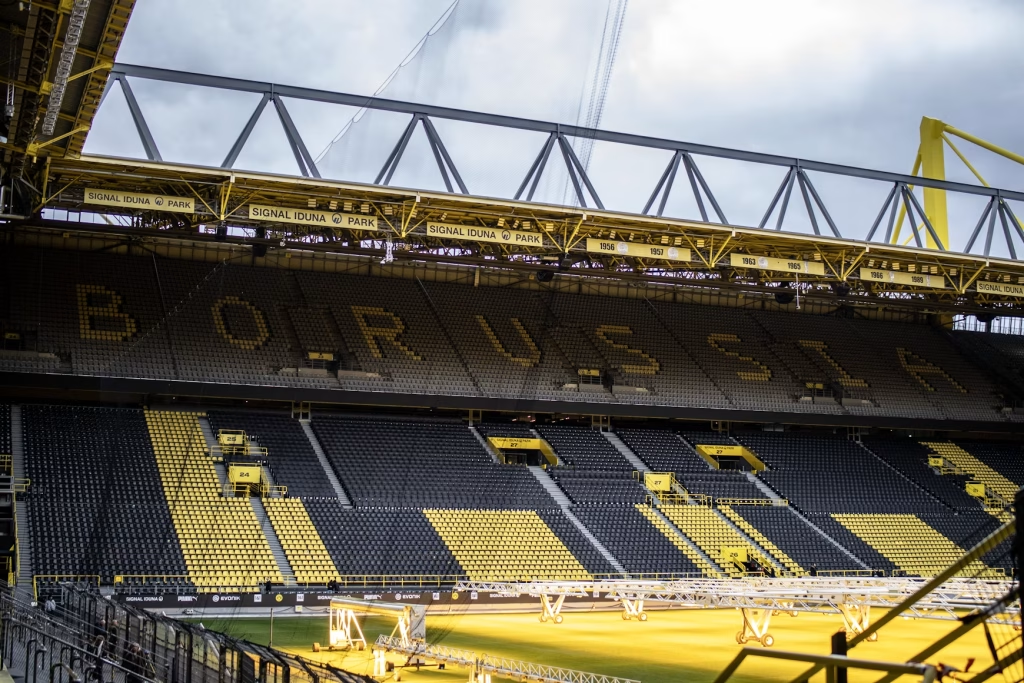
There is football, and then there is a Borussia Dortmund home game. Signal Iduna Park — still called the Westfalenstadion by most locals, and listed as BVB Stadion Dortmund for European nights — is Germany’s biggest stadium, holding 81,365 people on Bundesliga matchdays, and it is built around one of the great sights in world sport: the Südtribüne, better known as the Yellow Wall, the largest standing terrace in European football. It opened in 1974, thrown up in a hurry when Dortmund replaced Cologne as a host city for that summer’s World Cup, and it has grown from a modest 54,000-seat bowl into the black-and-yellow cathedral you see now.
BVB fills it to roughly 99% capacity year after year — the highest average attendance on the continent — which is the one honest catch worth stating up front: getting a ticket is the hard part, not enjoying yourself once you’re in. Sort that out and you’re in for the best 90 minutes German football has to offer.
Seating Overview
At most stadiums you weigh sightline against price. At Signal Iduna Park you also weigh where you want to be pointed — because half the show is on the pitch and the other half is the wall of 25,000 people singing behind the south goal. The stands are steep, single-purpose football terraces set right on top of the grass, so there is genuinely no bad view of the game. The real question is whether you want to be in the atmosphere or looking at it.
Best Non-Premium Seats
The Nordtribüne (North Stand), lower blocks facing the Yellow Wall. This is the seat most first-time visitors do not think to ask for, and it is the one I would point you to. You are seated, you are behind the opposite goal, and you spend the whole match staring straight down the barrel of the Südtribüne in full voice — every tifo, every scarf, every wave of the choreography aimed right at you. It costs less than the prime touchline seats, and for the specific thing that makes this ground famous, it is the best view in the house. The trade-off is you are behind a goal, so tight tactical detail at the far end is harder to follow.
The Osttribüne and Westtribüne (East and West Stands), lower rows along the touchline. These are the classic “watch the football” seats — halfway-line views down the long sides, with the East side holding the dugouts and benches. Sightlines are excellent and the steep rake means even the back of the lower tier feels close. The West is the main stand and runs a touch pricier because the premium areas live there; the East gives you a very similar view for a little less.
The south corners, lower tier, next to the Yellow Wall. If you want to feel the Südtribüne’s energy without standing on it, the seated blocks in the lower corners beside the south terrace put you right on its shoulder. You get spillover noise and a superb angle on the goal, at a mid-tier price. A good middle ground for anyone who wants the intensity but needs a seat with a number.
Best Value Seats
The Nordtribüne seats are the smart-money pick twice over: you face the best view of the Wall and pay less than you would on the main stands. For a group that wants seats together at a fair price with the full visual spectacle, this is where I would look first.
The upper tier on the East side is the other value option. You give up a little proximity, but the height opens up the whole pitch — you see shape, movement, and the tactical picture — and upper-tier touchline seats generally undercut the lower rows. On a stand this steep, “upper” does not mean “distant.”
Cheapest Way In
Südtribüne standing (the Yellow Wall), domestic matches only. This is the cheapest ticket in the building by a wide margin — BVB keeps terrace prices among the lowest of any major club in Europe, which is a point of pride, not an accident. You stand for 90 minutes, packed shoulder to shoulder, and you sing. The catch: it is home fans only and strictly black-and-yellow (turn up in the opponent’s colours and you will be moved or turned away), it is standing room with no assigned spot, and it converts to all-seater for Champions League and international games — so the cheap-terrace option simply does not exist on European nights.
Nordtribüne standing is the other budget entry — a smaller home terrace opposite the Wall, same standing arrangement, and usually a little easier to get than the Südtribüne itself.
Our Pick
If you are visiting for the first time and you can sit still, take a lower Nordtribüne seat facing the Yellow Wall — you get the single best view of the thing you came to see, at a price that will not cost much. If you are up for the full-contact version and it is a league game, the Südtribüne terrace is the experience of a lifetime and costs less than a cinema ticket in some cities. One of those two, depending on your legs.
What to Avoid (and What’s Worth Trying Once)
There is very little genuinely bad seating here — the geometry is that good. The thing to watch for is the very back seated row on the Nordtribüne, where over the years a sliver of restricted-view seating existed behind the terrace lip; if a listing looks oddly cheap for a “seat,” check the view before you buy. And away fans should know their place is fixed: the visitors’ section is the north-east corner (standing in the lower blocks for league games, seated just above), a good corner but a corner nonetheless, and there is no wandering into home ends in opposition colours.
Worth it once — the Yellow Wall. No standing terrace on earth is a better place to watch a game with your heart rather than your eyes. You will not have a seat, you will barely be able to move when BVB score, and you will spend the whole match singing songs you do not know the words to. Do it once. It is the reason people fly here.
Premium Seating & Clubs
The premium product lives almost entirely on the Westtribüne (West Stand) — the main stand along the halfway line, home to the business seats, the hospitality lounges, the directors’ area, and the sponsors’ spaces. It is a comfortable, central, catered way to see a BVB game, and for high-demand fixtures it is often the most reliable way to guarantee entry when regular tickets go to a members’ ballot.
The Best Premium Experience
The halfway-line business seats and lounges on the West Stand are the standout — central views straight down the middle of the pitch, indoor lounge access with food and drink before the match and at half-time, and an entrance that skips the turnstile crush. On a matchday when the whole city is trying to get in, that combination of a guaranteed prime seat and a warm room to stand in is the premium call that earns its price here.
Best Value Premium
If you want the hospitality experience without the top-tier spend, look at the entry-level business seats towards the corners of the West Stand rather than dead centre. You keep the lounge access, the catering, and the covered concourse — the things you are really paying for — and give up only a few degrees of viewing angle for a meaningfully lower price. That is the insider move in this stand: buy the lounge, not the exact centre-line seat.
Other Premium Options
Beyond the business seats, BVB runs a set of named VIP lounges and hospitality tiers across the premium side, each with its own entrance, catering, and service level, plus reserved parking for larger group bookings. There is no courtside-style pitch-level product here — this is a football ground in the German tradition — but the range of lounge tiers means you can set the spend high or low and still get the catered, guaranteed-seat experience.
Suites & Group Options
Private boxes and group hospitality packages are booked through BVB’s official hospitality arm, generally sell to companies and larger parties, and bundle premium central seating with a private or shared lounge, full catering, and reserved parking for groups of four or more. If you are putting together a corporate day or a big-group trip, that is the route; individual visitors are better served by the business seats above.

Signal Iduna Park Seating Plan & Capacity
Signal Iduna Park holds 81,365 for Bundesliga matches — the largest capacity in Germany — combining seated areas and the standing terraces. For Champions League and international fixtures, standing is not permitted, so the terraces convert to seats and capacity drops to just over 66,000, all-seater. The Südtribüne (Yellow Wall) alone holds 24,454 standing fans, the biggest single terrace in European club football.
The ground is a clean four-stand rectangle, and the blocks number in a logical ring: the Südtribüne (South / Yellow Wall) runs blocks 10–15 and 80–84; the Nordtribüne (North) covers blocks 60–78 and contains the away section in the north-east corner and the family block in the north-west; the Osttribüne (East) is blocks 40–54 with the dugouts and media; and the Westtribüne (West / main stand) holds blocks 20–34 with the premium areas. You can pull up the official interactive block plan on BVB’s site before you buy — worth doing so you know exactly which corner you are in.
Dortmund Tickets: Getting the Best Seats
Here is the honest reality: BVB is one of the hardest tickets in Europe to get at face value. Home games are close to sold out on season tickets and member sales before the general public ever sees them, and the club caps private resale mark-ups at 10% over face, which keeps prices sane but supply thin. Members get first refusal through the official BVB ticket shop; if you strike out there, the club’s own resale platform is where season-ticket holders return seats they cannot use — check it repeatedly in the days before the match, because that is where face-value seats actually surface. The BVB-FanWelt box office by the ground opens 2.5 hours before kick-off on matchday, but assume it is sold out and do not build a trip around it.
For visiting fans without a members’ route, the secondary market is often the realistic path in, especially for a specific date — just build in the reseller’s mark-up, and buy early for Der Klassiker against Bayern and for Champions League nights, which are the priciest and the first to vanish. You can compare current resale availability and prices on [Vivid Seats]. If you are travelling as an away supporter for a European tie, go through your own club’s official allocation — that is the cleanest and cheapest way into the visitors’ section.
Signal Iduna Bag Policy
Keep it small. Bags larger than roughly A4 size — about 297 × 210 × 150 mm — are not allowed inside, and everything that is allowed gets searched at the gate. If you turn up with a rucksack, there are staffed bag-drop cabins near the entrances (including one opposite the away entrance on Strobelallee and the “Helmbude” by the North Stand) that hold larger bags for a small cash fee — bring a coin, it is usually well under a euro — but suitcases are not accepted, so do not roll up straight from the train with your luggage.
One useful exception to the size limit: a small power bank, roughly phone-sized, is allowed, and worth packing, because the mobile network around the ground struggles on matchdays and your phone will be working hard. Travelling light is the whole game here.
Key Venue Policies
A few things catch first-timers out. Gates open 2.5 hours before kick-off, and you will want that cushion — security and the sheer volume of people mean the queues are real. Colours are enforced: opposition kit is barred from the Südtribüne and the home ends, and BVB colours are barred from the away section, so wear neutral clothing if you are in a mixed area.
Beer is served (this is Germany after all— Brinkhoff’s No.1 is the house pour), so there is no need to smuggle anything. And the usual bans apply firmly: no bottles, cans, glass, outside food or drink, flares or pyrotechnics, laser pointers, professional cameras, or large flag poles.
The stadium is cashless. Every fixed kiosk and bar takes debit and credit cards plus the usual phone wallets (Apple Pay, Google Pay and the rest), and BVB also runs its own prepaid “Stadiondeckel” card you can top up. The one exception is the roaming beer sellers with the backpack kegs — those take cash, and cash only. Bring a card you can tap and you will never think about it again. (Worth knowing for later: several of the best street-food stands in the city centre, including the famous Wurst Willi, are still cash-only, so keep a few coins on you for after the match.)
Accessibility is well organised. There are dedicated wheelchair and companion-seat areas across several blocks, accessible toilets and concessions on the concourses directly behind them, and staff who come round to take food and drink orders from wheelchair users so you do not have to fight the queues. There are designated spaces for deaf and visually impaired fans, and the U-Bahn route to the ground is step-free.
Useful to know: if you ever feel overwhelmed and need a quiet space, you can say the word “PANAMA” to any steward or volunteer and they will help you find one. BVB’s disability-support team takes questions by email in advance.

Getting to Signal Iduna Park
Take the train. Dortmund is a compact city, the stadium sits just south of the centre by the Westfalenpark exhibition grounds, and driving on a matchday is a headache you do not need.
Public Transport
The classic run is the U45 Stadtbahn from Dortmund Hauptbahnhof straight to the matchday-only “Stadion” stop — about ten minutes, running every few minutes from a couple of hours before kick-off, and the carriages themselves are half the fun, packed with scarves and chanting on the way in. The U46 to Westfalenhallen drops you a five-minute walk away and is often less crowded. Regional RB and RE trains run to the “Signal Iduna Park” station a short walk from the ground.
The best part: your match ticket doubles as a free transport pass across all of North Rhine-Westphalia on matchday, valid until 3 a.m. the next morning — so the train is not just easiest, it is free. (One wrinkle: if you have a digital or print-at-home ticket, you need to request the free companion transport ticket separately when you buy; and it covers regional trains, not the fast ICE/IC services.)
Do one thing before you leave your hotel: save both your match ticket and your free transport pass to your phone’s wallet while you still have a solid signal. The mobile network around the ground buckles under the weight of 80,000 phones about an hour before kick-off, and you do not want to be reloading your ride home — or your entry ticket — in the middle of a crowd.
Taxis & Ride-Hailing Apps
Taxis and ride-hailing apps are fine for getting there if you are not near a train line, but understand the picture afterwards: 80,000 people leave at once, the roads around the ground clog solid, and prices surge. If you are going to use one, have it drop you a few streets out and walk in, and after the whistle either wait it out with a beer or walk towards the centre before you order the car.
Signal Iduna Parking
If you must drive, there are over 10,000 pay-and-display spaces around the stadium and exhibition grounds, running roughly €8–9, and you generally need to buy the parking permit in advance (through Messe Dortmund / DOPARK21) rather than paying at the gate. The car parks open several hours before kick-off. The local trick for beating the post-match gridlock on the B1 is the park-and-ride at TU Dortmund university — free parking, a shuttle to the ground, and you skip the worst of the traffic on the way out.
Can You Take an E-Scooter or Bike to Signal Iduna Park?
Cycling is genuinely well catered for: BVB lays on around 1,000 free, guarded bike spaces across three sites right by the ground — near the FanWelt on Strobelallee, opposite the Helmut-Körnig-Halle, and on the south-east side — open from roughly two hours before kick-off until an hour after. E-scooters are the catch. There is a restricted zone around the stadium where the hire apps will not let you park or end a ride, and because the mobile network collapses before kick-off, you can find yourself unable to log the scooter out at all — which means it keeps charging you. If you scoot in, end the ride well outside the exclusion zone, or use the bike parking (it takes private scooters too), rather than riding right up to the gates.

Top Tips for Dortmund Football Matches
Dortmund on a matchday runs on a rhythm the locals know by heart: trains full of yellow, hours in the pub before kick-off, the scarves up for “You’ll Never Walk Alone,” and win or lose, the players walking to the Südtribüne at the end to salute the people who never sat down. Here is what turns a good trip into the real thing.
What Is the Yellow Wall at Signal Iduna Park?
The Südtribüne is the largest standing terrace in European football and the beating heart of the whole experience: 24,454 people on one continuous bank behind the south goal, coordinating tifos, songs, and colour that make the ground feel like it is breathing.
Photo tip: sit in the Nordtribüne opposite so the Wall faces you — that is the view that ends up as everyone’s favourite photo and favourite memory.
Arrival
Be inside the seating bowl 40 minutes before kick-off — not at the turnstiles. Gates open 2.5 hours out, but the concourses bottleneck badly as kick-off nears, and if you only reach the stadium footprint 30 minutes before, you will likely still be shuffling through the concourse when the anthem plays. Forty minutes inside the bowl gives you the warm-up, the build-up, and a calm start to the day.
Get in for the hush before the anthem. The best part of “You’ll Never Walk Alone” is not the singing — it is the few seconds before, when the stadium music cuts out and 81,000 people fall silent with scarves raised, right before the first note drops. Miss it and you have missed one of the finest moments in the sport.
Borussia Dortmund Matchday Traditions to Know
“You’ll Never Walk Alone” (similar to Liverpool) rings out just before kick-off, scarves aloft across the whole ground — a tradition adopted here in the 1990s and still the spine-tingling centrepiece of the day.
The line-up call-and-response. The stadium announcer reads out each home player’s first name and the entire ground roars back the surname — a ritual led for over thirty years by club legend and “Held von Berlin” Norbert “Nobby” Dickel.
The players’ walk to the Südtribüne. After the final whistle the team walks to the Yellow Wall to applaud the supporters — win or lose. It happens every single game, and it tells you everything about how this club sees its fans.
Food and Drink inside the Stadium
Bratwurst and chips are the go-to — honest German matchday food, cheap and done right — and the house beer is Brinkhoff’s No.1. Remember it is all cashless, so have a card ready.
Time your queue carefully. If you are seated, beat the half-time rush by getting food in the first 20–25 minutes of a half rather than at the whistle. If you are on the Südtribüne, this does not apply: leave your spot and you will not get it back, so eat before you go in and settle in for the duration.
Expect a Bierdusche. The moment a BVB goal goes in, plastic cups of beer fly skyward in the celebration and anyone near the lower tiers or the terrace gets a light christening — the “beer shower.” Do not wear anything that cannot take a splash of lager.
How Do You Get Out of Signal Iduna Park After the Match?
Leave from the Westfalenhallen station rather than the main stadium stop. The underground concrete tunnels there act like an echo chamber, and the post-match chants bouncing off the walls while you wait for the train are a memory in themselves — and you dodge the worst of the crush at the main platform. Trains run extended and late, so there is no need to rush; hang back ten minutes for the players’ salute and let the first wave clear.
Best Photo Spots at Signal Iduna Park
The Yellow Wall mid-tifo, shot from the Nordtribüne across the pitch, is the signature image. The scarf-lift during “You’ll Never Walk Alone” is the other one. And from outside, the stadium’s bright yellow external pylons lit up against the night sky are visible across the city — the shot that says “Dortmund” without a caption.
Does Signal Iduna Park Have an App? BVB App & Mobile Tickets
BVB’s official app handles mobile tickets, matchday information, and news, and it is where your digital ticket lives. Download and log in before you travel, and save your ticket offline — the mobile network around the ground collapses under the weight of 80,000 phones about an hour before kick-off, and you do not want to be reloading a ticket in the security queue.
Where Is the BVB Club Shop? (BVB-FanWelt)
The BVB-FanWelt megastore sits right by the stadium and you do not need a match ticket to shop it, which makes a non-matchday or an early-arrival visit the smart time to go — on matchday it is a scrum in the final hour before kick-off, and the selection there is far bigger and calmer than the in-concourse kiosks.
Little Rituals That Mark You Out as a Regular
Order a “Pilsken.” It is the Ruhr-dialect pet name for a Pilsner, and asking for one instead of just “a beer” quietly signals you know where you are.
Embrace “Fritz-Walter-Wetter.” If you wake up to pouring rain, do not grumble — locals call it “Fritz Walter weather,” after the captain who won the 1954 World Cup final in a downpour. In German football, filthy weather is considered lucky and tends to make for a fiercer, more physical match.
Take in the smell of the concourse. The scent hits before the noise does — a very specific Ruhr perfume of spilled beer, cigarette smoke, sharp mustard, and roasted almonds (gebrannte Mandeln) from the sweet stalls. Regulars will tell you it smells like coming home.
Buy a fanzine on the walk in. Fan-produced magazines (the best known is schwatzgelb) and ultra-group merchandise sold on the approach help fund the enormous choreographies you see on the Wall — a euro or two well spent even if you cannot read the German.
Know the terrace rules. The Südtribüne is home-only and black-and-yellow only, and it vanishes for European nights when the ground goes all-seater — so a “standing on the Yellow Wall” plan only works for a domestic league or cup game.
Are Signal Iduna Park Tours Available?
Yes — and if you cannot get a match ticket, a tour is the way inside. BVB runs a self-guided “Stadionspaziergang” (a QR-code walk-through, from around €9, starting at the Foyer West on select days between 10:00 and 18:00), plus guided options including a 2.5-hour After-Work Tour with a guide’s storytelling and a cold beer included, and step-free accessible tours. The Borusseum, the club’s own museum inside the stadium, walks you through the trophies and the history. Book ahead — tours fill up.
Is Signal Iduna Park Family-Friendly?
The REWE family block in the north-west corner is purpose-built for young fans — a strict no-smoking zone, discounted prices for children up to 14, and matchday extras like face-painting and appearances from the club mascot, Emma. Two rules to plan around: children under 7 are not allowed on the standing terraces at all, and every child needs a ticket — under-6s can get a €1 child ticket at the turnstile with proof of age. For a family, the family block is the easy, sensible choice over the general seated stands.
Getting Close to the Players
This is not autograph-hunting the American way — there is no open batting-practice-style window — but the realistic move is to be outside the players’ and team entrances before the match, where fans gather for signatures and photos, and to watch the pre-match warm-ups from the lower rows near the tunnel side for your best in-stadium sighting. (Off the pitch, there is another good bet — see Mit Schmackes in the Gameday Scene below.)
Things to Do in Dortmund Beyond the Match
If you have a spare half-day, the Deutsches Fußballmuseum (German Football Museum) sits right across from the Hauptbahnhof and is a proper national museum of the German game — an easy win on a non-matchday or a rainy morning. Nearby, Westfalenpark and the Florian Tower (Florianturm) give you green space and a city view, and the regenerated Phoenix See lake district is a pleasant afternoon of waterside dining a short ride from the centre. The stadium itself is Dortmund’s number-one attraction on TripAdvisor, so you are already at the main event.

Hotels Near Signal Iduna Park
Dortmund is compact and — plainly — cheaper to stay in than most major European football cities, so you can base yourself well without overpaying. Because your match ticket covers free regional transport on matchday, location matters less than you would think: anywhere on the Stadtbahn network gets you to the ground for nothing. The one thing that does matter is timing — hotel stock is limited for a city this size, and rooms sell out fast for Der Klassiker and Champions League nights, so book those weeks out.
Best Areas to Stay in Dortmund
City Centre / around the Hauptbahnhof is the pick for most visitors. You get Dortmund’s restaurants, bars, and nightlife on your doorstep, the German Football Museum next door, and the U45 running direct to the stadium on matchday — the best all-round base.
By the stadium / Westfalenhallen (the Innenstadt-West area) is for people who want to walk to the ground and soak up the pre-match build-up right outside their door. It is quieter away from matchdays, with a cluster of solid hotels within a 10–15 minute walk.
Kreuzviertel is the local’s choice — a lively district of bars and cafés on the walking route between the centre and the stadium, with more character than the chain hotels and a genuine neighbourhood feel. Fewer big hotels here, more apartments and small stays.
Hotel Recommendations
Walking Distance— Radisson Blu Hotel Dortmund. Out by the Westfalenpark and the exhibition grounds, this is about as close as a proper full-service hotel gets to the stadium — near enough to walk to kick-off and back. It is one of the more comfortable places in the area, with a pool and spa to sink into after ninety minutes on your feet. The trade-off is that you are away from the city-centre nightlife, so it suits fans whose priority is the match rather than the after-party. Toward the pricier end for the area, and worth it for the location.
Mercure Hotel Dortmund Messe. Right by the exhibition grounds and an easy walk to the ground, this is the practical, no-drama choice: you are in the pre-match buzz without paying a premium for it, you can drop your bag and be at the turnstiles in minutes. Rooms are straightforward and the price is fair for how close you are. Comfortable middle ground.
Dorint An den Westfalenhallen. About an eleven-minute walk from the stadium, this is the step up if you want walk-to-the-match convenience with a bit more comfort — a calmer, more grown-up base than the cheaper places nearby, and handy for the Borusseum or a tour on a non-matchday too. Costs a little more, and earns it if comfort matters to you.
Take The Train— Hotel Unique Dortmund Hauptbahnhof. Steps from the main station, which is the whole point: you are one U45 ride from the ground on the way in and a short walk from your bed on the way out, with the city’s bars and restaurants around you. This is the pick if you are arriving by train and want the centre rather than the stadium fringe. Sits in the mid-range.
City Centre — Steigenberger Hotel Dortmund. A dependable, well-run hotel in the heart of town, walkable to the exhibition grounds and central for everything you would want to do on a non-match evening. It leans a little more upmarket without being a splurge — a safe, comfortable base for a couple who want the city as much as the football.
Good Value — Moxy or ibis Dortmund City. Two modern, no-fuss options near the Westenhellweg shopping street, both recently refreshed, both priced for people who plan to spend their waking hours out in the city rather than in the room. If you want somewhere clean, central and easy on the wallet to sleep and shower between the pub and the pitch, either does the job.
Budget Options
For a genuine budget stay that does not strand you miles out, the a&o Dortmund Hauptbahnhof hostel is right by the main station with both private rooms and cheaper dorm beds, and direct transport to the ground — you trade a little polish for a low price and an unbeatable location, which is exactly the right trade for a football weekend. The B&B Hotel Dortmund-Messe is the other value option: a simple, clean place about a fifteen-minute walk from the stadium, cheaper than the branded hotels around it, with the honest trade-off being basic rooms and a paid breakfast. Neither is fancy; both are close to what you actually came for.

Matchday Scene
A Dortmund matchday is not a two-hour outing — it is a whole day, and the city surrenders to it completely. It starts mid-morning, long before kick-off, when the first yellow-and-black scarves appear on café terraces and station platforms. By early afternoon the whole place is moving in one direction. If you have never done it, picture a slow tide of 80,000 people in club colours flowing south towards the ground, beer in hand, songs already starting on the trains.
And if you have done it before, you already know the feeling in your chest when the U45 doors open and the chanting begins — that is the part that pulls people back season after season. Win or lose, it spills back into the city late into the night. There is no tailgating in the American sense here; the ritual is beer, bratwurst, and the streets.
Where to Go on a Dortmund Matchday
The Alter Markt (Old Market Square), city centre — the traditional gathering point, and the easiest, most welcoming base for away and neutral fans. The pubs spill out onto the square, the mood of the whole fanbase is on display, and the U45 runs straight from here to the ground. If you are visiting and want one meeting point, make it this.
The Kreuzviertel — the buzzing bar-and-café quarter between the centre and the stadium, and the locals’ walk-in route. The done thing is to grab a Wegbier (a “road beer”) from a corner kiosk — a Trinkhalle, or “Bude” — and sip it on the stroll down towards the ground. It turns the final stretch into a slow, black-and-yellow procession, and it is the most authentic way in.
Strobelallee, right at the stadium — this is the home-fan party, centred on Strobels (see below). Loud, packed, overwhelmingly BVB support, and brilliant if you want to be right in the middle of the noise rather than somewhere neutral.
Borsigplatz, north of the centre — not a pre-match drinking spot so much as a pilgrimage. This roundabout is where BVB was founded in 1909, in a pub that is now a currywurst-and-chips shop decked out in club history, and it is where the team bus circles with every major trophy. Worth the short U-Bahn ride if you want to stand where it all began.
Best Pregame & Postgame Pubs in Dortmund
Strobels (Strobelallee, right by the stadium) is the essential one — arguably the most famous BVB fan pub in the world, with DJs, big screens, bratwurst smoke, and an atmosphere that builds for hours before kick-off. Get there early; it fills fast, and it is home support through and through.
Brauhaus Wenkers at the Alter Markt is the traditional beer-hall move before you take the U45 in — proper Dortmund brewing heritage in a big, loud room that spills onto the square.
Mit Schmackes in the Kreuzviertel is the pub owned by BVB cult hero and 2014 World Cup winner Kevin Großkreutz — heaving with club memorabilia, screens showing every match, and big plates of hearty local food. Großkreutz is often in himself, so bring a shirt if you fancy an autograph.
The Fiddler’s is a dependable, more laid-back Irish pub with plenty of screens if you want to follow other matches alongside the BVB crowd.
Where to Eat: Currywurst, Schnitzel & Ruhr Classics
Wurst Willi, on the Petrikirchhof in the city centre, is the post-match institution — a currywurst trailer with a permanent queue that the staff burn through at speed. It is cash only (unlike the stadium), closed on Sundays, and absolutely worth the wait. Eating here after a game is a Dortmund rite of passage.
Westphalian classics — schnitzel, sausages, big plates and bigger steins — are easy to find around the Alter Markt and the Kreuzviertel, and they are the right fuel for a matchday.
The local beer is a highlight in its own right: try a Brinkhoff’s No.1, Hövels, or Bergmann wherever you land. Dortmund is a brewing city first, and the beer is part of the day, not an afterthought.
Pace Yourself — a BVB Matchday Is a Marathon
A 3:30pm kick-off does not mean a 2pm start. Locals are out eating, drinking, and singing from mid-morning, and if you try to match them beer-for-beer from 10am you will be asleep by half-time. Treat the day as a marathon, not a sprint, and you will still be standing for the walk to the Südtribüne at the end.

Why You Should Go
Signal Iduna Park is, plainly, one of the best places on the planet to watch football. The Yellow Wall is a genuine wonder of the sport — 25,000 people making noise and colour on a scale you have to stand near to believe — and the whole day around it, from the U45 full of scarves to the players saluting the terrace at the end, has a warmth and a realness that a lot of bigger-money grounds have lost. Tickets are hard and the terrace is home-only, so plan ahead and manage expectations on that front. But if you can get in, few trips in football give you more for your money. Go once and you will understand why people call it a pilgrimage.
Explore other European Football Grounds as well as these
Parc De Princes (Paris St. Germain)
Wembley Stadium in London
Written by Brad Richards, Founder of Gameday Guides. This guide was meticulously researched using official stadium policies, local fan forums, and updated team sources. We aim to help you plan with confidence — enjoy your gameday! If you have any tips, if we missed anything, or if you have a question, don’t hesitate to shoot an email.