
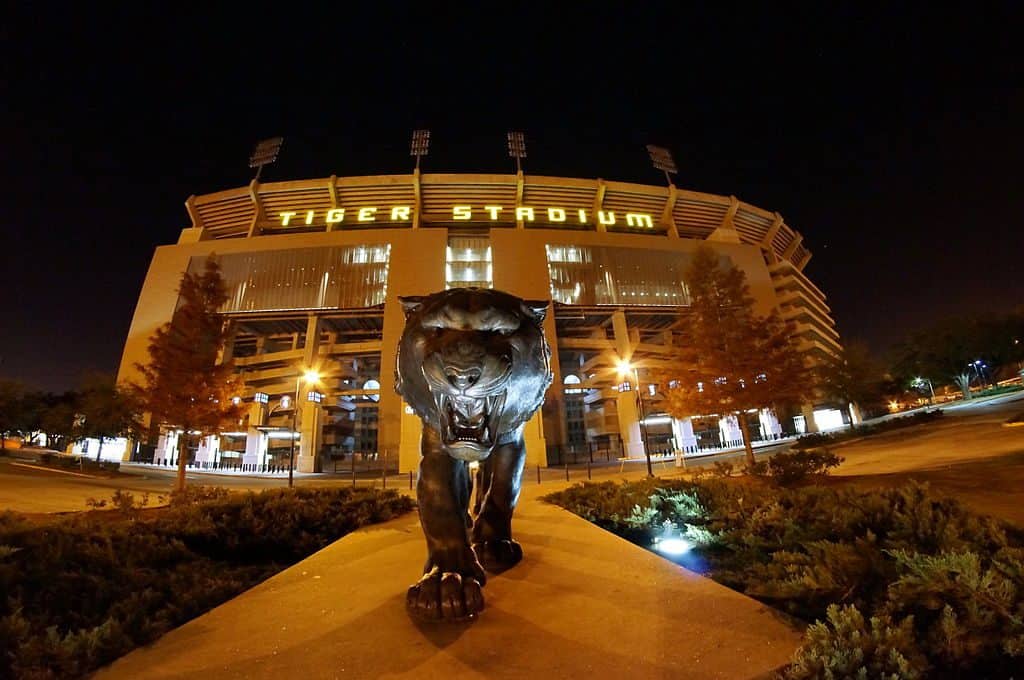

Best Seats At Tiger Stadium
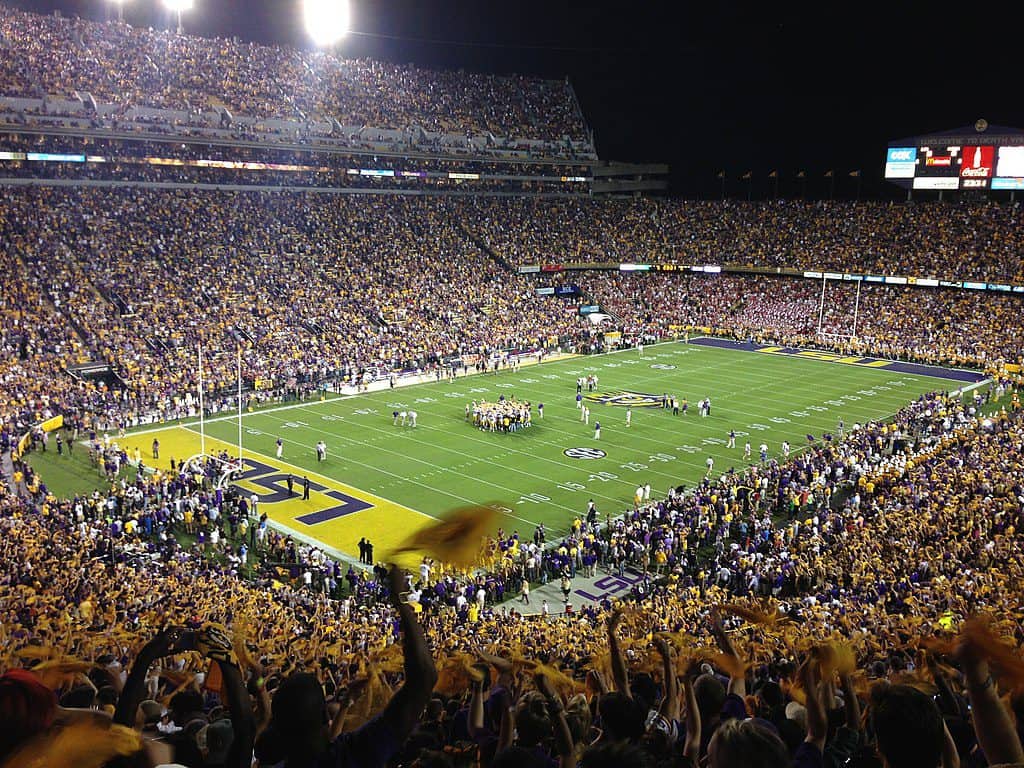
There is nowhere quite like Death Valley on a Saturday night. Tiger Stadium holds 102,321 people in a steep, enclosed bowl that traps crowd noise the way few stadiums on earth can — and when it hits, it physically hits. ESPN’s panel of college football writers ranked it the best stadium in the sport in 2024, and that wasn’t controversy, it was confirmation of something LSU fans already knew.
Are there cons to this wonderful place? Well sure. Getting in and out of Baton Rouge after a night game is legitimately difficult, and September heat will make you question your life choices before kickoff. Come anyway. Everybody who has ever been here says the same thing afterward: you have to go at least once.
Seating Guide
Tiger Stadium is oriented north-south, with the LSU bench running along the west sideline. The stadium rises sharply on all four sides, which is actually a feature — even the upper decks stay close to the field, and the steep walls are what create the legendary noise. The biggest decisions are west sideline vs. east, lower bowl vs. upper, and whether you want proximity to the student section.
Best Non-Premium Seats
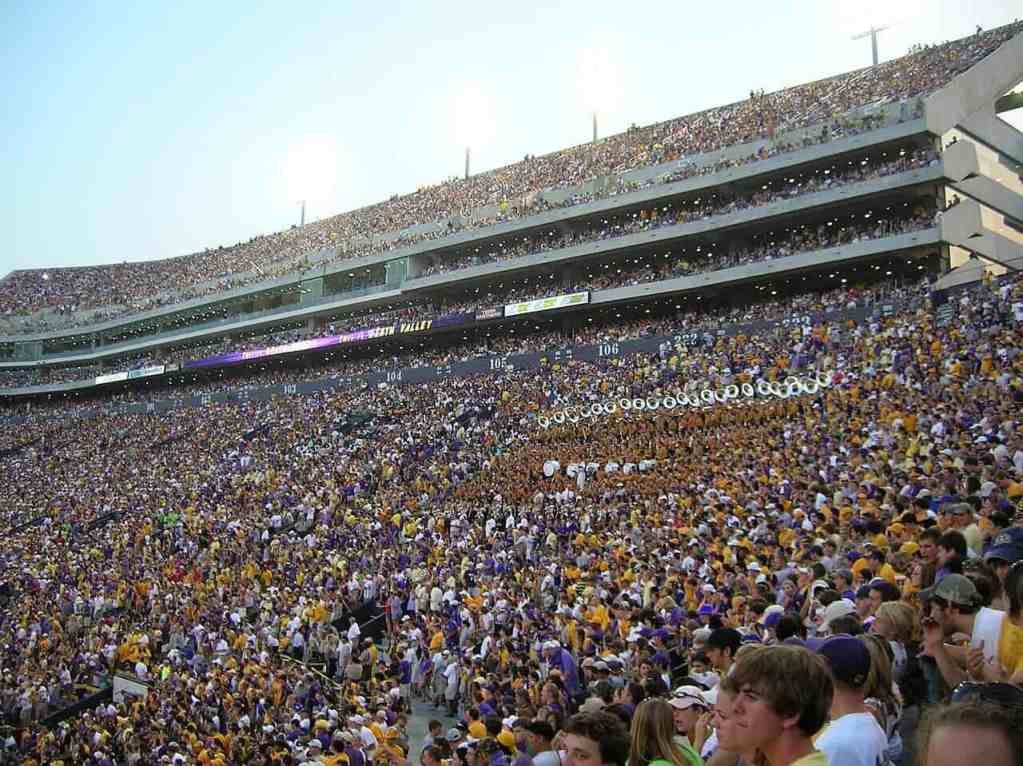
West Sideline Lower Bowl (Sections 101–106): These are the best non-premium seats in the building. You’re sitting behind the LSU bench, between the 30-yard lines, with a direct and unobstructed view of the field. Rows 15–30 offer the best balance — high enough to see plays develop, close enough to feel every substitution. Expect to pay for the privilege, especially for SEC West matchups.
West Upper Deck — Tiger Terrace (Sections 510–520): The Tiger Terrace seats at the front of the west upper deck are the best-kept secret at Tiger Stadium. These are chairback seats with an elevated view that lets you see the full field at once, and the west side gets shade earlier on afternoon games. Sections 515–517 at midfield are the sweet spot. You get the full bowl atmosphere crashing around you from a genuinely comfortable vantage point.
East Sideline Lower (Sections 302–306): The visiting side mirrors the west lower bowl for sightlines at a lower price. You’re opposite the LSU bench, sun-facing on day games, but still in a great football seat close to midfield. First-timers who want to be in the lower bowl without paying the west sideline premium should look here.
Best Value Seats
Upper Deck East Midfield (Sections 534–536): These elevated seats give you a bird’s-eye view of formations and play development that the lower bowl simply doesn’t allow. Chairbacks, full field visibility, and significantly cheaper than anything on the west side. The tradeoff is sun exposure for day games — factor that in if you’re going in September.
Budget Option
Upper End Zone (Sections 400s): The cheapest way into Death Valley. The sightlines aren’t perfect and you’ll be craning on plays at the far end, but you’re inside 102,000 screaming people watching one of the best programs in college football. The north end zone upper deck puts you adjacent to the student section, which is the loudest section in the building — for better or worse. One hard warning: avoid Row 36 in the South End Zone (around Section 406). Ribbon board renovations have created an obstructed scoreboard view from that specific row that nobody warns you about until it’s too late.
Our Pick
West upper deck Tiger Terrace, sections 515–517, rows 1–4. You get the LSU sideline perspective, shade for afternoon games, chairback seats, and a sightline that makes you feel like you’re watching from the broadcast booth. Best value-to-experience ratio in the building for a non-club ticket.
Weather & Shade Reality
The west sideline gets shade first on afternoon games, and in Baton Rouge that matters enormously. September and early October games can hit 95°F with humidity that makes it feel significantly hotter — if you’re going to a day game during the first half of the season, the west side is meaningfully more comfortable than the east. Night games flip the equation entirely. The heat breaks by halftime, and by the fourth quarter you’ll be glad you brought a light layer. Don’t let this talk you out of afternoon games — just dress for Louisiana. Here is the Baton Rouge Weather forecast.
Seats to Avoid
Look sit anywhere if its a big game, its worth being in this stadium for that without question, but if you’re planning or part of the Tiger faithful, here are some areas to avoid.
South End Zone Row 36 (Section 406 area): The ribbon board installation created a legitimate sightline problem here. You lose the main scoreboard entirely. Not worth it at any price.
East Upper Deck Corners (Sections 401–402 and 443–444): Steep, sun-exposed, and the angled view makes following plays on the far end of the field genuinely difficult. These are “I was there” seats, not “I watched football” seats.
Worth It Once — Adjacent to the Student Section: You can’t buy actual student tickets, and don’t try — a valid LSU student ID is required. But sitting in the lower bowl near sections 105–106 puts you close enough to feel the student energy without being in it. The north end zone lower bowl is the loudest, most chaotic corner of Tiger Stadium. Go once to understand why opposing players have nightmares about this place.
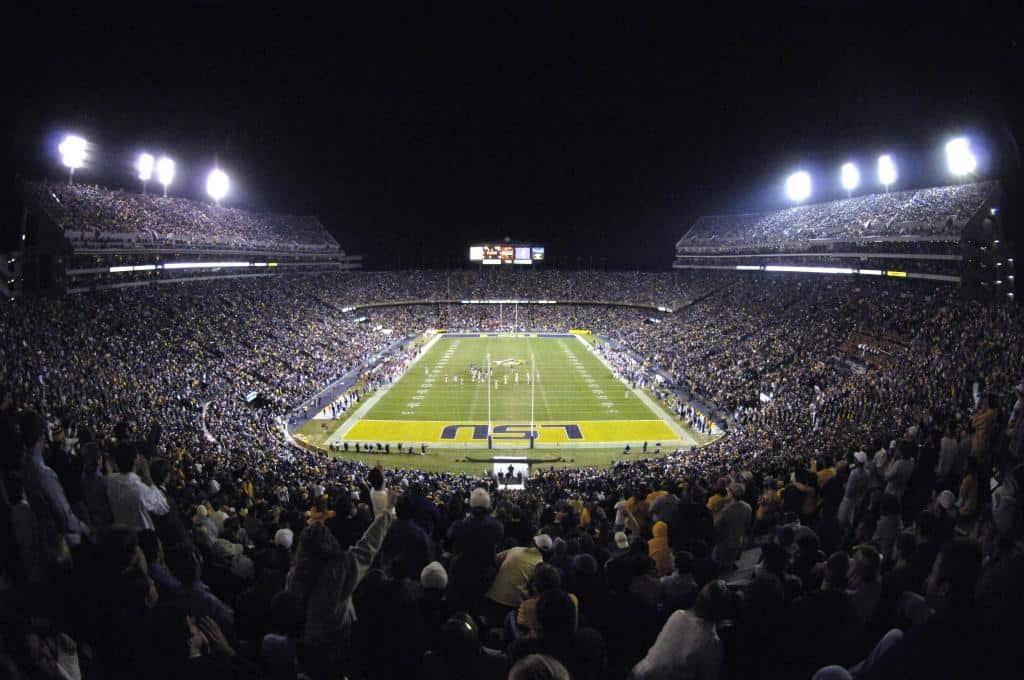
Premium Seating & Clubs
Tiger Stadium has three distinct premium clubs plus private suites, all tied to Tiger Athletic Foundation contributions. These aren’t just “cushier chairs” — the West Club in particular is a genuinely impressive facility that rivals anything in pro sports.
The Best — Stadium Club West: The flagship of Tiger Stadium premium. Spread across 75,000 square feet on three levels above sections 100–106, the West Club includes covered exterior seating with a direct west sideline view, climate-controlled interior lounges, private restrooms, elevator access, and a complimentary buffet covering full meals, appetizers, and non-alcoholic beverages. This is the gold standard if comfort is the priority without sacrificing the atmosphere.
Best Value — Louisiana Fish Fry Products Skyline Club (Sections 650–658): Open-air premium club in the upper south end zone holding up to 1,500 fans. Your ticket includes an all-you-can-eat rotating buffet of Louisiana Fish Fry menu items plus one complimentary drink, with beer and wine available for purchase. You keep the outdoor atmosphere while getting real food perks and a social vibe. Best bang for the premium dollar at this stadium.
Also Notable — Stadium Club South (Sections 550–568): Spans the south end zone with climate control, complimentary buffets, and an exclusive entry concourse. The end zone view is the tradeoff versus the West Club’s sideline perspective, but this is a solid mid-tier premium option if the West Club pricing is out of range.
Suites & Group Options: Tiger Den Suites accommodate 15–20 guests with full lounge setups, kitchenettes, multiple TVs, and premium catering available for purchase. All premium seating requires TAF contributions and pricing varies significantly by opponent. Contact LSU Athletics directly at lsusports.net for suite availability and current contribution requirements.
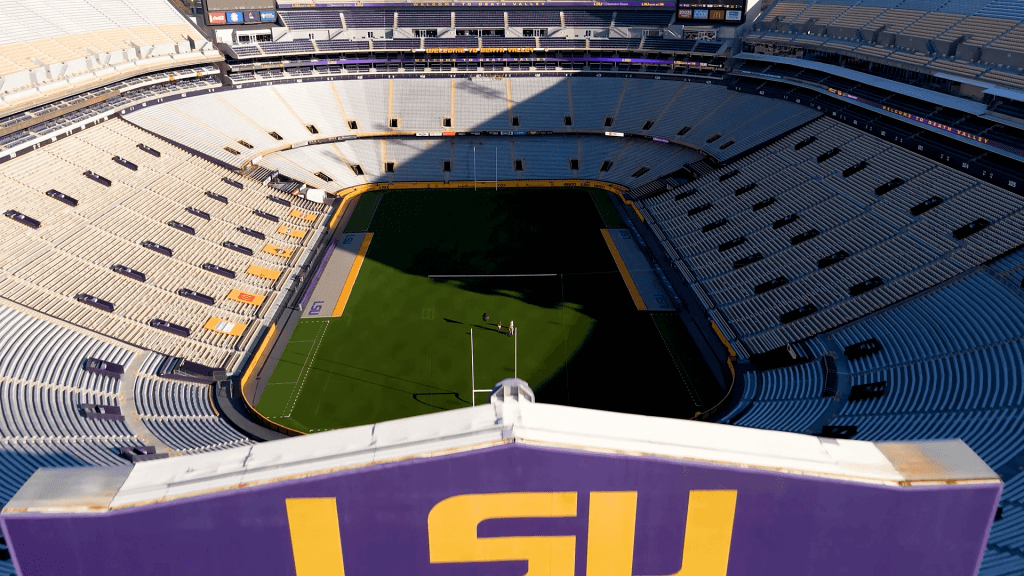
LSU Tiger Stadium Seating Chart
Tiger Stadium at LSU currently seats 102,321 fans. It has grown significantly since it first opened in 1924 with only 12,000 seats. Today, it is one of the largest stadiums in the SEC, NCAA, and the world. And should be rocking the next few years with arrival of Lane Kiffin.
One significant expansion occurred in 2012, during which 70 luxurious “Tiger Den” suites, over 3,000 club seats, and more than 1,500 additional general public seats were added. This expansion not only enhanced the stadium’s capacity but also elevated the overall fan experience. Here is a link to the Tiger Stadium Seating Chart as well as the 3D seating chart.
Tickets to LSU Football Games
LSU is a genuine top-tier college football program with one of the most in-demand home atmospheres in the sport. Tickets aren’t cheap, and for big games they move fast.
Know the demand tiers. Alabama, Ole Miss, and Texas A&M matchups sell out months in advance. Secondary market prices for those games are real — plan well ahead. Mid-tier conference games and non-conference matchups are often still available closer to kickoff at reasonable prices.
Secondary market prices drop before smaller games. For games against unranked non-conference opponents, prices on the secondary market often fall in the 48–72 hours before kickoff as season ticket holders who can’t attend offload seats. If your schedule has flexibility, this strategy works.
TigerDroppings.com is underused. LSU’s primary fan forum has a marketplace section where season ticket holders sell individual games directly to avoid StubHub fees. You’ll find face value or near-face-value tickets to games they can’t attend — worth checking before you pay secondary market markups.
Night game premium is real. Any game flexed to a 7 p.m. or later kickoff carries a 30–50% secondary market markup compared to a comparable afternoon game. If you see the time slot announced late, move quickly.
For most games, the secondary market is a great option. Check out our partner Vivid Seats for LSU tickets for any sport, or Saints whatever. The inventory is liquid, you can compare section-by-section pricing with seat views, and for non-marquee games you’ll typically find competitive pricing. They do have fees sometimes though.
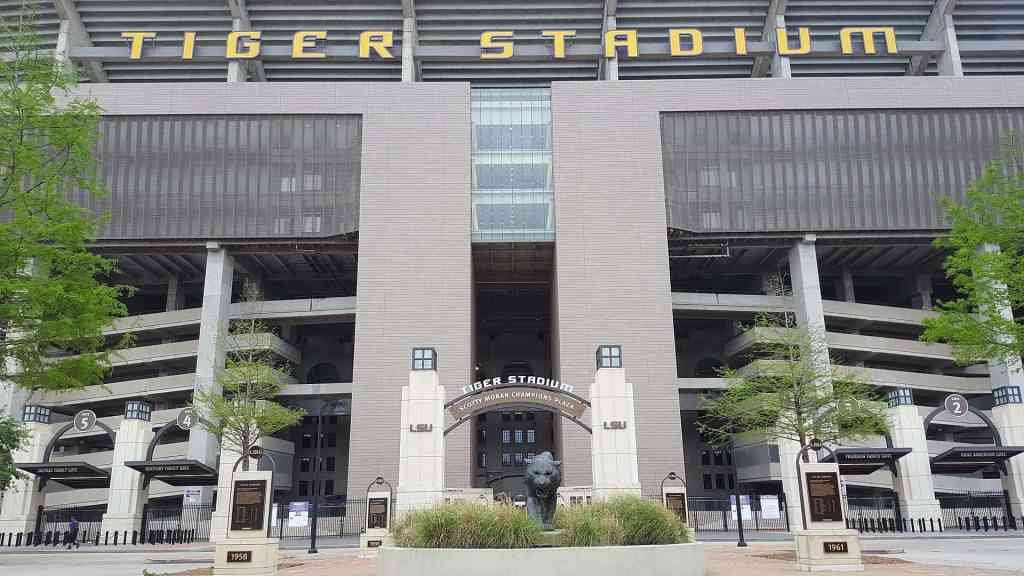
LSU Tiger Stadium Bag Policy
Tiger Stadium enforces a strict clear bag policy under the “Geaux Safe” initiative. You’re allowed clear tote bags 12″ x 6″ x 12″ or smaller, one-gallon Ziploc-style clear bags, or small clutch purses no larger than 4.5″ x 6.5″. All backpacks are prohibited — clear or not, regardless of size. Medical bags must enter at Gate 10 or the Southwest Roll Gate. There is no bag check, so don’t arrive with a non-compliant bag expecting a solution.
If you show up with a regular backpack or an oversized bag, you’re walking all the way back to your car or hotel to drop it off — no compromise, no temporary solution. Sort out your bag setup the night before.
If you come without a bag, take advantage of the Express Lanes at entry — they move significantly faster.
3 Key Policies to Know
No re-entry. Once your ticket is scanned, it cannot be used again. If you leave the stadium, you need an unscanned ticket to get back in. This is strictly enforced — plan accordingly before you step out.
One sealed 32-oz water bottle is allowed. Use it. Stadium vendors can run dry during September heat, and staying hydrated matters more than you’ll think when it’s 95°F and 90% humidity at kickoff.
Cashless or Cash?: Tiger Stadium is fully cashless. Cash-to-card conversion kiosks are available throughout the stadium if you need to convert, but bring a card and save yourself the line. This catches people off guard every season.
Getting To LSU Tiger Stadium
Tiger Stadium sits at the corner of N. Stadium Road and Nicholson Drive in the middle of LSU’s campus in Baton Rouge. There’s no single magic transportation solution — the right approach depends on where you’re staying and how early you’re arriving.
Parking at Tiger Stadium
Most on-campus lots are permit-only and sold through lsusports.net in five color-coded zones; buy in advance, because they fill. All lots open seven hours before kickoff, not at a fixed clock time — for a 6:30 p.m. game that’s 11:30 a.m. If you don’t have a permit, the Old Front Nine lots run first-come at around $50, card only at the entrance.
Once pregame checkpoints go up roughly four hours out, non-permitted cars get diverted around campus and the realistic free option is the Gourrier Avenue corridor on the west side. Approach via Burbank Drive, or from downtown via River Road or Nicholson, and check the official parking map before you leave — lots and campus roads have shifted with recent construction.
Parking Hack to Know: LSU publishes a separate postgame parking map (see above), and it’s the one that matters. Police enforce directional exiting, so your lot decides which way you leave, not you. Park east — Parker Coliseum, the Old Front Nine, the Highland and Burbank neighborhoods — if you’re heading to I-10 east afterward, and park near the river if you’re going west or north on I-110. Free ADA parking is at the back of Lot 406 off Gourrier, first-come with a valid permit, and has its own shuttle to the gates.
Public Transit
CATS Touchdown TRAX is the city’s official park-and-ride and it’s cheap. Around $10 per person round trip, starting roughly three hours before kickoff and dropping near the LSU softball fields. Pickup hubs have included L’Auberge Casino, the I-110 underpass at Florida Street, and Hotel Indigo — confirm the current list with CATS. The latest website update said Touchdown Trax was paused in 2024, but check the linked website for schedules an latest updates.
The Pastime shuttle is the downtown drinker’s route. Pastime runs its own Tiger Transit to and from the stadium for home games. Park under the Mississippi River Bridge rather than Pastime’s small front lot — they ask this specifically — and you get a bar built into your transport plan.
Rideshare
Uber and Lyft work well for arrival. For post-game, plan your strategy in advance — there’s no official designated rideshare pickup area, and drivers can’t navigate onto campus until traffic clears. The fix is your legs: walk clear of campus before you open the app, north toward the Chimes Street area or south past the athletic facilities. Better still, wait out the first hour at a bar and request a ride when the surge has dropped and the roads are moving.
Walking and Biking
If you’re staying anywhere in the Highland Road and North Gates corridor, the stadium is an easy walk and this is the best situation available — park once, eat and drink at the North Gates, walk to the game, walk back.

LSU Tiger Stadium Gameday Tips
Death Valley on a Saturday night is organized madness at a scale most fans have to see to believe, and the culture around it is half the reason people fly across the country for a regular-season game. First-timers who show up at kickoff miss the first act entirely.
Weather Forecast and What to Wear to an LSU Game
Moisture-wicking fabrics only through October. Heat radiating off the concrete in September is unforgiving and the humidity makes it worse than the thermometer reads. Save denim and boots for late-season night games, which genuinely can get cold by the fourth quarter.
Check the color code before you pack. LSU designates certain home games as “Gold” or “Purple” for coordinated crowd color, and the wrong shade stands out in every photo. Confirm the promotional schedule on LSUsports.net first.
Bring a poncho, not an umbrella. Umbrellas are prohibited and get confiscated and discarded at the gate — LSU recommends ponchos instead. In a Louisiana September, assume you’ll need one.
Here is the Weather Forecast for Baton Rouge. Check that Humidity.
Arriving at Tiger Stadium: Gates, Timing and Express Lanes
All parking lots open seven hours before kickoff, not at a fixed clock time. For a 6:30 p.m. kickoff that’s 11:30 a.m. Older guides still circulating say lots open at 7 a.m., which has not been LSU’s policy for years.
Gates open two hours before kickoff, premium areas at three. Student gates and all remaining gates open together at the two-hour mark, so that crush is real. If you have club or suite access, use the extra hour.
Going bagless puts you in the Express Lanes. Fans without bags get dedicated faster entry at Gates 3, 4, 8, 11/12, 23 and 26. Phone, card and keys in your pockets is the fastest way in, full stop.
You can bring one factory-sealed water bottle up to 32 ounces. One sealed bottle per person, up to a liter — the most under-used allowance at Tiger Stadium. Freeze it overnight and it’s still cold at kickoff.
Medical-needs bags enter at Gate 10 or the Southwest Roll Gate. Those are the only checkpoints staffed for the inspection, and diaper bags that fail the clear-bag rule count as medical items. Any other gate means walking the perimeter.
LSU Football Parking and Traffic: What Actually Works
Without a permit, arrive more than four hours out or accept the west side. Once pregame checkpoints go up, non-permitted vehicles get diverted toward the free lots, and in recent seasons the realistic late-arrival option has been the Gourrier Avenue corridor. Approach via Burbank, or from downtown via River Road or Nicholson.
Use LSU’s custom Waze gameday map, not stock navigation. LSU builds a Waze layer each season with restricted streets, lot availability and the correct entrance for your specific lot. Google Maps will route you into a checkpoint.
Yard parking is a real Baton Rouge institution. Residents off Highland Road and around the North Gates sell front-yard spots, usually cash and usually cheaper than a campus permit. The bigger advantage is the exit — side streets empty far faster than campus lots.
Never park on the neutral ground or the Nicholson shoulders. Medians and landscaped areas anywhere on campus are off limits and enforced. This is a tow, not a ticket.
Free ADA parking is at the back of Lot 406, entered off Gourrier Avenue. Behind Tiger Park next to the LSU Soccer Stadium, first-come and limited, with a valid state ADA permit or license shown to officers on site. A shuttle runs to the stadium and back.
Getting Out of Death Valley After the Game
Your parking spot decides your exit, so pick it by where you’re sleeping. Police enforce directional exiting — you leave the way they send you, not the way you want. Heading east on I-10? Park east: Parker Coliseum lots, the Old Front Nine, the Highland and Burbank neighborhoods. Heading west or north on I-110? Park by the river.
Contraflow is not a fixed plan and changes game to game. LSU publishes a separate postgame parking map alongside the pregame one each season. Use that one — searching generic “LSU contraflow” pulls up whatever was true in some other year.
Three streets around the stadium close to cars entirely. North, South and West Stadium Drive are shut all gameday. Postgame, Skip Bertman between Nicholson and the railroad closes for roughly 45 minutes for pedestrians, and Nicholson between North and South Stadium closes so the crowd can cross.
The cheapest traffic strategy is not being in it. An hour in a North Gates bar after the final whistle beats an hour idling on Nicholson, and you get home at roughly the same time in a better mood.
LSU Tailgating: Where to Set Up and What to Know
Wander, be curious, and say it’s your first time at Tiger Stadium. LSU tailgates run cast iron gumbo pots, crawfish boils and jambalaya rigs going since dawn, and the hospitality is not a myth. You will be fed. A bottle of whiskey offered in return gets you adopted on the spot.
Know what each zone is before you pick one. The Parade Ground is students and Greek organizations who staked spots the night before. The Greek Amphitheatre is where the band rehearses and the Victory Hill parade forms up. Touchdown Village and the RV lots are the hardcore multi-day operation. Visitors do best around the Amphitheatre.
Sandbags, not stakes, and keep cookers away from the oaks. Staking near the live oaks is prohibited and staff check for it. No cooker on campus may exceed a 55-gallon drum, none may sit in travel lanes or parking spaces, and cooking is banned on Memorial Plaza and the War Memorial.
Don’t put chairs or equipment in empty parking spaces. Those are vehicle-only and you’ll be moved. Same for erecting fencing or laying temporary flooring on the Parade Ground.
Coolers stop at the gate. Everything that makes the tailgate work — coolers, ice chests, cans, bottles, outside food — is banned inside, and there’s no re-entry once your ticket is scanned. Plan the day as two separate events.
Victory Hill: Where to Stand and When
The Victory Hill parade starts two hours and fifteen minutes before kickoff. LSU runs it as one procession including the Golden Band from Tigerland and the team, so don’t catch the band and leave. Stay for all of it.
Position near the Greek Amphitheatre first, then move down the hill. The band warms up there before the parade forms, so you get the rehearsal and a clear look at the start. Fans stack both sides of North Stadium Drive, so a spot on the hill itself has to be claimed early on a big game.
The band marches back to the band hall after the game. Most college bands don’t. If you’re still on campus and hear the drum cadence start up, stop for five minutes — it’s the quietest, best-kept piece of the whole tradition.
LSU Gameday Traditions Every First-Timer Should Know
“Callin’ Baton Rouge” plays twice, not once. Garth Brooks’ version goes off before kickoff and again into the fourth quarter, and 102,321 people stand both times. The Louisiana Senate formally named it LSU football’s official welcome song in 2023.
Learn to bow for the Chinese Bandits. When the band strikes up “Chinese Bandits” after a defensive stop or turnover, the whole stadium bows until the song ends. The name comes from Paul Dietzel’s third-string defense on the 1958 national championship team, borrowed from a comic strip — one of the oldest living traditions in the building.
The first four notes of the Pregame Salute are the moment. The band takes the field about 17 minutes before kickoff, and those opening notes are what LSU fans mean when they talk about Death Valley. Be in your seat for it.
Understand the “Tiger Bait” situation. Wear opposing colors and you’ll hear it all day. The move is a wave or a shrug — LSU fans are hospitable to visitors who take the ribbing well, and the people who have a bad day here are almost always the ones who didn’t.
The “Hot Boudin” cheer, decoded. You’ll hear “Hot boudin, cold coush-coush, come on Tigers, push push push” around campus all day. Coush-coush is a traditional Cajun cornmeal breakfast dish, and “push” is pronounced “poosh” to rhyme with it. Now you’re in on it.
“Neck” is the chant nobody officially plays. A version of a Dem Franchize Boyz song, banned by LSU Athletics in 2010 after the student section added explicit lyrics on national TV, then sporadically revived and re-banned since. The band doesn’t play it, but the chant still surfaces in the student section.
Food, Drink and Cashless Inside Tiger Stadium
Tiger Stadium is fully cashless. No concession stand or merchandise counter takes cash — bring a card or have Apple Pay or Google Pay ready. Cash-to-card machines exist throughout the stadium, but the lines cost you game time.
Alcohol rules are strict and the cutoff is early. Two drinks per transaction, ID checked every time regardless of how old you look, no in-seat vendors, and sales stop at the end of the third quarter. Make your last run before the halftime rush, not in it.
Time concession runs to the middle of a quarter. Halftime lines run 20-plus minutes at every game. Step out mid-second or mid-third and you’re back before anything matters.
Get on The Chimes waitlist before you’re anywhere near it. The gameday wait at the North Gates institution runs into hours. Join the digital waitlist as early as you can; if it’s still backed up when you arrive, go straight to the rooftop, which turns over faster. Jambalaya and boudin are on the stadium concession menu too — the food floor is higher here than anywhere in college football.
Cell Service, Your Group and the LSU App
Assume cell service is better than it used to be, but don’t bet the day on it. AT&T put $45 million into a distributed antenna system inside Tiger Stadium ahead of the 2026 season, precisely because 100,000 phones in one bowl used to collapse the network. Improved, not solved.
Download tickets to your phone’s native wallet and screenshot the QR code. Not the email, not the team app — the wallet, plus a screenshot as a fail-safe, because wallet apps sometimes try to refresh over cellular right at the gate.
Set a physical rally point with a time before you split up. “Text me when you’re leaving your seat” does not work here. Pick something unambiguous — the southeast corner of the Maravich Center, 15 minutes after the final whistle — and hold to it.
The LSU Sports Mobile App is worth the install. Mobile tickets, parking passes, stadium maps, live stats and gameday alerts in one place, and the fastest route to a parking update when a lot fills.
Pack a cheap FM radio. Tuning the LSU Sports Radio Network broadcast while you watch live is the old-school move that still works, and it’s genuinely useful for penalties and injuries you can’t make out from the upper deck.
Tiger Stadium History and Odd Facts
Students used to live inside the stadium. In the 1930s state money was available for dormitories but not stadium seating, so LSU built dorms into the structure with seats on top — east in 1932, west in 1935, north in 1936. The idea is credited to athletics manager T.P. “Skipper” Heard, with Governor Huey Long helping in other ways. Students lived in them into the late 1980s, and the football team itself did during the 1986 season.
Players touch a 1955 crossbar on the way out. The crossbar from the north end zone goalposts that stood from 1955 through 1984 hangs above the locker room door to the field, painted with one word: WIN! Every player touches it heading out.
The field is marked every five yards, and the goalposts are the wrong shape on purpose. Most college fields mark ten-yard increments; Tiger Stadium marks every five. The north end zone keeps H-style goalposts rather than the modern Y-style slingshot, which is what lets the team run through the uprights taking the field.
“Death Valley” started as “Deaf Valley.” Per school lore the nickname came from the ringing ears students left with, and the noise has registered on LSU’s own seismograph — first at the 1988 Earthquake Game against Auburn, when the crowd reaction to the winning touchdown showed up on a campus seismometer.
The Campus Mounds may be the oldest man-made structures in the Americas. Two grassy 20-foot mounds along Dalrymple Drive, sitting right in the tailgating footprint. A 2022 LSU radiocarbon study put construction start at roughly 11,000 years ago — thousands of years older than the pyramids — though LSU’s own archaeologists have published alternate readings. Either way they’re on the National Register, and the university now calls them the LSU Campus Mounds, not the “Indian Mounds” name still in older guides.
Best Photo Spots at Tiger Stadium
Mike VII’s habitat, in the morning. The enclosure sits between Tiger Stadium and the Maravich Center next to the LSU sports shop, free and open year-round. He’s most active early and in the evening; by mid-afternoon the crowd is three deep and he’s asleep. Catching him in the pool is held to be a good omen.
The stadium exterior at dusk before a night game. The defining shot of a Tiger Stadium trip — golden-hour light, the bowl lit up, purple and gold across campus. Take it before you go through the gates; there’s no re-entry.
The west upper-deck ramps about 30 minutes out. If you’re on the west side, step onto the exterior ramps before kickoff for an elevated, unobstructed look at the sun dropping toward the Mississippi — the best photo available without leaving the stadium.
Bringing Kids to an LSU Game
Every person needs a ticket, regardless of age. There’s no lap-child exception at Tiger Stadium — LSU is explicit that even the smallest fan needs their own. Budget for it before you plan the trip.
The Bud Light Fan Zone opens five hours before kickoff, live music at four. It’s in front of the Maravich Center across from the stadium, in the pre-peak window when a family can actually move around. The Maravich Center itself also opens to the public five hours out, and on a 95-degree afternoon that air conditioning is the best bailout on campus.
Steer clear of the student sections. Loud, densely packed and standing the entire game. The upper west deck and south end zone lower bowl are calmer with the same view.
Lactation rooms exist inside and outside the stadium. One on the ground level of the northwest side near section 106 inside the Trauma Room, and a tailgating room at 305 Coates Hall, first-come and locking from the inside. Most restrooms have baby changing stations, and first aid stations offer air-conditioned private ones.
Keep kids off the Campus Mounds and explain why. Older guides suggested letting children roll down them; LSU has since fenced them and enforces access rules because of the damage decades of sliding caused. Admire them from the paved paths — the real story beats a hill to roll down.
Hotels Near LSU Tiger Stadium
Baton Rouge doesn’t have enough rooms for an SEC home weekend and the pricing shows it. Book three to six months out for a marquee game, a few weeks for a nonconference Saturday. The bigger decision isn’t the hotel — it’s which side of the traffic you want to be on, because that’s what decides whether your night ends with a ten-minute walk or ninety minutes on Nicholson Drive.
Best Areas to Stay Near LSU
On campus and the North Gates (walk to the stadium). The only zone where you skip parking, checkpoints and contraflow entirely. It’s also where the grown-up bar corridor is — The Chimes, the original Raising Cane’s, Louie’s — so your whole day happens on foot. There are almost no hotel rooms here, which is exactly why they go months in advance. Book this if you can, full stop.
The Nicholson Drive corridor, one to two miles south (the practical pick). Close enough to walk on a good night or take a short ride, far enough south to sit outside the campus road closures. It’s also the right side of campus if you’re driving south or west afterward, since directional exiting will push you that way anyway. This is the best balance of price, proximity and escape route.
Downtown, two miles north (best if you’re not driving). The food, the bars and Third Street are here, and it’s the only area with real shuttle service to campus — both CATS Touchdown TRAX and the Pastime shuttle run from down here. You’re commuting to campus twice, but you can do it without ever getting behind the wheel, and downtown clears out faster than anything near the stadium. Choose this if the weekend is about Baton Rouge as much as the game.
College Drive and Citiplace, ten to fifteen minutes east off I-10 (the value belt). Newer chain hotels, easy interstate access, and where you look when everything closer is sold out or priced into orbit. Park east of campus on gameday and the exit works in your favor. Nothing here feels like a college town, and that’s the trade.
South on River Road (the overflow answer). L’Auberge sits ten minutes down and functions as a shuttle hub, which makes it a legitimate option rather than a consolation prize when the campus-area hotels are gone.
Where to Stay in Baton Rouge
The Cook Hotel — the only hotel actually on the LSU campus, on the University Lakes off West Lakeshore Drive. Walk to Tiger Stadium. Conference-center rooms rather than boutique, and housekeeping is the recurring complaint, but nothing outweighs walking home after the final whistle.
Sonesta ES Suites at Southgate — on Nicholson about a mile south of the stadium, walkable on a nice night. Kitchen suites and free breakfast make it the family and group pick. Daiquiri shop attached to the building.
The Watermark — a converted 1920s bank on Third Street and the nicest room downtown, on the nightlife spine and near the shuttle pickups. Thin walls; ask for something away from the elevators.
Hotel Indigo — a block over on Convention Street, and a CATS Touchdown TRAX pickup point, so you can walk downstairs and ride to campus without a car. Small rooms, paid parking. A logistics pick.
Hilton Baton Rouge Capitol Center — the big downtown standby, short walk to the shuttles and Third Street. Historic building aging unevenly, but it holds a large group under one roof.
L’Auberge Casino & Hotel — ten minutes south on River Road, newer rooms than most of downtown, rooftop bar and pool, late-night food, and a Touchdown TRAX hub so the car can stay parked all day.
Easier on the Wallet
Home2 Suites Citiplace — newer building off College Drive with kitchenettes and a genuinely good free breakfast, about fifteen minutes out. Firmly commuter territory.
Hampton Inn at I-10 and College Drive — the reliable cheap bed in the same belt and often the last thing available for a big game. Small rooms and interstate noise; ask for a room off the highway side.
LSU Gameday: Inside a Football Weekend in Baton Rouge
There are louder claims in college football and almost no better ones: a home Saturday night in Baton Rouge is the sport at its peak. LSU plays most home games under the lights, a tradition running back to the first one in 1931, so the city gets a full day to build toward kickoff and uses every hour of it. The food beats anywhere else on the college football map, the tailgates are cooking operations rather than coolers, and 102,321 people inside Death Valley is something opposing players talk about years later. It’s a two-day takeover of a city, not a three-hour event.
Friday Night in Baton Rouge
Friday is the settle-in night, and where you go depends on your crowd. Most visiting fans arrive wanting a real Louisiana dinner rather than a party, because Saturday is going to be long and everyone knows it. Get the sit-down seafood meal now, before every good room in the city has a two-hour wait.
Downtown is the calmer play: Tsunami on the Shaw Center rooftop has sushi, a full bar and the best river view in the city, with Third Street below it as the nightlife spine. The college crowd is already loud in Tigerland by nine, and the North Gates on Highland Road fills with alumni doing the same at lower volume. Rest up or warm up; pick one.
Saturday Morning: The Slow Build
Gameday here starts early and moves slowly on purpose. Parking lots open seven hours before kickoff and cookers get lit mid-morning; locals treat the morning as the calm before ten hours of pacing. Start at Louie’s Café, the checkered-floor diner that’s fed LSU since 1941 — 6:30 a.m. to 2:30 p.m. now, not around the clock, with a gameday wait past half an hour — or get beignets and café au lait at Coffee Call on College Drive, open from six.
The Pregame Scene: Tailgates, Victory Hill and Death Valley
By mid-afternoon campus turns into something closer to a state fair built around a cathedral. You smell it before you see it — jambalaya, boudin and grilled everything off hundreds of setups under the live oaks. The Parade Ground is students and Greek organizations who staked their spots Friday night; the RV crowd at Touchdown Village arrived days ago. Strangers hand you a plate; that’s how it works here.
The day has fixed points. The Golden Band from Tigerland rehearses at the Greek Amphitheatre, then leads the team down Victory Hill two hours and fifteen minutes before kickoff, fans stacked both sides of North Stadium Drive. It’s one procession including band and team, so don’t leave once the band passes. Mike the Tiger’s habitat sits across from the stadium — free, open year-round, and students swear catching him in the pool is a good omen.
Inside, “Callin’ Baton Rouge” plays twice, before kickoff and again into the fourth quarter. The honest catch: the bigger the game, the slower everything moves, so get on campus early and let the day come to you.
Best Bars for an LSU Gameday
The Chimes (North Gates) has been the meeting spot since the 1980s, with a 200-deep beer list and a rooftop that turns over faster than the main floor. Get on the digital waitlist before you park.
Fred’s (Tigerland) is the institution — open since 1982, the city’s oldest college bar, cash for the door, and steaks off the grill out front on gamedays.
Walk-On’s on Burbank is the original, opened by two LSU basketball walk-ons in 2003 with Drew Brees a co-owner since 2015. Close enough to hear the stadium; the natural postgame landing spot.
Tin Roof Brewing north of campus is the local craft answer, big outdoor deck and food on site, no cover.
Where to Eat in Baton Rouge
Mike Anderson’s on West Lee Drive has done dark-roux gumbo and charbroiled oysters for fifty years, and handles a group easily.
Parrain’s on Perkins is the other classic, worth the wait for the seafood gumbo alone.
Phil’s Oyster Bar on Perkins is the local call for charbroiled oysters in a room papered with LSU memorabilia. Closed Sundays.
Elsie’s Plate & Pie in Mid City handles casual — burgers, red beans and the pies it’s named for.
Cecelia Creole Bistro downtown is the newer room locals send visitors to. Skip the chains; there’s a local version of whatever you’re craving and it’s better.

Why You Should Go
There is a reason why ESPN and other outlets consistently rank this as the best atmosphere in college football, because on a big game Saturday, it simply is. The case is straightforward: 102,321 people packed into a steep, enclosed bowl that turns crowd noise into something you feel in your soul, a pregame built on real cajun food and genuine hospitality to visitors, and an atmosphere that opposing players still bring up years after they’ve left. Add the Kiffin era’s arrival and the program’s ambitions, and for the next few years Saturdays in Baton Rouge are going to matter.
Is it a hassle? Some. Getting out of Baton Rouge after a night game takes patience, and September heat will test you before kickoff. Go anyway. Nobody walks out of Death Valley on a Saturday night wishing they’d skipped it — they walk out understanding why everyone told them to come. If you call yourself a college football fan, this one belongs on the list, once at minimum.
Check out all of our College Football Guides as well as these SEC roadtrips and regional gems:
Written by Brad Richards, Founder of Gameday Guides. This guide includes insights from personal visits as well as updated info from team sources, fan forums, and stadium policies. We aim to help you plan with confidence — enjoy your gameday.