
Best Seats At Angel Stadium
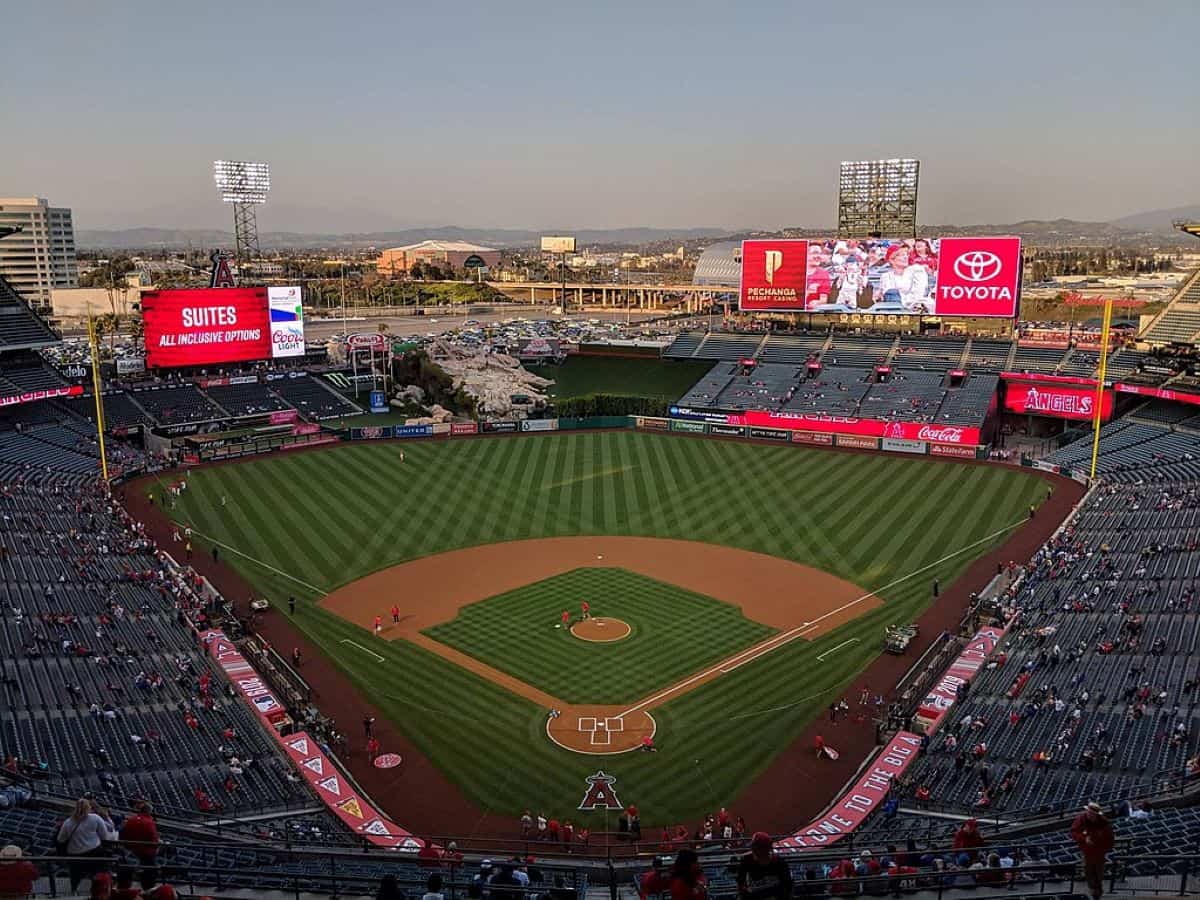
Angel Stadium is the fourth-oldest ballpark in the majors, and it wears its age well. This is Southern California after all. Because it was built for baseball first, the sightlines from foul pole to foul pole are genuinely good, and the upper deck sits lower and closer to the field than the towering top tiers at most newer parks. It’s a suburban stadium in the truest sense — freeways, strip malls, and Disneyland all within a few minutes — which shapes almost everything about how you plan a day here, from parking to shade.
Keep in mind, Day games can be hot, and the seat you pick determines whether you spend three innings baking or sitting comfortably in the shade. Here’s how to choose.
Seating Strategy
The thing that separates a great seat from a rough one at Angel Stadium isn’t distance from the field — the whole lower bowl is close. It’s sun exposure and, if you’re in the outfield, whether the bullpens block your view. Baseball-specific stuff drives the picks here: baseline angles, foul-ball territory, and the afternoon sun that hangs over the first-base side.
Best Non-Premium Seats
The lower bowl behind home plate and down the infield, roughly Sections 110–126: this is the sweet spot for watching a game without paying premium prices. You’re on the Field Level (the 100s), close to the plate, with the Angels dugout in front of Sections 110–112 and the visitors’ dugout down toward 125–126. The tradeoff is sun — Field Level sits below the overhang and isn’t covered, so a day game here means direct light for most of the afternoon.
The Terrace Level infield, Sections 201–213: one level up and, critically, fully under the overhang. These sit directly above the Field Level 100s, so you’re still close, just slightly elevated with a cleaner view of the whole diamond and defensive alignment. The Angels dugout lines up below Sections 209–213, which makes them the most popular on the level.
The upper deck (View Level, the 400s): because the top tier here is unusually low, the first few rows of the upper deck give you a real, unobstructed view of the field for a fraction of the lower-bowl price. If you’re grabbing cheap seats, aim for the front rows of the infield sections rather than the back.
Best Value Seats
The Terrace Level infield (Sections 201–213) is the smartest money at Angel Stadium, and it’s not close. You get an elevated infield view, easy access to the main concessions and concourse behind home plate, and — the part that matters most in summer — shade, because every row on this level sits under the deck. You give up a little proximity versus the Field Level, but you gain comfort and a better read on the whole field. This is the “terrace all-star / terrace box” tier you’ll see labeled on the seating map.
Cheapest Way In
The View Level (400s) is the honest budget answer. The seats are steeper, which actually helps — the pitch keeps sightlines clear even from higher rows — and because the deck is low, you’re closer to the action than the price suggests. The real downside is the climb and the distance from the premium concessions clustered lower down.
The outfield pavilions are the other cheap route, but read the next section before you buy, because not all outfield seats are created equal here.
Our Pick
If you’re visiting for the first time and want one recommendation, take the Terrace Level infield around Sections 205–213. You’re close, you’re shaded, you’re near the best concessions, and you’re looking straight down the lines at the dugouts — the most comfortable good seat in the building, especially for a day game.
Heat & Shade
Sun is the real variable at Angel Stadium, and the fix is structural, not guesswork. The Terrace Level (200s) sits entirely under the upper-deck overhang, so those seats stay shaded through a day game. The Field Level (100s) is uncovered and gets full afternoon sun, with the first-base side and right-field pavilion holding the light longest. The most protected spots in the park are the field-level seats directly behind home plate, shielded by the press box and club structure overhead. If you’re coming for a weekend afternoon game in July or August and want to stay cool, the Terrace Level is the move; if you’re set on the Field Level, aim behind the plate and bring sunscreen and a hat regardless.
What to Avoid (and What’s Worth Trying Once)
The front rows of the right-field pavilion, roughly Sections 236–240: they look close and exciting until you realize the bullpens sit in front of Sections 258–260 and the low outfield wall blocks the sightline from the first few rows. You end up watching relievers stretch instead of the game. If you want to sit in right field, buy back a few rows so you’re seeing over the bullpen, not into it.
Worth it once: the outfield pavilion on a fireworks night. The view of the game itself is the weakest in the park, but for a postgame fireworks show — or just a cheap, loose, sun-on-your-shoulders summer evening with a beer — the outfield has its own easygoing appeal that the pricier infield seats don’t.
Premium Seating Options
Angel Stadium’s premium tiers all funnel through one indoor anchor: the air-conditioned club and restaurant space behind home plate at field level, currently branded the Lexus Diamond Club. The premium options are essentially different ways to buy access to that space plus a better seat, ranging from a single field-level row to full private suites. Lead with location and tier when you shop; the sponsor names change, the geography doesn’t.
The Best Premium Experience
The dugout-level suites are the standout — ten private suites at field level, tucked between the Angels and visiting dugouts, roughly 50 feet from home plate. Each holds about 12 guests with ultra-cushioned seating, a private in-suite restroom, a VIP entrance, and access to the club restaurant and cocktail bar behind the plate. It’s the closest you can sit to a big-league batter’s box at this park, and priced accordingly — generally four figures per game and climbing for marquee matchups.
Best Value Premium
The club seats behind home plate (the first ~15–20 rows of Sections 114–122) are the premium play that actually makes sense for a normal fan. You get wide, padded seats directly behind the plate, in-seat wait service, and access to the indoor club restaurant and lounge — most of the premium experience for a fraction of a suite. Worth knowing before you go: “access” to the club means exactly that. You can sit at the bar or order à la carte, and there’s an all-inclusive buffet available for an added per-person charge if you want the sit-down meal. If you’re weighing this against the field-level box row, this is the better buy.
Other Premium Options
The field-level box row (Row AA in front of Sections 109 and 127) is a single private row of wide, extra-legroom seats just outside each dugout, with in-seat service and club access — great for field proximity, though a camera well of about 20 feet sits between you and the dugout, so you’re field-adjacent more than player-adjacent. The Terrace-level club behind home plate (currently the Don Julio Club, Sections 216–218) offers elevated, lounge-style premium seating with executive chairs and countertops — a comfortable middle ground that isn’t a full suite. Club Level ticket holders across these tiers also get the two lounges overlooking the Plaza Courtyard and the brewery-style taproom in the right-field stands.
Suites & Group Options
Angel Stadium has around 87 suites spread across the dugout, club, and terrace levels, holding anywhere from about 8 to 54 guests, with modular group suites that combine into larger spaces for big parties. They’re the corporate-entertaining and celebration option, generally running four to five figures per game depending on matchup and location, with in-suite catering and VIP parking available to add. Book through the Angels’ premium sales team or a suite marketplace.
Angel Stadium Seating Chart and Capacity
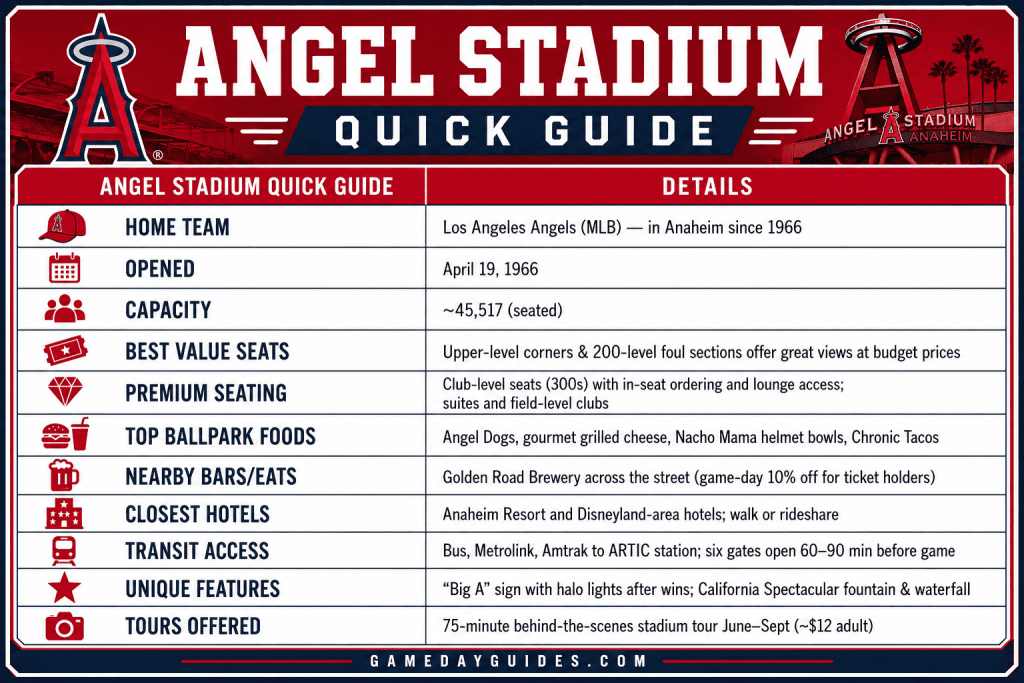
Angel Stadium holds roughly 45,500 for baseball (commonly listed at 45,517). It opened in 1966 and is laid out in four tiers: Field Level (100s) closest to the field, Terrace Level (200s, Sections 201–230) directly above and under cover, the outfield pavilions wrapping the outfield (the 230s–260s), and the View Level (400s) up top. Home plate anchors the infield with the dugouts in front of the low 100s, and the bullpens sit in front of Sections 258–260 in right-center.
Here is an updated Seating Chart To Angel Stadium.
Getting Angels Tickets
The Angels haven’t made the playoffs in over a decade, which is bad for the franchise but good for your wallet — this is a buyer’s market on the secondary side for most of the schedule. Weeknight games against non-rivals are routinely cheaper on resale than face value, so a marketplace like Vivid Seats (see below) usually beats the box office for anything but the hottest dates. The exceptions are weekend games, Dodgers and Yankees visits, and fireworks nights, which hold their price and sell early. If you want a specific block of shaded Terrace seats for a summer weekend, buy ahead rather than day-of.
Get your Angels Tickets Here! Our partner Vivid Seats has the best seats to Angels games or just about any event in Southern California.
Angel Stadium Bag Policy
Angel Stadium runs a strict, modified clear-bag policy, and it catches a lot of people off guard. You can bring a small purse or bag no larger than 12″ x 12″ with a single zipper closure or flap, or a clear plastic or vinyl bag not exceeding 12.75″ x 6.5″ x 12.75″ with no hidden interior pockets. Medically necessary items and diaper bags accompanying an infant are allowed after inspection. No backpacks of any kind, clear or not, unless they meet the clear-bag dimensions. Everything gets searched at the gate.
Here’s the part worth planning around, especially if you’re coming from Disneyland or straight off a flight: there is no bag storage at Angel Stadium. No coat check, no lockers, no staff who will watch an oversized bag. Anything that doesn’t meet the size rules has to go back to your car — and if you don’t have a car, you’re stuck. If you’re traveling with luggage or a larger bag, use an off-site bag-storage service (Bounce and Radical Storage both operate near the stadium and around Anaheim) and drop it before you arrive.
Key Venue Policies
You can bring your own food, which surprises people — it just has to be in a clear plastic bag no larger than one gallon, in individual portions rather than bulk. You can also bring one factory-sealed clear plastic bottle of water or a sports drink, up to one liter; frozen bottles are prohibited for safety, though they’re sometimes allowed on hot days at the stadium’s discretion. No outside alcohol, and no hard-sided coolers. At the gate you’ll walk through a metal detector — belts, wallets, phones, keys, and jewelry stay on you, but cameras, sunglass cases, and other large metal objects come out of your pockets first.
Angel Stadium is fully cashless, top to bottom — every concession, retail stand, and parking booth takes cards or Apple/Android Pay only. If you’ve got cash you want to use, there are reverse ATMs throughout the ballpark that convert bills into prepaid debit cards. Don’t show up expecting to pay cash for a beer.
Accessible parking is available outside Gates 1–6 and the Home Plate Gate; parking staff will direct any vehicle with a valid disability placard or plate. Wheelchair-accessible, semi-ambulatory, and companion seating is offered across all price levels rather than corralled into one section, so you can find accessible seats near where you actually want to sit. The Angels post a full accessibility guide on their site with elevator and entrance details.
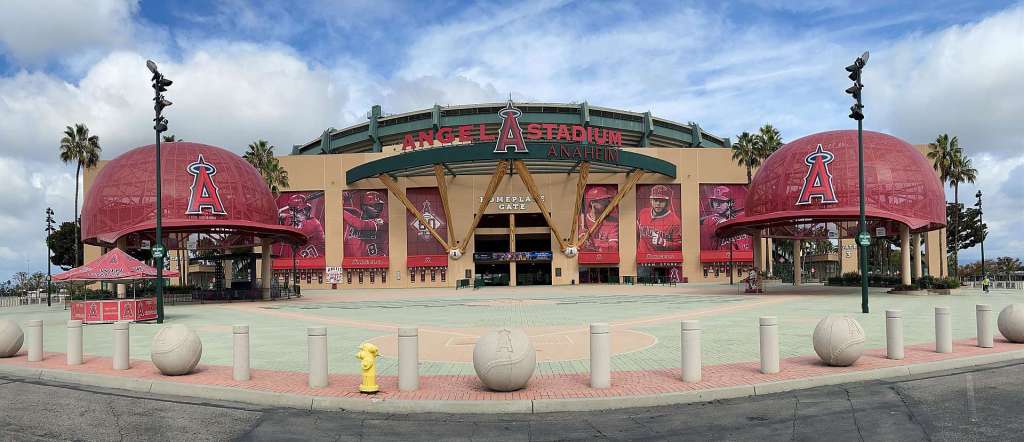
Parking At Angel Stadium
This is car country. Most fans drive or rideshare, but there’s a real train option for weekend games that’s worth knowing about, and the geography rewards a little planning either way.
Driving & Parking
Official stadium parking runs $25 for general and $35 for preferred when you buy in person ($27 and $37 online), with oversized-vehicle and bus parking at $100. The lots open two and a half hours before first pitch through three entrances — Douglass Road, State College Boulevard, and Orangewood Avenue — and they fill up on busy nights well before the game. Douglass Road is the most direct in and out; avoid exiting via State College, which backs up worst after the final out. To skip the postgame crush entirely, park deeper in the lot near the Orangewood side and eat the five-minute walk, or prepay a spot on an app like SpotHero ahead of time to lock in a rate. Buying a parking pass in advance through Vivid Seats or a similar service typically beats the drive-up price.
Rideshare
Uber and Lyft drop-off runs through the Orangewood/VIP entrance, and pickup is in front of Gate 1 near the City National Grove of Anaheim — look for the rideshare pole. Fares from around Anaheim and Orange County land in the low double digits, but they surge hard right after games. Either schedule your pickup ahead or walk a few minutes away from the stadium to catch a cheaper fare, because standing in the pickup zone at final out is how you end up paying triple.
Metrolink (Angels Express)
For weekend home games and select weekday games, Metrolink runs the Angels Express, a round-trip train that drops you right at the stadium — about $10 round-trip for adults, with kids under 17 riding free when they’re with a paying adult. The train pulls into ARTIC (the Anaheim Regional Transportation Intermodal Center) a short walk from the Douglass Road gate. It’s genuinely the least stressful way in for a weekend game if you’re staying near a Metrolink line, since you skip parking and the exit gridlock entirely. Check the schedule, though — it doesn’t run every game.
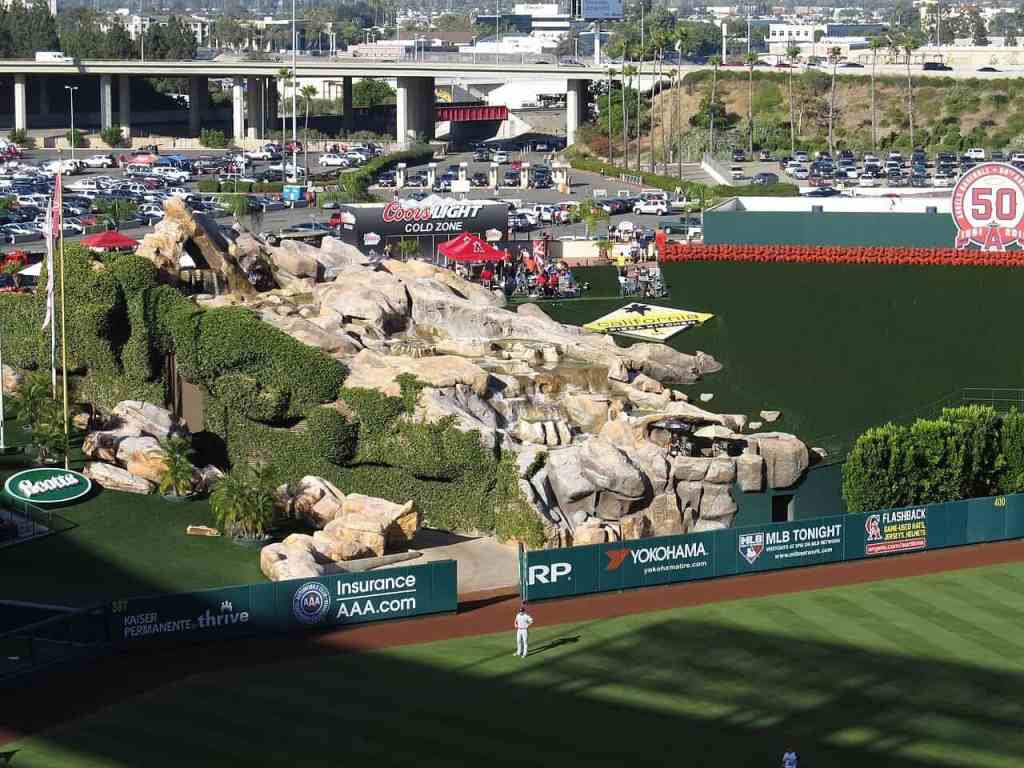
Insider Tips for Angels Stadium
Angel Stadium is an easygoing, family-first ballpark where the pregame scene happens across the street and the traditions lean charming rather than rowdy. It’s also a park in transition — new ownership, an unresolved question about the land it sits on, and a winter calendar that keeps the gates open long after the last out. Here’s what regulars know that first-timers usually don’t.
Did The Anaheim Angels Just Get Sold?
Yes. The Angels have a new owner and a good one. Just know nothing about the ownership change affects a game you attend this season or next. Kroenke Sports & Entertainment agreed in September 2026 to buy a controlling interest in the Angels from the Moreno family, ending Arte Moreno’s 23-year run, but the deal isn’t expected to close until the first quarter of 2027 and still requires approval from Major League Baseball. Terms weren’t officially disclosed; reporting put the valuation around $4 billion including the team’s regional sports network, which would top the record price the Padres sold for.
The lease is the reason you can plan a trip here without worrying. The Angels’ agreement with the City of Anaheim, which owns the stadium and the land, runs through 2032 with team options that extend to 2038. Whatever a new owner eventually wants to build, the Big A is hosting baseball for years yet.
The thing to watch is the parking lot, not the ballpark. Anaheim approved a $320 million sale of the stadium and its surrounding acreage to Moreno in 2020, then the deal collapsed in 2022 amid a corruption investigation that took down the mayor, and the land question has sat unresolved ever since. Kroenke is a real-estate developer first — SoFi Stadium and the district around Ball Arena in Denver are his — so the 150-odd acres of asphalt around the park are the interesting asset here.
If the team ever renames itself the Anaheim Angels, this is why. California’s “Home Run for Anaheim Act,” signed days before the sale was announced, requires the club to be referred to as the Anaheim Angels in official materials if the city grants a surplus-land exemption to sell or lease the stadium property. It’s a legislative nudge at a naming grievance that’s been running for 20 years.
The California Spectacular
The rock pile in left-center is called the California Spectacular, and it does more than sit there. Walt Disney Imagineering built it during the 1996–98 renovation, when the football seating that had enclosed the outfield for the Rams era came down and the mountain views came back. Recycled water runs down the rocks continuously; the geysers fire and the pyrotechnics go off for every Angels home run and before every game.
First-timers should know the blast means a homer before the ball lands. If you’re watching from the upper deck on the third-base side, you’ll see the flames go up a beat before the crowd noise reaches you.
The Big A and the Halo
The 230-foot “A” you see from the 57 Freeway is the stadium’s original 1966 scoreboard marquee. It stood behind the left-field fence until 1979, when it was moved out to the parking lot to make room for football. It’s the reason the whole place is nicknamed the Big A.
Drive past after a game and check the halo — if it’s lit, the Angels won. It works for road games too, so a lit halo on a night the team is in Seattle still means they took it.
Arrival Strategy
Gates open 90 minutes before a night game and 60 minutes before a 1pm start. Batting practice starts two hours out, which means for a day game you’re arriving after most of it is over — plan around that if BP is the point of showing up early.
The Home Plate Gate between the two giant red caps is the main entrance, but it’s the busiest. Gate 3 on the first-base side near Section 122 and Gate 2 on the third-base side near Section 114 both dump you onto the same field-level concourse with a fraction of the line. Gate 6 is the odd one out — it’s up in right field on the Terrace Level.
Park deep and walk. The lot opens two and a half hours before first pitch and the spaces closest to the gates go first, but the walk from the Orangewood side is five minutes and it’s the difference between rolling out after the game and sitting in a queue.
Tailgating in the Big A Lot
Tailgating is legal in exactly one place: the Big A Lot. Anywhere else in the stadium parking lot and you’ll be shut down. Only propane or gas grills with a fuel valve shutoff are permitted, and outside catering is banned outright.
Drinking in the parking lot is illegal, full stop. It’s an Anaheim municipal code violation, not a stadium house rule, so the tailgate here is food and shade rather than beers in the bed of a truck. Plenty of people get this wrong on their first visit.
Food & Drink Strategy
The helmet nachos are the signature order — get them once, then move on. For an actual meal, the rotisserie chicken behind Section 114 is a genuine step up from concession-stand food, and it’s on the same concourse as the field-level restrooms if you’re timing a between-innings run.
Bring your own food. One clear plastic bag no bigger than a gallon, individual portions rather than bulk, plus one factory-sealed clear bottle of water or sports drink up to a liter. Families do this constantly and nobody blinks at the gate.
The independent vendors outside the gates sell bacon-wrapped street dogs, and they’re better than the inside version. They’re cash-only because they sit outside the cashless perimeter, so keep a few bills in your pocket for the walk back to the car.
Sit-down spots exist if you know where to look. Official picnic areas are in the Gate 2 and Gate 3 courtyards and at the Centerfield Patio on the Terrace Level — useful if you’ve got a group and don’t want to eat balanced on your knees.
Exit Strategy
The escalators at Gates 1 and 4 reverse direction in the seventh inning. They run upward before and during the game, then flip to run down to speed the exit. Almost nobody knows this, and it beats the ramps if you’re coming down from the View Level.
Douglass Road is the fastest way out; State College is the worst. Park on the side you plan to exit from when you arrive, because the lot funnels toward whichever exit you’re nearest and switching sides afterward means crossing the whole lot on foot or in traffic.
The lot closes an hour after the event ends, so the “wait it out in the car” strategy has a ceiling.
Traditions and In-Game Culture
The Rally Monkey shows up on the board when the Angels are trailing late — a holdover from the Disney era that stuck, and the crowd genuinely responds to it.
Watch for the PAC-MAN Race. Fans get pulled from the stands, dressed as a blue ghost, and sent to outrace PAC-MAN on the field. It’s been running a few seasons now as part of the club’s partnership with Orange County–based Bandai Namco.
Noisemakers are banned, with one exception: team-issued Halo Sticks. Beach balls are worse than banned — inflating one or chasing it is grounds for ejection, which surprises people at a park this relaxed about everything else.
First-Timer Must-Do
Get in early enough to walk the concourse behind home plate on both the Field and Terrace levels. The 2002 World Series trophy sits just inside the team store entrance, and the walls on both levels are lined with exhibits on team and individual milestones. It’s a free walk through Angels history and it takes fifteen minutes.
Where to Take Photos
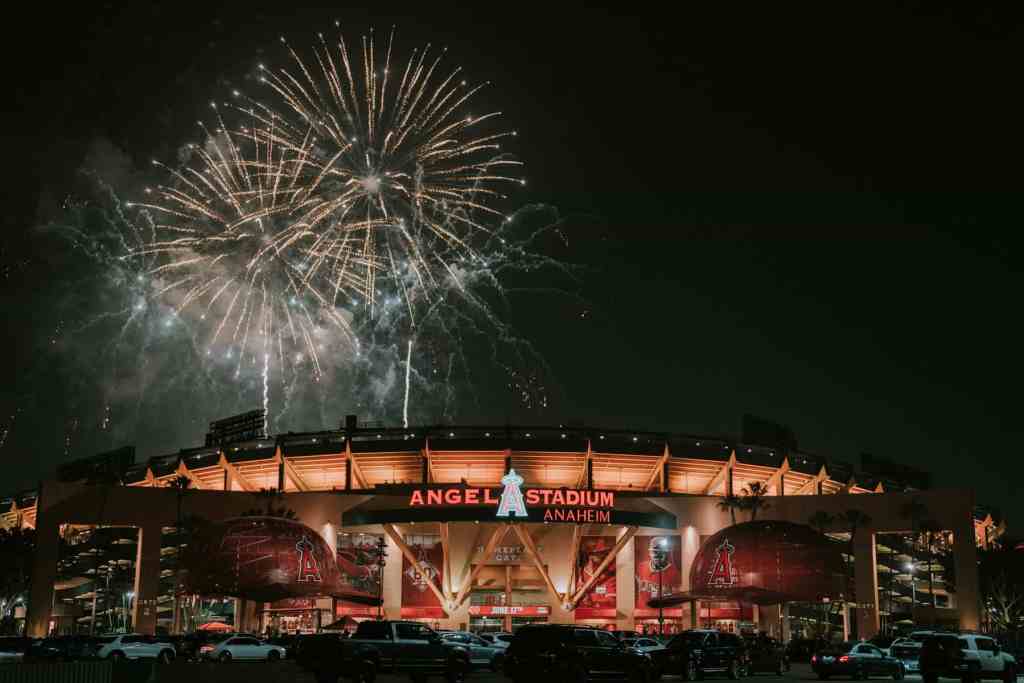
The two oversized red caps flanking the Home Plate Gate are the arrival shot and the one everyone recognizes.
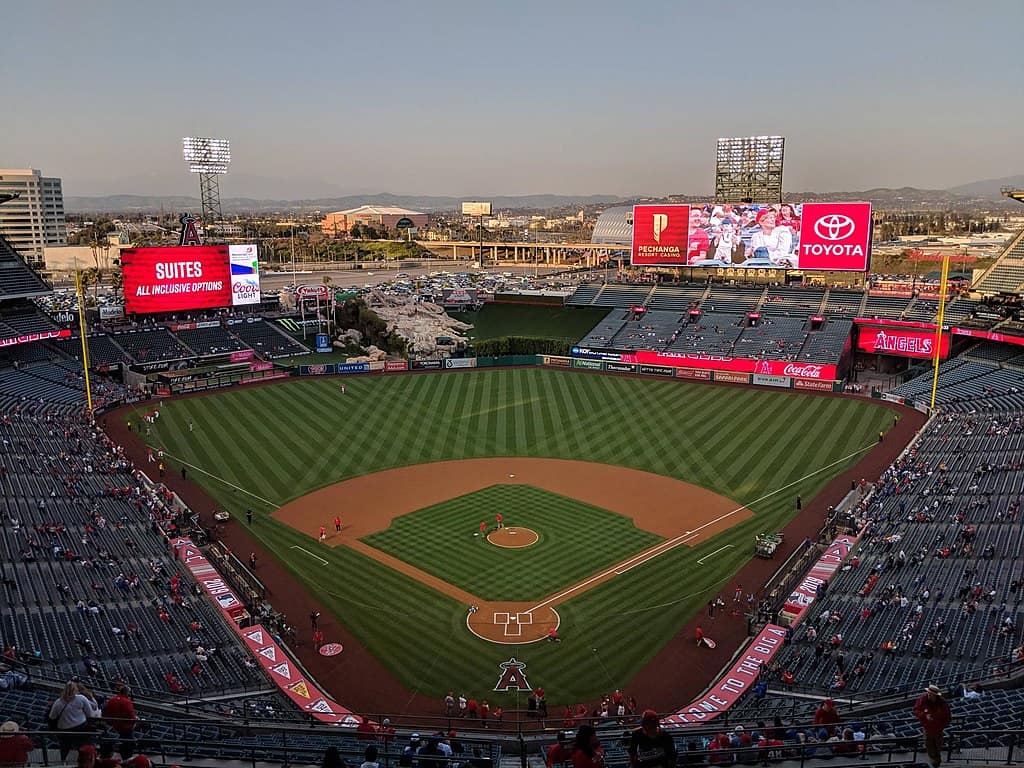
For the field, shoot from the Terrace concourse behind home plate during the golden hour before a night game — you get the full bowl with the rock pile in frame and the San Gabriels behind it on a clear day.
Families and Kids
Kids Run the Bases happens after the game on select Sundays for ages 3 to 13. Line up at the Gate 4 Courtyard; kids must run on their own without an adult, no cleats, no sliding, and they run once and exit. Junior Angels Kids Club members get preferred access by showing their membership wristband, which is worth knowing if you’re going to be there more than once.
The Level Up arcade in the Right Field Pavilion near Section 240 is free to play. World’s Largest PAC-MAN, PAC-MAN Battle Royale Chompionship and 30-plus classics like Galaga and Dig Dug all cost nothing with a game ticket — it was the first arcade of its kind in an MLB ballpark. The Gashapon capsule-toy machines next to them do require tokens, so that’s where the “free” ends.
PAC-MAN Chomp Stop opened next door in 2026 and is the only place in the park serving pineapple soft serve in a collectible PAC-MAN helmet.
Quiet rooms are available at Section 101 and in the Guest Relations office near Section 133 — calming lights, low noise, tactile toys, and staff monitoring them. Nursing suites are in the same two locations, and family restrooms are at Sections 107, 132, 312 and 340.
Strollers are fine if they collapse and fit under your seat. Anything bigger gets checked at the nearest Guest Relations desk rather than turned away.
Autographs and Player Access
Position along the foul lines and near the dugouts during batting practice, which starts two hours before first pitch. Because gates open 90 minutes out, you’re arriving into the back half of the window — get to your spot immediately rather than exploring first.
Bring your own ball and something flat to sign, plus a marker. The good rail positions fill within minutes of the gates opening.
Note that the ballpark tours don’t help here. Pregame tours include batting practice viewing, but autographs and photos are explicitly prohibited on them.
Merch and the Team Store
Skip the main shop behind home plate and use the smaller stores scattered around the concourses. Same caps and jerseys, a fraction of the line, especially in the two innings after the game ends.
The App and Ticket Logistics
Everything runs through the MLB Ballpark app and there is no way around it. Entry is mobile-only, screenshots of your ticket are rejected at the gate, and there is no will call window — so load your tickets and, ideally, add them to your phone’s wallet before you leave home.
In-seat food ordering exists but only for premium tickets — the Lexus Diamond Club in Sections 114–122 and the Club Level in Sections 309–343. Everyone else walks.
Free Wi-Fi is on the “AngelStadiumWiFi” network, which matters more than usual at a park where your ticket lives on your phone.
Venue Quirks
The park is cashless everywhere, including the parking booths. Reverse ATMs that turn bills into prepaid debit cards are at four spots: the Advanced Ticket Windows across from the Diamond Club on Field Level, Section 133, Section 237 and Section 418.
Both bullpens sit behind the wall in left field — the Angels’ pen closer to the Left Field Pavilion, the visitors’ tucked right behind the fence. If watching relievers warm up is part of the appeal, that’s the side to sit on.
There’s no bag storage anywhere on the property and no re-entry. Anything that fails the size rules goes back to your car, and once you’re out, you’re out.
The foul poles and the yellow screens attached to them are in fair territory — a ball off either one is a home run. It comes up more than you’d think.
Aerosol sunscreen is prohibited, which catches people out at a park where the sun is the main thing you’re planning around. Bring the lotion kind.
Monster Jam and the Offseason
Monster Jam runs at Angel Stadium every winter and it’s the biggest non-baseball draw of the year. The trucks lay a dirt track over the infield, which means the lower-bowl infield sections that are merely good for baseball become the best seats in the building, and the View Level ends up a long way from the action. Recent years have brought both a December weekend and a January or February date, so check the schedule rather than assuming one window.
Buy the Pit Party add-on if you’re bringing kids. It opens roughly four hours before showtime and puts you on the floor with the trucks and drivers — it’s the part people remember, and it’s a separate purchase from the event ticket.
The Behind-the-Scenes tour is the best-value thing at this ballpark and it runs year-round. Around $26 for adults and $22 for kids, seniors and military, it takes you down to the field, into the Angels dugout, through the visitors’ clubhouse, and up to the Gene Autry Suite and the broadcast booth — 75 to 90 minutes, and parking is free on non-game days. Tours run on select days the team is on the road, so the offseason is the easiest time to get on one.
Ticket windows close entirely during the offseason, so tours, Monster Jam and anything else in the winter are online-only purchases.
Expect a quiet Hot Stove. Baseball’s collective bargaining agreement expires December 1, 2026, and both the league and the players’ union have said publicly that a lockout is the likely outcome. A lockout freezes trades and signings but does not touch stadium events — Monster Jam, tours and concerts run regardless. If it drags into February or March, the 2027 season opener is what’s at risk, so hold off on booking travel around Opening Day until there’s a deal.
Things to Do Nearby
Disneyland and Disney California Adventure are five minutes away and are what most out-of-towners are really in Anaheim for.
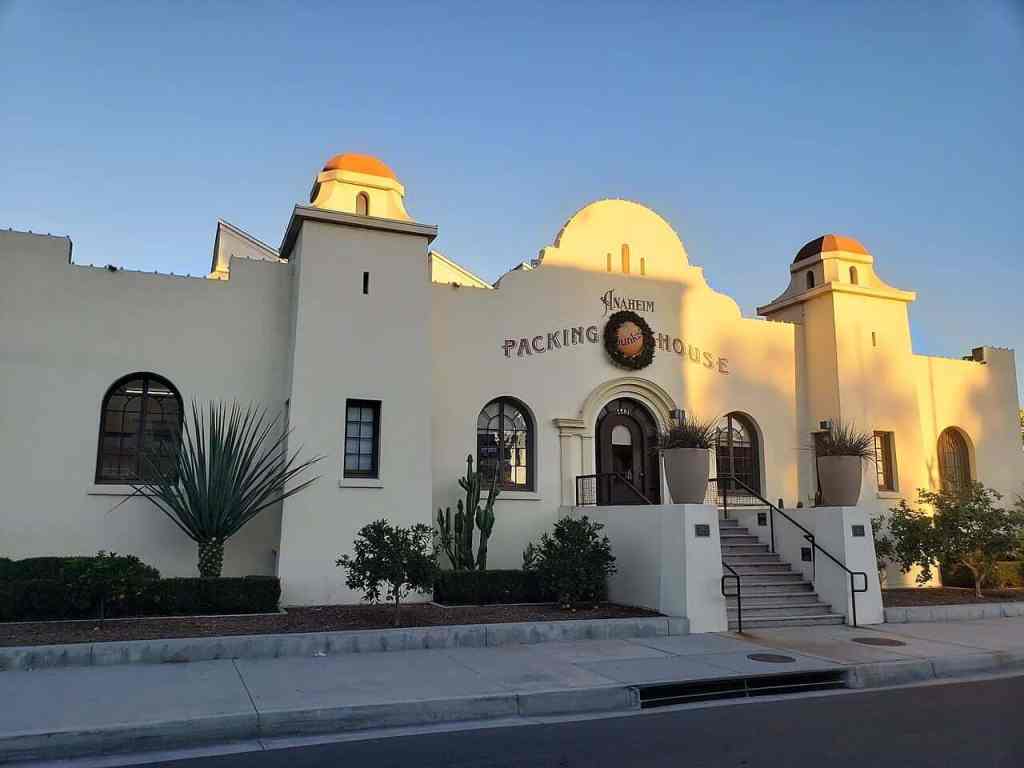
The Anaheim Packing District is the best non-theme-park afternoon in town — a restored 1919 citrus warehouse about four miles out, now a food hall with a couple dozen vendors and bars under one roof.
Knott’s Berry Farm covers a second coaster day, and Huntington, Newport and Laguna are all a short drive when you want sand instead of crowds.
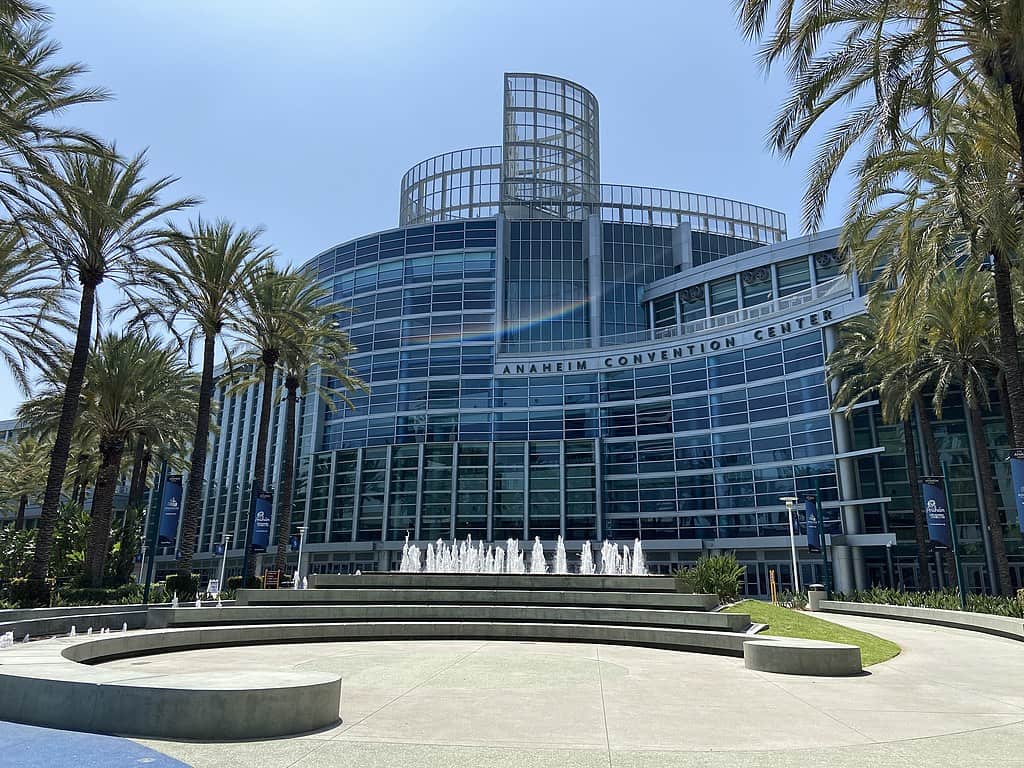
Hotels Near Angel Stadium
Anaheim is built for the Disneyland crowd, which means a deep bench of mid-range chains with pools, free breakfast, and easy freeway access. For a baseball trip, the move is to stay close enough to walk to the game or hop the train, and the cluster right around the stadium and the ARTIC station handles that better than the Disneyland-side hotels. Weekend Disney crowds can tighten availability, so book a week or two out for a Saturday game.
Best Areas to Stay
The Douglass Road / State College corridor right by the stadium and ARTIC is the target for a pure baseball trip — you can walk to the game or catch the train, and you’re next to the Honda Center too. The Katella Avenue corridor between the stadium and Disneyland (roughly two miles) is the pick if you’re mixing baseball with the parks: safe, loaded with chain restaurants, and a 5–15 minute drive or rideshare from everything. Stick to recognizable brands along Katella and skip the older motels farther east, where quality drops off fast.
Hotel Recommendations
The TownePlace Suites by Marriott Anaheim Maingate is the closest walkable hotel to the stadium — a recently renovated all-suite property with full kitchens, free breakfast, an outdoor pool, and a 5-to-10-minute walk to the gates on sidewalks the whole way. It’s the pick if you want to skip parking entirely and walk to the game. The Ayres Hotel Anaheim is a notch nicer (complimentary buffet breakfast, pool and hot tub) and sits directly across from ARTIC, so you can take the train or walk under the freeway to the lot — the walk is a touch longer and less pedestrian-friendly than the TownePlace, but the hotel itself is the better-rated stay. The Embassy Suites by Hilton Anaheim Orange offers two-room suites and cooked-to-order breakfast within about half a mile, though the walk to the game crosses State College and the main parking entrance, so plan to rideshare. For a Katella-corridor base that splits the difference between baseball and Disneyland, the Hampton Inn & Suites Anaheim Resort Convention Center is a reliable chain about a mile and a half out with free breakfast and solid service.
Budget Options
The Ayres Hotel Orange, slightly farther out, delivers the same Ayres quality — breakfast buffet, clean rooms, strong reviews — usually at a lower rate than the Anaheim location, and it’s a short drive to the stadium. For true bottom-dollar, the cluster of national-brand budget inns along Katella toward the Convention Center will get you a clean room and freeway access; you’re trading walkability and polish for price, but for a fans-who-just-need-a-bed weekend they do the job.
Bars and Restaurants Near Angel Stadium
The pregame culture here happens across the street, not inside a downtown bar district — Angel Stadium is surrounded by parking lots and freeways, so the breweries on Orangewood and the nearby taprooms serve as the unofficial pregame headquarters. The play is to park or grab a beer at one of these, then walk over, which saves you the parking fee and some of the exit traffic.
Best Pregame & Postgame Bars
Golden Road Brewing sits practically across the street from the stadium and is the high-energy fan hub — a big, dog-friendly patio with yard games and umbrellas, 30-plus taps brewed onsite, and a full kitchen. Expect crowds on weekends and big matchups; the parking fills early, which is exactly why walking from here works. Noble Ale Works is the local insider pick, a 2011-vintage microbrewery about a ten-minute walk out that’s less mobbed than Golden Road, with a serious hop-forward lineup (Big Whig IPA, Naughty Sauce) and a laid-back tasting room — the spot to go when you want good beer without the crush.
Karl Strauss Brewing Company nearby is the classic brewpub option, reliable American bar food and house ales, a good fallback when Golden Road is slammed — and regulars report it’s a parking hack too, since it’ll typically apply your lot fee to your tab if you eat there before walking over (worth confirming when you park, as these arrangements change). JT Schmid’s Restaurant & Brewery is the sit-down choice — a full menu of steaks, pizza, and pasta with house brews, closer to the Honda Center, better for an actual dinner than a quick pint.
Best Restaurants in the Area
Beyond the gameday breweries, the Anaheim Packing District is the best eating in town for visitors — a food hall in a restored citrus warehouse with a rotating cast of vendors and bars, worth the short drive for a pre-game meal with more range than the concourse. For the wider Anaheim craft-beer scene, Brewery X on La Palma has grown into one of the city’s biggest names, with a full kitchen and a packed events calendar, and Bottle Logic Brewing is the destination for barrel-aged stouts and inventive small-batch pours. If you’re staying Disneyland-side, Ballast Point at Downtown Disney is the most convenient craft option without leaving the resort.

Why You Should Go
Angel Stadium isn’t flashy, and it isn’t trying to be — it’s one of the most honest, affordable baseball experiences left in California. The upper deck is closer than most parks, you can bring your own food, the sightlines are clean from foul pole to foul pole, and watching the rockpile erupt while the Big A lights up at sunset is pure Southern California. If you want baseball without the theme-park pricing that surrounds it, sit in the shade on the Terrace Level, grab a beer across the street first, and enjoy a real ballpark that still feels like one.
Explore all of our baseball guides as well as these Southern California staples:
Petco Park and Dodger Stadium.
Crypto.com Arena and the Intuit Dome
The Rose Bowl and the L.A Coliseum
Written by Brad Richards. Founder of Gameday Guides. This guide includes insights from personal visits as well as updated info from team sources, fan forums, and stadium policies. We aim to help you plan with confidence — enjoy your gameday. If you have any tips, if we missed anything or you have a question, don’t hesitate to shoot us an email.