


Heading out on an SEC road trip? Explore all of our College Football Travel Guides
Best Seats At Texas Football Games
DKR Texas Memorial Stadium seats 100,119 and is the fourth-largest stadium in college football. The atmosphere on game days is legitimately electric—”Texas Fight” and “The Eyes of Texas” echo through downtown Austin, and the entire city shuts down for Longhorns football. The concourses get packed, parking is a disaster if you don’t plan ahead, but the sightlines from the lower bowl are genuinely great and the stadium atmosphere is one of the best in the country.
Seating Overview
The Texas sideline is the west side, backed by the tall bulk of Bellmont Hall; the visitor sideline is east, and the student section, the Longhorn Band and Bevo all live in the south end zone. The single most useful thing to know before you open a seating chart: the overwhelming majority of DKR is bench seating, not chairbacks, so two tickets at identical prices can buy wildly different afternoons.
The north end zone — the Red McCombs Red Zone — faces the enormous south videoboard head-on, which is why it punches above its price. Elevation matters more here than at most stadiums, because the lower rows sit close enough to the field that you lose the far sideline.
Best Non-Premium Seats
The west sideline lower bowl, between the 30s. Best sightline, best sound, home sideline, and the side that gets shade first. It’s also the priciest non-premium ticket at DKR and the first to sell for SEC games. Check the listing for chairbacks before you buy — a few west sideline sections have them, most of the stadium doesn’t.
The north end zone lower bowl, mid rows. You look straight down the field at the south videoboard, so you never turn your head for a replay. Sit above roughly the first fifteen rows; below that the field flattens and you lose the far 20. Shortest lower-bowl walk to the Hall of Fame and Smokey’s Midway.
The upper deck sidelines, low rows. Elevation is DKR’s friend — you read route concepts and coverage rotations that row 8 never sees, with the UT Tower behind it all. What you give up is noise, which lives in the lower bowl.
Best Value Seats
The east sideline lower bowl. Same geometry as the west side for consistently less, because Texas fans want their own sideline. The catch is sun: this is the last side to lose it, so it’s a bargain in November and a mistake at 2:30 in September.
The north end zone upper deck, front rows. Head-on videoboard from a height that shows the whole field, well below lower-bowl pricing, and a short walk to the Gate 8 and Gate 25 exits — which matters when 100,000 people leave at once.
Budget / Cheapest Way In
The upper deck end zones. High, behind the play, and on a clear night the Tower view earns back part of the ticket. You’re on aluminum for three and a half hours, and the metal holds heat long after the sun drops.
Upper corners, bought late in the week. Texas is a donor-gated season ticket market, so upper-deck inventory gets dumped onto resale by people skipping a non-conference game, and it softens in the last 72 hours. Worst geometry in the stadium for the lowest price of the week.
Our Pick
North end zone lower bowl, above the first fifteen rows. Videoboard head-on, band and student noise rolling toward you from the far end, shortest walk to the pregame — for less than the west sideline costs.
Heat & Shade at DKR
Buy west, and buy high. Bellmont Hall shades the west stands well before the east side loses the sun, and the east side stays in it almost the entire way through an afternoon kickoff. Row height buys more shade than section number does, so in September take high and under the overhang over low and close every time.
What to Avoid (and What’s Worth Trying Once)
The upper deck corners. You pay for elevation, then throw the benefit away sitting at a severe angle. Too far to feel it, too angled to read it. If corners are all that’s left for a game you don’t care about, watch it from a bar on Sixth Street.
The lowest rows behind the team benches. Coaches, photographers, medical staff and a rotating wall of very large athletes stand between you and the field. Close to football, not much football.
Lower-row east side bleachers for an early-season day game. Aluminum bench, direct sun, three and a half hours, Austin in September. The most common first-timer mistake at DKR, and the seats aren’t priced like one.
Worth it once: the south end. Students, band and Bevo are down there and it’s loud in a way the rest of the building isn’t. Ordinary sightlines, and you’ll stand the whole game whether you planned to or not. Go once. Don’t take your parents.
Premium Seating & Clubs at DKR
DKR has an unusually deep premium tier for a college stadium, spread across three sides of the building — the west (Bellmont Hall), the north end zone (Red McCombs Red Zone) and the east (Reese M. Rowling Hall). Most of it requires Longhorn Foundation membership rather than just money, which catches out-of-town buyers off guard.
The Best Premium Experience
The eighth-floor club above the north end zone. Currently branded the Touchdown Club, it’s a sprawling indoor hospitality space with outdoor chairback seating looking straight down the field from the north end — which means you get the videoboard, the full length of the field, and air conditioning ten steps behind your seat. That combination of head-on sightline and indoor refuge is the reason this is the premium space to pick at DKR in September. Entry is via the Red McCombs Red Zone gates, and access is tied to the ticket.
Best Value Premium
The fifth-floor club in Bellmont Hall on the west side. This is the one we’d actually buy. Currently the Ricoh Stadium Club, it sits on the home sideline with a full cash bar and a gameday buffet available for purchase through the start of the fourth quarter, and it costs a fraction of what the suites and the all-inclusive spaces do. You are paying for a seat on the best side of the stadium plus somewhere cool and civilized to stand — not for free food you won’t eat. For anyone attending one or two games a year who wants the sideline without the sticker shock, this is the pick.
Other Premium Options
The sixth-floor concourse of the north end zone holds two tiers worth knowing: the Terrace Club, tied to the chairback sections directly in front of it, and the Longhorn Lounge on its east side, which is an open-air lounge with upscale food and a bar available for purchase — a real hangout rather than a corporate box. The seventh floor of Rowling Hall on the east side houses the Tito’s Texas Club, with indoor hospitality and outdoor chairbacks between the 20s. The ninth floor of Bellmont Hall contains the Centennial Suite, a climate-controlled indoor room with chairbacks, TVs and private restrooms. Sponsor names on these change with the deals; the floors and sides don’t.
The 2021 south end zone build added its own club tier, and it comes with a warning: the seats down there often look half empty on television because ticket holders spend the game in the indoor lounge or on the field-level standing patio rather than in their seats. It’s a genuinely luxurious way to watch a game. It is not a loud, seated, traditional stadium experience, and if that’s what you flew in for, buy in the lower bowl instead.
Suites & Group Options
Suites sit on all three built-up sides, with dedicated entrances at Gate 5 on the west, between Gates 27 and 28 on the east, Gate 16 in the north end zone, and Founders Suite entrances outside Gates 1 and 32. They’re sold through the Longhorn Foundation rather than the ticket office, and pricing scales hard with opponent — an SEC headliner is a different market from a September non-conference game. Groups without suite budget should look at REVELxp, which runs the turnkey reserved tailgates on the LBJ Lawn.
For information on how to get premium seats to Longhorn games check out their website.

DKR Texas Memorial Stadium Seating Chart
DKR-Texas Memorial Stadium holds 100,119, which makes it one of only a handful of 100,000-seat stadiums in the country and among the largest in the SEC. The attendance record is 103,507, set on September 15, 2018 against USC.
Here is the Interactive Seating Chart to Texas Football Games.
Tips for Getting Texas Longhorn Football Tickets
Texas season tickets require active Longhorn Foundation donor status and a waitlist, so the public path is single-game inventory, which goes on sale in the summer when it’s available, plus the resale market. SeatGeek is UT’s official ticket marketplace, which matters here more than at most schools: season-ticket holders transfer and resell through it, so the released inventory shows up there first and cleanly.
As a rule, prices soften midweek for non-conference games and never soften at all for the SEC headliners — those price like postseason games from the day the schedule drops, and waiting costs you money. Vivid Seats (see below) also carries Texas games alongside most other Austin events if you’re building a weekend around more than football.
Get Texas Longhorns Tickets Here! Vivid Seats has tickets to Texas Longhorn games and just about any event going on in Austin from ACL to the F1 race to events at the Moody Center.

DKR Texas Memorial Stadium Bag Policy
DKR runs a strict clear bag policy, branded “Steer Clear,” and it’s enforced at the gate with no bag storage on site. You may bring a clear plastic, vinyl or PVC bag up to 12″ x 6″ x 12″, or a one-gallon clear resealable storage bag. Purses and clutches do not have to be clear, but they must be smaller than 4.5″ x 6.5″ — roughly wristlet size, and this is the rule that catches the most people. Anything bigger has to be clear.
Prohibited: backpacks, grocery totes, mesh or straw bags, duffels, camera and binocular cases, and diaper bags. Note that last one carefully — diaper bags themselves are banned, and the contents have to go into a clear bag instead. You can carry binoculars or a camera around your neck without a case, and a blanket over your arm.
Key Stadium Policies
It’s fully cashless. Every concession, merchandise and parking transaction takes cards or mobile wallet only. Cash-to-card kiosks are in the Hall of Fame and at Gate 7 if you show up with bills, and there are ATMs at Gates 1 and 7 and Section 107 on the west, the Gate 8 plaza in the north, and Section 28 on the east.
There is no re-entry. Once you scan in, you’re in for the day. Do your pregame before you enter, not halfway through the second quarter.
Your gate is assigned. Mobile ticketing is the only option, no screenshots, and the gate printed on your ticket is the gate you use. Download tickets to your phone’s wallet before you leave the hotel — cell service around the stadium degrades badly as the crowd builds.
Also worth knowing: the entire UT campus is tobacco-free, including vapes and including the parking lots. Alcohol sales stop at the end of the third quarter, two drinks per transaction. Umbrellas, strollers and artificial noisemakers are all prohibited.

UT Football Parking and Getting To DKR
Don’t drive to this one if you have any alternative. DKR sits in the middle of a university campus with traffic control points and one-way street conversions that kick in at 5 a.m. on gameday, and public parking near the stadium is genuinely scarce. Walking from downtown or a hotel near campus is the best option here, and it’s not close. Or having a Uber/Lyft/Waymo drop you near enough to walk.
Parking at DKR
Almost all lots and garages within walking distance of DKR are reserved for Longhorn Foundation permit holders, who qualify by donating at least $250 in football seat gifts. What’s left for the public is small and specific: the Health Center Garage, Lot 15, and Lot 18/92, all paid and all bookable in advance through ParkMobile. Lots open at 7 a.m. on a normal gameday and 6 a.m. for an 11 a.m. kickoff, and towing on restricted streets starts at 12:01 a.m. Street parking near campus effectively does not exist on a Saturday.
The parking hack most visitors never find: the Texas Facilities Commission state garages. The state of Texas rents out its downtown employee garages on football Saturdays through its Texas Tailgate reservations program — State Garage F at 14th and San Jacinto, State Garage Q near 1607 San Jacinto, and others. They’re a fifteen-to-twenty-minute walk from the stadium, they’re not on any UT parking map, and they’re cheaper than the private lots the tailgate crowd fights over. Book ahead through the TFC site.
The other move locals make is renting a driveway. Residents in North and West Campus list private spots and driveways through Prked, SpotHero and ParkWhiz on gameday. They’re usually cheaper than the official garages, they’re a shorter walk than the state garages, and — the real advantage — you’re not spiralling down four levels of a packed garage behind 800 other cars afterward. Book a few days out; the good ones near campus go early.
Whatever you do, do not let your GPS put you on I-35. Out-of-towners get routed onto the interstate by default and it’s a parking lot for miles in both directions well before kickoff. Come in on MoPac and cut across on Enfield to 15th Street instead, and leave an hour earlier than the map says.
If you’re bringing an RV or an oversize vehicle, State Lot 26 at 701 W 51st St takes them for a flat fee on a first-come basis with no reservations, and UT runs a free round-trip shuttle from the UT Athletics Fields across Guadalupe St. to the stadium. There are no hookups, water or restrooms out there — plan accordingly.
Public Transit to DKR
CapMetro runs enhanced service on gamedays with several routes converging on campus, and fares are low. It works well if you’re staying downtown or along a major corridor, and it sidesteps the entire parking question. UT students, faculty and staff ride free with a valid UT ID. Check the CapMetro app the week of the game — gameday routing and stop closures shift with the road closures around the stadium.
Rideshare at DKR
Use the official rideshare zone: UT designates an airport-style pickup and dropoff on the south curb of Dean Keeton between Robert Dedman Dr. and Red River St., signposted from the surrounding streets. Getting there is straightforward. Getting out is where people lose an hour and forty dollars.
The postgame move is to walk north or east first, then request. The area immediately around the stadium becomes a geofenced surge zone the moment 100,000 people reach for their phones simultaneously, and San Jacinto flips to one-way southbound after the game, so drivers can’t reach you the way they came in. Ten minutes of walking north past Dean Keeton or east toward the I-35 frontage puts you outside the worst of it, at a normal fare, with a driver willing to accept the trip. Walk up to wear Crown and Anchor bar and the Posse are. Get an uber around there.
Walking to DKR
From downtown — Sixth Street, Congress Avenue, the Capitol — it’s a twenty-to-thirty-minute walk, mostly uphill on the way there and pleasantly downhill on the way home. From West Campus it’s fifteen. This is the reason to stay central: on gameday, walking is not the budget option, it’s the fast one.

Texas Football Gameday Insider Tips
Texas gamedays have been rebuilt from the ground up over the last several years, and if your last visit was before Bevo Blvd, you’re walking into a different event. There are five free pregame zones surrounding the stadium, none of which require a game ticket, and the concessions inside are priced better than almost anywhere in college football. Here’s how to work the day.
Bevo Blvd & the Free Pregame Zones
All five pregame areas are free and none require a game ticket. Bevo Blvd, Longhorn City Limits, Smokey’s Midway, Hook ‘Em Hangout and Big Bertha’s Bazaar are open to anyone who shows up. If you have friends in town without tickets, this is a full afternoon on its own.
Bevo Blvd takes over San Jacinto Blvd from 20th St. to the Etter-Harbin Alumni Center. It opens several hours before kickoff with food, live music, the Longhorn Band, and drink prices well under what you’ll pay inside. Get there early; the closer to kickoff, the more it’s a shuffle.
Line up on Bevo Blvd near Gate 1 about three hours out for the Bevo parade. The street clears and Bevo XV walks in with cheerleaders, band members and the team. It’s the photo everyone wants and the moment the day’s energy actually turns on.
Longhorn City Limits is a genuinely good free concert on the LBJ Lawn. The bookings have included Ludacris, Nelly, Zach Bryan and Tanya Tucker. Tito’s Tailgate sets up by the LBJ fountain for the 21-and-over crowd, and Pinkerton’s BBQ serves on the lawn every gameday.
Take the kids to Smokey’s Midway on DeLoss Dodds Way. Carnival games, a 90-foot slide with a view of the UT Tower, Fletcher’s Corny Dogs, and free entry — plus it’s the walk-in route to the Hall of Fame.
Arrival Strategy & Gates
Gates open two hours before kickoff. UT students holding Big Ticket packages get in three hours early at Gate 25. Ticket resolution opens earlier still — Gate 8’s box office is live four hours out.
You must enter at the gate printed on your ticket. This is the biggest change from a few years ago, and the old advice about picking a faster gate no longer applies. Check your assigned gate before you leave the house so you approach the stadium from the right side.
Download your ticket to your phone’s wallet at the hotel. No screenshots are accepted, and cell service in the crowd outside the gates gets unreliable at exactly the moment you need it.
Food & Drink Strategy at DKR
Fan First Pricing is real and it’s the best concession deal in the SEC. Around fifteen items sit at an average 30% discount all game long — not a first-quarter promotion, all game. Select stands also run $5 and $6 12-ounce beers. You don’t need to smuggle anything in.
Use the renovated west interior concourse stands on the ground floor. They were rebuilt with grab-and-go and self-checkout, which means they clear a line at a completely different speed than the older stands elsewhere in the building. Worth the walk at halftime.
The four in-stadium bars are the best-kept secret at DKR. The Tito’s Lounge at Gate 8, the Bulleit Frontier Lounge on the 6th floor near Section 14, the Bud Light Back Forty at Gate 25 and the Dulce Vida Tequila Bar at Gate 32 are 21-and-up spaces that are dramatically less chaotic than the main concourse. Craft cocktails on tap, and somewhere to stand that isn’t a stairwell.
Skip the halftime rush entirely. Go with about four minutes left in the second quarter or wait until three minutes into the third. The concourses at DKR are narrow for a stadium this size and halftime is when that shows.
Beating the Austin Heat
Freeze a sealed liter bottle of water the night before. One factory-sealed plastic bottle up to one liter is permitted per person. Frozen, it survives to the second half.
Find the water monster nearest your section before kickoff, not at halftime. There are sixteen free refill tanks around the stadium and they aren’t marked on the concourse map — ask an usher when you sit down and you’ll know where to go when you need it.
The four cooling stations are near Sections 32, 106, 118 and 124. St. David’s staffs them with fans and cooling towels, free. If you’re in the upper deck on a September afternoon, memorize the closest one.
Wear something you can sit on. Aluminum bench in direct sun gets genuinely hot to the touch, and it stays hot after the sun goes behind the deck.
Know where the first aid station is if you’re bringing anyone vulnerable to heat. St. David’s staffs full stations at Sections 1 and 105 on the west, Sections 32 and 127 on the east, and Sections 13, 18 and 117 in the north end zone, with EMTs in blue vests posted near the portals in between. For older visitors, pregnant fans or anyone who’s had trouble in heat before, that’s real peace of mind — and it’s a lot faster than trying to find help from your seat.
Stadium Traditions & Culture
Learn Hook ‘Em Horns before you get there. Index and pinky extended, middle fingers held down by the thumb. A hundred thousand people throw it up at once during “Texas Fight” and it’s an odd feeling to be the only one who doesn’t.
Smokey the Cannon fires on kickoff and after every Texas score. It lives in the southeast corner and it is loud in a physical way. If you’re sensitive to concussive noise — or bringing a small kid — don’t buy the low rows nearest to it.
Stay for “The Eyes of Texas” after the game. The team lines up in front of the student section and the whole stadium sings it together, win or lose. Leaving before this is the mark of someone who doesn’t know where they are.
Look up at the UT Tower on the walk back. After a Texas win it’s lit burnt orange, visible from most of the north side of campus. It’s the best free thing you’ll see all day.
Bringing Kids to a Texas Game
Sign kids ages 7–12 up for the Hook ‘Em Herd. It’s a pregame fun run on the field just before the team takes it. Signups open at the tent on Bevo Blvd just south of Gate 1, first-come, first-served, and both the kid and the guardian need game tickets. Free wristband and t-shirt.
Kids under two are free if they’re held. No ticket required as long as they don’t occupy a seat.
Strollers are prohibited inside the stadium. Plan on carrying, and remember the diaper bag itself is banned — pack the contents in a clear bag.
Smokey’s Midway is the kid answer for the pregame. Free carnival games, the big slide, and it’s the one part of the day that doesn’t require standing in a beer line.
Photo Spots & the Signature Shot
The Longhorn logo in the south end zone seats. Get in early, before the section fills, and shoot from the opposite end or the upper deck — once the students arrive it’s gone for the day.
The Bevo parade on San Jacinto, three hours out. The one photo that says you were in Austin rather than at a football game.
The UT Tower from the top of Smokey’s Midway slide. Ninety feet up, and better than any ground-level angle you’ll get on campus.
Austin City Limits Music Festival and the F1 Race in the Fall
Sometimes game weekends will coincide with the F1 race at the Circuit of Americas in October and ACL festival. Its a glorious time to be in Austin, but if its the weekend of the game you want, book early. I can’t emphasize this enough.
Merch, the Hall of Fame & the Team Store
You don’t need a ticket to buy merch. The Nike tent on Bevo Blvd south of Gate 1, the West Team Shop outside Gate 6, the shop at Moody Center, pods outside Gates 2A and 8, and trailers by Gate 25 all operate before the gates open. All cashless.
Inside, the upper-deck stores at Sections 105, 117 and 129 are far calmer than the lower-bowl locations at Gates 1, 6 and 8. Same stock, a third of the crowd.
The Frank Denius Family Hall of Fame is free and open on gamedays. It’s inside Gates 14 and 16 in the north end zone, accessible from Smokey’s Midway before you scan in and from the interior concourse afterward. The original Smokey the Cannon is in there.
If you want to get Longhorn gear before gameday, check out our partner Fanatics. They have pretty massive selection and it may be a bit cheaper than the team store.
Exit Strategy
Don’t go straight to your car. Traffic around campus is gridlocked for the better part of an hour, the one-way streets reverse direction postgame, and you will sit in it. Walk to a bar, wait 40 minutes, drive home in ten.
If you’re walking to downtown, head south on foot immediately — pedestrian flow moves fine even when vehicles don’t, and you’ll be on Sixth Street before the parking garages have emptied a level.
Tailgating at Texas
Tents and setups go up from 7 a.m. Open tailgating is permitted in the yellow-marked spaces on UT’s published gameday map; permit holders in the purple surface lots can tailgate in those.
REVELxp runs the reserved tailgates on the LBJ Lawn — the only way into the red zones on the map. They handle tents, tables, TVs and catering, and no open-flame cooking is allowed in those spaces.
Move your car before Friday night if you park on campus regularly. UT clears a long list of lots and streets by 11:59 p.m. Friday and tows starting at midnight.

Texas Longhorns Gameday: The Austin Scene
Austin doesn’t do gameday like the rest of the SEC. There’s no single tailgating field that swallows the city — the day splits across a few distinct districts, and which one you pick largely decides what kind of Saturday you have.
The tightest ring is the campus bars, everything within a fifteen-minute walk of DKR. This is where people who actually intend to make kickoff drink, and it’s the oldest scene in town: Scholz Garten sits between the Capitol and campus, with Posse East and Crown & Anchor just north of the university. The rhythm most fans follow is a couple of hours at one of those, then Bevo Blvd, then the gates. West Campus, up around Guadalupe — “the Drag” — and 24th Street, is the student version of the same thing: cheaper, louder, younger.
Sixth Street and downtown is twenty to thirty minutes south on foot and it’s where the night goes after the game. Live music in historic storefronts, packed sidewalks, rooftop patios, and a crowd that’s half Longhorn fans and half people who have no idea a game happened. It’s chaotic and touristy in the way it’s supposed to be. West Sixth is a bit more laid back vibe and fun as well.
Rainey Street, southeast of downtown, is the grown-up alternative — a block of century-old bungalows converted into bars, cocktail patios and food trucks. Neighborhood feel instead of a strip, better drinks, less shouting. If you’re staying downtown and want the postgame without the crush, go here instead.
Gameday Bars Near DKR Stadium
Scholz Garten (1607 San Jacinto Blvd) is the oldest operating business in Texas, established 1866, and it’s the pregame institution — a German beer garden a fifteen-minute walk from the stadium that fills three hours before kickoff. Arrive early or stand.
Posse East (2900 Duval St) is the unpretentious one: cheap beer, a big patio, students and alumni mixed together, ten minutes from the north gates. This is the actual fan experience rather than the famous one.
Crown & Anchor Pub (2911 San Jacinto Blvd) is the postgame headquarters — a scruffy campus pub where the burgers are good, the patio is packed after wins, and people stay for hours reliving the fourth quarter.
The Tavern (922 W 12th St) has been open since 1933 and skews local rather than tourist. It’s the calm option, with real food and no fight for a table, and it’s on the walk between the stadium and downtown.
Cain & Abel’s (907 W 24th St) is the West Campus student bar — cheap, loud, outdoor picnic tables, a very specific demographic. Fun for an hour, not a destination.
Best Restaurants in Austin
Franklin Barbecue is still the most famous brisket in America and still involves a multi-hour line; go once if you’re a completist. Terry Black’s and La Barbecue deliver 90% of the experience with a fraction of the wait, and Micklethwait Craft Meats is the local’s answer — everything scratch-made, sausage and pickles included.
For tacos, Veracruz All Natural is the migas benchmark and Valentina’s Tex Mex BBQ does smoked brisket tacos that justify the drive south. Tacodeli is the reliable breakfast-taco call before a morning kickoff.
If you want a proper dinner, Uchi remains Austin’s best restaurant for creative Japanese, Olamaie does elevated Southern with a Michelin star, and Emmer & Rye runs a changing farm-to-table menu with handmade pasta. All three need reservations well in advance on a football weekend.
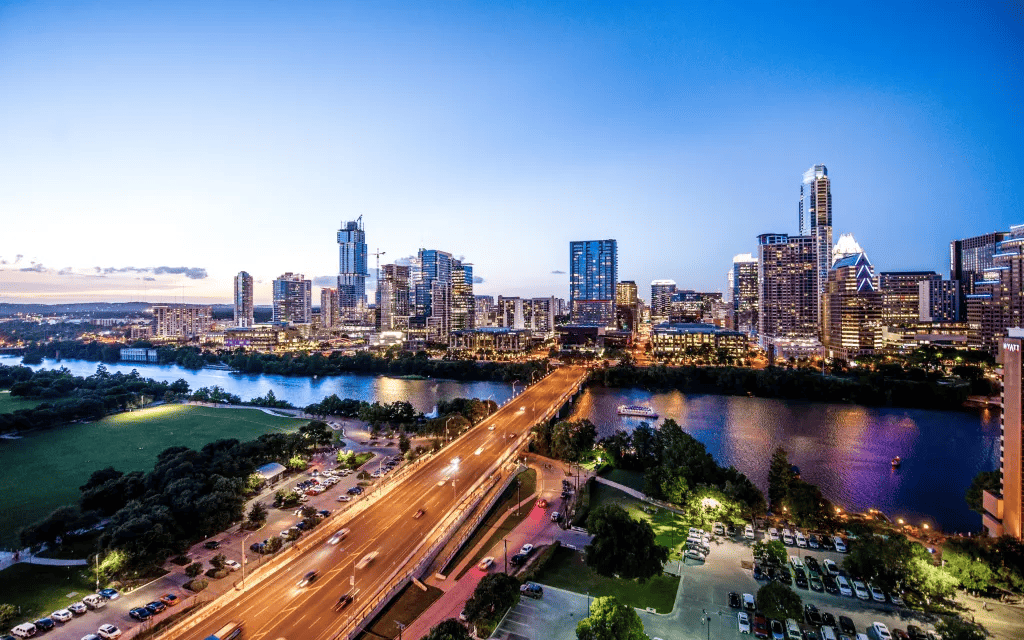
Hotels Near DKR Texas Memorial Stadium
Stay where you can walk, because on gameday walking beats every other option to DKR. Austin sells out hard on football weekends — for an SEC headliner, book the day the schedule comes out, not the month before.
Best Areas to Stay
The campus and Capitol corridor — roughly 17th to 24th Street between Lavaca and Red River — is the target. You’re a fifteen-to-twenty-minute walk from the stadium, in the middle of the pregame bar scene, and clear of the road closures. Downtown and Rainey Street, closer to the river, add twenty minutes of walking and a much better night out; take this one if the weekend is about Austin and the game is one part of it. Skip anything by the airport or in the northern suburbs — you’ll spend the whole weekend in traffic you could have avoided.
Hotel Recommendations
The AT&T Hotel and Conference Center is on the UT campus itself, which makes it the shortest walk to the stadium of any real hotel in town and puts you inside the gameday atmosphere from the moment you step outside. It’s the comfortable middle rather than a splurge, the rooms are solidly business-grade, and the on-site coffee and restaurant options mean you don’t have to leave to get breakfast on a chaotic morning. Tradeoff: it’s a conference hotel, and on a non-football weekend it feels like one.
Hotel Ella is the character pick — a converted 1900 mansion in West Campus with columns, a wraparound porch and a courtyard pool, about a mile from DKR. It’s the splurge in this list and it earns it if the trip is a celebration rather than a football-only run. The tradeoff is that it’s small and it books out first on big weekends.
Hilton Garden Inn Austin University Capitol District sits at 17th and San Antonio with a rooftop deck and a walk to both the stadium and downtown. It’s the reliable comfortable-middle option, well-run, and the rooftop is a genuinely good place to end a night. Parking is expensive and valet-only, which is fine if you’re not driving to the game — and you shouldn’t be.
Hampton Inn & Suites Austin @ The University/Capitol on Lavaca is the value pick in the walkable zone: free breakfast, spacious rooms, and the same twenty-minute walk to DKR as hotels charging twice as much. It’s not exciting. On a weekend where the point is the stadium and the bars, that’s the right call.
Hotel Van Zandt puts you on Rainey Street, a block from the best cluster of bars in the city, with live music in the lobby and a rooftop pool. It’s the best hotel on this list and the worst location for the game — a thirty-plus minute walk or a rideshare into the traffic. Take it if the game is the excuse and Austin is the trip.
Budget Options
Holiday Inn Austin-Town Lake sits on Lady Bird Lake at the I-35 frontage with something rare downtown: free parking for guests. The rooms are dated and you’re looking at the interstate from half of them, but the hike-and-bike trail is directly behind the building and downtown is a walk or a short ride away. You’re trading polish for forty dollars a night in parking fees alone.
HI Austin Hostel is on the lake southeast of downtown, with dorm beds and a few private rooms. It’s genuinely peaceful and directly on the trail, but you’re a bus ride or a long walk from everything, and it’s the correct answer only if the budget is the binding constraint.

Why You Should Go
DKR has one of the best atmospheres in college football. The stadium is loud, the traditions are iconic, and the entire city of Austin shuts down for Longhorns football. The concessions are legitimately excellent with local Austin food vendors, the sightlines from midfield seats are great, and you’re in the middle of one of the best food and music cities in America. If you’re looking for a complete game-day experience that goes beyond just watching football, Austin and DKR deliver. Oh, and Hook Em’.
Don’t forget to check out and all of our college football guides here as well as these:
Check out Daikin Park (formerly Minute Maid Park) in Houston and Globe Life Park in Arlington,
The Frost Bank Center in San Antonio, and of course AT&T Stadium, home of the Dallas Cowboys.
Written by Brad Richards, Founder of Gameday Guides. This guide includes insights from personal visits as well as updated info from team sources, fan forums, and stadium policies. We aim to help you plan with confidence — enjoy your gameday.