


Best Seats at Kinnick Stadium
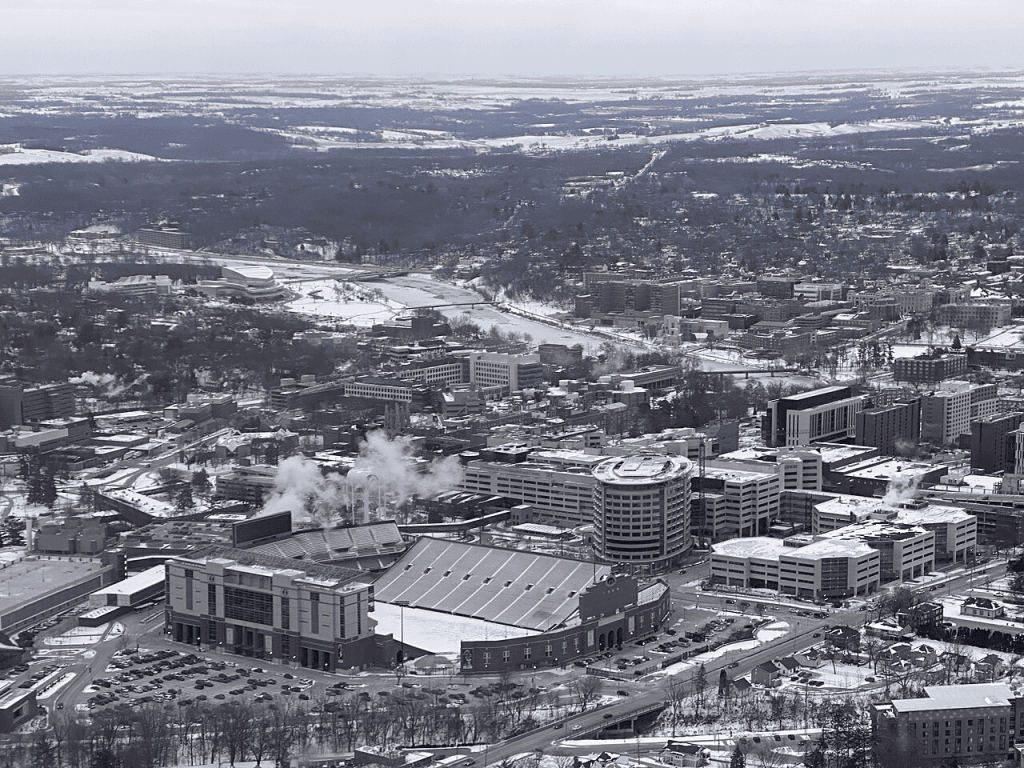
Kinnick Stadium sits below street level. In 1929, crews carved roughly thirty feet down into the west side of the University of Iowa campus and had the place finished in under a year — which is why you walk down into the bowl instead of climbing up into it, and why 69,250 people in a sunken concrete ring sound like a good deal more than that. Iowa has played here every fall since, on a field named for the halfback who won the school’s only Heisman Trophy in 1939 and died flying a Wildcat in the Pacific four years later.
Two things are worth knowing before you buy a ticket. The end of the first quarter, when the whole stadium turns and waves to the children’s hospital, will pull your heartstrings whether or not you have any connection to Iowa. And the seats are aluminum bleachers, 79 rows deep on each sideline, with no roof, no overhang and nowhere to hide from the weather. Plan for that second part, and this is one of the best Saturdays in college football.

Seating Overview at Kinnick Stadium
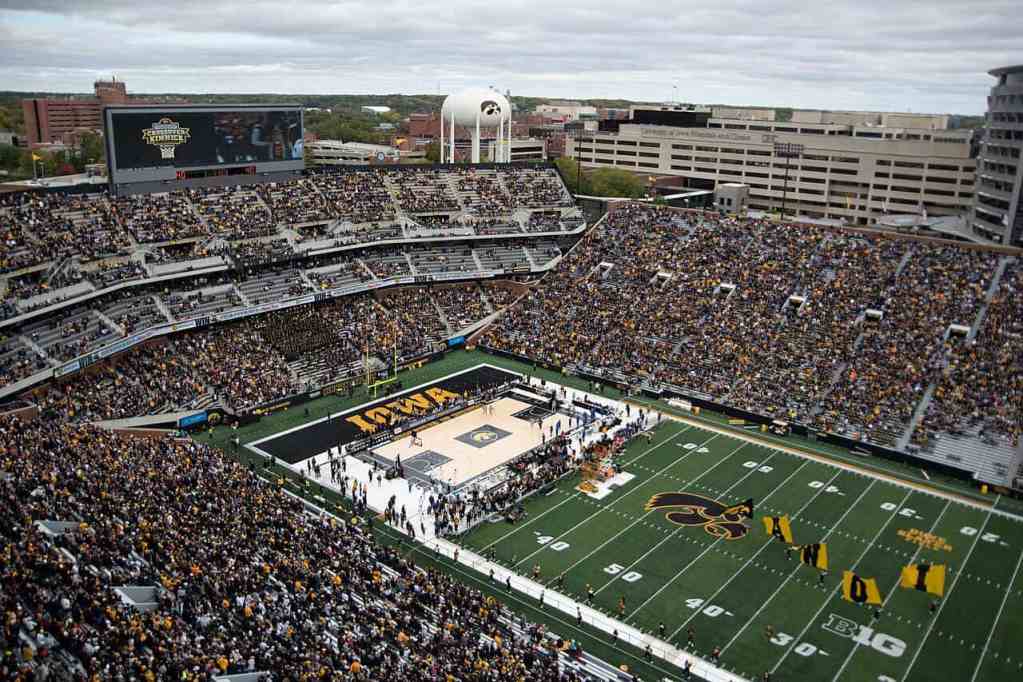
Kinnick reads simply once you know two things. The main bowl is one continuous ring of sections numbered 101 through 140 that runs unbroken from field level to the top of the stadium — no upper deck on the sidelines, just one enormous rake of bleachers. Iowa’s bench sits on the west side between Sections 126 and 127; the visiting bench is directly across on the east side between 105 and 106. That puts midfield at 126–127 west and 105–106 east, and everything else falls into place from there.
The only true upper decks are in the end zones. Sections 211–221 form the upper south end zone, 40 rows deep, with the Iowa student section in 219–221 and the marching band down below in 116. Sections 331–341 are the upper north end zone — the “Kinnick Edge” seats added in 2019, only 19 rows, sitting above the club level. Premium is all on the west side inside the Paul W. Brechler Press Box, plus the north end zone clubs. What separates a good seat from a bad one here isn’t distance, because the bowl is tight and the sightlines are honest almost everywhere. It’s row number, sun and wind exposure, and whether a bench is blocking you.
Best Non-Premium Seats at Kinnick Stadium
Sections 124–129, west sideline, rows 15–35. Midfield on Iowa’s bench side, high enough that the sideline crowd and the coaching staff aren’t in your frame, low enough that you’re still hearing helmets. You pay the most of any non-premium seat in the building for it, and on a sold-out rivalry weekend the resale premium over the east side is real.
Sections 103–108, east sideline. The same midfield geometry from the visitor bench side, and consistently cheaper than the mirrored west sections because there’s no press box, no club and no donor gravity over here. Trade-off: you’re looking across at the premium side rather than sitting on it, and there’s nothing above you at all — no structure, no shade, no wind break.
Sections 214–218, upper south end zone. Elevated straight down the field, which is the best angle in the building for watching a formation develop, and you’re seated directly beside the student block in 219–221 — close enough to get the noise, far enough that nobody’s standing on your bench all afternoon. Trade-off: it’s an end zone view, so goal-line play at the far end is a guess.
Best Value Seats
Sections 331–334 and 338–341, upper north end zone. The newest seats in the stadium sit above the Kinnick Edge club level, and the sections are only 19 rows deep, so even the back row is closer to the action than the top of the sideline bowl. The north concourse behind them is the widest and best-stocked in the building, with the shortest restroom lines on a full house. You’re at the opposite end from the student section, so the noise arrives rather than surrounds you.
Lower corners, roughly Sections 111–114 and 132–135. Corner angles in a bowl this tight are far more forgiving than the price suggests, and rows 20 and up give you a genuine diagonal view of both end zones. These move late on the secondary market for non-conference games, which is when the gap between what you pay and what you get is widest.
Cheapest Way Into Kinnick Stadium
Sections 335–337, the middle of the upper north end zone, are reliably the last seats to move and the first to get discounted. The reason is worth knowing: the north videoboard sits directly behind those three sections, so you have to turn around to see a replay. If you’re going for the atmosphere rather than the film study, it’s the cheapest ticket in the building with a real view of the field. For a non-conference September game, the top rows of the upper south end zone run similarly cheap.
Our Pick
Sections 126 or 127, rows 20–30 — midfield, Iowa’s side, above the bench and the photographers, and close enough to the west concourse that you’re not committing to a five-minute climb every time you want a drink. If those are gone or priced like a bowl game, take 216 or 217 in the upper south end zone instead and spend the difference on dinner downtown.
Sun, Wind & Iowa City Weather
There is effectively no covered seating at Kinnick. No canopy, no upper-deck overhang above the sidelines, nothing between you and the sky in the vast majority of the bowl — so for a September noon or 2:30 kickoff, sunscreen and a hat aren’t optional, and there’s no “shady side” to buy your way onto. Free hydration stations sit on the concourse at Sections 102 and 120, and you’re allowed to carry in one empty refillable bottle to fill there.
By late October the problem flips from sun to wind. The high rows of Sections 211 and 212, at the top corner of the upper south end zone, are the most exposed seats in the stadium and the ones experienced fans warn about on a cold day. Layers, a blanket — allowed, and you’ll want one — and the understanding that a November night game in Iowa City is a genuinely different sport from a September afternoon. Here is the Iowa City Weather Forecast
What to Avoid (and What’s Worth Trying Once)
Rows 1–8 directly behind either bench (126–127 west, 105–106 east). You’re eye-level with the field, which sounds great until eighty players, coaches, trainers and camera operators stand up in front of you for four quarters. Go eight to ten rows higher in the same section and the view transforms.
The top rows of 211 and 212. Corner angle, longest climb in the stadium, and full exposure to whatever the weather is doing. They’re cheap for reasons that show up in the third quarter.
Worth it once: the top of the bowl on the east sideline. Seventy-nine rows up, no structure around you, the whole sunken stadium below and the hospital tower beyond it — it’s the view that explains why Kinnick sounds the way it does. Bad seat for watching a slant route. Great seat for understanding the building.
Premium Seating & Clubs at Kinnick Stadium
Iowa runs five premium products, split between the west-side press box structure and the 2019 north end zone build. Set expectations first: football premium seats at Kinnick are not sold as single-game tickets. Everything below runs through season allocations, per-seat contributions to the I-Club and, for the top tiers, a priority-points waiting list. Occasionally a seat surfaces on the resale market when a season holder can’t make a game. That’s the realistic route in.
The Best Premium Experience
McCord Indoor Club, level one of the press box. The only all-inclusive premium inventory in the stadium and the only seats where you watch from inside, climate-controlled, behind glass — with stadium sound piped in so the room doesn’t feel sealed off from the game. In a stadium with no cover anywhere else, that’s a meaningful thing to own in November. It operates off a priority-points waiting list alongside the private suites.
Best Value Premium
Mediacom Outdoor Club, level two of the press box. The smart call, and it isn’t close. These are the only chairback seats in the open air at Kinnick — wider, with armrests, elevated over the west sideline and running the length of the field — with an indoor lounge directly behind them to duck into. You keep the outdoor atmosphere that people come to Kinnick for and lose the aluminum bench. Unlike the indoor club and the suites, there’s no waiting list for Mediacom or Pacha club seats; availability is assigned during the seat-selection window by priority points.
Other Premium Options
The Ted Pacha Family Club on level two of the north end zone anchors the 1,500-plus Kinnick Edge club seats — outdoor chairbacks looking straight down the field, with an indoor club room behind them. Ironmen Boxes sit at concourse level in the north end zone, and private suites occupy levels one and three of the press box, both on multi-year agreements. Full current detail lives on Iowa’s premium seating page.
Suites & Group Options
Suites and Ironmen Boxes are priced by size and location and are sold on three- or five-year agreements through the UI Athletics Ticket Office, with a waiting list in front of the door. For a group that just wants hospitality without a suite, Iowa sells Hawkeye Village ticket packages that pair a game ticket with a pregame tailgate — all-you-can-eat food, drinks, yard games and music — which is a far more realistic option for a reunion crowd of fifteen or thirty than chasing a box.
Kinnick Stadium Seating Chart
Kinnick Stadium holds 69,250 fans, making it one of the larger venues in the Big Ten and consistently one of the loudest given its classic bowl design. The north end zone is the one to know — that’s where the stadium faces the University of Iowa Stead Family Children’s Hospital, home of the famous first-quarter Wave.
Before you buy, pull up the interactive Kinnick Stadium seating chart to get oriented — the west sideline, east sideline, and end zone sections all play very differently, and knowing the layout before you shop saves you from a bad impulse buy on the secondary market.
Getting Iowa Football Tickets
Big 10 Games: For any Big Ten home game — especially Iowa State (the Cy-Hawk Series), Wisconsin, Penn State, or Michigan — buy early and buy face. The official Hawkeyes ticket site releases individual game tickets at face value, and popular games sell out in the donor/season ticket presale before the general public gets a shot. If you’re an alum who donates to the athletic department, even at the minimum level, that priority window matters.
Secondary Markets: Secondary market (Vivid Seats, SeatGeek, StubHub) is your best option for non-marquee games — MAC conference opponents, mid-tier Big Ten matchups — where face value inventory is still available but secondary prices drop below face as the game approaches. Mid-week purchases typically outperform weekend buys as local sellers drop prices rather than eating them. Check out our partner Vivid Seats for Hawkeyes Football or Basketball Tickets. Or any event home or away.
As Hotels go, Tickets Go: Iowa City is a small town and hotels and tickets move together. When hotels in Iowa City and Coralville fill up, ticket demand spikes — use lodging availability as a proxy for how tight the ticket market is going to get. If you’re seeing no hotel rooms within 20 minutes, expect secondary ticket prices to hold or climb.

Kinnick Stadium Bag Policy
Kinnick runs a clear bag policy. You may carry in one bag of clear plastic, vinyl or PVC no larger than 12″ x 6″ x 12″, or a one-gallon clear zip-top bag, which does the same job for about a dollar. A small clutch up to 4.5″ x 6.5″ is allowed alongside it and does not have to be clear. Purses, handbags, backpacks and cinch bags are all refused at the gate, with no bag check on site — leave it in the car.
The allowances people miss: you can bring your own food in a clear one-gallon storage bag, and you can bring one water bottle — factory-sealed or empty and refillable, up to a gallon — to fill at the hydration stations inside. Blankets are permitted, and so are seat cushions with no back support. Diaper bags, breast pumps and medically necessary items go through after inspection at any gate and get tagged.
Prohibited and worth flagging because they catch visitors out: umbrellas (bring a poncho — it rains in Iowa in September), strollers and car seats, coolers, CamelBak-style hydration packs, personal chairbacks, signs and banners, noisemakers, video cameras, camera lenses six inches or longer, and tobacco of any kind including vapes. Everyone walks through a metal detector, but you keep your phone, keys and wallet on you.
Key Kinnick Stadium Policies
No re-entry, at all. Once you scan in you’re in for the day, and that includes stepping back out to Krause Family Plaza. Finish the tailgate before you walk to the gate.
Fully cashless. Every concession stand, every merchandise stand and every parking lot takes credit or debit only. There is no cash option on gameday anywhere in the footprint.
Alcohol is sold inside, and it stops at the start of the fourth quarter. Two drinks per person per transaction, ID checked for anyone who looks under 30, and you can’t carry a drink out of the stadium.
Accessibility. Two street-level entrances with elevators sit off Evashevski Drive on the north side for the north end zone accessible seating; all other accessible seats are on the concourse and reachable from any gate. Complimentary ADA golf cart shuttles run from two hours before kickoff until an hour after the game, and post-game they operate only outside Gates H, I and M.
Getting to Kinnick Stadium
Iowa City is a town of about 75,000 that absorbs 69,250 people in an afternoon, and the single best decision a visitor can make is to not drive to the stadium. There’s a free shuttle network that most out-of-towners never find, and the walk from downtown is twenty-five minutes through the middle of campus.
Kinnick Stadium Parking
Athletics lots open six hours before kickoff and never before 6:00 a.m., and queuing on the streets beforehand isn’t allowed. Day-of public parking runs $40 per car at the Finkbine Golf Course Lot, the Lower Finkbine Lot and the Softball Lot, with RVs at $100 in the same three; Lot 11 and the Newton Road Ramp charge by the hour. Prepaid single-game passes for Lot 3 (Library) and Lot 65 are $40 and must be bought by noon the day before, limit one, and they’re mobile-only — printed passes are refused at the gate. Everything is cashless. Height limits matter if you’re in something tall: the Hawkeye Ramp clears 8’2″, the Field House Ramp and Ramp 3 only 7′.
The tip nobody publishes: look at how the roads reverse before you pick a lot. Hawkins Drive and Hawkeye Wave Way close to non-emergency traffic two and a half hours before kickoff and stay shut until two hours after the game, and Hawkins is coned to three inbound lanes and one outbound. Melrose Avenue closes westbound about an hour before kickoff, and after the game it runs two lanes westbound out to US-218. If you’re headed east or north afterward, parking west of the stadium means driving away from your route before you can turn around.
Free Parking & the CAMBUS Shuttle
This is the move. Parking is free — genuinely free, not discounted — in the Hancher Auditorium Lot (55), the Hawkeye Commuter Lot (85) and the Hall of Fame Lot (71), and free CAMBUS shuttles run continuously from those lots to the stadium starting two hours before kickoff and for about an hour after the final whistle. There’s a fourth route from Downtown/Schaeffer Hall for anyone parking in the city ramps and eating downtown first.
The Commuter Lot route drops at Carver-Hawkeye Arena on Elliott Drive; Hancher and Downtown both run to the VA Loop on Newton Road. No fare, open to the public, and while everyone who paid $40 to park sits in the Melrose queue, you’re moving. See the CAMBUS football shuttle page for the current route map.
Rideshare
Uber and Lyft operate in Iowa City and surge hard in the ninety minutes before kickoff. One rule that catches people: rideshare vehicles without a football parking pass are not allowed inside University parking lots, so your driver cannot take you to a lot entrance — you’ll be dropped on a public street and walk in. Set a specific meeting point with your group before you split up, because post-game pickup clusters around the Ped Mall and the streets east of campus, and phone service near the stadium is unreliable exactly when you need it.
Walking from Downtown Iowa City
The Pedestrian Mall to Kinnick is a 20–25 minute walk west across the Iowa River and through the Pentacrest, and on a home Saturday it’s the best twenty-five minutes of the day — the whole route is people in black and gold heading the same direction. Coming back after the game it’s faster than any vehicle, and it lands you exactly where the bars are.
Hawkeye Gameday Insider Tips & Hacks
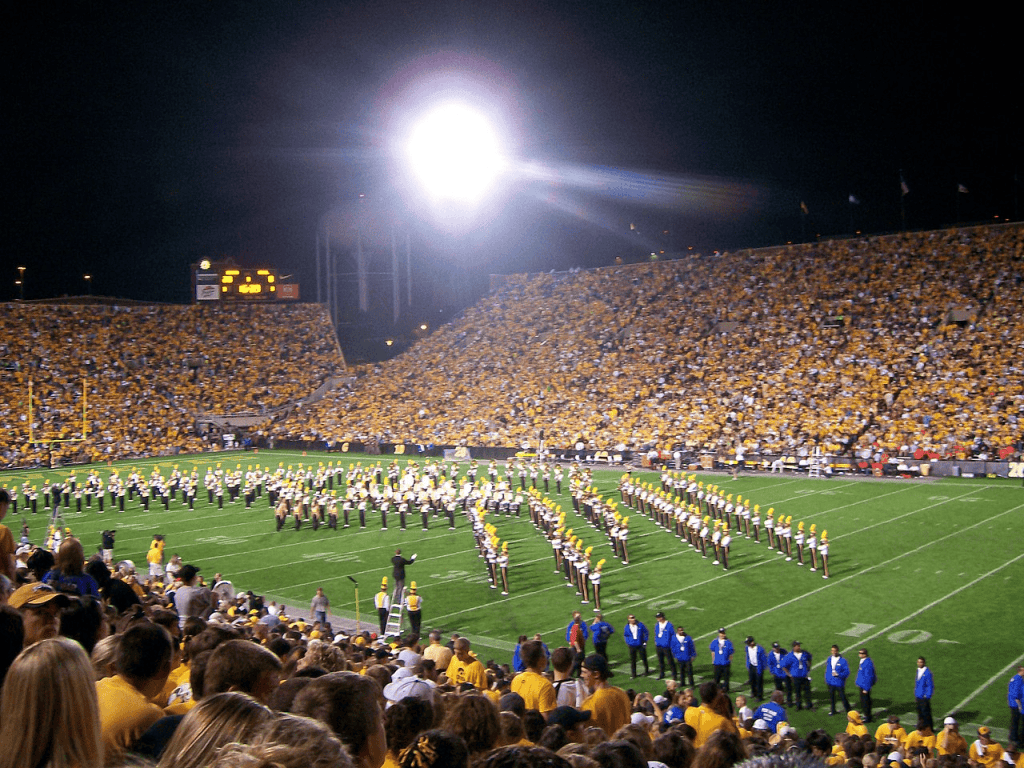
Kinnick’s reputation as one of the loudest venues in the Big Ten isn’t an accident — it’s the bowl design doing exactly what it was intended to do. But the gameday experience here is about more than Kinnick rewards people who show up early and know what’s coming. The traditions here are timed to the minute, several of the best things on a Hawkeye Saturday happen outside the stadium and don’t need a ticket, and a handful of small logistical calls — where you sit, what you rent, which concourse you use — separate a good day from a long one.
Rent a Chairback (Yes, Really)
Reserve a chairback before you go, or rent one at the gate for $15. Kinnick is twenty miles of aluminum bench and personal chairbacks are prohibited, so the stadium rents them instead — game-day rentals at the customer service booths inside Gate B and Gate M, while supplies last, or reserve ahead at order.seatbacks.com/hawkeyeseats. For anyone over about thirty-five sitting through a four-hour Big Ten game, this is the best fifteen dollars available at Kinnick Stadium and hardly any visitor knows it exists.
Bring a blanket even in September. It doubles as padding on the bench and it’s one of the few soft goods that clears the gate without inspection.
Kinnick Stadium History & Nile Kinnick
Learn who Nile Kinnick was before you go. He won the Heisman in 1939 for the “Ironmen” team, was a Phi Beta Kappa scholar and senior class president, and died at 24 when his Navy fighter went down in the Gulf of Paria in 1943. His No. 24 is one of two numbers Iowa has retired, and the stadium took his name in 1972.
Listen for his Heisman speech before the national anthem. Iowa plays the audio of Kinnick’s acceptance address over the boards before every home game. It’s a genuinely remarkable piece of oratory from a 21-year-old, and the stadium goes quiet for it. If you skipped the history, you’ll spend it wondering why everyone around you is standing so still.
Ask about the pink visitors’ locker room. Hayden Fry, who had a psychology background, had it painted pink in 1979 to keep opponents passive. It’s still pink, it’s still one of the most argued-about quirks in college football, and coaches who come through Iowa City tend to say they love it.
The Kinnick Edge Renovation
The north end zone is 2019, everything else is older. The $89 million Kinnick Edge project rebuilt the entire north end — 1,600-plus indoor and outdoor club seats, a new concourse, new restrooms and concessions, and new videoboards. It’s the reason the north side of the stadium feels like a different building from the south.
Use the north concourse even if you’re not sitting there. It’s the newest, widest and best-stocked space in Kinnick, and the lines move faster there than anywhere in the older sections of the bowl.
Arrival Strategy & the Hawk Walk
Be at Krause Family Plaza two hours before kickoff for the Hawk Walk. The team arrives at the south entrance and every player and coach touches the helmet on the Nile Kinnick statue on the way in. The plaza is open to everyone before that — the official Hawkeye Tailgate runs there from three hours out — but it’s cleared after the Hawk Walk and a game ticket is required from then on.
Catch the marching band’s free concert at 1 hour 15 minutes. The Hawkeye Marching Band plays a full 25–30 minute show at the Hawkeye Indoor Track, 930 Evashevski Drive, and you do not need a game ticket to watch it. Most visiting fans have no idea it’s happening.
Be in your seat 20 minutes out. That’s when the band takes the field for the pregame show, and it runs straight through the Kinnick video into the anthem into the Swarm. Miss it and you’ve missed the best fifteen minutes of the day.
Iowa Hawkeyes Traditions at Kinnick
The Wave, end of the first quarter. The entire stadium — home fans, visiting fans, players, coaches, officials — turns and waves to the patients and families watching from the University of Iowa Stead Family Children’s Hospital next door. It started in 2017 and it has become the thing Kinnick is known for nationally. Put the phone down for it. You’ll be glad you did.
The Swarm. Players come out with arms interlocked, walking as one line, to AC/DC’s “Back in Black.” It’s a Hayden Fry invention and for a night game it’s the single loudest moment before kickoff.
The I-O-W-A chant, after every score. Each corner of the stadium owns one letter, the spirit squad raises a flag so you know which one is yours, and it starts in the student section and rotates. Watch for your flag and yell your letter — that’s the whole game.
Don’t leave your seat if Iowa wins. The band plays the Hawkeye Victory Polka — their arrangement of “In Heaven There Is No Beer” — and the stadium sings it. It is the most Midwestern thing that happens in college football and it’s completely missing from most visitor guides.
Put your hands up for the Burrito Lift. During a timeout, a burrito appears on the videoboard and the crowd “lifts” it around the stadium, courtesy of Pancheros, which was founded in Iowa City. Committed sections hoist an actual human instead.
Kinnick Stadium Food & Drink
Eat the pork tenderloin, skip the nachos. Twenty concession stands ring the concourse and the menu is honest Big Ten fare rather than a food hall — but a proper breaded Iowa tenderloin, wider than the bun it comes on, is the one thing you can get here that you can’t get at most stadiums. The grill stands on the northeast concourse carry them.
Buy your beer before the second half. Sales stop at the start of the fourth quarter and the third-quarter lines reflect that. Get it as the teams come back out.
Pack a sandwich. Outside food is allowed in a clear one-gallon bag, which almost nobody takes advantage of, and it turns the halftime concourse into a non-event for your group.
Food vendors set up in Krause Family Plaza too, at the south end outside Gate A — worth a walk through before you scan in, since you won’t be coming back out.
Kinnick Stadium Tailgating
Melrose Avenue is the scene. The stretch south of the stadium and the side streets running off it are where private driveways, front yards and local businesses run open tailgates from early morning. Walk it even if you’re not invited anywhere — you will be, repeatedly, by about the third block.
Know the alcohol rules before you carry a drink anywhere. Beer and wine are allowed in University parking areas on football gamedays; hard liquor is not, and carrying an open container on public sidewalks or streets on the way to campus will get you cited and the drink confiscated.
Propane and charcoal grills are fine in the lots, never in the ramps, one 20-pound cylinder per device with no spares, and open wood fires and portable fire pits are prohibited outright.
RVs park Friday night only between 7:30 and 10:00 p.m., in the contributor lots, and if you’re driving something oversized without an assigned space you’ll be routed to the Commuter or Hancher lots regardless of what your pass says.
Bringing Kids to a Hawkeye Game
Borrow a free sensory bag. Kinnick is certified sensory-inclusive by KultureCity, and Fan Services stands inside Gates B, H, I and M lend bags with noise-cancelling headphones, fidget tools, visual cue cards and strobe-reduction glasses. No questions, no charge.
Two lactation rooms are open on the concourse, near Section 133 in the north end zone and across from Section 119 in the south.
Strollers are banned, so plan the walk. Strollers and car seats do not come through the gate and there’s no storage — for a small child that’s a carry, and it’s an argument for the upper north end zone, where the sections are 19 rows instead of 79.
Note where UI Police sit: Section 123. That’s lost-and-found, lost persons and the check-out point for assisted listening devices, and it’s the address to give a kid old enough to walk on their own.
Best Photo Spots at Kinnick Stadium
Shoot from the top of the sideline bowl before the crowd fills in. Because there’s no upper deck in the way, the highest rows on either sideline give you the whole sunken stadium in one frame — the shot that shows why the place looks like a bowl carved out of the ground.
The Nile Kinnick statue at the south entrance is the standard exterior shot, and it’s busiest right before the Hawk Walk. Come an hour earlier if you want it without a crowd.
Leave the long lens at home. Camera lenses six inches or longer and all video cameras are refused at the gate; phones and small cameras are fine.
Kinnick Stadium Tours & Off-Season Visits
Iowa runs Hawkeye Tours of Kinnick outside gamedays, and they go into parts of the building — the press box, the club spaces, the “guts” of the stadium — that a ticket doesn’t get you. Book through Hawkeye Tours; availability is seasonal and tied to the events calendar.
Kinnick isn’t only a football stadium anymore. It has hosted an outdoor women’s basketball game in front of 55,646 people in 2023 and, more recently, Savannah Bananas dates — so if you’re searching for a non-football event here, it’s worth checking the athletics calendar rather than assuming.
Things to Do in Iowa City
Start at the University of Iowa Athletics Hall of Fame. Three floors in the Roy G. Karro Building on the west side of campus, free to enter, and Nile Kinnick’s actual Heisman Trophy is in it along with the wrestling national title hardware. Hours can be inconsistent, so check before you drive over.
The Stanley Museum of Art sits on the stadium side of the river, at 160 W. Burlington Street, about fifteen minutes on foot from Kinnick, and it’s free. One of the strongest university art collections in the country, including a Jackson Pollock, in a building that opened in 2022.
For a Sunday morning before you drive home, the Herbert Hoover Presidential Library and Museum is fifteen minutes east in West Branch, just off I-80 at Exit 254. The birthplace cottage, the restored village and the prairie trail behind it are a better stop than any rest area on the interstate; the museum building has been through a renovation, so check current hours before you commit the morning to it
Hotels Near Kinnick Stadium
Iowa City has far less hotel inventory than a Big Ten Saturday requires, and rooms for a ranked opponent or a rivalry weekend are gone months out. Book as soon as the schedule drops, and if the city is full, look at Coralville before you look anywhere else.
Best Areas to Stay
Downtown Iowa City, around the Ped Mall, is the choice if you want to walk everywhere and be inside the atmosphere from Friday night onward — the bars, the restaurants and the 25-minute walk to Kinnick all start at your front door, and you never touch a car. Coralville, ten minutes west and functionally attached to Iowa City, has several times the room supply, easier parking and a walkable cluster of hotels and restaurants at Iowa River Landing; it’s the practical base if you’re driving in from out of state. Cedar Rapids, 30 miles north on I-380, is the overflow when both sell out — a 30–40 minute drive that can stretch past an hour on post-game I-380.
Where to Stay in Iowa City
Hilton Garden Inn Iowa City Downtown University — 328 S. Clinton Street, the closest full-service hotel to campus and the shortest walk to Kinnick of anything downtown. The Vue on the twelfth floor is the best view in Iowa City and a legitimate reason to book here even if you’re not staying. Parking is paid and separate, which surprises people at check-in.
Graduate by Hilton Iowa City — 210 S. Dubuque Street, literally on the Pedestrian Mall, which makes it the returning-alum pick: you walk out the door into the bars. The trade-off is that you’re above the noise on a Saturday night, and the parking arrangement is a ramp walk rather than a lot.
Element by Marriott Iowa City — 314 S. Clinton Street, a block off the Ped Mall, with made-to-order breakfast and an attached garage. The comfortable middle option downtown, and it tends to hold availability slightly longer than the two above.
Where to Stay in Coralville
Drury Inn & Suites Iowa City Coralville — 815 1st Avenue, walking distance to Iowa River Landing, and the best-run hotel in the market by a distance. The 5:30 Kickback puts free food and free drinks in front of you every evening, which on a two-night football trip is worth more than most upgrades. Book it first.
Staybridge Suites Iowa City–Coralville — 801 E. 2nd Avenue, attached to Xtream Arena, with full kitchens and separate living space. The right call for a family or a group splitting a suite over a Friday-to-Sunday trip.
Hyatt Regency Coralville Hotel & Conference Center — 300 E. 9th Street, the biggest property in the area and the one to call if you need a block of rooms for a reunion. Conference-hotel feel rather than character, but the location at Iowa River Landing means dinner and drinks are a walk away.
Budget Options
The Highlander Hotel — 2525 Highlander Place, out by the I-80 interchange northeast of town. Family-owned, restored with a deliberate mid-century look, with Lucy’s downstairs for pizza and a retro arcade off the bar. You need a car and you’re ten minutes from downtown, but it’s the most interesting room you’ll get at the price. Skip the older budget properties clustered on 9th Street in Coralville — the savings are small and the recent reviews are rough.
Iowa Hawkeyes Gameday: Bars and Restaurants in Iowa City
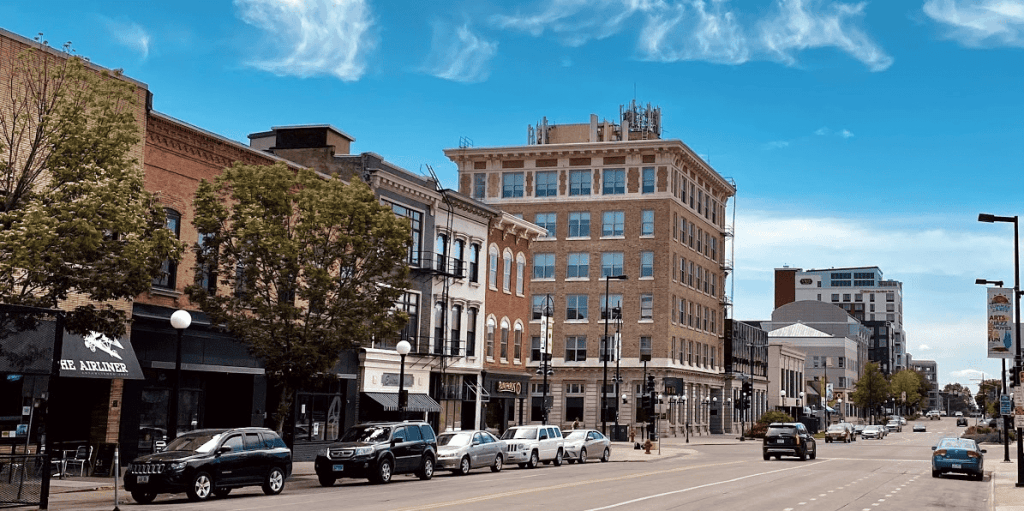
A Hawkeye Saturday moves east to west and then back again, and if you understand that pattern you understand the whole day. It starts downtown — coffee and breakfast around the Ped Mall and the Northside, people in black and gold filling the sidewalks by nine in the morning even for a 2:30 kickoff. Then the migration: everyone walks west across the Iowa River, through the Pentacrest, past the Old Capitol and down toward Melrose Avenue, where the tailgate belt starts. Grills come out at dawn. Front lawns turn into bars. Corn hole boards appear in driveways of houses that have been doing this since the Fry era, and the smell of pork on charcoal hangs over about a square mile of the west side. The thing visitors always report back is how aggressively friendly it is — Iowa Nice is a real phenomenon and it manifests, on a football Saturday, as strangers handing you a plate of food because you’re wearing the right colors, or the wrong ones.
After the game it reverses. Tens of thousands of people walk back east down Melrose toward downtown while the cars sit still, and the Pedestrian Mall — an open, car-free block of bars, patios and restaurants in the middle of town — absorbs all of them at once. That’s the part first-timers get wrong: they sprint for their car and spend an hour in traffic, when the move is to walk twenty-five minutes, get a beer, watch the late games, and drive out at seven into empty streets.
Iowa City is a small town with a serious bar district and a Big Ten crowd’s worth of people in it, and on a night after a win, with the Victory Polka still in everyone’s head, it’s about as good as a college town gets. Here are some places to sample.
Fun Pregame & Postgame Bars in Iowa City
The Airliner — 22 S. Clinton Street, and it’s been on that corner since 1944, which makes it the closest thing Iowa City has to a required stop. Order the breakfast pizza before a noon kickoff; it’s a genuine Iowa City thing and it will absorb whatever you did the night before.
Joe’s Place — 115 Iowa Avenue, an old-school bar with a rooftop patio that fills the second the weather cooperates. Less of a scrum than the big Ped Mall rooms, and a better bet if you want to actually hear the person next to you.
Deadwood Tavern — 6 S. Dubuque Street, a proper dive with cheap beer and no pretensions. The insider part: they let you bring in outside food, and Nodo across the street makes the sandwiches, so a table at Deadwood is the best lunch-and-a-pint combination downtown.
Donnelly’s Pub — 110 E. College Street, an Irish pub with real burgers and fish and chips, and the place downtown that skews toward adults rather than undergrads. Good landing spot postgame if the student bars aren’t your speed.
Big Grove Brewery & Taproom — 1225 S. Gilbert Street, ten minutes south of the Ped Mall and worth the walk for the beer and the enormous patio with fire pits. Gameday watch parties spill outside all afternoon.
Solid Restaurants in Iowa City
Hamburg Inn No. 2 — 214 N. Linn Street, an Iowa City institution that every presidential candidate in living memory has eaten in. Come for breakfast, order a pie shake — an actual slice of pie blended into a milkshake — and accept that there will be a wait on a Saturday.
A & A Pagliai’s Pizza — 302 E. Bloomington Street, thin crust, red booths, family-run for decades and the best pizza in town. One catch that ruins plans: it doesn’t open until 4:00 p.m., so it’s a postgame or Friday-night stop, never a pregame one.
Pullman Bar & Diner — 17 S. Dubuque Street, open from breakfast to midnight and the most reliable meal downtown at any hour. The burger is what to order.
St. Burch Tavern — 127 Iowa Avenue, the gameday-weekend brunch that everyone tries to get into, plus a good dinner menu and a basement bar. Book it, or go at nine in the morning.
The Webster — 202 N. Linn Street, the Friday-night dinner if the trip is a milestone. Small, seasonal, genuinely excellent, and the reservation is the hard part — book it before you book the hotel.
Why You Should Go
Kinnick Stadium is one of those places that shows up on “best college football experiences” lists for legitimate reasons — the atmosphere is real, the Wave is genuinely moving, and Iowa City delivers a complete gameday from tailgate through last call in a way that few small college towns can match. It’s compact, walkable, and authentically college football in a way that newer, more commercial stadiums often aren’t. If you haven’t been back since graduation or have never been, make the trip for a Big Ten game in October — the weather window, the stakes, and the atmosphere all line up.
Check out some of our other College Football Guides for the Big 10 as well as these regional gems:
Arrowhead Stadium and Kauffman Stadium in Kansas City
Lucas Oil Stadium in Indianapolis (Home of Big 10 Championship Game)
Written by Brad Richards, Founder of Gameday Guides. This guide includes insights from personal visits as well as updated info from team sources, fan forums, and stadium policies. We aim to help you plan with confidence — enjoy your gameday.