
Best Seats at Lane Stadium
Few buildings in college football hit you in the chest the way this one does. Lane Stadium sits at just over 2,000 feet in the Blue Ridge, the second-highest FBS stadium in the eastern half of the country, and 65,632 people packed into it on a Saturday night is one of the loudest environments in the sport. The honest catch is getting here: Blacksburg is nine miles off I-81 and 45 minutes from the nearest regional airport, and the last ten of those miles crawl on gameday.
Nobody stumbles into a Virginia Tech home game by accident, which is exactly why the crowd that shows up is the crowd that shows up. Below is how the building works — where to sit, what it costs you, and what the chart won’t tell you.
Lane Stadium Seating Overview
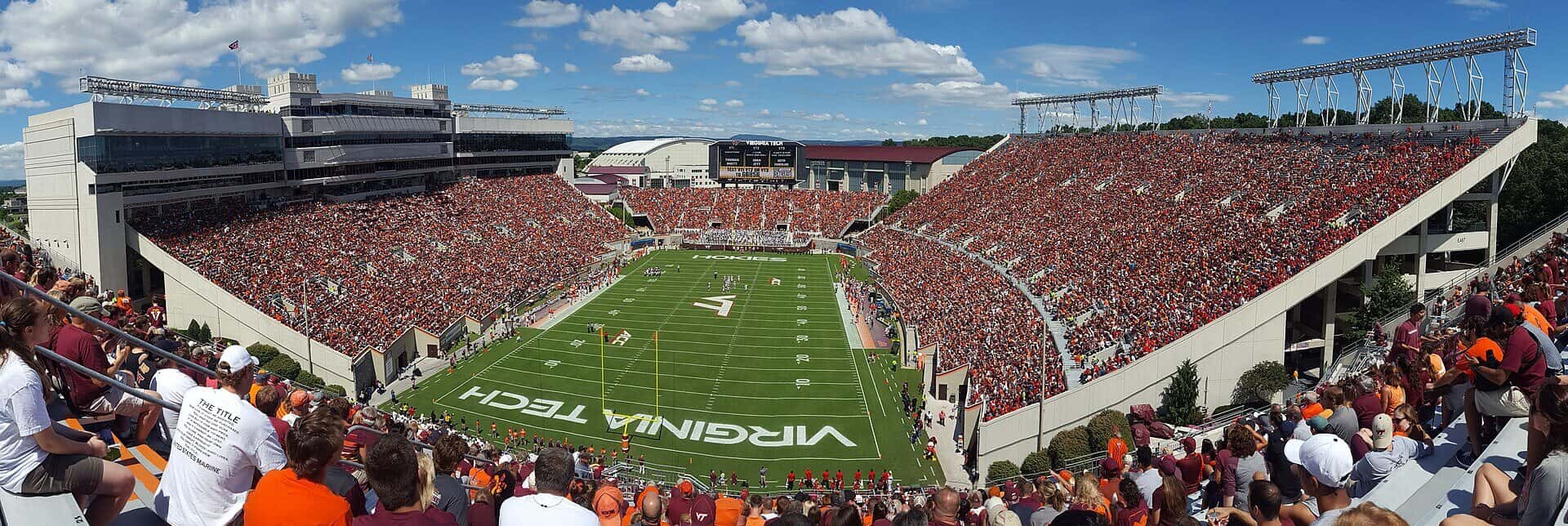
What separates a good seat here from a bad one isn’t elevation and it isn’t price — it’s your relationship to two things: the west sideline, where the Hokie bench and press box are, and the open north end, where the team comes out. The lower bowl is one continuous ring: the south end zone starts the count, the west stands hold the home sideline, the north end is students, and the east stands are the visitor side. The 200 level begins above the south end zone and runs up the east side; there is no upper deck of general seating on the west.
Almost everything in here is bench seating. That matters more than people expect over three and a half hours — you can rent a padded Hokie Seat with a back at the gate for $15, or reserve one in advance through HokieSeats.com, and they’re permitted in the east and upper south quadrants. It’s the cheapest comfort upgrade in the building and most visitors don’t know it exists until they see people carrying them in.
Best Non-Premium Seats at Lane Stadium
Lower west sideline at midfield (the 110s) — The gold standard. You’re on the Tech bench side with the 50 in front of you, low enough to hear sideline communication and read both benches, and inside the loudest half of the building. The catch: the top rows of these sections are the Outdoor Club, so the general-admission seats are the lower and middle rows, and they price accordingly.
Lower east sideline at midfield (the 130s) — Same midfield geometry, usually for less, because you’re on the visitor bench side rather than in the middle of Hokie Nation. If your priority is actually watching football develop, this is the smart-money version of a midfield seat. You’ll have opposing energy near the bench and slightly less of the home-crowd wall behind you.
Lower north corners (the 115–117 and 125–127 range) — These wrap toward the open north end, so the entrance happens close enough to feel without needing a student ticket. Depth perception on plays at the far south end is rough and the angle reads more end zone than sideline, but for a first-timer who came for the atmosphere as much as the game, this is the trade worth making.
Best Value Seats
Upper east sideline at midfield (the low 230s) — A full-field view with the Blue Ridge over the far rim, at a real discount to either lower sideline. Lane’s upper deck is steep enough that anyone uneasy with heights should take it seriously, especially in the front rows. For tracking play design, this out-watches a lower corner seat that costs more.
Lower east sideline for a night game — Worth calling out separately. Night is when Lane is at its best, the whole bowl locked in from the first snap, and from the east side at midfield you get that atmosphere plus a genuine football view for less than the west side commands.
Cheapest Way Into Lane Stadium
Lower south end zone (the low 100s) — The most affordable real seats in the building, looking straight down the field, which watches better than a deep sideline corner. You’re inside for every second of the entrance. Depth perception at the far north end is the price. The Corps of Cadets sits down here too, which is its own show.
Upper deck corners — High and well off midfield, so the view is distant, but you’re in the room for far less than anything along a sideline. Fine for a group or a first trip where being there beats the sightline.
Our Pick
Take the lower west sideline at midfield, in the rows below the Outdoor Club — home crowd, clean midfield view, and close enough that the jump rattles your row. If budget decides it, the east side at midfield for a night game is the sneaky-smart play: nearly the same view of the football, a wall of noise either way, more money left for Saturday night downtown.
Weather, Sun and Cold at Lane Stadium
This is a mountain venue and the calendar matters more than the compass. A September afternoon kickoff can be genuinely hot and there is almost no shade in the bowl — the one meaningfully covered area is the upper rows of the south end zone club sections, and that’s ticketed. Bring sunscreen and a hat for an early-season 3:30, and remember aerosol cans and umbrellas both get turned away at the gate.
By late October the problem inverts. Night games get cold fast once the sun drops behind the ridge, wind funnels through the open north end, and the temperature on the concourse two hours before kickoff has nothing to do with the temperature in the fourth quarter. Layer for any late-season night game regardless of where you sit.
What to Avoid (and What’s Worth Trying Once)
The deep upper corners — Far from midfield, far from everything, and frequently priced above a straight-on end-zone seat that watches better. Given the choice at similar money, take the lower south end zone every time; at least you’re looking down the field instead of across it.
Older lower-bowl rows with structural obstructions — Lane has been expanded in stages since 1965 and some lower-bowl spots sit behind rails or support steel. On the resale market, pull the seat-view photo for that exact section and row before you commit. Thirty seconds, saves an afternoon.
Worth it once — the north end student section. You will not see the far end of the field well and you will stand and get jostled for three hours. What you get is a point-blank seat to the best entrance in the sport from directly behind the tunnel. If you can get in through a student or alumni connection, do it once, for a night game, against a ranked opponent.

Premium Seating and Clubs at Lane Stadium
Premium here breaks into four buckets: the field-level corner suites built around the entrance, the climate-controlled club seats on the west sideline and in the south end zone, a hospitality lounge on the concourse, and 43 traditional private suites. Demand has changed completely under the new staff — club season tickets and the Lane Lounge both sold out for 2026, the fastest premium sellout in program history, which leaves the per-game corner suites and whatever club inventory reaches resale as the realistic doors in for a visitor.
The Best Premium Experience
The Sandman Suites are the one premium option that only makes sense at this building. They’re two 16-seat suites at field level in the northeast and northwest corners, which puts you hanging over the tunnel end when the stadium jumps. They’re sold whole, per game, with food, drink, game tickets and up to three parking passes included — which makes them the rare premium space a visitor can book for one specific Saturday instead of a season. The honest tradeoff: you’re in a corner. This is a buy for the entrance and the exclusivity, not for the cleanest look at the football.
Best Value Premium
If you want the best sightline in the stadium with amenities behind it, the west-sideline club seats are the call — chairback, real legroom, an air-conditioned lounge with its own concessions and restrooms, and midfield geometry looking straight across the 50. That last part is what makes it over-deliver against the south-end club: you’re paying a club price and sitting where the best general seats are, not behind an end zone. It’s a season product, so single-game access means watching resale, but when a pair appears it’s the first premium seat I’d grab.
Other Premium Options
Zone Club (south end zone, sections 201–206) — Chairback club seats with an exclusive lounge, and the one premium area with real cover, so it’s the play when rain or late-season cold is in the forecast. Virginia Tech is upfront that the elevated end-zone angle isn’t the best view in the building.
Touchdown Terrace (400 level, south side) — Two rows of chairbacks plus an ADA row in the front of the top-section overhang, with lounge access, premium concessions, private restrooms and elevator service. Tiny inventory, high demand, and it’s about comfort and the video board rather than proximity.
Lane Lounge (concourse level, between sections 110 and 112) — Unlimited food and drink, indoor shelter and a pregame radio show, sold as a season pass with a small number of single-game passes when they exist. Sold out for 2026; worth watching for next year.
Suites and Group Options
Lane has 43 private suites on the west side and in the south end zone — climate controlled, theater seating, wet bar, TVs, in-suite catering, private restrooms in the south end. They’re leased by season and currently sold out, with a waitlist through the premium seating team at PremiumSeating@vt.edu. For a group that wants suite treatment on one specific date, the Sandman Suites or a suite-resale platform are the only realistic routes.

Lane Stadium Seating Chart and Capacity
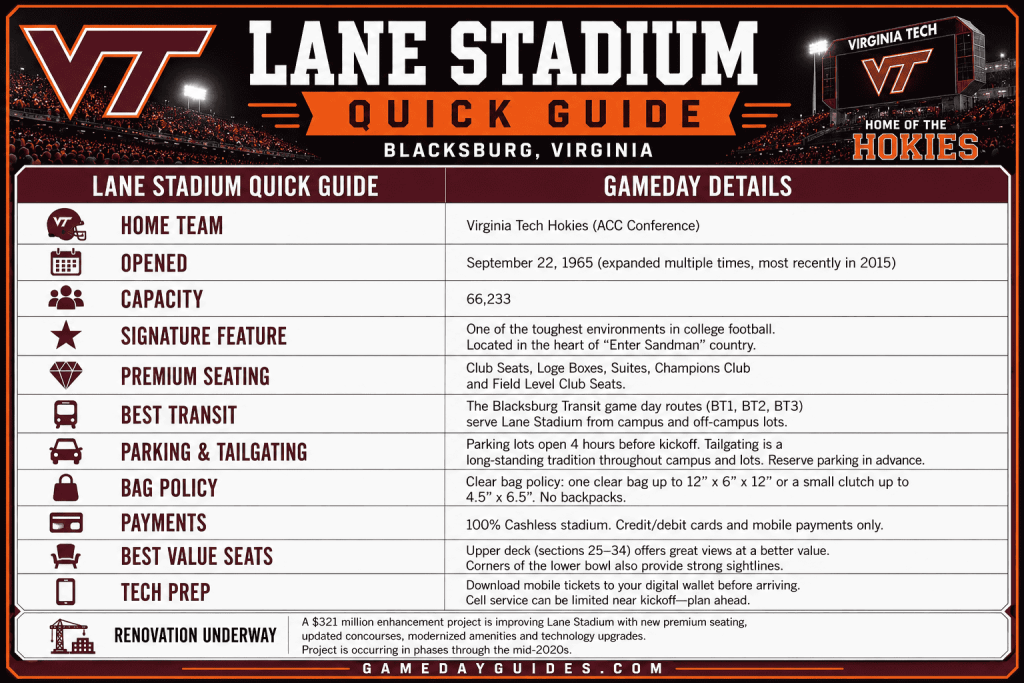
Lane Stadium holds 65,632, a figure that’s been stable since 2012 and sits mid-pack for the ACC — smaller than the Big Ten giants, bigger than most of its own conference.
The lower bowl is a continuous 100-level ring; the 200 level runs above the south end zone and up the east side; the 400 level is a sliver on the south side. The press box tower and suites anchor the west sideline, the video board sits above the south end zone, and the north end — the open end where the team enters — is students.
The chart quirk that trips everyone up: Virginia Tech renumbered the entire stadium in 2024, moving sections and seat numbers into sequential order. Rows didn’t change. Anything written before that — old forum threads, older seat-view pages, some resale listings — will show single- and double-digit section numbers that no longer exist. If a number on a chart you’re reading doesn’t start with a 1, 2 or 4, you’re looking at the old map. Use the official interactive seating map for anything you’re about to spend money on.
You can explore the official VT seating map to zoom in on specific sections and rows.
Hokies Tickets and How To Get Them
Season seats run through hokiesports.com and are tied to Hokie Scholarship Fund giving, so the better locations carry a per-seat donation on top of the ticket. For everyone else, the secondary market is the shop. Hokie Nation turns out regardless of record — the program cleared 59,000 a game during a three-win season — which puts a floor under prices that a lot of comparable programs don’t have, and demand for the better seats has climbed sharply with the coaching change. The rivalry game against Virginia and any visit from a ranked opponent price like postseason games; buy those the week the schedule drops. Non-conference games against Group of Five opponents are where softening happens, and day-of listings from season-ticket holders dumping seats are a real play on those. Everything is mobile — no paper tickets, and screenshots aren’t guaranteed to scan, so load them to your wallet before you leave the hotel.
You can also grab Hokies Tickets through our partner at Vivid Seats, for football, basketball or just about any event on the planet.

Lane Stadium Bag Policy
Virginia Tech runs a strict clear bag policy. You get one clear plastic, vinyl or PVC bag no bigger than 12″ x 6″ x 12″, or a one-gallon clear freezer bag, and you may carry a small clutch of 4.5″ x 1″ x 6.5″ alongside it. The trap: fanny packs of any type are banned, clear ones included. So are purses, backpacks, cinch bags, diaper bags, camera cases and seat cushions with arms or backs.
There is no bag check and nothing is held at the gate — an oversized bag goes back to your car or in the bin, and anything left outside gets collected and discarded. Medical items clear at a designated gate after inspection.
Lane Stadium is Cashless and Other Policies To Know
No re-entry. Once you leave Lane Stadium, you’re not getting back in. Plan accordingly — use the restroom, eat enough food, and make sure you don’t need anything from your car before you go through the gates.
Everything inside is cashless and there are no ATMs. Cards, Apple Pay, Google Pay. Beer and seltzer are sold at designated stands, two per ID per transaction, ID checked regardless of how old you look, and sales stop at the end of the third quarter.
Phone charging — bring a portable battery pack. Between mobile tickets, photos, social media, and maps, your phone battery will take a beating on gameday. There are no reliable public charging stations inside the stadium.
Virginia Tech Gameday Tips
A fall Saturday in Blacksburg runs on a script the locals know cold, and most of what makes this place special happens outside the four quarters. Here’s how to slot into it like you’ve done it before.
Enter Sandman at Lane Stadium: The Best Entrance in College Football
The team has come out to Metallica since 2000, and the thing that makes it different from every other stadium anthem is that the whole bowl jumps. Not the student section. The whole bowl. Johnny Cash’s “God’s Gonna Cut You Down” plays first as the players gather at the north tunnel, the video board runs its build, and then the riff drops and 65,000 people start moving in unison. You feel the concrete flex under your feet.
It is a measurable event, not a figure of speech. The Virginia Tech Seismological Observatory sits about a mile from the stadium, in a Cold War–era fallout shelter out by the Executive Airport, and its seismograph picks up the jumping at the start of every home game. The Geosciences department posts the seismograms game by game on its site — if you were there, you can go look up the trace your row helped make. When Metallica themselves played Lane on May 7, 2025 and closed with the song, the crowd registered what local media christened the Metallica Quake.
Be on your feet before the song starts, and don’t watch it through your phone. First-timers get caught flat because the build is slow and the drop is sudden. If you’re in the upper deck, keep a hand near a rail — the pitch up there is steep and the bouncing catches people out. Straight after, the stadium locks arms and sways through “we’re ready… we’re ready… we’re ready for y’all” into kickoff, and fans keep singing the Metallica lyrics well after the audio cuts, so learn them.
For the entrance specifically, the north end is the seat. The students own the north end zone and sit directly behind the tunnel; the next best thing without a student pass is the lower north corners, close enough that the jump arrives as a physical thing rather than a view of it. From the west sideline at midfield you get the entrance plus the best football sightline in the building, which is the trade most visitors should take.
Arrival Strategy and the Hokie Walk
Get to the Hokie Walk about two hours out. The Highty-Tighties — the Corps of Cadets regimental band — lead the players, coaches and spirit squads from the athletic complex to the stadium while fans pack both sides of the route. It’s the closest you get to the team all day. For a marquee game, stake a spot 20 to 30 minutes early; the rope line fills fast.
Gates open two hours before kickoff and every gate has a metal detector. Add time. Gates 1, 2 and 3 serve the south, 4 and 5 the west, 6 the northwest, and 7 is students only. Check the gate map against your section rather than walking to the first gate you see — the ring is bigger than it looks from the parking lot.
Download your ticket before you get near campus. All-mobile venue, self-scan pedestals, and cell service goes to mud once the crowd builds.
Tailgating at Virginia Tech
Hokie Village is the free fallback and it’s a good one. Set up on the turf practice field by the Beamer Way gate, it opens three and a half hours before kickoff and runs until 45 minutes before, with live music, food trucks and beer. No pass, no cost, and it’s the easiest place to land if you don’t have a tailgate of your own.
Campus lot tailgating requires a parking pass, and the closer lots run through the Hokie Club. Tailgates must stay immediately behind your vehicle, and the rules have teeth: no amplified sound systems or DJ gear, no thrown footballs or frisbees, nothing blocking roadways or sidewalks, and tents can’t go up before gameday morning. REVELxp runs turnkey tents if you’d rather show up to something already standing.
Center Street is the student scene, and it’s worth a walk-through even if you’re not partaking. Just off campus behind the east side, it’s where the student and young-alumni tailgate lives — stacked sound systems, balconies, porch parties. Be aware the town has tightened the reins in recent years with a party-registration system, fencing and a heavier police presence, so it’s a more controlled version of the legend you’ll hear about from someone who graduated a decade ago.
Food and Drink Inside Lane Stadium
The smoked turkey leg is the move, and yes, eating your own mascot is part of the joke. They’re enormous, you can smell them from sections away, and they’re the single most photographed thing in the building that isn’t the field.
Buy it in the first quarter, not at halftime. The concourses clear out fast at the half and you’ll spend ten minutes in line you’d rather spend in your seat.
If you’re drinking, note the ID rule. Everyone gets carded regardless of age, an out-of-state license can draw a request for a second form of ID, and it’s two drinks per transaction. Sales end when the third quarter does, so the fourth-quarter beer run doesn’t exist here.
Traditions a First-Timer Needs to Know
Skipper will make you jump the first time. The Corps of Cadets fires the cannon when the team takes the field and after every Tech score, and it’s positioned outside the stadium, so the bang arrives from a direction you’re not expecting. It was built in 1963 by a group of cadets led by Homer Hickam — the author of Rocket Boys, the book behind October Sky.
Bring your keys and shake them on third down. On key defensive third downs the whole stadium jingles car keys. It’s been going for more than 40 years and it’s the easiest tradition to join on your first visit.
Learn the call-and-response before you need it. “Let’s Go!… Hokies!” bounces between the east and west sides, one side shouting the first half and the other answering. In the red zone you’ll hear “Stick it in!” And at the end of the third quarter the entire stadium — band included — does the Hokie Pokey.
Watch the freshman cadets in the south end zone. After every Tech score they do push-ups on their classmates’ shoulders, matching the running point total. Late in a blowout it becomes its own event.
Two quieter symbols matter as much as the loud ones. The lunch pail represents the blue-collar defense and now carries the names of the 32 Hokies lost on April 16, 2007; the Hokie Stone in the tunnel, which players touch on the way out, is inscribed “For those who have passed, for those to come, reach for excellence.”
Check whether it’s an Effect game before you pack. The stadium coordinates a single color for designated games — white, maroon, orange for Homecoming — and being the one wrong dot in the picture is a small, avoidable regret.
Best Photo Spots at Lane Stadium
Shoot the jump from across the bowl, not from inside it. From your own section you get the backs of the people in front of you; from the opposite sideline you get 65,000 people in motion, which is the shot.
The upper rows on either sideline give you Lane framed by the Blue Ridge. That’s the photo that sells this place to people who’ve never been.
Outside, the Hokie Stone and the walk route are the postcards, and downtown the neon Virginia Tech flag at Top of the Stairs is the classic “I was in Blacksburg” frame.
Bringing Kids to a Virginia Tech Game
Hokie Village is the family anchor — free, fenced, food trucks, games, and the HokieBird working the crowd, all before you go anywhere near a turnstile.
Bring ear protection for small kids. Between Skipper and the jump, this is a genuinely loud building, and the reading isn’t a metaphor.
The lower south end zone is the family end of the bowl — straight-on view, close to family restrooms behind section 205, and none of the stand-all-game intensity of the north end.
Strollers are prohibited inside and there’s no bag storage, so plan to carry, and every person needs a ticket regardless of age, infants included.
Exit Strategy
The streets around the stadium clog the instant the whistle goes. If you drove and parked on campus, the patient play is to let the lot drain while you’re somewhere else — which is exactly what downtown is for. If you’re on transit, the Campus Shuttle back to the Transit Center is the fastest way out; just remember the Orange Loop shuts two hours after kickoff.
Lane Stadium Quirks Worth Knowing
Cell service inside a packed Lane crawls. With 65,000 phones on the same towers, texts stall and tickets load slowly. Download tickets in advance and pick a physical landmark to meet your group rather than relying on “text me when you’re here.”
Bench seating is the default. Rent a Hokie Seat at the gate for $15 if you want a back and an armrest — permitted in the east and upper south quadrants, and it also stakes out your width on the bench before the row fills in.
There is no bag storage anywhere on site. Whatever doesn’t clear the gate goes back to the car, and anything abandoned outside gets thrown away.
To report a problem discreetly, text (540) 739-0089 with the issue and your location. Lost and found lives in the South Tower lobby beside Gate 4 and clears out an hour after the game.
Some Side Trips in Blacksburg
If you’ve got a morning or a Sunday before you drive home, the mountains are the reason to linger. Cascades Falls in nearby Pembroke, about a 30–40 minute drive, is a Hokie bucket-list hike — a 4-mile round trip up a shaded creek to a 66-foot waterfall (take the rockier lower trail up for the scenery, the easier upper trail back; $3 to park, honor system). On the way back, Mountain Lake Lodge is the “Kellerman’s” resort from Dirty Dancing, with plaques marking film scenes and a short, steep sunset hike to Bald Knob behind it.
Closer in, the Huckleberry Trail is a flat paved rail-trail that’s perfect for a dog walk or an easy morning before kickoff, and campus itself rewards a wander — the Drillfield at the heart of it all, the Duck Pond, and the April 16 Memorial are worth the time, especially for alumni showing the place to someone new.

Getting to Lane Stadium
Blacksburg is nine miles north of I-81 on US-460 and it isn’t on the way to anything, so most people drive: about 45 minutes from Roanoke, three and a half hours from Charlotte, four to five from D.C. Park once and walk — this is a compact campus and the road network isn’t built for 65,000 people leaving at the same moment.
Lane Stadium Parking
Public gameday parking on campus is cashless and best bought in advance through the athletics site, in the Perry Street Garage, Data & Decision Science, Lower Stanger and Squires lots. Perry Street and Data & Decision Science hold back a limited number of day-of spaces payable by card at the gate; the other two are pre-purchase only. Lots open at 7 a.m. for Saturday games, and Beamer Way closes three and a half hours before kickoff, which changes how you approach the stadium from the north and east.
The tip that saves money and grief: your normal campus parking authorization is worthless on gameday. Parking Services permits — annual, daily and ParkMobile — are explicitly not valid in athletics-controlled game-day lots, and cars without the right pass get towed. Note too that some lot numbers were renumbered for 2026 even though the locations didn’t move, so if you’re working from a pass or a map from a previous season, check the current one. Local civic groups and a few school lots around town also sell spaces on gameday, which is often the easiest close-in option once campus fills.
Blacksburg Transit and the Campus Shuttle
Blacksburg Transit runs an expanded gameday schedule and it is free to every rider, which makes it the best answer if your hotel sits on a route. Every route except the Two Town Trolley drops at the Transit Center Loops near the Perry Street garage; from there the Campus Shuttle runs to stops near Cassell Coliseum, a short walk from the stadium. Extra service starts three hours before kickoff. Coming out, the Campus Shuttle leaves from Cassell back to the Transit Center Maroon Loop, and the Orange Loop closes two hours after kickoff — worth knowing before you plan a long postgame.
Rideshare
Uber and Lyft both operate here, but with a small-town driver pool: 20- to 30-minute waits and heavy surge after a game are normal. The designated pickup and drop-off area is on Washington Street next to the Hahn Garden. The better move postgame is to walk toward downtown first and request from there — you’ll pay less and wait less than everyone standing in the same spot outside the stadium.
Walking and the Huckleberry Trail
The local move is the Huckleberry Trail, the paved rail-trail everyone calls the Huck, which links downtown to campus and lets you skip gameday road traffic entirely on foot. If you’re staying downtown or anywhere along it, walking in is faster than driving in and immeasurably faster than driving out.

Hotels in Blacksburg
Blacksburg is a small town with a big stadium, so gameday weekends sell the good rooms out months ahead and push rates well past a normal Saturday. Marquee games go first and go early. If a specific game is the reason for the trip, book when the schedule drops, not when you get around to it.
Best Areas to Stay
Campus and Prices Fork Road — The walkable, do-it-once-right zone. Staying on or beside campus puts Lane and downtown both inside a manageable walk, which means the car stays parked from Friday afternoon until you leave. You pay for that, and it’s usually worth it.
Downtown Blacksburg — If the bars and the alumni reunion are the point of the weekend, stay on Main Street. You’re steps from everything and a straightforward walk to the stadium.
Christiansburg, about 15 minutes south — Where the value is. The chain hotels off I-81 run noticeably cheaper than anything in town; the tradeoff is a drive in and gameday traffic on the way. The right call if you’re booking late or watching the budget.
Hotel Recommendations
The Inn at Virginia Tech and Skelton Conference Center — The sentimental and practical first choice: the only hotel on the main campus, Hokie Stone exterior, and The Loyal restaurant and bar on site for a Friday dinner that doesn’t require moving the car. It books out earliest for football weekends, so grab it the moment your game lands on the schedule. It also runs gameday RV parking, which is a niche but real advantage. Splurge tier, and gameday rates say so.
Hyatt Place Blacksburg/University — Modern, close to campus, walkable to both downtown and the stadium, and consistently the most reliable of the mid-to-upper options when the Inn is gone. Walkability is the whole pitch.
Residence Inn Blacksburg-University — Suite-style with a kitchen, a mile and a half from Lane on Prices Fork, dog- and kid-friendly. The pick for a family or a group that wants space and a fridge for tailgate supplies. Comfortable middle.
Main Street Inn — The downtown play, a small property right in the middle of Main Street, so you roll out of bed into the bars and the walk to campus. Parking is tight and street noise is real; that’s the trade for the location.
Hilton Garden Inn Blacksburg University — A few miles out on Plantation Road with free parking and an easy drive in, which is exactly what you want if you’re arriving late Friday and don’t fancy negotiating downtown with luggage.
Budget Options
Holiday Inn Express & Suites Blacksburg–University Area on Plantation Road is the solid in-town value — free breakfast, free parking, a short drive to the stadium, no downtown premium. For the cheapest beds, the cluster off I-81 in Christiansburg (Hampton Inn and its neighbors) runs lower than anything in Blacksburg proper. You’re trading a 15-minute drive and some gameday traffic for real savings, which is the correct trade if you’re booking late.

Virginia Tech Gameday: A Football Saturday in Blacksburg
Here’s the thing about a Blacksburg football weekend: it’s a homecoming whether or not it’s Homecoming. Alumni drive in from D.C., Richmond and Roanoke on Friday night, downtown fills with people who haven’t seen each other since graduation, and by Saturday morning the whole town is maroon and orange. The center of it is a few blocks of Main Street and College Avenue that have been the heart of Hokie nightlife for decades. The storefronts turn over; the feeling doesn’t. You will run into someone you went to school with. That’s not a maybe.
The rhythm goes: breakfast somewhere on Main, out to the lots or Hokie Village by late morning, a walk down Center Street to see the students at full volume, the Hokie Walk two hours out, then into the bowl early enough to be standing when Enter Sandman drops. Afterward the town absorbs 65,000 people in about twenty minutes and everyone ends up within four blocks of everyone else.
Best Pregame and Postgame Bars in Blacksburg
Top of the Stairs — The one every alum has a story about, up its namesake staircase since 1978, home of the Rail and the neon VT flag everyone photographs. Know that it opens in the late afternoon and closes Sundays and Mondays, so it’s a postgame and Friday-night spot, not a pregame one.
Hokie House — “Ho House” to anyone who’s been. Two floors of decades-old sports-bar comfort, walls papered in Hokie gear, cheap and unpretentious, and the rare place where students and parents both end up happily. Open from late morning, so it works before the game too.
Square 5 Public House — The grown-up answer downtown: a proper pub with actual food, open from late morning, and noticeably less of a student crush than the College Avenue bars. Where locals go when they want to hear each other.
PK’s Bar & Grill — Big, loud, north end of Main, a wall of TVs and enough room for a group of ten to land without a reservation. It’s a college bar and it behaves like one, but for an early kickoff or a watch-the-other-games afternoon it’s the easy call.
540 Social — Arcade games, axe throwing and food under one roof, which makes it the practical answer if your group includes people who are not that interested in the football conversation.
Best Restaurants in Blacksburg
The Maroon Door — The step-up option, an upscale brewery and scratch kitchen for the Friday-night dinner that feels like an occasion before the weekend gets loud. Mid to upper range.
622 North — The fine-dining pick in town, a wine list that’s genuinely good, and the place to take parents or make a night of it. Reserve on a game weekend. Upper range.
The Blacksburg Tavern — A house turned restaurant on South Main doing Appalachian cooking and fried chicken people drive for, and it opens at noon on Saturdays. Mid range and worth the walk.
Namaste Kitchen — Nepali and Indian on North Main, big portions, quick service, open all afternoon. The best value dinner downtown and a welcome change from three days of bar food. Mid range.
G2’s All American Grill — Burgers and wings on College Avenue, tiny inside, sidewalk tables when it’s warm, cheap enough to feed a group before kickoff. The unglamorous, correct answer for gameday lunch.

Why You Should Go
Lane Stadium earns its reputation honestly. Feeling 65,000 people move the ground under you is a thing you cannot get from a broadcast, and the seismograph a mile away has the receipts. But the real pitch is the whole weekend: a tight mountain college town where football is the centerpiece and the rest — the downtown bars, the turkey-leg smoke, the walk down the Huck, the reunions that happen by accident — is what you actually remember. It’s a trek to get to Blacksburg. That’s exactly why the people who make it keep coming back. And it always hits you right in the chest. Go Hokies!
Check out our other College Football Guides as well as these regional gems:
Northwest Stadium and Nationals Park in D.C
Bank of America Stadium in Charlotte
Written by Brad Richards. Founder of Gameday Guides. This guide includes insights from personal visits as well as updated info from team sources, fan forums, and stadium policies. We aim to help you plan with confidence — enjoy your gameday. If you have any tips, if we missed anything or you have a question, don’t hesitate to shoot us an email.