

Best Seats At Rice-Eccles Stadium
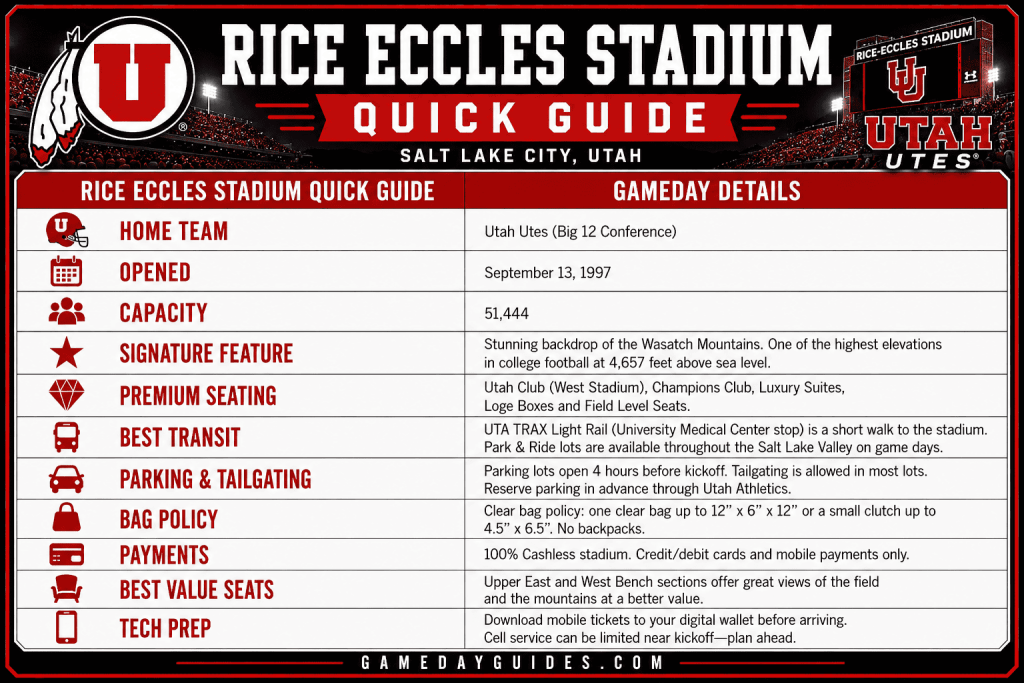
Rice-Eccles Stadium sits at 4,637 feet on the University of Utah campus, backed by the Wasatch Mountains and overlooking downtown Salt Lake City — it’s one of the most visually stunning settings in college football. The 51,444-seat venue opened in 1998, hosted the Opening and Closing Ceremonies of the 2002 Winter Olympics, and has been one of the toughest places to play in college football for two decades. The Utes have strung together 90-plus consecutive sellouts dating back to 2010, and the 2021 completion of the Ken Garff Red Zone enclosed the south end zone and turned the bowl into a noise trap.
One honest reality: this is a dry stadium — no alcohol is sold inside for football games — so plan your pregame accordingly. That said, the atmosphere inside more than makes up for it, and this guide will help you find the best seat to experience it.
Rice-Eccles Stadium Seating Overview
The field runs north-south and the sections run in one continuous numbered ring with a letter prefix telling you which side you’re on: W6 through W18 up the west side, N19 through N29 behind the north end zone, E30 through E42 up the east side, and S43 through S51 in the south end zone. That means the section number alone doesn’t tell you much — E30 sounds like a low number but sits near the north corner, not midfield.
The single most important thing to know is that the Utah bench is on the east side, in front of E35–E37, and the visiting bench is on the west in front of W11–W13. The MUSS student section owns the entire southeast corner. Get those two facts straight and the chart reads itself.
The other thing that separates seats here: chairbacks. Most of the bowl is aluminum bleacher. The chairback “Red Seats” are concentrated in the midfield sideline blocks on both sides, which is also where the best sightlines are — so comfort and view are priced together rather than as separate decisions.
Best Non-Premium Seats at Rice-Eccles Stadium
Sections E35–E37 (East Sideline, Midfield). This is the home sideline at the 50, with chairbacks in every row and the Wasatch behind you when you turn around. E36 is dead center. It’s the most expensive non-premium block in the building, and on a rivalry weekend it prices closer to premium than to general seating.
Sections E34 and E38 (East Sideline, Toward the Corners). Same chairback block, same side of the field, a few yards off midfield and noticeably cheaper. E38 puts you right on the shoulder of the MUSS, so you get the student-section noise without needing a pass. You lose the true center angle and pick up a slight lean toward one end zone.
Sections W10–W14 (West Sideline, Midfield). Chairbacks and a straight-on view of the field with downtown and the valley behind you, and you’re facing the mountains for the whole game. The catch is you’re sitting behind the visiting bench, and the corner of this side nearest the north end is where opposing fans cluster.
Best Value Seats
Sections E30–E33, lower rows. The east side above the chairback block goes back to bleachers, which is where the price drops. You’re still on the Utah side, still surrounded by season-ticket regulars, and low rows here put you close enough to hear the line calls. You give up seat backs and legroom, and the angle leans hard toward the north end zone.
Sections S47–S51 (South End Zone, Elevated). Chairback seats behind the goal posts in the Ken Garff Red Zone for well under sideline money. The elevation fixes most of what’s wrong with end zone seating, and you’re in the newest part of the building with the widest concourse. Deep passing plays toward the north end will always be a guess from here.
Cheapest Way Into a Utah Game
The north end zone, N19–N29. Cheapest real seat in the stadium, and it has one genuine advantage over the south end: the 7,800-square-foot videoboard is above the south end zone, so from the north you’re looking straight at it all game. This corner of the bowl is also one of the loudest. Long bleacher rows, no backs, and everything at the far end of the field is a rumor.
Standing room, when it’s released. Sold-out rivalry weekends sometimes leave SRO as the only way in. It gets you on the concourse with a rail view if you claim one early, and nothing if you don’t. Sideline rows run as deep as 66, so a bad SRO spot is genuinely worse than a high bleacher seat.
Our Pick
E38, rows 10 through 30. Home sideline, chairbacks, and close enough to the MUSS that you’re inside the third-down noise without buying a student pass — which is the thing first-timers actually remember about this place. It prices below E35–E37 for a difference of about fifteen yards.
Heat, Sun and Altitude at Rice-Eccles
September kickoffs at 4,637 feet in a high desert are brighter and drier than the thermometer suggests, and the sun does real damage before the temperature ever feels extreme. Sunscreen and water matter more here than at a sea-level venue at the same temperature — the stadium lets you bring an empty bottle in and refill it, which is the fix.
The other half of it is the drop. Once the sun goes behind the Oquirrhs, a 78-degree afternoon becomes a 50-degree fourth quarter in about forty minutes. Bring a layer to every game before November even if you’re sweating at kickoff, and note that umbrellas are prohibited — ponchos are the stadium’s own recommendation.
What to Avoid (and What’s Worth Trying Once)
Sections W11–W13. These are the best west-side sightlines in the stadium and they sit directly behind the visiting bench. If you’re rooting for Utah you’ll pay midfield chairback prices to spend three hours next to the away team’s staff, families and traveling supporters. Fine if you’re the visitor. Poor value if you’re not.
Sections W6–W9. The designated visiting fan block, with the away band placed at the front. Show up in red here and you’re the away fan. The seats themselves are unremarkable anyway — corner angles toward the north end.
Worth it once — the MUSS, E38–E42. Six thousand students, capped, $50 for the season, which includes the pregame tailgate. They stand the whole game, do the Third Down Jump on every opposing third down, and hang a “5” over the railing to tally false-start yards when the noise works. It’s a corner section, so the far end zone is a long way off and you’re on aluminum for three-plus hours. If you’re not a student, E38 next door is the workaround.
Premium Seating & Clubs
Premium at Rice-Eccles splits across two eras. The west tower holds the original 1998-era suites and club seats on the fourth and fifth floors. The south end zone holds everything built in 2021 — suites, loge boxes, ledge seats and a field-level club — and that’s where the good stuff is.
The Best Premium Experience
The field-level club in the south end zone. Indoor-outdoor space with a patio that puts you at ground level a few steps off the playing surface, with full food and beverage service. Nothing else in the building gets you that close, and the sightline down the field from behind the end zone at field height is a completely different game than watching from a suite. It’s the hardest premium space here to get into on a single-game basis.
Best Value Premium
Premium Terrace in the Ken Garff Red Zone. Chairback seats, a dedicated concourse, and — the part that changes the math — all-you-can-eat concessions at the two stands on that level. For a family of four or anyone who grazes, the included food closes most of the gap to the ticket price over a standard end zone seat. This is the premium tier I’d point a normal person at.
Other Premium Options
Loge boxes in the south end zone are semi-private four-to-six-seat setups with dedicated service, and they’re the sweet spot for a small group that doesn’t need a full suite. Ledge seats in the same structure are the lightest-touch premium option. West tower club seats on the fourth floor are the older product — indoor-outdoor, glass looking east at the Wasatch, and worth it mainly for a cold late-November kickoff.
Suites and Group Options
Rice-Eccles has 25 executive suites across the west tower’s fourth and fifth floors and the south end zone. They’re mostly held by donors and corporate partners; single-game availability comes and goes and runs through an inquiry form on the stadium’s premium hospitality page rather than an open sale. Expect a hard premium on the BYU game.

Rice-Eccles Stadium Seating Chart
Rice-Eccles seats 51,444, which makes it one of the smaller venues in the Big 12 — and it plays much bigger than that because the bowl is fully enclosed and steep. Actual attendance regularly beats the listed number; the record is 54,383 against BYU in 2024. It’s an open-air stadium with no roof and no retractable anything, on FieldTurf.
The chart’s one real quirk is the numbering. Sections don’t restart per side — they run continuously around the ring, W6 to W18, N19 to N29, E30 to E42, S43 to S51, with the letter telling you the compass side. So a “low” number like W6 is a corner and a “high” one like E42 is also a corner. Premium sections in the south end zone use separate S, SC and L prefixes on top of that.
Utah publishes a 3D interactive seating map that shows the actual view from any section
Utah Football Tickets
Utah’s sellout streak dates to 2010 and has passed ninety straight games, so walking up on gameday isn’t a plan. The primary market moved to Paciolan and lives at UtahTickets.com, with tickets managed in the Utah 360 app. The useful pattern for a visitor: Utah’s season-ticket base is large and loyal but doesn’t attend every game, so resale inventory builds steadily and typically softens inside the last 48 to 72 hours for non-marquee opponents — bleacher and north end zone seats are where face value gets beaten most often.
The exception is the rivalry: the BYU game prices like a postseason game and never comes down, so buy it the week the schedule drops rather than waiting. Chairback sideline blocks are the one place where the secondary market consistently runs above face all season.
Get your tickets to Utah Football, Basketball, the Jazz or Mammoth through our partner Vivid Seats.

Rice-Eccles Stadium Bag Policy
For Utah athletic events, one clear bag per person no larger than 12″ x 12″ x 6″, or a one-gallon clear storage bag, plus a small clutch for privacy items. No backpacks, purses or non-clear bags of any kind. Diaper bags are allowed with the infant present and are searched; medical supply bags are allowed with inspection. Note that concerts and non-Utah events at this stadium run a stricter no-bag policy, so a rule you followed at a summer show doesn’t apply in the fall.
Every main gate has a no-bag express lane, and it is meaningfully faster. Entry is now NFC tap-to-scan followed by weapons detection, so having your ticket already in your phone wallet before you walk up is the difference between ten seconds and two minutes.
Key Venue Policies
Rice-Eccles is dry, including the premium levels. No alcohol is sold anywhere in the building on gameday and none may be brought in — guests found with it are escorted out. The only exception in Utah’s policy is service in the stadium’s reception rooms for privately rented events that are closed to the general public, with no U students present and no charge for the alcohol, which means it can never apply to a football Saturday. So no, there’s no suite or club workaround here. Aluminum cans, coolers, artificial noisemakers, personal cameras and video recorders, and umbrellas are also prohibited. Phone cameras are fine.
Fully cashless, with no fallback. Every transaction is card or phone payment, and the ATMs have been removed from the building. There are no cash-to-card kiosks. Cash is genuinely useless here.
No re-entry, ever. Once you scan in you’re in. Combined with the dry policy and the two-hour gate window, that shapes the whole day — do your eating and drinking outside first.
One sealed liter of water in, or one empty bottle. Factory-sealed, one liter or less, not frozen; or bring an empty reusable bottle (no glass) and use the filling stations on the concourses. Accessibility is solid — all restrooms are ADA compliant, and Utah runs StreamText live captioning that you can pull up on your own phone in over 180 languages.
For a full updated list of all polices check the Utah Athletics website.
Getting to Rice-Eccles Stadium and Parking
Rice-Eccles is on the University of Utah campus on the east side of Salt Lake City, about 3 miles east of downtown. The address is 451 South 1400 East, Salt Lake City, UT 84112 (for your GPS/Google Map purposes). Getting there is straightforward, but gameday traffic is a reality.
Rice Eccles Stadium Parking
Campus lots require a pass and the good ones go to season-ticket holders and tailgaters long before gameday; general lots open about five hours out and premium lots at 6 a.m. Guardsman Lot southeast of the stadium is the tailgate epicenter and fills first. Street parking in the residential blocks east and south of campus is signed and enforced — read the sign, not the empty curb. If you’re driving to campus, be there three hours early or don’t bother.
The move nobody writes about: park at a TRAX station down the Red Line and ride in, because your game ticket is your UTA fare for the entire day under the Ticket As Fare program. That’s free rides on TRAX, bus and the S-Line, both directions, and it turns a $30 parking problem into a $0 one.
TRAX Light Rail and Rideshare
The UTA TRAX Red Line stops at Stadium Station, which is directly west of Rice-Eccles — a 3 to 5 minute walk to the gates. The Red Line runs from the University of Utah Medical Center all the way to South Jordan/Daybreak, with 26 stations along the route. Park at any TRAX station and ride in. Your game ticket doubles as your fare on all UTA transit for the entire day, so it’s literally free. After the game, trains queue up at Stadium Station waiting for fans. The ride from downtown is about 15 to 20 minutes. This is the single best piece of gameday advice for visitors.
Rideshare. Uber and Lyft both work well for getting to Rice-Eccles, though expect surge pricing around kickoff and immediately after the game. Lyft has a designated pickup zone on 500 South, southwest of the stadium. All other rideshares pick up on 1300 East between the S.J. Quinney College of Law and Presidents Circle. Drop-offs are on 500 South as well. Budget $15-25 from downtown before surge. After the game, walk a few blocks away from the stadium to reduce your wait and surge pricing.
Walking & Biking. If you’re staying near campus or downtown, walking is viable — it’s about a 40-minute walk from Temple Square. Bicycle racks are located at various spots around the stadium. The campus is bike-friendly, and it’s a pleasant ride on a fall afternoon.

Rice-Eccles Stadium Insider Tips
A fall Saturday here starts early and outside. The tailgate does the work the stadium can’t, the walk from the TRAX platform gives you the mountains and the Olympic cauldron on the way in, and the noise inside a fully enclosed 51,000-seat bowl at altitude is the reason opposing coaches talk about this place. Here’s what to actually do with the day.
Rice-Eccles Stadium History and the Olympic Connection
The Olympic thread here is live, not historical. Rice-Eccles hosted the 2002 Winter Olympics Opening and Closing Ceremonies, and it’s slated to host the Opening Ceremony again for the 2034 Winter Games — no other college football stadium in the country can say either thing.
The bones are from 1927. The venue opened as Ute Stadium, became Rice Stadium in 1972, and was demolished and rebuilt in under ten months between the 1997 and 1998 seasons so the program never missed a home schedule. The Ken Garff Red Zone in 2021 closed the last open end and added 5,637 seats.
Arriving at Rice-Eccles Stadium: Gates and Timing
Gates open two hours before kickoff, not ninety minutes. Plenty of sites still say ninety. Two hours is the current, official number.
Use Gate L on the southeast corner at 500 South. It has the most scanners, sits closest to the Guardsman Lot tailgate, and it’s where the team arrives — so you can walk out of the tailgate and into the building without crossing the campus.
Be in your seat 30 minutes before kickoff. The Pride of Utah performs, the countdown runs, and the team run-out into a full bowl is the single loudest moment of the pregame. Arrive at kickoff and you’ve missed it.
Take the no-bag lane. Every main gate has one and most people don’t use it. Leaving the clear bag in the car is worth ten minutes on a sellout.
Utah Football Tailgating
Guardsman Lot southeast of the stadium is where the real tailgate is. Tailgate Island inside it is the dense middle — food trucks, live music, grills. Premium lots open at 6 a.m., general lots about five hours before kickoff, and 2.5 to 3 hours out is the sweet spot.
Tailgate Way on 500 South is the walk-through version. If you’re coming from TRAX or downtown you’ll pass straight through it on the way to Gate L, which makes it the easy option for visitors without a car or a canopy.
Utah Village sits north of the Eccles Tennis Center. It opens two hours before kickoff, and the ESPN 700 pregame radio show broadcasts live from it. Free, no ticket needed to hang around, and far less chaotic than the lots if you’ve got kids.
Drink here, because you can’t drink in there. This is the whole reason the pregame is as big as it is. No re-entry means the tailgate is a one-way trip.
Rice-Eccles Stadium Food and Drink
East Eats is the food truck alley on the east concourse. It’s the best eating in the building and most first-timers walk right past it looking for a traditional stand.
Mobile order from your seat. The Wi-Fi installed in 2024 made in-stadium mobile ordering actually work — order through the app during a TV timeout and skip the line entirely. The concourse is narrow for a stadium this size and jams badly at halftime.
The grab-and-go stand at Gate D uses AI touchless checkout. West side, near the main stadium stairs. Walk in, take what you want, walk out. It’s the fastest food in the building by a wide margin.
Premium Terrace tickets include unlimited food. Two stands on that level, all-you-can-eat, which is worth pricing out against regular seats plus four rounds of concessions.
Bring a bottle. One sealed liter or one empty reusable, and refill inside. The concessions map on the stadium site marks every filling station.
Utah Football Traditions
The Moment of Loudness runs between the third and fourth quarters. The lights go down, the crowd raises two fingers on each hand for #22 and holds up phone flashlights, and instead of a moment of silence the stadium erupts for 22 seconds in memory of Ty Jordan and Aaron Lowe, who both wore the number and died nine months apart. It’s the best thing that happens here. Don’t be in the concession line for it.
The Third Down Jump. Every opposing third down, the MUSS jumps on the aluminum bleachers with three fingers up while the rest of the bowl screams. When it draws a false start, a “5” goes over the railing to tally the penalty yards.
Red Thunder is back. The ROTC cannon, one of the program’s oldest traditions, disappeared from 2021 through 2024. Red Thunder II returned in 2025 and now fires from the northwest corner near the tunnel after every Utah score — paired with pyrotechnics off the south end zone board.
Flash the U. Both hands, block U shape. It’s the universal Ute greeting and it took off nationally after the 2009 Sugar Bowl win over Alabama. Throw it and you’re a local.
Look east for the Block U on the mountain. It’s been up on the foothills since 1905 and it lights up after Utah wins. Check “Stripe the Stadium” games too — for those, your section is assigned red or black, and it’s on the ticket.
Getting Out After the Game
TRAX is the exit strategy. Trains stack at the platform waiting to fill. If you park-and-rode, you’re moving inside ten minutes while the lots aren’t.
If you drove, don’t rush it. Guardsman Way south and 500 South west are the two bottlenecks and they stay ugly for half an hour. Walk back into the tailgate or up to a campus bar and let it drain.
Best Photo Spots at Rice-Eccles Stadium
The Olympic Cauldron is the shot. The refurbished 2002 cauldron sits on a 32-foot pedestal at the plaza outside the southwest corner, open year-round with no ticket required. No other college football stadium in the country has one.
Golden hour from the west stands looking east. Late-afternoon kickoffs put the last light directly on the Wasatch behind the east side. Ten minutes before sunset, from the upper west rows.
Gate L before the team arrives. The Ken Garff Red Zone facade behind you and a building crowd in front — the best atmosphere shot of the day.
The Utah 360 App and Stadium Wi-Fi
Utah 360 is the official app and you need it. Digital tickets, parking passes, in-stadium navigation and mobile concessions ordering all live there. Download your tickets and parking pass into your phone wallet before you leave the hotel.
The Wi-Fi is free and it works. Join “RiceEcclesWiFi.” No password, no registration. It’s better than most college stadium networks and it makes mobile ordering usable without burning data.
Opt into the alert line. Text UUTAH to 78015 for in-venue emergency and weather alerts. Given how fast weather turns on the bench in October, it’s worth thirty seconds.
Red Zone Team Store and Merch
The Red Zone store on the southwest concourse is the main one, and it’s crowded by kickoff. Go the moment gates open or wait until the fourth quarter. There are additional Red Zone points at Portals 7, 20 and 41.
There’s a Red Zone location in the Guardsman Way tailgate lot. You can buy gear without going through security or holding a ticket, which is the trick if you’re meeting people and don’t want to lose your spot in line later.
Bringing Kids to a Utah Game
Strollers aren’t allowed inside — but you don’t have to leave them at the car. Bag Storage in the College of Law, on the corner of Campus Drive and University Street just north of the stadium, checks strollers and wheelchairs. Almost nobody knows this and it saves the walk back.
Kids two and under get in free on a lap. Baby changing stations are in every men’s and women’s restroom, and there are two nursing pods, one on the east concourse and one on the west.
Premium Terrace is the family play if you’re upgrading. Unlimited food on the level means no negotiating a fourth trip to the concession stand. For regular seats, the mid rows of E30–E34 are the calmest part of the home side.
Ute Walk and Player Access
The Ute Walk is your best shot at the team, and it’s 2.5 hours before kickoff. Players and coaches walk from the Spence & Cleone Eccles Football Center down Guardsman Way and 500 South to the stadium. Line the route and you’re at arm’s length.
Be at Gate L for The Arrival. Food, live music, and an exclusive game-specific shirt for the first 75 fans there when the team pulls up. The shirts aren’t sold anywhere.
Post-game autographs are a maybe, not a plan. Utah’s own guidance is that players often sign when time and NCAA rules permit but nothing’s guaranteed. The tunnel end in the northwest corner is where to stand. Pregame warmups from the low rows are the more reliable window.
The 2027 NHL Winter Classic at Rice-Eccles Stadium
Rice-Eccles hosts the Discover NHL Winter Classic on December 31, 2026 — Utah Mammoth against the Colorado Avalanche, the franchise’s first outdoor game and the last of the league’s 32 teams to play one. Puck drop is late afternoon into East Coast prime time, on TNT.
Everything in this guide about seating geometry changes for it. A hockey rink is laid across a football field, so sideline sections that are worth a premium in the fall become the only seats with a real angle on the ice, and the end zones become distant. Tickets run through Ticketmaster for this one, not Utah’s Paciolan system.
Plan for actual winter and no re-entry. A New Year’s Eve afternoon in an open bowl at 4,637 feet, with the sun gone by the second intermission. Layers, hand warmers, and the same prohibited-items list — no umbrellas, ponchos only.
Things to Do in Salt Lake City on a Football Weekend
The Natural History Museum of Utah is a ten-minute drive up the hill from the stadium. Dinosaur fossils, Great Basin ecology, and a building cut into the foothills with a terrace looking back down over the valley. It’s the closest genuinely good thing to the stadium and it works as a Friday afternoon or a Sunday morning.
Drive Big Cottonwood Canyon if you’re here in October. Twenty-five minutes southeast of campus, and the first two weeks of October are peak color. You can do the drive and be back for a 4 p.m. kickoff.
Temple Square is on your way back downtown. It’s free, it’s a ten-minute walk from the TRAX line you’re already riding, and the grounds and architecture are worth an hour whether or not the religious history interests you.

Hotels Near Rice-Eccles Stadium
Salt Lake City is a great city with a functioning downtown and a train that runs to the stadium, so you’re not stuck choosing between a campus motel and a highway exit. That flexibility disappears on rivalry weekends — the BYU game books out months ahead, and so does anything walkable to campus.
Best Areas to Stay
University District and Foothill, immediately east and south of campus, is the walk-to-the-game choice. Quiet, residential, and nothing to do at night — but you’ll be at Gate L in fifteen minutes on foot while everyone else is in traffic.
Downtown, three miles west and on the Red Line, is the right answer for most visitors. Bars, restaurants, and a 15-minute train ride that your game ticket already covers in both directions.
Sugar House, ten minutes southeast of campus, is the local pick — independent restaurants and a neighborhood feel rather than a tourist one. Weaker TRAX access, so it’s a driving base.
Hotel Recommendations
Salt Lake City Marriott University Park is the closest full-service hotel to the stadium, about a mile on foot through campus. Two restaurants on site and the shortest gameday walk of anything in this list. The tradeoff is that the area empties out at night — you’ll be taking TRAX downtown for dinner anyway.
University Guest House is the on-campus option, smaller and more residential, with free parking. It’s the one to book if you’re visiting a student or you want to be inside the campus atmosphere rather than adjacent to it.
The Grand America is the downtown splurge — full spa, multiple restaurants, the nicest property in the city by a distance. Fifteen minutes from the stadium on the train and it goes first on big weekends.
Kimpton Hotel Monaco has actual personality, which is rare downtown, and puts you inside the Main Street bar district. Best pick if the pregame scene matters as much as the game.
Little America is the Salt Lake institution — dated in the good way, indoor and outdoor pools, and priced well below what the size of the rooms suggests. Good for families.
Hampton Inn & Suites University-Foothill is the reliable middle: free parking, southeast of campus, short drive or train to the gates. Nothing memorable, nothing wrong.
Budget Options
Hyatt House Downtown is extended-stay format with kitchenettes and pet-friendly rooms, two miles out with good Red Line access. You’re trading atmosphere for a fridge and a lower nightly rate, which is a fine trade for a three-night stay.
The chain motels along the I-15 corridor through Murray and Midvale are the genuine value floor. You’re 15 to 20 minutes out by car, but the Red Line runs down that way — so park at a station and your game ticket covers the ride. You give up walkability entirely and there’s nothing to do where you’re sleeping.

Utah Gameday Scene: Where Fans Go in Salt Lake City
Because the stadium is dry, everything social about a Utah gameday happens outside the gates, and the day has a rhythm you can feel from the moment you step off the train. Guardsman Way starts smelling like charcoal by mid-morning. Alumni claim the same patch of asphalt they’ve had since the Mountain West years and spend more time working the row of neighboring canopies than watching whatever’s on the TV strapped to the tailgate. There’s no formal invitation to any of it, and that’s the part visiting fans consistently report back on — wear the wrong colors, walk up to a grill, and you’ll usually leave holding a plate. Utah friendliness is a thing here. Then the drums start up on the corner for the Ute Walk and the whole lot drains toward 500 South at once.
Afterward it swings the other way. There’s nowhere to linger in the building, so the crowd empties fast — some back into the lots to finish what’s left of the cooler, most onto TRAX and down the hill, where Main Street and 300 South fill with red inside an hour. If you’re in from a Big 12 town for the first time, that hour on the train and that first bar downtown is where you’ll actually meet Utah fans, and it’s worth building into the day rather than driving straight back to the hotel. Come in Friday if you can: this is a real city with a proper dinner scene and mountains twenty-five minutes away, and it rewards a night on the front end more than most college towns do.
Best Pregame and Postgame Bars
The Pie Underground on 200 South is the campus rite of passage, a basement pizza place with graffiti covering every surface and decades of students’ initials on the walls. Loud, cash-cheap and packed by late morning — this is the alumni nostalgia stop.
Green Pig Pub downtown has Ute memorabilia everywhere, including the original Rice Stadium sign hanging inside, and a Saturday brunch built around early kickoffs. It’s a block off the 400 South TRAX line, which makes it the easiest pregame-to-stadium handoff in the city.
Squatters Pub Brewery on 300 South is a real brewery with a real kitchen rather than a sports bar that pours beer, and it’s the place to solve the “what do people drink in Utah” question before someone asks it in the lot. Chasing Tail Golden Ale is the local order.
Whiskey Street on Main is the grown-up option — proper cocktails, a serious food menu, and the room that fills first after a night win. Best pick if your group skews more reunion dinner than tailgate.
Best Restaurants in Salt Lake City
Red Iguana on North Temple is the city’s most famous restaurant and earns it; the moles are the whole point and the reason there’s always a line. Go at four o’clock or accept the wait. ($$)
Pago in the 9th & 9th neighborhood is the best dinner in Salt Lake — small, seasonal, and the place locals send visitors who want to be surprised. Book it for Friday night, not gameday. ($$–$$$)
HSL is the other 9th & 9th pick, looser and more comfortable than Pago, with a Sunday brunch that works as a last meal before the airport. ($$)
Even Stevens is the fast option that isn’t a compromise — a local sandwich shop that donates a sandwich for every one sold, and the right eleven-a.m. base layer before a long afternoon in the lots. ($)

Why You Should Go
Rice-Eccles is truly one of the great gameday secrets in the country. You get a mountain backdrop that photographs like a postcard, a fully enclosed bowl at altitude that gets genuinely loud, traditions like the Moment of Loudness that feel earned rather than manufactured, and a train that drops you at the gate for free. It’s a small stadium that plays enormous — and the dry-stadium quirk that sounds like a drawback is exactly what makes the tailgate outside one of the best in the sport.
Check out all of our College Football Guides as well as these Big 12 gems:
and dont forget the Delta Center.
Written by Brad Richards, Founder of Gameday Guides. This guide includes insights from personal visits as well as updated info from team sources, fan forums, and stadium policies. We aim to help you plan with confidence — enjoy your gameday. Shoot me an email if we missed anything or need any corrections.