


Save the quick guide above to your phone and explore our guides to Marvel Stadium and the MCG
Best Seats at Rod Laver Arena
Every January the tennis world turns its attention to a blue court beside the Yarra River, and the stadium wrapped around it is Rod Laver Arena. This is where Australian Open champions are crowned under lights, often well past midnight, and for the rest of the year it swaps the net for a stage and runs as one of the busiest concert arenas on the planet. It opened in 1988 as Centre Court of what was then Flinders Park, with the first retractable roof of any Australian venue, took Rod Laver’s name in 2000, and holds just under 15,000 people, so even the top rows feel close.
The honest reality is that the bowl was built around a tennis court rather than a stage: in concert mode the southern end folds away, and where you sit relative to the stage matters more than which price tier you buy. Here’s how to choose, for a show or for the tennis.
Seating Overview at Rod Laver Arena
Rod Laver Arena is a two-tier bowl: a lower level of sections 1 to 18 running in a ring, and an upper level numbered from 20 into the 50s. For end-stage concerts the stage goes at the south end, so section 1 at the north end sits dead centre, facing it across the floor, while the sections on either side wrap down the long sides towards the stage. The floor is general admission standing or reserved seated blocks, depending on the show. For tennis, the southern seats roll back into place and the court is surrounded on all four sides.
Best Non-Premium Seats
Concerts: lower level, section 1 and its neighbours (2 and 18) — the straight-on view the lighting rig, screens and staging are designed for, with every screen in your eyeline. The catch is the front-of-house sound desk on the floor in front, which can clip the view from the lowest rows if you’re short.
Concerts: lower level, the long sides (roughly 3 to 6 and 14 to 17) — closer to the stage than section 1, at a three-quarter angle that still takes in the screens. You trade a little of the full production picture for proximity.
Australian Open: lower level behind the baseline (the north end around section 1 and the south end around sections 9 to 11) — the broadcast view, where you read the depth, spin and angles of every shot. These are the most sought-after tennis seats in the building and priced accordingly.
Australian Open: lower level along the sides — the closest you’ll get to the players, but you swivel your head for every rally. Great for one match, tiring for a full session.
Best Value Seats
Concerts: “restricted view” seats in the lower level beside the stage (around 7–8 and 12–13) — sold cheaper because a speaker stack or the edge of the set gets in the way, yet fans repeatedly report being among the closest seats in the house. You’ll often lose sight of the big screens, so check fan photos for the tour; a glass rail is a minor nuisance, a speaker stack is not.
Concerts: the front rows of the upper level, straight on — a clean angle over the whole floor for well under lower-level prices. The first row sits behind a glass balustrade, so a row or two back is better.
Australian Open: the first rows of the upper level behind the baseline — the whole court reads clearly from up there at a fraction of lower-level prices, and in a day session the upper level gets more shade.
Cheapest Way In
Concerts: upper-level side sections are the lowest-priced seats at most shows, and the building is compact enough that they never feel as distant as the top tier of a 20,000-seat arena. The back row can have speakers hanging across the top of the screens, so avoid the very last rows.
Concerts: general admission floor is usually priced in the middle tier, but it’s the cheapest way to be within metres of the stage. You stand all night, bags aren’t allowed in the standing area, and your view depends on how early you queued.
Australian Open: an early-round session in the upper level is the cheapest reserved seat on Rod Laver Arena, and first-week tickets cost a fraction of the second week’s.
Australian Open: a finals-weekend ground pass, when it includes the arena. In 2026, ground-pass holders were let into Rod Laver Arena for the day sessions on the final Saturday and Sunday, with the doubles, junior and wheelchair finals. Check the inclusions on your chosen day before buying.
Our Pick
For a concert, the lower level one or two sections either side of section 1, in the middle rows — the centred view without staring over the sound desk, and high enough that the floor crowd never blocks you. For the tennis, the front rows of the upper level behind the baseline at a first-week night session — the full court, the best atmosphere and the price of an early round.
What to Avoid (and What’s Worth Trying Once)
Concerts: the upper level closest to the stage on either side — side-on angles, speakers in the way and, for most productions, little or no screen visibility. Pay a little more to move round the bowl.
Concerts: seated floor blocks towards the back — flat floor, no rake, and every head in front of you is in the way. A lower-level seat at the same price is almost always the better view.
Australian Open: seats marked “Restricted View” on Ticketmaster — usually a handrail in your line of sight. The umpire’s chair and court furniture don’t count as restricted, so check their position on the map too.
Worth it once: general admission at the barrier. The arena is small enough that the front of the floor feels like a club show compared with a stadium tour. Queue early, accept the standing, and see it from the barrier at least once.
Best Seats for In-the-Round Shows, Sport and Family Events
When a tour plays in the round, the stage moves to the middle of the floor, the southern end comes back into play, and section 1 is no longer special. Pick the lowest lower-level row you can afford on any side, but check fan photos from the tour first: some central-stage productions stand on support towers that block part of the view.
For netball, WWE, comedy and family shows, the playing area runs the length of the arena, so the centre of the long sides is the best view and the ends are cheaper.

Premium Seating at Rod Laver Arena
Premium here is a short list: private suites, a sit-down restaurant and a card-member lounge, plus promoter VIP packages for individual shows. During the Australian Open, Tennis Australia runs its own hospitality program.
The Best Premium Experience
Australian Open hospitality is the premium experience this building is famous for. The packages pair a lower-level seat on Rod Laver Arena with dining and drinks in hospitality spaces around the precinct, such as the AO Glasshouse.
They are sold by Tennis Australia and its authorised agents, and selling an unauthorised package to the AO is an offence in Victoria, so book only through an official seller.
Best Value Premium
Book a table at Railyards and keep your regular ticket. The Level 3 restaurant serves an à la carte menu before the show to anyone holding a Rod Laver Arena ticket, so you get the sit-down dinner and a calm pre-show bar without paying suite prices. Book through OpenTable, because walk-ins depend on space. If you carry an American Express card, card members can walk into the American Express Lounge on Level 3 without a booking, via the lift opposite Door 14.
Other Premium Options
G.H. Mumm Champagne Bar and the Upper Deck bar are both on Level 4, for a quieter drink away from the main concourse. Promoter VIP packages vary by tour, and VIP holders often enter early through Gate 5 on Olympic Boulevard. The promoter contacts buyers with the details.
Suites & Group Options
Rod Laver Arena’s suites were refurbished with local timber and seat 12 or 18 guests, with catering built around Victorian produce. They can be leased for a single event or permanently, and are sold only through Melbourne Park’s premium team.

Rod Laver Arena Seating Map & Capacity
Rod Laver Arena holds about 14,500 people for most events, the venue’s own figure, and the tennis bowl is usually quoted at 14,820. The record crowd is 16,183, for Justin Timberlake’s in-the-round show in November 2007.
The seating map has one quirk worth knowing: lower-level rows use single letters (A, B, C) and upper-level rows use double letters (AA, BB, CC), so a double-letter row tells you you’re upstairs before you look at the section. Seats labelled “restricted view” are flagged for anything from a speaker stack to a glass rail, and fans often find them better than the label suggests.
Here is the interactive Rod Laver Arena Seating Map for the Australian Open and you should be able to get a decent idea of your view for other events as well.
Does Rod Laver Arena Have a Roof?
Yes, and it’s retractable: two rolling sections, each spanning the court on arched trusses. When the arena opened in 1988 it was the first retractable roof at any Australian venue. The original mechanism took about 25 minutes to open or close; the replacement fitted in the redevelopment does it in about five minutes.
The roof is closed for every event except the Australian Open, and with it shut the bowl is climate-controlled — at the 2018 men’s final, played under a closed roof on a 38-degree day, Marin Čilić said it felt like 23 or 24 degrees inside.
Is Rod Laver Arena the Biggest Arena in Australia?
It’s the biggest indoor arena in Melbourne and the largest at Melbourne Park, ahead of John Cain Arena (about 10,500) and Margaret Court Arena (7,500), all three with retractable roofs. Nationally it’s second to Sydney’s Afterpay Arena, which holds about 21,000 with a standing floor.
Getting the Best Tickets
AXS is now Melbourne Park’s official ticketing partner for year-round events, replacing Ticketek from 22 August 2026, although a handful of shows booked earlier still run through Ticketek; your event page says which. AXS tickets display as an AXS Mobile ID that refreshes every 60 seconds, so a screenshot won’t scan. Log in to the app before you leave home and the ticket works offline.
Resell only through AXS Official Resale or Ticketek Marketplace: Melbourne Park says it cannot verify tickets bought on Viagogo, Ticket Merchant, Tixel, StubHub or Facebook Marketplace. Multi-night runs are normal here, so if the first date sells out, wait for the added show rather than paying a reseller’s mark-up.
What’s On at Rod Laver Arena
The calendar is mostly touring concerts, often over several nights, plus comedy, WWE, family shows and occasional sport. The arena converts to tennis mode from about mid-December to mid-February for the Australian Open, so there are no concerts in that window. For what’s on today or tonight, the official Rod Laver Arena events page lists every confirmed show with set times.
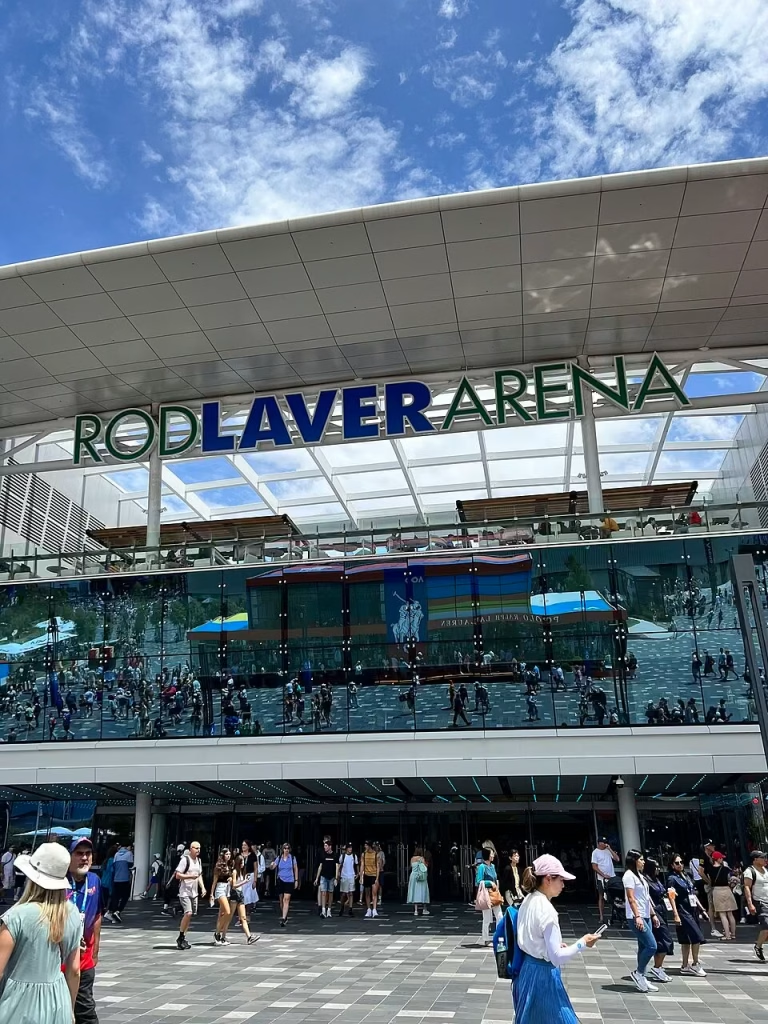
Rod Laver Arena Bag Policy
For most events, bags must be A4 size or smaller. Handbags are fine at that size if they have no studs or embellishments. At sport and family events, one bag per person that fits under your seat. No bags at all are allowed in the general admission standing area, along with studded belts and large earrings. Larger bags are allowed for medical reasons, and every bag is searched.
Cloaking locations are listed on each event page (for concerts, usually the Information Desk at Gate 4 or Show Court 3); suitcases and prohibited items are not accepted. At the Australian Open, the rule is one bag per person that fits under the seat, and suitcases are refused.
Is Rod Laver Arena Cashless?
Yes. All outlets are card-only, credit or debit.
Rod Laver Arena Gates and Entry Times
Gate 3 (via Garden Square) handles general admission at concerts. Gate 4 (via Olympic Boulevard) is for reserved seating and suites, and Gate 5 on Olympic Boulevard is for VIP packages. Gate times are on each event page; for a 7:30pm show they’re typically around 6pm. The time on your ticket is usually the support act, and the headliner follows an hour or more later.
Key Venue Policies
Pass-outs are allowed at some events but not others; check your event page before planning dinner outside, because without them there’s no re-entry. Small amounts of food may be brought in, and you can carry a soft plastic water bottle up to 750ml. Small handheld cameras are fine; detachable lenses over 300mm are not. Small umbrellas are allowed but must stay closed inside. Smoking and vaping are allowed only in the designated area on the external concourse. Anyone 12 and under must be with an adult.
Accessibility: ramps and lifts serve the seating bowl, there’s a Changing Places facility near Door 7 and a sensory room opposite Door 9, hearing augmentation receivers are at the Gate 4 Information Desk, Companion Cards are accepted, and accessible seats and parking are booked through AXS for most events.

Getting to Rod Laver Arena
Rod Laver Arena is in Melbourne Park on Olympic Boulevard, on the north bank of the Yarra River and about a 10-minute walk from Flinders Street Station. Public transport or walking is the best way in, since the on-site car park is small and fills on big nights.
Rod Laver Arena Parking
The official car park is the Eastern Plaza Car Park (Entrance D, Olympic Boulevard). Pre-booking saves about 30 per cent on the event-day drive-up rate. Pre-booking closes at midnight the night before, and drive-up spaces sell out on big nights. Entry and exit run on licence plate recognition, your booking allows one entry and one exit, and there’s a one-hour grace period either side of your booked time. If the car park is full, Melbourne Park points drivers to Yarra Park at the MCG, Secure Parking and Wilson Parking, or the limited on-street parking along the river at the Royal Botanic Gardens.
If you’ll arrive in a different car from the one you booked with, update the plate in your account up to an hour before arrival. Otherwise the gate won’t recognise you and you’ll be stuck at the help button while a queue builds behind you. Here is the parking guide from the arena website.
Public Transport
Tram route 70 runs along Flinders Street and stops at Stop 7B Rod Laver Arena, directly outside, with Stop 7C serving John Cain Arena. The Free Tram Zone doesn’t reach Melbourne Park except during special events such as the Australian Open and AFL Grand Final week, so tap on. Since June 2026 you can tap on with a bank card, phone or smartwatch on every Melbourne tram and train, so visitors no longer need a myki.
Richmond and Jolimont stations are both a short walk away, and Flinders Street is a 10-minute walk. Cranbourne, Pakenham and Sunbury line trains now run through the Metro Tunnel and skip Richmond, so riders on those lines should use Town Hall and walk or tram from Flinders Street.
Rideshare & Taxis
The rideshare pick-up and drop-off point is outside John Cain Arena on Olympic Boulevard, and Melbourne Park asks you not to order until you’re standing there. The taxi rank is next to Melbourne Park Oval, also on Olympic Boulevard. On a sell-out night, walking ten minutes toward Swan Street or into the city before booking avoids the worst of the surge and the jam on Olympic Boulevard.
Walking & Cycling
The walk from the city via Federation Square, Birrarung Marr and the Tanderrum Bridge takes about 10 minutes and is the best way in on a fine evening. Bike parking is on Olympic Boulevard outside Rod Laver Arena and John Cain Arena; bring your own lock.

Australian Open at Rod Laver Arena
For a fortnight in late January, Rod Laver Arena is centre court of the first Grand Slam of the year, and the whole of Melbourne Park becomes a festival. Every singles final is played here, and the roof stays open unless heat or rain closes it. The week before the main draw, Opening Week brings qualifying, open practice and exhibition nights.
How Australian Open Tickets Work at Rod Laver Arena
Australian Open tickets are sold only through Ticketmaster, and resold only through Ticketmaster Resale. The AO is a declared major event in Victoria, so reselling a ticket for more than 10 per cent above face value is illegal.
A Rod Laver Arena ticket gives you a reserved seat for one session, either day or night, plus access to the outside courts and general areas for that session. Day-session holders must leave the arena when the day session ends but can stay in the grounds. A ground pass does not include Rod Laver Arena. Early-round sessions are a fraction of the price of the second week, and the singles finals and men’s semi-finals carry a limit of six tickets per customer.
A ticket buys a session, not a player. The order of play comes out the day before and can still change, so if you’re travelling to see one star, buy a night session (where the biggest names are usually scheduled) and accept the risk.
Australian Open Courts and Arenas at Melbourne Park
Rod Laver Arena is the centrepiece, but the AO is played across the whole of Melbourne Park, and knowing which court needs which ticket saves a lot of wandering.
Rod Laver Arena (about 15,000, retractable roof) hosts the biggest matches every day and every singles final. Reserved seats only.
Margaret Court Arena (7,500, retractable roof) is the second show court, with its own reserved day and night sessions. It’s cheaper than Rod Laver and often has a top seed or two on the day’s schedule.
John Cain Arena (about 10,500, retractable roof) has its own reserved tickets through the first nine days and the loudest, most local crowds of the fortnight, especially when an Australian is playing. Late in the tournament it hosts the AO Live concerts.
Kia Arena (5,000), 1573 Arena and ANZ Arena (3,000 each) are open-air show courts, along with the numbered outside courts. Ground-pass holders get in first come, first served, so queue before the match you want rather than during it.
Pick your courts from the order of play. It’s released the day before, and a first-week ground pass on the outside courts puts you a few metres from seeded players for a fraction of an arena ticket.
What Surface Is the Australian Open Played On?
The AO is played on a blue acrylic hard court, supplied by GreenSet since 2020; Melbourne switched to blue from green in 2008. The US Open is also a hard court but has used a different surface maker, Laykold, since 2020, and the two events use different official balls. Players notice differences in bounce and pace between the two, but from the stands you’re watching the same game.
Day vs Night Sessions
Night sessions are the atmosphere. In 2026 they began at 7pm, usually two matches, with the biggest names often scheduled under lights, and finals start at 7.30pm. Day sessions give you more tennis, typically three matches, starting at 11.30am on Rod Laver Arena in 2026, earlier on forecast hot days. A night session can run very late, so check the last tram home before the final set.
Heat, Shade and the Roof
Melbourne in late January can be brutally hot, and the tournament’s own conditions warn that seats may be in full sun for part or all of a day session. Under the AO Heat Stress Scale, once the reading hits its top level of 5.0, play stops on the outside courts and the roofs close on Rod Laver Arena, Margaret Court Arena and John Cain Arena. A Rod Laver Arena ticket is your insurance against both heat and rain. For a day session, the upper level sits closer to the roof structure and gets more shade, while the lower bowl takes more of the sun. Bring a hat, sunscreen and water either way.
Australian Open Tips
Only move at the change of ends. Standing or walking during play is not allowed. Ushers hold you at the entrance until the players sit down at the changeover.
Keep videos under one minute. The AO’s ticket conditions cap personal video of match play at one minute, including on social media. Telephoto lenses over 95mm, tripods and monopods are banned.
Pack food, not glass. Food in permitted packaging and plastic drink bottles are allowed. Eskies, containers over 1.5 litres, glass and any outside alcohol are not.
Use your AO ticket on the tram. In 2026 it covered free travel on route 70 and the extra 70a trams to Melbourne Park on the day of your ticket.
Go during Opening Week. In recent years Opening Week has included open practice sessions in Rod Laver Arena, exhibition nights and Kids Tennis Day on the Saturday before the main draw. It’s the most relaxed way to see the stars up close.

Rod Laver Arena Top Tips
Most nights here follow the same rhythm: a drink in the city or on Swan Street, a walk over the bridge as the arena lights up, then the crowd pouring back toward Richmond and Flinders Street. Here’s what helps.
Rod Laver Arena History: Why It’s Called Rod Laver Arena
Know what you’re walking into. The arena opened in 1988 as Centre Court of Flinders Park, the new home of the Australian Open. In January 2000 it was renamed for Rod Laver, the Queenslander who remains the only player to win the calendar-year Grand Slam twice, in 1962 and 1969.
It’s a concert record-holder too. Justin Timberlake’s 2007 in-the-round show set the attendance record of 16,183, and P!NK played 17 shows here on a single tour in 2009. A redevelopment completed around 2020 added the eastern main entrance and lifted rigging capacity from 30 to 100 tonnes, so bigger productions now fit.
Arrival Strategy
Don’t camp out for GA without checking the rules. Melbourne Park runs 24-hour security but asks fans not to queue far ahead of gates opening, and early arrivals are responsible for their own wellbeing until then.
Know that late entry is allowed. For most events you can enter any time after the start, unless the event page lists a lockout.
Rod Laver Arena Food & Drink
Eat in Garden Square before the show. St Andrews Beach Brewery sits right beside the arena with its own beer and wood-fired food. It’s closed Mondays and busy on show nights, so book.
Head for Meli at Door 9 if you have dietary needs. It’s the outlet built around gluten-free, vegan and vegetarian food. Konbi Don and Sunny are just inside Gate 4, and the main Food Hall is in the northern and southern pods.
Bring a snack and a soft bottle. Outside food in small amounts is allowed, which most arenas don’t permit, and it saves a queue between the support act and the headliner.
Exit Strategy
Walk to Richmond, or walk to the city. The trams outside fill fast after a sell-out. Richmond Station, or the walk back over the Tanderrum Bridge and through Birrarung Marr to Flinders Street, both move faster.
Stay off Olympic Boulevard on foot. It jams with rideshares and taxis after the show; the pedestrian bridges don’t.
Best Photo Spots at Rod Laver Arena
Find the Rod Laver statue. The 2.3-metre bronze by Lis Johnson shows Laver mid-volley. It was unveiled in 2017 with Laver himself there.
Walk past the Hall of Fame busts in Garden Square. Every Australian Tennis Hall of Fame inductee gets a bronze bust displayed in Garden Square, Laver’s among them.
Shoot the arena from the Tanderrum Bridge at dusk. The roof’s arches and the city skyline line up behind you as you walk in.
Families & Kids at Rod Laver Arena
Leave the pram at home for concerts. Prams generally aren’t allowed in, but pram cloaking is offered at sport and family events.
Know the free age. Kids 2 and under go free on a lap at most events, though some family shows require a ticket for every child. At the Australian Open, 2 and under are free as long as they don’t take a reserved seat.
Make Kids Tennis Day your first tennis. It runs on the Saturday of AO Opening Week and is built for younger fans.
Autographs & Player Access
Use the AO app for practice schedules. At the Australian Open, practice courts are where fans get closest to players, and the app lists who’s hitting where.
Look for open practice in Rod Laver Arena during Opening Week. In recent years fans have been able to watch the top players prepare inside the arena itself in the days before the main draw.
Rod Laver Arena Quirks
Text antisocial behaviour discreetly. You can report it anonymously by texting 0481 611 825 without leaving your seat.
Download the KultureCity app before a sensory-heavy show. The arena is a KultureCity partner and supports the Hidden Disabilities Sunflower program.
Get ticket help at the Fan Hub. It’s between Rod Laver Arena and Melbourne Park Oval, open daily and until the start of the event on show days. It also sells merchandise for Melbourne Park’s home clubs and the Australian Open.
Is There a Rod Laver Arena Tour?
Book through a sports tour operator, not the arena. Rod Laver Arena doesn’t sell a walk-up public tour. Melbourne sports tour companies include behind-the-scenes visits to Rod Laver or Margaret Court Arena on non-event days, though not from mid-December to mid-February.
Things to Do Near Rod Laver Arena
The MCG is a five-minute walk over the footbridge, and its tour and the Australian Sports Museum make a natural pairing. Birrarung Marr and Federation Square are on the walk in, and the Royal Botanic Gardens sit across the river, good for a morning before a night session.

Hotels Near Rod Laver Arena
Rod Laver Arena sits on the edge of the city, so you can stay almost anywhere central and walk or tram in. During the Australian Open, Melbourne hotels fill fast and rates climb, so book when you buy your tickets.
Best Areas to Stay
East Melbourne is the closest and quietest: leafy streets, apartment hotels and a walk through Yarra Park or Jolimont to the arena. Richmond puts you among the Swan Street pubs and Bridge Road restaurants, with Richmond Station a short walk from the gates.
Melbourne CBD, especially the east end around Collins Street and Flinders Lane, gives you the most hotels and the best food, a 10 to 20-minute walk away. Southbank works if you want river views and a short walk along the Yarra.
Where to Stay Near Rod Laver Arena
Pullman East Melbourne on Wellington Parade is the full-service pick closest to the precinct, with city and MCG views from the upper floors. You walk to the arena through Yarra Park. It’s a conference hotel, so the executive lounge can be crowded.
Quest Jolimont is serviced apartments with kitchenettes and washing machines, within walking distance of Rod Laver Arena and the MCG. Its small car park must be pre-booked.
Mantra on Jolimont is the same idea a block away, good for families or groups splitting a two-bedroom. Parking is tight and must be booked ahead.
The Motley Hotel on Bridge Road in Richmond is a small design hotel with a tram stop at the front door and Richmond’s restaurants on the block. There’s no gym and no parking out the front.
Grand Hyatt Melbourne at the top of Collins Street is the comfortable CBD option, with the east end of the city at your door and a walk down through Birrarung Marr to the arena. It’s big and busy, and service can be uneven at peak times.
The Hotel Windsor on Spring Street is Melbourne’s grand old heritage hotel, a short walk from the precinct. The building is beautiful, but some rooms are looking tired.
Budget Options
Bounce Melbourne on Flinders Street is a hostel with private rooms as well as dorms, in about the best location in the CBD for the walk to Melbourne Park. Expect hostel standards in the bathrooms and kitchen.
Holiday Inn Express Melbourne Southbank includes breakfast and is a short walk to the river and the city. The rooms are compact, and parking costs extra.

Bars & Restaurants Near Rod Laver Arena
A night at Rod Laver Arena usually starts somewhere else. Locals split two ways: Swan Street in Richmond, a strip of big old pubs and newer bars on the arena’s eastern side, or the east end of the CBD, where Flinders Lane’s restaurants and cocktail bars sit a 15-minute walk away.
During the Australian Open the scene moves inside the fence. Melbourne Park becomes its own festival, with bars, music and big screens across the precinct, and plenty of ground-pass holders never leave. After a show, Swan Street keeps the pubs open late, and the riverside bars under Federation Square catch the crowd walking back to Flinders Street.
Best Pre-Show & Post-Show Bars
Corner Hotel on Swan Street is Richmond’s best-known live music pub, a short walk from Richmond Station. Eat and drink upstairs while the band room downstairs runs its own gigs.
Richmond Club Hotel, also on Swan Street, has three levels with screens throughout, so it’s the pick if there’s a game on before your show.
Garden State Hotel on Flinders Lane is a huge, buzzy multi-level pub that can take a group without a booking. Expect a wait for a table on Friday nights.
Riverland Bar sits in the old vaults under Federation Square, right on the Yarra. It’s directly on the walk between the city and Melbourne Park.
Apollo Inn on Flinders Lane is a small, dimly lit cocktail bar behind a leather-studded door. Book ahead, because tables come with a time limit on busy nights.
Best Restaurants Near Rod Laver Arena
Chin Chin on Flinders Lane is the loud, always-full Southeast Asian restaurant that defines the street. It runs all day, so it works before or after a show.
Supernormal, a few doors down, does pan-Asian share plates, and its lobster roll is the dish everyone orders. Mid-to-upper price.
NOMAD on Flinders Lane does smoky Middle Eastern and Mediterranean cooking, with its flatbread and lamb shoulder the standouts. It’s the splurge on this list and needs a booking.
Pellegrini’s Espresso Bar on Bourke Street is the old-school Italian counter where Melbourne has been eating spaghetti and drinking espresso for generations. It’s cheap and quick.

Why You Should Go to Rod Laver Arena
Be here on a warm January night, when the sun is still going down behind the city, the roof is open to the sky and a fifth set is running toward midnight. Fifteen thousand people go silent on every serve, then rise as one on every break point and this becomes the most electric room in tennis.
The rest of the year it’s one of the world’s great concert rooms, still small enough that the back row feels part of the show. Come in January for a first-week night session, and walk in over the Tanderrum Bridge as the arena lights up ahead of you for one of the great events in sport.
Explore these guides as well:
Written by Brad Richards. Founder of Gameday Guides. This guide includes insights from personal visits as well as updated info from team sources, fan forums, and stadium policies. We aim to help you plan with confidence — enjoy your gameday. If you have any tips, if we missed anything or you have a question, don’t hesitate to shoot us an email.