
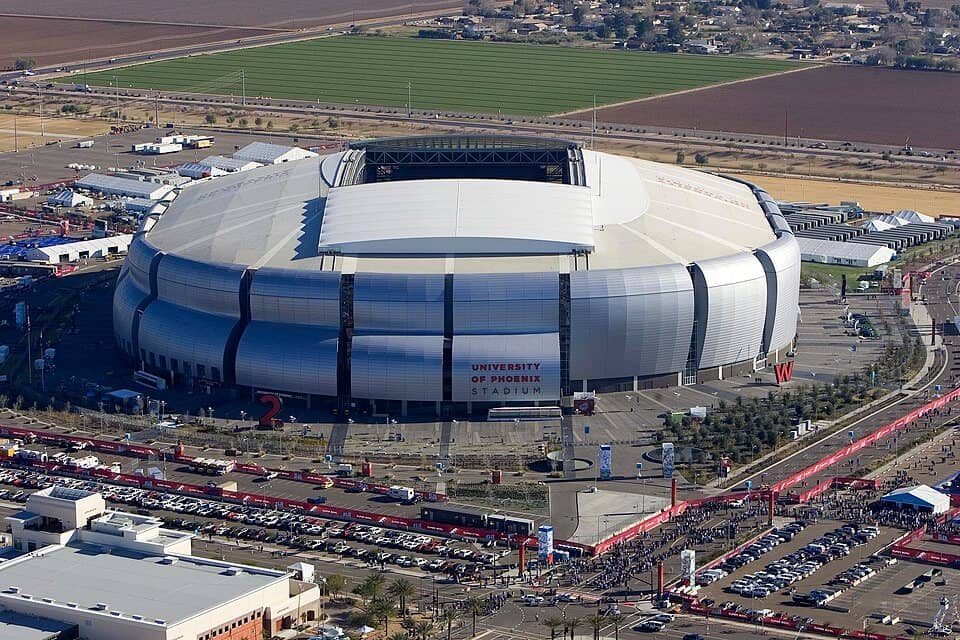

Best Seats at State Farm Stadium
From the outside it looks like a spaceship parked in the desert, and that’s not an accident — architect Peter Eisenman and Populous took cues from the coil of a rattlesnake and the ribbed barrel of a saguaro when they designed the place. Two pieces of engineering make it famous: a retractable roof that opens in about twelve minutes, and an entire natural-grass field that rolls out of the building on hundreds of steel wheels to sit in the sun between games. But the feature that matters most to you on a September afternoon is simpler than either of those — the whole bowl is air conditioned. The Cardinals spent decades baking at Sun Devil Stadium because they couldn’t host early-season day games in the Arizona heat. Here, they can, and you’ll feel the difference the second you clear the concourse doors.
The honest catch: the stadium sits out in Glendale, a good 20 to 40 minutes from the Phoenix and Scottsdale stuff most visitors actually want to do. Plan the trip around that and you’ll have a great time. Here’s how to pick your seat.
Seating Guide
State Farm Stadium seats around 63,400 for football, and the bowl is compact enough that there’s no truly distant seat — the architects hung the upper deck close and steep, so even the cheap rows feel involved. The real decisions here come down to three things: which sideline you’re on, how high you sit, and whether the roof will be open or closed on your date. Most of the time it’s closed and climate-controlled, which takes the heat math off the table and makes height the bigger question than sun.
Best Non-Premium Seats
The lower bowl sidelines, the 100s on the west (home) side are the heart of the building. Sections in the low 100s around the home bench put you on the Cardinals’ sideline with a clean look down the line of scrimmage, and the bowl’s pitch means you’re not staring at the backs of standing fans three rows down. The tradeoff is the usual one for field-level football: when the ball’s on the far 20, it’s far. You trade the all-field perspective for the feeling of being in it.
The opposite sideline, the visitor-side 100s, gets you the same elevation and a near-mirror view, usually for a little less because it isn’t the home bench. If you care more about being low and on a sideline than about which bench you’re behind, this is the smarter spend.
The lower rows of the 400-level sidelines are the move if you’d rather read the whole field than sit close. The upper deck is steep and hangs in tight, so a sideline seat between the 30s up top gives you the coaches’-tape view of routes and coverages developing — genuinely a better way to actually watch football than the lower bowl, and a fraction of the price.
Best Value Seats
The Ring of Honor rows — the lettered rows at the very front of any 400-level section — are the smart-money pick in the building. They sit right at the top of the upper concourse, so you walk in off the concourse and you’re basically there, no long climb. You get a true elevated sideline sightline and the upper deck’s better view of the whole field, and the price gap versus the lower bowl is wide enough to fund a nicer hotel or an extra night. What you give up is proximity and the lettered rows can fill the concourse behind you at halftime, but for the money nothing else here competes.
Cheapest Way In
The numbered rows above the Ring of Honor, deeper in the 400 corners, are the floor on price. These are the furthest seats from the field and the corners give you a diagonal angle, so the far end zone reads small. But the bowl’s compact build means even up here you can follow the game, and when the roof is closed the upper deck traps the crowd noise as well as anywhere in the stadium. If your goal is simply being inside for a Cardinals Sunday at the lowest number, this is it — aim for the north corners over the south, since the south corners catch the worst of any open-roof sun.
Our Pick
If you only take one piece of advice: get into the lower-bowl sideline 100s on the home side, somewhere between the 30s. That’s where I keep ending up — I’ve sat in the lower 100s on that side several times now and never once wished I’d spent the money on club. You’re on the Cardinals’ bench, you’re low and in the noise, and on an open-roof day you’re on the shaded side of the building. It’s the seat I’d hand a friend without hesitating.
What to Avoid (and What’s Worth Trying Once)
The deep southeast corners, upper and lower, are the seats to skip on an open-roof day — they’re the most sun-exposed in the building and you’re staring across the full diagonal of the field. The very front balcony rows of the 400 level carry a different problem: there’s a safety rail running the lip of the upper deck that cuts across the sightline from the first row or two, so the “lowest upper-deck seat” you thought you scored can come with a bar through your view. Sit a few rows back.
Worth it once: the standing-room rail behind the end zones on the upper concourse. A surprising number of regulars never sit in their seat at all and watch the whole game from up there — it’s open, you can roam, and the view down the field is better than you’d guess. If you’ve got a cheap ticket and restless legs, it’s a fun way to take in a game.

Premium Seating Options
State Farm Stadium has quietly become one of the more aggressive premium buildings in the NFL after a multi-year renovation that added field-level clubs in both end zones and a midfield club on top of the existing suite and club inventory. Everything below leads with location and tier — sponsor names on these spaces turn over, but where they sit doesn’t.
The Best Premium Experience
The field-level casitas behind the south end zone are the signature, and there’s nothing else like them in the league. Each one is a private two-story cabana built into the end zone — a covered “front porch” right at field level, feet from where the Cardinals come out of the home tunnel, and a private rooftop deck above it for the wide view. They share an all-inclusive lounge, the Casita Garden Club, that opens hours before kickoff. It’s the most expensive way into the building and unapologetically so, but if money’s no object and you want the one room your guests will talk about for a year, this is it.
Best Value Premium
The smart premium call isn’t field level at all — it’s the traditional club-level sideline seats on the 200 level (the club sideline sections around midfield). This is where the value lives. You get the wide, padded seats, the climate-controlled interior lounges, the upgraded food and full bars, the private restrooms, the dedicated entrance and early stadium access — the whole premium-day experience — for a fraction of what the field-level products cost, and from a sightline that’s frankly better than being down at field level where the action sails over your head. If a friend asked me which premium ticket actually over-delivers, I’d point straight here.
Other Premium Options
The north end zone has its own field-level lounge, a retro supper-club-styled space (the Morgan Athletic Club, named for the franchise’s 1898 origins) that feeds the field suites, tunnel suites, and sideline field seats clustered around it — live music, all-inclusive dining, valet. At midfield on the club level there’s a newer chef-driven destination club (Casa Roja at the Fifty) for members who want the food to be the event. Down on the field you’ll also find field boxes built around oversized lounge seats for groups of four to six. And on the main concourse at midfield, loge boxes offer semi-private four-to-eight-seat pods — a good middle ground for entertaining without committing to a full suite.
Suites & Group Options
The loft suites ring the building on a private suite level and typically hold 16 to 24 guests, with a game-day attendant, private restroom, preferred parking, a private entrance, club-lounge access, and in-suite catering. They’re the move for corporate groups or a big celebration; book through the Cardinals’ premium seating office well ahead of marquee dates, which go first.
State Farm Stadium Seating Chart and Capacity
State Farm Stadium holds about 63,400 for Arizona Cardinals games and expands past 73,000 for mega-events like the Fiesta Bowl, a Super Bowl, or a Final Four by filling field-level risers. For fans, the bowl works in three tiers — the lower bowl (100 level), the club level (200 level), and the upper terrace (400 level) — with the private loft and field-level suites tucked between. The field runs roughly north-south, the Cardinals’ bench is on the west sideline, and the building is one of the few in the league that’s fully climate controlled. Here is the Seating Chart For State Farm Stadium in Phoenix.
Getting the Best Tickets
The Cardinals don’t sell out the way a perennial contender does, which is the single most useful fact for buying here. For an ordinary mid-season home game against a non-rival, the secondary market routinely sits below face value, and waiting into game week pays off as season-ticket holders dump seats. Flip it for the marquee dates — a divisional game against the 49ers, Rams, or Seahawks, or a national-brand visitor like the Cowboys, Eagles, or Chiefs — and prices climb while the building fills with traveling fans (it’s not unusual to see half the stands in the other team’s colors). Buy those early. For everything else, hold and let the resale market come to you.
Get Your Arizona Cardinals Tickets Here – Our patner Vivid Seats offers a range of Cardinals, Fiesta Bowl, the College Football Playoff, Final Fours and more!
Upcoming Events At State Farm Stadium
State Farm Stadium stays pretty busy for a lot of the year with concerts, the occasional Super Bowl, Final Four and concerts. State Farm Stadium is also home to the annual Fiesta Bowl which is part of the College Football Playoff. Here is a list of upcoming events.

State Farm Stadium Bag Policy
State Farm runs a strict NFL clear-bag policy and enforces it literally — staff at the perimeter hold bags up against cardboard cutouts marked to size. You’re allowed one clear plastic, vinyl, or PVC bag no bigger than 12″ x 12″ x 6″ — tote, backpack, fanny pack, or cinch bag all count — or a one-gallon clear freezer bag, plus one small non-clear clutch no larger than 4.5″ x 6.5″ x 2″. “Clear” means see-through, not smoke-tinted, and a tinted bag at the correct size still gets turned away.
Diaper bags are specifically prohibited — pack bottles, formula, wipes, and creams into your clear bag instead, and note that unopened bottles and food are only permitted when a child under two is with you. If you show up with a non-compliant bag there are two Mobile Bag Check locations outside the secured perimeter at $20 per bag, open until 75 minutes after the game. Or use a marked Handbag Handoff receptacle before security and donate it — the team passes those to local women’s shelters, so you’re never choosing between the walk back to the lot and the trash can.
Policies to Know
You can bring in one factory-sealed, non-frozen 16.9 oz bottle of plain water per person — not sports drinks, not flavored water — which is the rare freebie worth knowing about, since drinks inside run what drinks inside always run. Outside food and alcohol are prohibited. Arizona is an open-carry state, but weapons of any kind are not allowed inside the stadium. And three sections are entirely alcohol-free — 114, 424, and 432 — useful to know whether you’re avoiding the party or seeking the quiet.
Cashless: The stadium is 100% cashless everywhere — concessions, bars, merch, all of it — and takes tap, chip, and Apple/Google/Samsung Pay. Cash-to-card reverse ATMs that issue a prepaid debit card sit on the Main Level at Sections 104 and 123 and Terrace Level at Section 416, with a standard ATM at Section 124. If you’re already out at the Flight Deck and realize you’re holding cash, staff will point you to the Offices entrance next to the Box Office, where there’s another one.
Accessibility: Accessibility here is a strength. Accessible seating sits on every level including the Lofts and field boxes, each platform with a power outlet for electric wheelchairs and medical equipment, and every level reaches by elevator from the five entrances. Courtesy carts run from accessible parking to the plaza security checkpoints starting two hours before kickoff — afterward, wait at the ADA Shuttle Tent where you were dropped and check in for a ride back. Assistive listening devices are available at all four Guest Services offices (Main Level near 104 and 123, Terrace near 417 and 448) in exchange for an ID.
There’s also a Sensory Room on the Main Concourse by the Guest Services booth at Section 104, with low lighting and sensory bags, and sensory bags at every Guest Services booth.
We recommend you check the Cardinals handy A to Z Guide to see all the policies.
Getting To State Farm Stadium
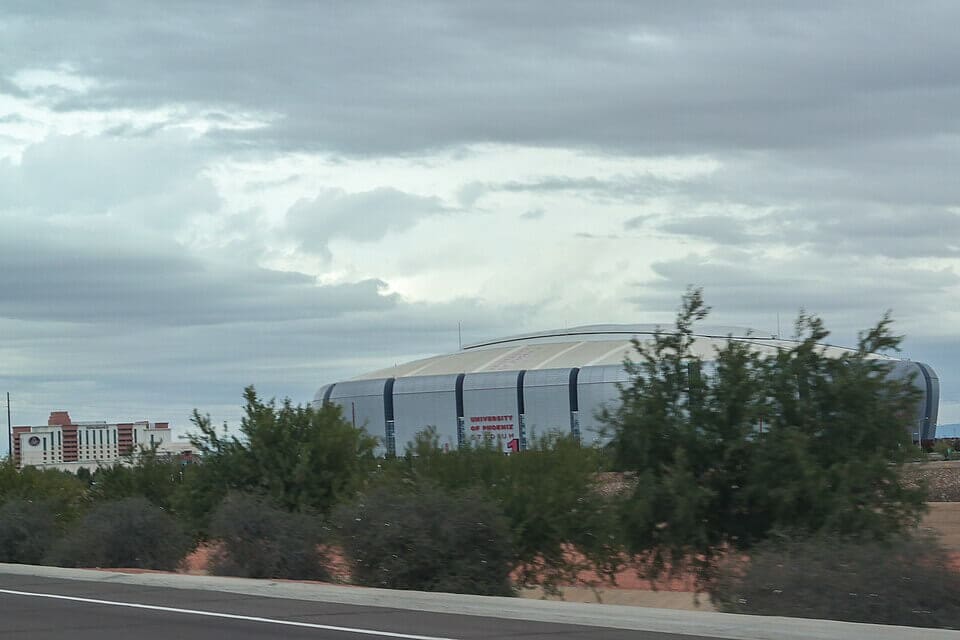
The stadium sits off Loop 101 in Glendale, about 14 miles west of downtown Phoenix and 20 miles from Sky Harbor airport. This is a drive-or-rideshare venue — plan around that first.
State Farm Stadium Parking
Coming from Phoenix or the airport, it’s I-10 west to Loop 101 north, exiting at Cardinals Way or Glendale Avenue. The official Sportsman’s Park lots open four hours before kickoff and run roughly $10 to $30 for general parking. The most useful parking insight at this stadium has nothing to do with where you park and everything to do with when you leave: the walk in is never the problem, but the lot release afterward is brutal and predictable. Dealt with this many times. Takes forever to get out if you’re in the wrong area of the parking lot.
Don’t bolt at the final whistle. Sit fifteen to twenty-five minutes, or better, walk over to Westgate and let the lots drain — you’ll get home faster doing nothing than joining the immediate rush. Also, The adjacent Westgate Entertainment District lots are the popular cash alternative and put you right in the bars and restaurants when you’re done.
Two things that save real time. Park toward the edge of your lot, near the 91st Avenue exit side — you’ll walk a bit further before kickoff and skip a long crawl through the middle of the lot afterward. And if you’re in Preferred (Red), search “Red Lot – State Farm Stadium” in Waze rather than the stadium address; Red is only enterable from Maryland Avenue at 95th, and the generic address will route you to a gate that turns you away. From the south, exit Cardinals Way. From the north, exit Glendale Avenue, west to 99th, then east on Maryland.
One Westgate warning: on event days the district charges event rates and enforces restaurant-designated spots hard. Park in one and walk to the game without paying the event rate and you’ll come back to a tow.
Public Transit
Be honest with yourself: there isn’t a good one. The Valley Metro light rail does not reach Glendale. The practical options are the Route 70 bus along Glendale Avenue, which stops near 95th Avenue a short walk from the stadium for a couple of dollars, or — on Cardinals home dates only — taking light rail to the Desert Sky Transit Center at 79th Avenue and McDowell and catching the game-day shuttle from there. From the airport, a transit trip runs close to two hours, so unless you’re already a Phoenix bus regular, skip it.
Rideshare
Uber and Lyft work well here and the stadium has dedicated infrastructure for them — drop-off and pickup is the Black Lot, just south of the stadium off Cardinals Way. The catch is the post-game surge, which spikes hard the moment the whistle blows. The fix is to not stand in the Black Lot watching the multiplier climb: walk five minutes north into Westgate, grab a drink, and request your ride 20 to 30 minutes later once the crush clears and the price settles.

State Farm Stadium Insider Tips
State Farm Stadium rewards people who treat the day as more than the three hours of football. There’s a full pregame world on the Great Lawn, a heat-and-security rhythm that decides whether your first twenty minutes are pleasant or miserable, and a desert outside the door that’s worth setting an alarm for. Here’s what the regulars know.
The Building Itself
Look for the grass field parked outside the stadium on your way in. The entire playing surface sits in a 19-million-pound tray that rolls out of the building on steel wheels to sit in the sun between games. It’s the thing this stadium is famous for and most fans walk past it without realizing what they’re looking at.
Check the roof call before you decide what to wear. It opens in about twelve minutes and the team makes the decision based on weather, so the same date can be a sealed, chilled dome or an open-air afternoon. Either way the bowl is air conditioned — this is the rare NFL building where a September kickoff is genuinely comfortable.
Notice there are no columns blocking anyone’s view. Four concrete super-columns carry 700-foot trusses over the seating bowl, which is why a domed stadium this size has no obstructed sightlines from structure — only the upper-deck safety rail, and only in the first row or two.
First-Timer Must-Dos
Walk to the Pat Tillman Freedom Plaza at the north end near Gate 2 before you do anything else. Tillman left the NFL after 9/11 to serve and was killed in Afghanistan; the plaza honors him with a bronze statue, a reflection pool, and a 42-foot wall — 42 was his number at Arizona State. It takes five minutes and it’s the most meaningful thing on the grounds.
Put a bet down at the BetMGM Sportsbook on the Great Lawn — no other NFL stadium has one. It was the first sportsbook ever built at an NFL venue: two stories, 17,000 square feet, a 265-square-foot video wall, five teller windows, and 27 self-service kiosks. League rules stop books inside stadiums from taking gameday action, but this one sits just outside the building, so it takes bets all day.
Find the Ring of Honor names circling the upper deck. It’s the quickest read on a franchise that’s been around since 1898 — the oldest continuously run team in pro football, older than the NFL itself.
Getting In Without the Wait
Clear security more than 30 minutes before kickoff. Gates open 90 minutes out and the checkpoints are officially busiest in the final half hour — that’s the window where the line backs up into the lots.
The heat is what makes arriving late actually hurt. The screening perimeter is outdoors and the air conditioning doesn’t reach you until you’re through the glass doors, so a late arrival means standing in full sun in a slow line instead of a fast one.
Don’t empty your pockets at the checkpoint. Screening was modified — you walk through the pedestals with your clear bag in hand, and only fans who trigger an alert get routed to a second screening where bags go on the table.
Have your digital parking pass open before you reach the lot attendant. Parking and tickets are both fully digital now, and fumbling for a pass at the gate is what turns a moving lot line into a stopped one.
The Pregame Scene Without a Tailgate
Head to the Great Lawn if you don’t have a tailgate spot. Lot tailgating is for ticket-holders parked in Sportsman’s Park, but the Lawn and Heritage at Sportsman’s Park run a beer garden and a live-music stage open to anyone.
Book a table at Flanker Kitchen inside the sportsbook for the morning slate. Doors open at 9am on Cardinals gamedays and the second-floor balcony overlooks the Great Lawn. Gameday reservations are strongly encouraged and they go early.
Catch the early games at the Cardinals Flight Deck on the northeast side. It’s a shaded, tented area with a big screen running RedZone and a DJ — the best free option for killing the hour before your gate.
Finish everything outside before you scan in. There’s no re-entry at this stadium under any circumstance, so the Lawn, the sportsbook, and Westgate all have to happen on the front end of your day.
Eating and Drinking Inside
Eat the Arizona names, not the generic stands. The Cardinals stocked the concourses with local operators — Someburros for fried tacos, Barrio Queen for Mexican, Pork on a Fork for homegrown barbecue, and Humble Bistro doing French-braised, double-fried wings worth the line.
Hit the Rivalry Grill at Sections 129, 235, or 420 for something you can’t order again. It’s an opponent-themed dish that changes for every home game, so it’s different every time you come back.
Order through the Cardinals app and skip the counter entirely. Express mobile ordering is the single best line hack in the building, and it matters most at halftime when every stand backs up at once.
Refill the water bottle you carried in rather than buying one. Same water, no charge. Just make sure it’s the one factory-sealed disposable plastic bottle you’re allowed — metal bottles and thermoses don’t get through the gate at all.
Get your last beer before the third quarter ends. Main-concourse alcohol sales stop there, and you’re capped at two drinks per transaction all game. Club, Loft, and Luxury guests keep buying for an hour after the whistle.
Getting Out Clean
Take the ramps or escalators down, not the elevators. Elevators near Gate 1 go on brief holds after the game for team and staff movement, and you’ll stand there watching everyone else clear the building.
The bowl empties faster than the lots do. Nobody gets stuck walking out of this stadium — the jam is entirely in the parking release, which is why sitting still for twenty minutes beats sprinting to your car.
Cash out any physical sportsbook tickets before you leave town. Easy to forget you’re holding a paper slip when you’re heading to the airport in the morning.
Photo Ops
Shoot the exterior at dusk. The metal skin was designed to echo a barrel cactus and it catches low light better than it does midday glare, when it just reads flat and gray.
Get the open-roof shot from the upper deck if the roof is open. Lit grass framed by desert sky is the photo nobody expects from a building people assume is a dome.
The Tillman statue is the shot with actual meaning. Early, before the plaza fills, and you’ll get it without a crowd in frame.
The App, the Wi-Fi, and the Team Store
Download the Cardinals app before you leave the hotel. It holds your ticket and parking pass, runs express food ordering, and streams RedZone and live replays inside the building. It’s not optional here — it’s the whole gameday interface.
Connect to “Stadium Wi-Fi” — no password. It’s free, powered by Cox, and it’s the actual fix for a phone that’s crawling because 60,000 people are on the same cell towers.
Shop the team store on the way in or wait until the third quarter. Those are the two windows where you’re not queuing — halftime is the worst of it.
Families & Kids
Grab a “Safe in the Seat” locator wristband at a Guest Services booth. You write your seat location and phone number on it in case you get separated. Booths are on the Main Level near Sections 104 and 123 and the Terrace Level near 417 and 448.
Kids 24 months and under get in free on a lap pass. Ask the staff scanning tickets at the gate, with the child present — one lap pass per adult ticket.
Sit in 114, 424, or 432 for the calm version of a Cardinals Sunday. Those three sections are alcohol-free, and there’s an alcohol-free tailgate zone in the East Green carpark if you want the lot experience without the party.
Leave the big stroller in the car. Large strollers, wagons, and car seats are prohibited; small umbrella strollers pass after inspection.
Use the Sensory Room on the Main Concourse by Section 104 if the noise gets to be too much. Low lighting, sensory wall displays, bean bags, and sensory bags — and those bags are available at every Guest Services booth too. Family restrooms with changing tables are on the Main Level near 114 and 136, Club near 204, 219, 230, and 247, and Terrace near 404, 421, 435, and 454.
Autographs & Player Access
Get to your seat the moment gates open, 90 minutes before kickoff. Warmups are the entire autograph window at an NFL game — there’s no batting-practice equivalent that stretches it out.
Position at the rail in the lower-bowl corners nearest the tunnels. Players enter and exit through the end-zone tunnels, so the corner sections at field level are where the traffic actually passes you.
What Catches People Out
Bring a layer even when it’s 110 outside. The building runs cold and the lower bowl sits under the vents — a recurring complaint from people who dressed for the parking lot instead of the stadium.
Carry a battery pack. Your ticket and your parking pass both live on your phone, and a dead battery in the Terrace Level is a genuine problem rather than an inconvenience.
Skip the Terrace Level entirely if heights bother you. The 400s are steep with narrow rows, and fans with vertigo consistently say they wish they’d bought Main or Club instead.
Expect a lot of the other team’s jerseys. When a national-brand opponent is in town this plays closer to a neutral-site game than a home game. If you’re the visiting fan, you will not feel outnumbered or unwelcome.
Smoking areas are inside the perimeter, so you don’t burn your ticket using them. Main Level is beyond the Gate 2 exterior; Club, Loft, and Terrace use the north ramp. Vaping isn’t permitted anywhere.
Get Outside While You’re Here
This is the part I’d plan the trip around. Phoenix in football season is hiking weather, and the desert is right there.
Do Camelback Mountain by way of Echo Canyon if you want the real one. It’s a 1,280-foot scramble — more climbing than hiking — and takes most people two to three hours round trip. Get there before sunrise; the lot fills by 6:30 on a weekend and you want to be descending before the sun is high.
Take Pinnacle Peak in north Scottsdale if you’d rather enjoy it than survive it. Smooth, well-graded out-and-back with great desert scenery and zero scrambling. Early on a winter weekend morning it’s about as good as a casual hike gets — my favorite of the two.
Treat sun and water as non-negotiable even in January. The air feels mild and the sun does not care. Pack water, wear sunscreen, start early.
Beyond the Game
Spend a morning in Old Town Scottsdale — the walkable heart of the metro for galleries, shops, and patios, and the base I’d recommend to most visitors anyway.
See the Desert Botanical Garden if you only do one non-football thing. It’s the fastest way to understand the Sonoran landscape you’ve been driving through all weekend. The Phoenix Zoo is the easy call with kids.
Drive to Sedona if you have a full extra day. About two hours north and worth every minute for the red rock — I’d build a weekend around it on its own.
Shop Tanger Outlets or hit the Desert Diamond Casino without leaving Glendale. Tanger sits right next to Westgate and the casino is a few minutes north — both are useful for filling the gap between an early arrival and a late kickoff.
Hotels Near State Farm Stadium
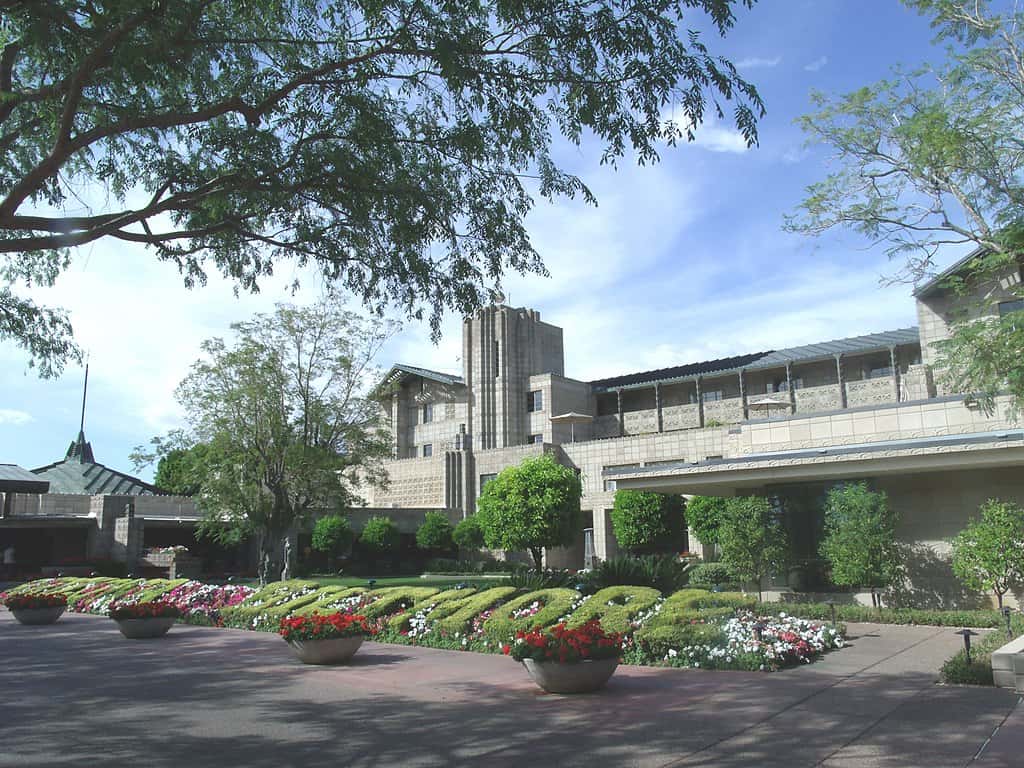
Glendale itself is thin on the kind of lodging you’d build a trip around — it’s a quiet suburb that happens to have a stadium. So the real decision is whether you want to stay close and walk to the game, or stay where the city actually is and drive over. I’d point most visitors toward Old Town Scottsdale or downtown Phoenix and the 20-to-40-minute drive, because that’s where the food, the nightlife, and the morning hikes are. Book early for any marquee game weekend — the Westgate-area hotels are the first to fill.
Best Areas to Stay
The Westgate / Glendale Sports District is the stay-close play — a cluster of hotels within a half-mile walk of the stadium, surrounded by chain restaurants and the Tanger outlets, dead quiet otherwise. Great if your trip is the game and nothing else. Old Town Scottsdale, about 40 minutes east, is where I’d base — walkable blocks of bars, patios, and restaurants, with the best hikes a short drive north. Downtown Phoenix, about 20 minutes from the stadium, splits the difference: a real city core with the Roosevelt Row arts district, sports, and an easy freeway shot to Glendale.
Hotel Recommendations
Near the stadium, the Renaissance Phoenix Glendale Hotel & Spa is the standout — you can walk to Westgate, the stadium, and the outlets, and it’s the nicest room in the immediate area. The Holiday Inn Glendale Stadium & Entertainment District is the value pick close in, with free parking and breakfast that the surrounding lots will charge you for, and the Hampton Inn & Suites Glendale-Westgate is a reliable walk-to-everything option next to Tanger.
In Old Town Scottsdale, the Canopy by Hilton Scottsdale Old Town is my pick — a rooftop pool and bar, a genuinely good lobby restaurant, and you can walk out the door into Old Town (Cien Agaves is around the corner). The Hyatt Place Scottsdale/Old Town and Hilton Garden Inn Scottsdale Old Town are solid, well-located alternatives a notch down in price. In North Scottsdale, check out the Westin Kierland near Kierland Commons. Lots of shopping and restaurants around you can walk too.
Downtown, the Cambria Hotel Downtown Phoenix has a rooftop deck and sits walkable to the bars and restaurants, while Placemakr Downtown Phoenix offers apartment-style suites that are great for a group or a longer stay.
Budget Options
The Holiday Inn Glendale Stadium is the genuinely smart budget play near the venue — free parking and free breakfast claw back the fees you’d pay elsewhere in the district, and you can walk to the game. Stepping down further, the Hampton Inn & Suites Glendale-Westgate gives you the same walkable location for a bit less, with the only real tradeoff being the $18 parking that’s unavoidable anywhere in this area.
The center of gravity here is Westgate, the open-air entertainment district a five-minute walk north of the stadium. It’s where the non-tailgating crowd lands before and after the game — a pedestrian plaza of bars and restaurants around a fountain — and it gets jammed hours before kickoff on game days, so come early or come after.

Cardinals Gameday: Westgate, Scottsdale & the Phoenix Scene
Gameday here has a split personality, and knowing that ahead of time is the difference between a good trip and a frustrating one. The pregame is genuinely excellent and it all happens on stadium grounds — the Cardinals built an eight-acre park outside their front door and program it like a festival. The nightlife is a different story. Glendale is a quiet suburb that happens to own a stadium, and once the Westgate crowd thins out around 9pm, the actual bars and restaurants people fly to Phoenix for are 25 to 40 minutes east.
So the play most visitors should run: arrive early and spend the pregame on the Great Lawn, walk over to Westgate afterward to let the parking lots drain, then drive back to Old Town Scottsdale or downtown Phoenix for the night. You get the tailgate culture and a real city evening instead of choosing between them.
What the Cardinals Run Before Kickoff
The Great Lawn is the heart of it — eight-plus acres of programmed pregame. The Cardinals call it the heart and soul of gameday and they mean it: tailgate space, the BetMGM Sportsbook, Heritage at Sportsman’s Park, and the Great Lawn Stage, which hosts live performances before every home game. You don’t need a tailgate setup or a parking pass in the lots to enjoy any of it.
The Cardinals Flight Deck on the southeast plaza is the best free spot on the grounds. A shade structure with seating, an oversized LED video wall running the early NFL games, live music at the Tillman Stage, and mobile gourmet concessions. If you’ve got two hours to kill and no plan, this is where to kill them.
Heritage at Sportsman’s Park opens three and a half hours before kickoff and has public space, not just private. Three stories with a beer garden, fire pits, misters, and a rooftop terrace looking out over the Valley — the sunset views from up there are the best on the property.
Book the Pregame Party at Heritage if you want the tailgate without owning a grill. All-inclusive menu and open bar in a reserved space on the Great Lawn, a short walk from the main gates. Worth it for groups and for anyone flying in who can’t haul a cooler.
Don’t miss the first-hour drink specials once you’re inside. Starting when the main gates open and lasting exactly one hour, discounted drinks run at the South Bridge Bars near Sections 101 and 137 on the main level and the Four Peaks Grab N Go near Section 425 on the terrace. It’s the one window where drinking inside the stadium isn’t a punishment, and almost nobody knows about it.
The Big Red Brew Haus is the air-conditioned option your ticket already covers. It opens early and it’s open to anyone holding a game ticket — the move on a day when the walk from the lot has already cooked you.
Best Pregame & Postgame Bars
Yard House anchors Westgate — enormous beer list, shareable food, and enough square footage to absorb a pregame crowd without a two-hour wait. A five-minute walk from the gates.
Whiskey Rose is the Westgate spot with actual character: a country bar and grill with a mechanical bull, live music, and a barbecue menu that outperforms the room. Good happy hour on the appetizers.
Saddle Ranch Chop House covers the same Westgate territory with a bigger patio, and it’s the easier call with a group that wants to sit outside and watch the district fill up.
Flanker Kitchen inside the BetMGM Sportsbook is the only real bar on stadium grounds. Doors at 9am on gamedays and a second-floor balcony over the Great Lawn — reserve ahead, it fills.
Zipps Sports Grill is where I’d go to escape the tourists. Homegrown Arizona sports grill, Glendale location a short drive from the stadium, good wings, every screen on. It’s a locals’ room, not a destination, and that’s the point.
Where to Go Before and After the Game
Be honest about Westgate: it’s a well-built entertainment district full of good chains, and it empties out not long after the stadium does. If you want a night, point the car east.
Old Town Scottsdale is the Valley’s nightlife center, about 40 minutes from the stadium. Compact, walkable blocks where you can park once and hit a dozen places on foot — patio bars, tequila rooms, live music, and a late-night club strip along Saddlebag Trail and Stetson Drive. Wasted Grain is the reliable pick for live cover bands that turn into a dance floor later. It’s the densest concentration of bars in Arizona and it runs every night of the week, not just weekends.
Downtown Phoenix is the closer option, about 25 minutes, and the better one for a real drink. The cocktail scene here has gotten seriously good — Rough Rider hides in a basement off Central with a dark, woodsy room and some of the best drinks in the state, and The Rose Garden on 1st Avenue does a moody botanical thing with a patio. Downtown also puts you walking distance from Chase Field and Footprint Center, so you can stack a Suns or Diamondbacks game onto the trip.
Roosevelt Row is the arts district version, just north of downtown Phoenix. Murals, galleries, and small bars — Pretty Penny and Legends Never Die are both tiny, both excellent, both the opposite of a stadium bar. Best on First Friday, when the galleries open late and the street fills.
One honest skip: don’t build a night around downtown Glendale. The historic square is charming in the daytime for antiques and the holiday lights, but it isn’t a nightlife district and it’s a separate area from the stadium entirely.
Solid Restaurants in the Area
Pizzeria Bianco in downtown Phoenix is the one out-of-towners should plan around. Chris Bianco won a James Beard for it and it’s been called the best pizza in America for two decades — wood-fired, short menu, the Wiseguy and the Rosa are the orders. The original in Heritage Square is tiny and the wait runs 60 to 90 minutes with no takeout, so put your name in and go next door for a drink. If you’d rather not gamble, the Town & Country location on 20th Street takes reservations and is open Sundays when the original is closed.
Toca Madera in Old Town is the big-night-out room — modern Mexican and a serious steak program wrapped in a nightclub atmosphere, with a DJ, live fire performances, and a filet people write home about. Loud by design and priced accordingly; go for the spectacle with a group, not for a quiet conversation or for traditional Mexican.
Teleféric Barcelona near Fashion Square brought real Spanish tapas and paella to a city that’s been drowning in new steakhouses. The croquettes and the churros are the reason to go.
Miel de Agave on Scottsdale Road is the sleeper — Mexican with an Asian-fusion streak and a steak menu, huge portions, and some of the most consistent service in town. It’s the pick if Toca Madera sounds like too much but you still want the margaritas to be excellent.
Cien Agaves Tacos & Tequila in Old Town is one my favorite taco spots— two floors, a big covered patio, a genuinely good happy hour, and fresh tacos that don’t cost what Scottsdale usually charges. Easy with a group, no reservation drama.
Olive & Ivy does Mediterranean on a misted Old Town patio along the waterfront — the pick when you want a nicer dinner without a jacket.
Pretty Penny on Roosevelt Row runs seasonal international small plates out of a tiny kitchen and is one of the more interesting meals in Phoenix right now. Small room — book it.
Near the stadium, Westgate’s lineup handles a pregame meal fine. But if you’re basing in Scottsdale or downtown like I’d suggest, eat there instead — it’s a better meal for the same money, and you’re not fighting a stadium crowd for a table.
Coming for the Fiesta Bowl, a Playoff Game, or a Super Bowl
State Farm Stadium gets the big ones — three Super Bowls, national championship games, a Final Four, and the Fiesta Bowl every year — and a mega-event weekend runs on completely different rules than a Sunday against a division rival.
Base yourself in Scottsdale or downtown Phoenix, not Glendale. For a normal game the Westgate hotels are a convenience. For a Super Bowl or a Playoff week, the official events, the parties, the media row, and the fan festivals all set up in downtown Phoenix and Scottsdale — staying in Glendale puts you 40 minutes from the thing you flew in for, and you’ll spend the week driving.
Book roughly a year out for a Super Bowl and several months out for the Fiesta Bowl. Valley hotel rates go vertical on those weekends and the good Old Town and downtown rooms are gone early. The Fiesta Bowl lands in the holiday window, which is also peak snowbird season — the two collide and inventory disappears.
Expect the stadium’s security perimeter to expand for a mega-event. The BetMGM Sportsbook, for instance, sat inside the NFL perimeter on Super Bowl Sunday and was ticket-holders-only — things that are open to anyone on a normal Sunday can close to the public on a big one. Check what’s actually accessible before you plan your pregame around it.
The weather is the reason these events come here. Late December through early February in the Valley is 65 to 75 and sunny while most of the country is frozen, which is exactly why the Fiesta Bowl and multiple Super Bowls have landed in Glendale. Build in a hike, a round of golf, or a day trip to Sedona — the game is genuinely not the only reason to be here that week.

Why You Should Go
State Farm Stadium is one of the most genuinely impressive buildings in the NFL — the engineering is real, the sightlines are excellent, and the air conditioning turns what should be a brutal desert afternoon into the most comfortable game day in the league. Pair it with a Phoenix winter, where the weather is perfect and the desert hikes are right there, and a Cardinals trip becomes one of the easiest sports weekends to talk a group into. Just remember it’s a Glendale stadium in a Scottsdale-and-Phoenix town: base yourself where the city is, drive over for the game, and you’ll get the best of both.
Check out all of our NFL Guides as well as these Phoenix and regional stadium road trips:
Arizona and Arizona State
Mortgage Matchup Center (Suns And Mercury) and Chase Field in Phoenix
SoFi Stadium – LA Rams & Chargers
Written by Brad Richards. Founder of Gameday Guides. This guide includes insights from personal visits as well as updated info from team sources, fan forums, and stadium policies. We aim to help you plan with confidence — enjoy your gameday. If you have any tips, if we missed anything or you have a question, don’t hesitate to shoot us an email.