

Best Seats at the Allianz Arena
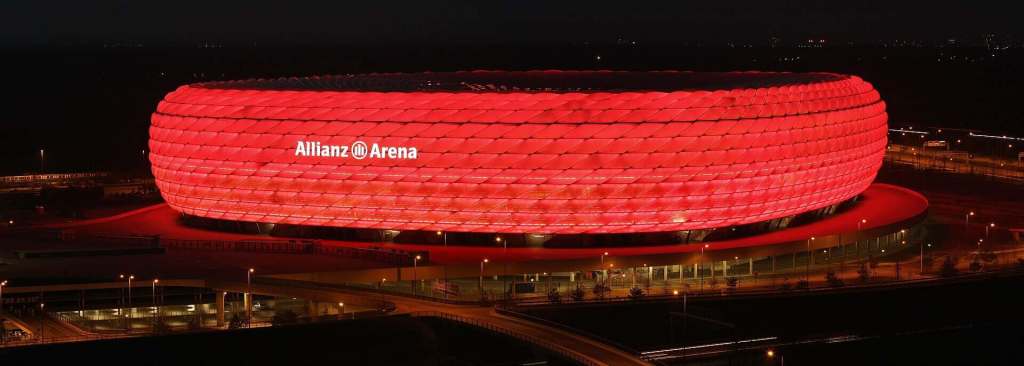
There are very few football stadiums that make a first impression like the Allianz Arena. The exterior is a skin of inflated ETFE cushions that glows a deep red on Bayern matchdays — the first stadium in the world built with a fully colour-changing façade, and still the one everyone photographs. Inside, it’s a steep, fully roofed three-tier bow101l that holds around 75,000 for a Bundesliga match, and when it’s full and the Südkurve is in full voice, it does exactly what a great ground should: it makes you feel like you’re inside the noise rather than watching it.
The hard part of seeing Bayern is not choosing a seat — it’s getting a ticket at all. Bayern sell out almost everything, tickets are personalised to the buyer, and the route a visiting fan should take is very different from what most tourists stumble into. Get that part right and the rest is one of the great football trips in Europe. So we’ll cover the seats properly, then spend real time on how to actually get in.
Seating Guide
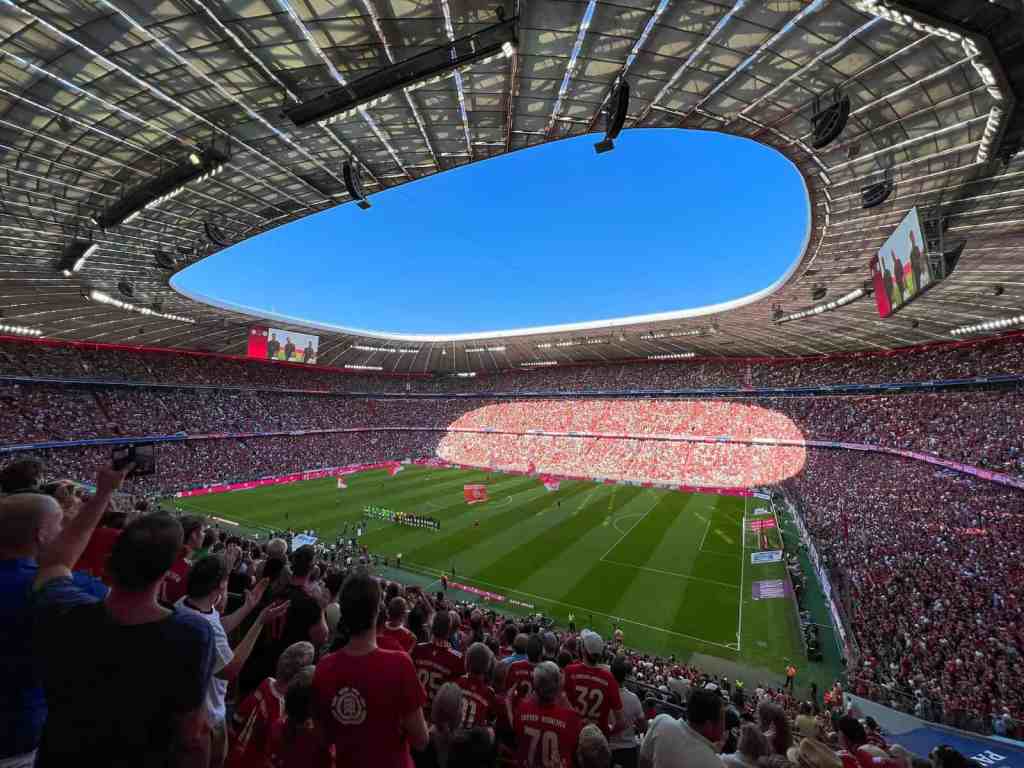
The Allianz Arena is a clean rectangular bowl with three tiers all the way round — lower, middle (the red seats, branded with the club crest and the Mia san Mia motto) and upper. Bayern play left-to-right across four stands: the West Stand (the main stand, where the dugouts, business seats and TV gantry sit), the East Stand, the North Stand behind one goal, and the South Stand behind the other, home to the famous Südkurve.
Because most visiting fans buy whatever the resale exchange offers rather than hand-picking a block, the useful question isn’t “which seat number” — it’s “what kind of afternoon do you want.” Here’s how the bowl actually breaks down.
The atmosphere end — Südkurve (South Stand, lower tier). This is the heart of the club. The Südkurve is a standing terrace of roughly 9,300 behind the south goal, and it’s where Bayern’s ultras sing for ninety minutes, wave enormous flags and produce the tifos — those full-stand visual displays — before kick-off. The catch for a travelling fan is twofold: it’s standing only (so no clear sightline if you want to study the game), and it’s the hardest part of the ground to get into as a non-member. For most first-timers, the Südkurve is something you experience from across the pitch rather than from inside. Worth knowing: for Champions League nights, UEFA rules convert the terraces to all-seater, so the standing experience is a Bundesliga-only thing.
The best view — middle tier, long sides. If you want to read the game properly, the middle tier along the West or East stand around the halfway line is the sweet spot — high enough to see the shape, close enough to feel it. Confirmed central blocks here run roughly 201–213. This is also where the corporate and business seating clusters, so genuine general-admission availability can be thinner.
The value play — upper tier, central. The upper tier is steep in the good way: even high up and central (blocks around 303–304 on the halfway line), the pitch stays close enough to follow the football, and it’s usually noticeably cheaper than a lower-tier longside seat. For a one-off visit where you want the whole panorama and the full scale of the place, this is the smart buy.
Behind the goal, sitting — North Stand. The opposite end from the Südkurve gives you the head-on view of the attacking play and a strong slice of the atmosphere without committing to standing. The upper north tier is also where away supporters are housed.
Our Pick
If you only take one piece of advice: aim for the middle tier on the long side, somewhere between the halfway line and the penalty area (the 200s blocks). You get the best balance of sightline, atmosphere and being close enough to the Südkurve to feel the wall of noise without being stuck standing. If that’s out of budget or sold out, a central upper-tier seat (around 303–304) is the value version of the same idea and never feels detached.
Weather & Shade Reality
The roof covers every seat, so you’re protected from most rain — though a strong wind can still blow some across the open rectangle above the pitch. There’s no real sun-versus-shade calculation to make here. The thing to plan for is cold: Munich evenings and the early and late ends of the season can be genuinely chilly, and a roofed bowl traps the cool air. Bring a layer you wouldn’t bother with at a summer ground.
What to Avoid (and What’s Worth Trying Once)
Upper-tier seats directly behind the scoreboards. Two large screens hang from the roof at the north and south ends. A handful of high seats tucked right behind them — for example up around block 315 in the south upper tier, or the very back of the away allocation in block 340 — can have the screen clip the top of your view. Not ruinous, but not what you want to pay a premium for.
Worth trying once — the away end, for the tactical view. It sounds odd, but the away allocation high in the north-west corner (upper tier, blocks roughly 340–347) is genuinely one of the better places to read a match. You’re up and back, but the bowl’s geometry keeps you connected to the pitch, and you get the full sweep of the game laid out in front of you. If you ever follow a visiting side here, don’t dread the seat — the view is better than the postcode suggests.
Premium Seating & Clubs
Bayern’s premium product is built around the Business Club, a large hospitality area of roughly 2,000 seats across the middle tier of the West (main) stand, plus 100-plus executive boxes dotted around the upper reaches of the bowl. These are largely the preserve of season members and corporate buyers, and single-match availability through normal channels is limited.
For a travelling fan, the practical reason to care about premium isn’t the prawn sandwiches — it’s access. When the regular ticket routes and the official Exchange have sold out for a marquee fixture (Der Klassiker against Dortmund, a Champions League knockout), an official hospitality package is often the only remaining route that guarantees entry. It’s expensive, but it’s legitimate and it comes with a real seat, which is more than the touts outside can promise. Bayern’s own travel arm also bundles tickets with hotel and transport for some fixtures.
Allianz Arena Seating Map
The Allianz Arena holds around 75,000 for a Bundesliga match (closer to 70,000 when it’s converted to all-seater for Champions League and other UEFA nights). It’s a clean rectangular bowl with three tiers — lower, middle and upper — running all the way round four stands: the West (main) stand with the dugouts and business seats, the East stand opposite, and the North and South stands behind each goal. Here is the Allianz Arena Seating Map.
Getting Tickets Bayern Munich Tickets
Bayern tickets are personalised and almost always sold out, so buy the right way: start with the official ticket portal (members get priority in the phased releases, and face value runs roughly €15–120), and once general sale is gone, use the club’s official Ticket Exchange, where members re-list seats at face value plus about 15% in your name — set your account up early and check daily the week of the match.
Skip the touts and big resale sites entirely: tickets carry the buyer’s name and ID is checked at the gate, so a ticket in someone else’s name can be refused, and those sites charge two to four times face with counterfeits a real risk. If you can’t get in, the daily FC Bayern Museum and Arena Tour (around €25) is the guaranteed Plan B.
Allianz Arena Bag Policy
Keep it simple: nothing larger than A4. Bayern strongly advise turning up with no bag at all, and there’s no meaningful left-luggage facility at the ground, so don’t plan around one. Anything bigger than A4 will be turned away at the turnstiles. Belt bags and small bags get searched on entry.
Key Venue Policies
A few things that surprise visitors, especially anyone arriving with British or American habits:
No outside food or drink — and that includes fruit. Apples, bananas, oranges and the like are specifically on the banned list, along with any bottles, flasks or liquids, glass and metal containers.
You can drink alcohol in your seat. Unlike English grounds, where alcohol is banned in view of the pitch, here you can buy and drink beer in the stands. Paulaner is the house beer and a pint runs around €5.50.
Cannabis is banned across the entire site — stadium, the Esplanade approach and the car parks — despite Germany’s wider relaxation of the law. Smoking is prohibited inside the seating blocks.
Cameras: standard SLR cameras with lenses up to 200mm are fine for personal use; no telephoto lenses, no tripods, no separate camera bags. Drones are banned over the whole site.
Full policy details: allianz-arena.com
Cashless or Cash?
The stadium is cashless inside. Food and drink kiosks take contactless cards and mobile payment (Apple Pay, Google Pay); older non-contactless cards won’t work, and if you’ve only got cash you’ll need to load a pre-paid Arena Card to spend anything. The one quirky exception is the ticket-upgrade desk just past security, where paying the difference to move to a better category is cash only — a small contradiction worth knowing if you think you might upgrade on the day.
Accessibility
The Allianz Arena is well set up for accessibility: a few hundred wheelchair spaces with companion seating, lifts and barrier-free routes, and an unbroken step-free path from Fröttmaning U-Bahn station to the ground. Level 2 is designed as a largely barrier-free concourse with adapted facilities. Wheelchair users, including away supporters, are directed to the South entrance. Bayern also run a dedicated accessible stadium tour for visitors with limited mobility — book that one ahead by phone or email rather than turning up.
Allianz Arena Top Tips and Facts
Munich does matchday with real ceremony, and most of it happens before you ever reach the ground — the red scarves gather in the city centre, the U6 fills up, and the whole crowd flows across a long open plaza to the glowing arena. Here’s how to do it like you’ve been before.
The Glowing Skin: What Makes This Place Unmistakable
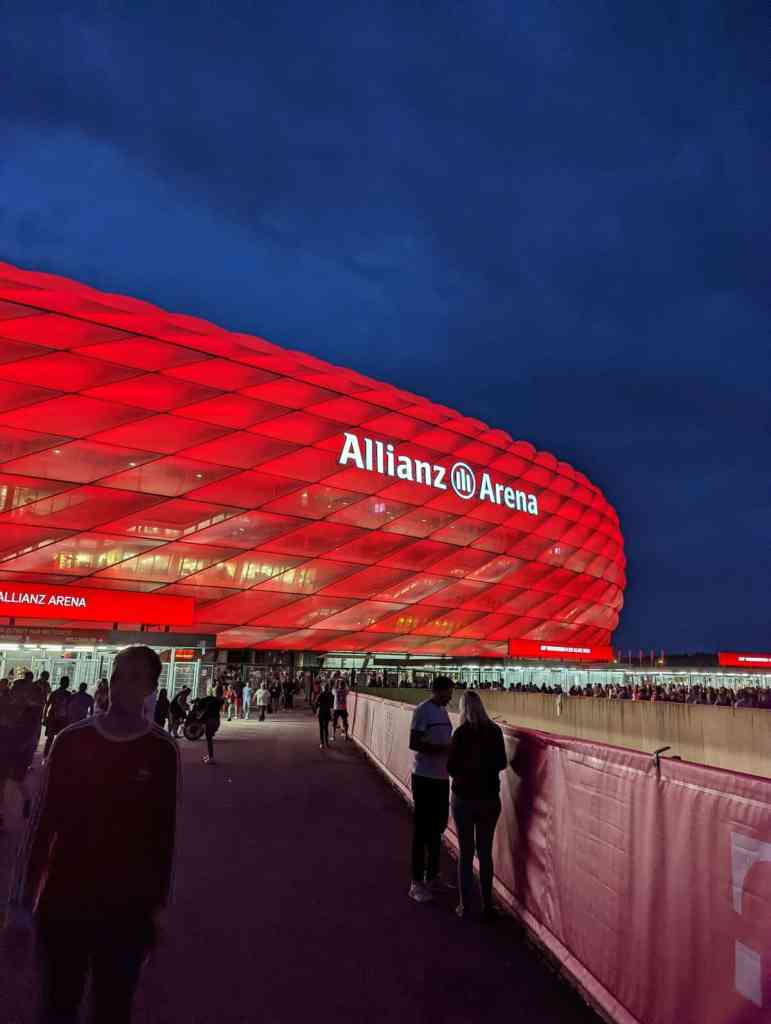
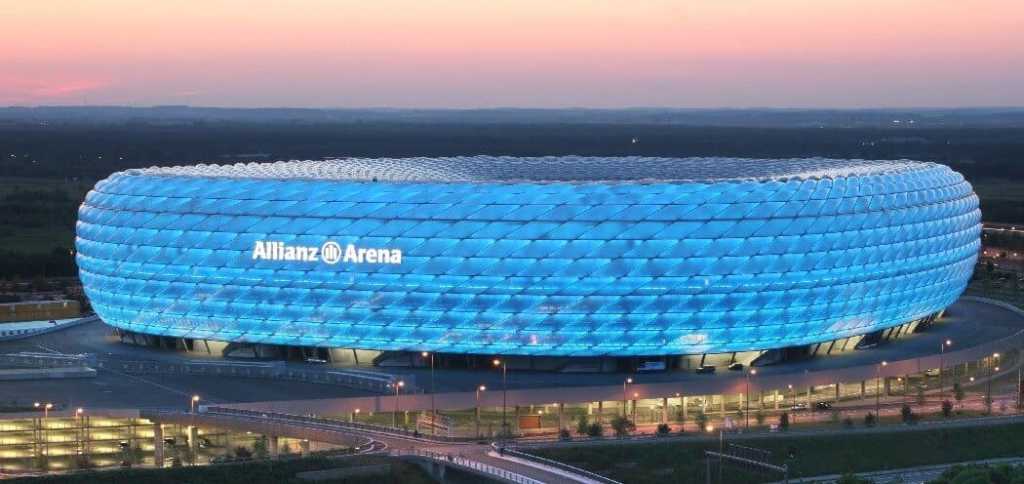
Cross the Esplanade toward the glow — it’s the thing first-timers remember longest. The Allianz Arena is wrapped in a skin of inflated ETFE air cushions by architects Herzog & de Meuron, and it was the first stadium in the world built to change colour — a deep, solid red for Bayern, white for Germany internationals.
Shoot the glow on the way in, not the way out. The shifting light shows are mostly a non-matchday thing; on a matchday the skin holds a steady red. Time an evening kick-off and shoot the arena lit up on your approach from Fröttmaning, while the light’s good and the crowd’s flowing — not on the way out when it’s a stampede.
American Football at the Allianz Arena (the NFL Munich Game)
The NFL plays regular-season games here. Munich has hosted since 2022, when Tom Brady’s Buccaneers beat the Seahawks in the league’s first-ever game on German soil, followed by the Panthers over the Giants in 2024. German appetite is enormous, and Munich shares hosting duties with Frankfurt and Berlin on a rotating basis.
The next one is 15 November 2026: Lions vs Patriots. Kick-off is 15:30 local, with Detroit the designated home side — a nod to star receiver Amon-Ra St. Brown’s German roots. Tickets run roughly €84 to €414 all-in through the NFL’s own international ticketing rather than Bayern’s system, with a six-per-account limit, and it will sell out.
Planning ahead? Munich doesn’t host every year. After 2026, the arena’s next confirmed NFL date is 2028 (teams and date still to be announced), and there’s no Munich game in 2027 — so 2026 is the one with a matchup locked in.
Getting In: Transport & Arrival
Buy your transport ticket — the match ticket does NOT cover it. This is the classic visiting-fan mistake: most Bundesliga clubs include local transport, Bayern don’t. You need a valid MVV ticket (Zone M covers the trip to Fröttmaning) from a machine or the app before you travel — riding without one is a fineable offence and inspectors do check.
Save your ticket to your phone before you set off. There’s free WiFi at the ground, but tens of thousands of people around the turnstiles can choke the signal at the worst moment — don’t be poking at a loading screen while the queue backs up.
Get to the U6 early. The line out to Fröttmaning becomes a crush in the last 30–40 minutes before kick-off; travel an hour or more out and you’ll walk on. From Fröttmaning it’s a 10–15 minute walk up a long flight of steps and across the Esplanade — and arriving early is the only way to catch the Südkurve’s pre-match tifo.
Agree a meeting point in advance. In a sea of 75,000 red shirts with the network straining, “where are you?” texts fail — pick a fixed landmark on the Esplanade or a specific entrance before you dive into the crowd.
Exit Strategy
Don’t bolt for the exit — the getaway is the slow part. Emptying the car parks after a match can take up to two and a half hours; the U6 is far quicker but still shoulder-to-shoulder for the first half hour. The relaxed move is to let the first wave clear while you finish your beer.
Traditions to Know: Stern des Südens & Mia san Mia
Sing along to “Stern des Südens.” The club anthem (“Star of the South”) is belted out before kick-off — join in even if you’re mangling the words.
Learn what “Mia san mia” means. The Bavarian club motto, roughly “we are who we are,” is written into the stands and the whole identity of the place. The Südkurve sets the rhythm of the noise and the rest of the ground follows.
Don’t wear away colours near the Südkurve. As at any serious ultras’ end, if your seat is in or around the South Stand, leave the opposition shirt at the hotel — stewards may turn you away from those blocks on safety grounds, even as a genuine neutral.
Allianz Arena Food & Drink
Eat in the city, not at the ground. The arena sits in an isolated spot with little around it, so do your pregame eating and drinking in central Munich and treat the kiosks (bratwurst, pretzels, Paulaner) as a top-up. There’s a sit-down Arena Bistro that opens a couple of hours before kick-off if you want somewhere indoors.
Keep your cup — it’s a souvenir. Drinks come in sturdy, branded reusable cups with a small deposit (Pfand) of a euro or two built into the price. Hand it back at any kiosk for the deposit, or just keep it — one of the cheapest, best souvenirs going.
Merch: The FC Bayern Megastore
Buy early at the Megastore by the ground. It’s enormous, you don’t need a match ticket to visit on opening days, and it’s far less of a scrum well before kick-off than at half-time or full-time. If you only want a scarf or shirt, get it early.
The App & Visiting the Museum
Set up the FC Bayern app before you travel — it’s genuinely useful, not junk. It holds your mobile ticket and, crucially, is where you register your number plate for parking in advance.
Doing the museum on a matchday? Come very early. You’ll need both your match ticket and a separate timed museum ticket, and it stops admitting matchday visitors well before kick-off — and the guided arena tours don’t run on matchdays at all.
Bringing Kids to the Allianz Arena
Everyone needs their own ticket, including children — there’s no lap seating.
The museum and tour are a hit with football-mad kids. The dressing room and tunnel especially; there’s a supervised crèche-style play area on non-matchdays for younger children while parents tour, and special kids’ tours run for groups. Note that pushchairs aren’t allowed on the standard tour route.
While You’re in Munich
With a spare half-day, head north to BMW Welt and the BMW Museum, right beside Olympiapark — free to wander and an easy add-on after the match. Closer to the centre, the English Garden is one of the largest city parks in the world, with beer gardens under the trees and surfers riding the Eisbach wave in the middle of the city. And Marienplatz and the Old Town are the historic heart — the Glockenspiel, the Viktualienmarkt, and a handy base for everything else.
Getting to the Allianz Arena
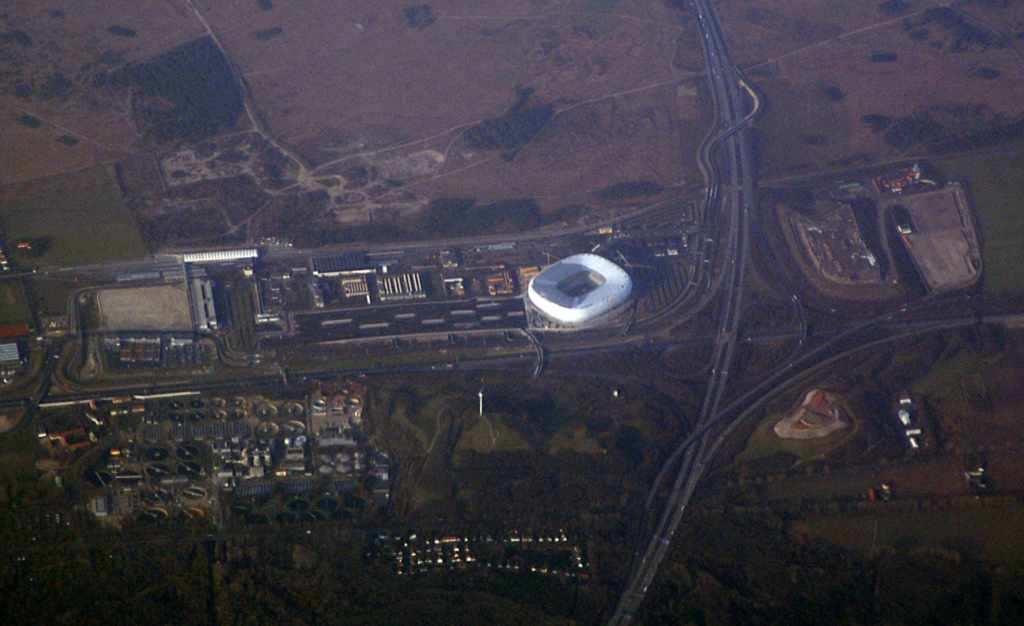
The stadium is on the northern edge of the city at Fröttmaning, and the honest answer is that public transport is the only sensible way in. Driving is for people who enjoy sitting in a car park for two hours.
Underground (U6) — do this. From the city centre, take the U6 towards Garching-Forschungszentrum and get off at Fröttmaning. From Marienplatz it’s roughly 16–20 minutes. If you’re coming from the main station or further out, take any S-Bahn to Marienplatz first and change onto the U6 there. Trains run every few minutes on matchdays. Remember the Zone M ticket — it isn’t included with your match ticket.
Rideshare and taxis — not recommended. There are no proper drop-off or pick-up facilities at the ground on matchdays; traffic is locked down to keep the flow moving, and you’ll end up walking from wherever a driver can actually stop. Save it.
Driving and parking — only if you must. The four-storey car parks under the plaza are vast but fill and empty slowly. Register your number plate online in advance via the app for around €12; pay on the day and it’s about €15, or up to €20 in cash on exit without pre-registration. The car parks open from 08:00 on matchdays. Reaching it: A9 from the south (exit 73, Fröttmaning-Süd) or A99 from the north (exit 12b, Fröttmaning-Nord).
Bike. Munich is a cycling city and the route to the ground is well signposted, with bike parking by the north entrance — a nice option in good weather, and it skips the post-match crush entirely.
Hotels Near Allianz Arena (There’s Not)
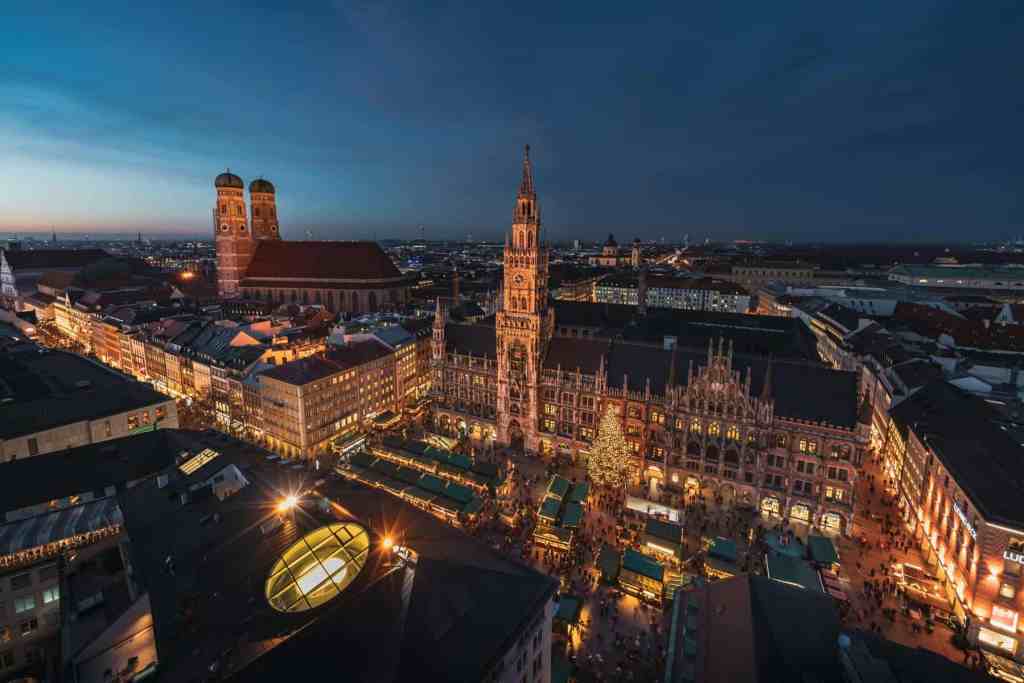
The single most important lodging tip for the Allianz Arena: don’t stay near the stadium. It sits in an isolated pocket of the city next to open heathland and, across the motorway, a sewage works — there’s nothing there for a visitor. Stay in central Munich and let the U6 do the work. The whole appeal of this trip is that the ground is 20–30 minutes from a genuinely great city, so base yourself in the city and treat the match as the centrepiece of a Munich weekend. For big fixtures and anything during Oktoberfest, book months ahead — the city sells out.
Best Areas to Stay
Altstadt (Old Town) — first-timers, start here. The historic core around Marienplatz puts you within walking distance of the squares, the beer halls, the Viktualienmarkt and the Hofbräuhaus, with fast U-Bahn links to the U6. It’s the most touristy choice and the priciest, but for a short trip it’s the easy, walkable, everything-on-your-doorstep option.
Schwabing — the matchday sweet spot. This lively district north of the centre sits directly on the U6 line, which means you can roll out of your hotel, stop for a beer on Leopoldstraße, and be at Fröttmaning in under half an hour with no changes. Plenty of restaurants and bars, the English Garden on your doorstep, and a slightly more local feel than the Old Town. For a football trip specifically, Schwabing is the smart pick.
Maxvorstadt — culture and value. Just west of Schwabing, this is Munich’s museum quarter (the Pinakotheken galleries) and a student-ish, well-priced area with good transport links into the centre and out to the ground. A solid middle ground between price and location.
Where the Football Crowd Stays
The Schwabing U6 Play. Hotels strung along the U6 in Schwabing — there’s a good spread from international chains to budget options near stations like Nordfriedhof — are the most practical matchday base in the city: direct line to the ground, vibrant area, no need to change trains.
The Old Town Splurge. If you’d rather wake up to the Frauenkirche and walk to the Hofbräuhaus, the Altstadt has the city’s grand hotels (the Mandarin Oriental and Rosewood at the top end) and characterful boutiques near Marienplatz. You’re paying for the postcard, but it’s a lovely one.
The Central-Station Convenience. The area around the Hauptbahnhof is unglamorous but supremely practical — reliable mid-range chains, a short ride to anywhere, and handy if you’re arriving by train or coming in from the airport.
Budget Options
Reliable budget and mid-range chains (the Motel One and Meininger style of place) have several Munich locations, including spots a five-minute walk from Marienplatz and others out in Schwabing on the U6. The trade-off is honest: smaller, simpler rooms and less character, but clean, well-run and brilliantly located for both the city and the match. For a football weekend where you’ll barely be in the room, they’re hard to beat.
FC Bayern Matchday Scene
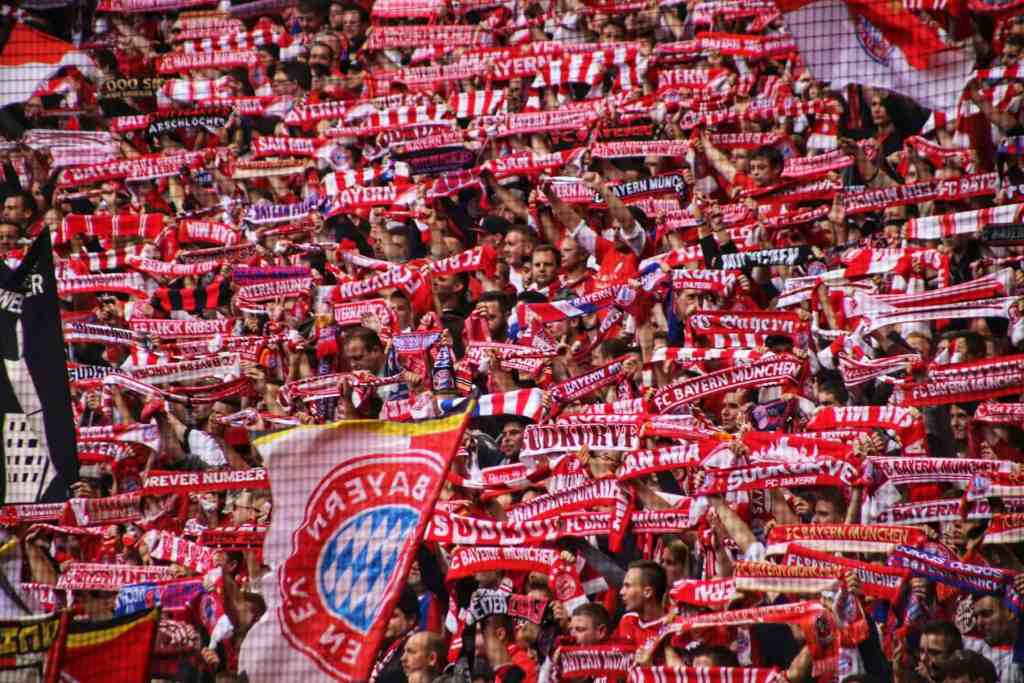
Munich’s matchday culture lives in the city, not at the stadium. Because there’s nothing to do around the ground itself, the pre-match ritual is a long, beery afternoon in the centre, then the red-scarf migration out on the U6 a couple of hours before kick-off. Afterwards, the crowd flows back into town and the beer halls fill again. Lean into it — the football is the excuse, the beer hall is the event.
Best Pregame and Postgame Bars
Hofbräuhaus — the most famous beer hall in the world and unashamedly touristy, but a genuinely fun place to start, with the oompah band, the litre steins and the painted ceiling upstairs. Order one beer here even if you move on. Right by Marienplatz.
Augustiner-Keller — near the Hauptbahnhof, one of Munich’s oldest and largest beer gardens, with chestnut-tree shade, a more mixed local crowd and what many locals will tell you is the best beer in the city. Away fans have drunk here for years without bother. The more authentic counterweight to the Hofbräuhaus.
Paulaner am Nockherberg — regularly voted Munich’s most beautiful Biergarten, a short tram hop from Sendlinger Tor, with excellent food and Paulaner on tap — fitting, given Paulaner is the beer you’ll be drinking inside the ground.
Viktualienmarkt beer garden — the open-air market in the Old Town has its own central beer garden, the easy, casual choice for a pretzel, a Weisswurst and a quick one in the sun before you head out.
Best Restaurants in the Area
Hofbräuhaus / Ratskeller — for the full Bavarian set piece: Schweinshaxe (pork knuckle), Weisswurst, pretzels and a litre of beer in a vaulted hall. The Ratskeller, under the New Town Hall on Marienplatz, does a more refined version of the same idea.
Viktualienmarkt stalls — the best cheap eat in the centre: Leberkäse rolls, fresh produce and Bavarian specialities, ideal when you want to graze rather than sit down before the match.
Augustiner-Keller (kitchen) — beyond the beer, the food here is properly good Bavarian cooking, and the garden setting makes it a destination in its own right.
Beyond the traditional stuff, Munich’s dining has real range — the Glockenbachviertel and the streets around Fraunhoferstraße in Isarvorstadt hold some of the city’s best modern restaurants if you want a night off from pork and pretzels.

Why You Should Go
The Allianz Arena is worth the effort it takes to get in — and make no mistake, it takes effort. The reward is one of the most striking stadiums on earth, a genuinely loud, partisan crowd at the home of Germany’s biggest club, and all of it attached to one of Europe’s most enjoyable cities. Sort the ticket early, base yourself in central Munich, give yourself a beer-hall afternoon before kick-off, and you’ll have one of the best football weekends going. And if the ticket lottery doesn’t break your way, the tour and museum mean you still get inside that glowing red shell — which, for a lot of visitors, is most of the magic anyway.
Explore our other World Football guides as well as these:
Wembley in London
Santiago Bernabéu in Madrid
Camp Nou in Barcelona
Written by Brad Richards. Founder of Gameday Guides. This guide includes insights from personal visits as well as updated info from team sources, fan forums, and stadium policies. We aim to help you plan with confidence — enjoy your gameday. If you have any tips, if we missed anything or you have a question, don’t hesitate to shoot us an email.