


Camp Nou: FC Barcelona’s Home Since 1957
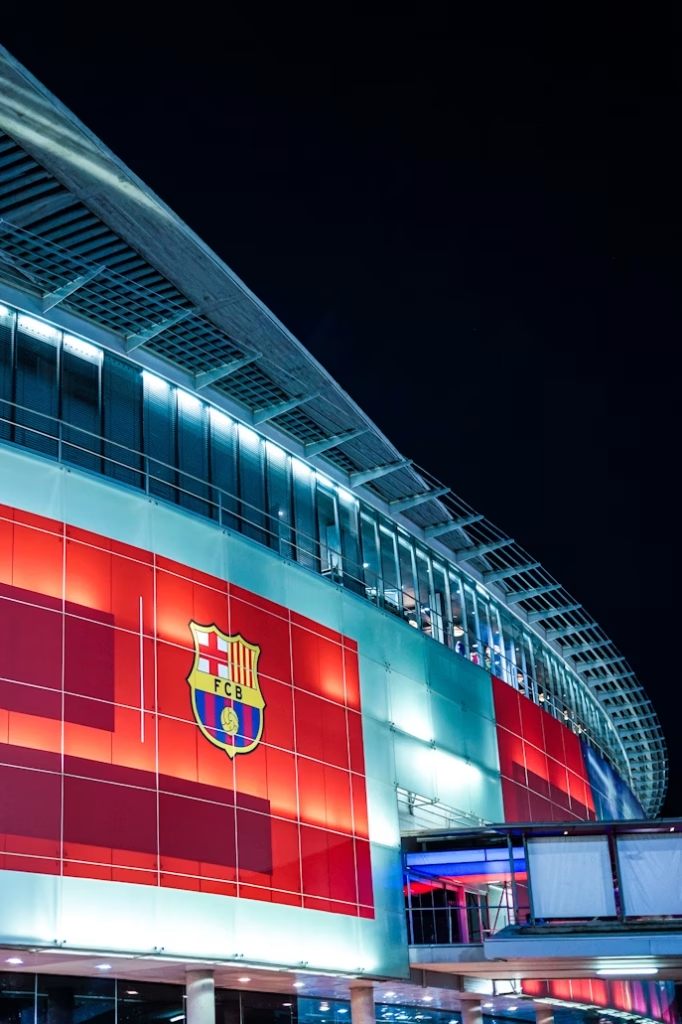
Camp Nou is where Johan Cruyff changed how Barcelona played football, where Ronaldinho made the impossible look easy, and where Lionel Messi scored more goals than anyone in the club’s history. FC Barcelona have played here since 1957, and for most of that time it was the biggest stadium in Europe, a huge open bowl in the Les Corts district with almost 100,000 seats and the words “Més que un club” — more than a club — at the heart of everything it stood for. Today, officially the Spotify Camp Nou, it is in the middle of a complete rebuild that will turn it into a 105,000-seat stadium with a roof over every seat.
The honest reality is that you are visiting a building site as well as a football stadium: the top tier is still closed, cranes stand over the stands, and the full stadium tour will not return until the work is finished. But Barça are back home, the crowd is singing again, and seeing the new Camp Nou take shape is part of the story. Here’s how to choose your seat, get a ticket and plan your visit.
Is Camp Nou Open? Camp Nou in 2026
Yes — Barça play their home matches at Camp Nou again. The team returned on 22 November 2025, after two and a half seasons at Montjuïc’s Olympic Stadium, and the stadium has been reopening in stages since then.
Capacity is currently 62,652. The first and second tiers are open on all four sides of the pitch. Two VIP tiers are expected to open in the second half of the 2026–27 season, adding about 6,000 seats. The third tier will not open until the roof is in place.
Barça will leave again in summer 2027. At the club’s General Assembly in September 2026, Barça announced a temporary return to Montjuïc from about June 2027 to January 2028, so that the new roof can be installed. If you are planning a trip for the first half of the 2027–28 season, check where the match is being played before you book.
Visiting without a match ticket? The Barça museum and a construction viewpoint are open almost every day, and the official store is open daily. Read the tour section below before you buy, because the classic stadium tour is not running.
Camp Nou Seating Plan & Best Seats
Camp Nou has four stands. The Tribuna is the main stand, with the directors’ box, the press area and most of the premium seats. The Lateral is the long stand on the opposite side of the pitch. Behind the goals are the Gol Nord (north end) and the Gol Sud (south end), where Barça’s main singing section now sits.
Each stand is divided into tiers: the first tier (1a graderia) at the bottom, the second tier (2a graderia) above it, and the third tier (3a graderia) at the top, which is still closed. When you see a ticket for “Tribuna 1st tier” or “Lateral 2nd tier”, that is the stand plus the tier. Camp Nou is a very wide bowl, so height matters: the second tier often gives a clearer view of the whole pitch than the back rows of the first tier, which sit under the tier above.
Best Non-Premium Seats
Lateral or Tribuna, second tier, near the halfway line. This is the best general-sale view in the stadium: high enough to see Barça’s passing patterns and both penalty areas, but not far from the pitch. Tribuna seats usually cost more because the stand also contains the premium areas.
Lateral or Tribuna, first tier, near the halfway line. You are close to the players and see the speed of the game. Avoid the back rows of the first tier, where the tier above can cut off part of the view.
Gol Sud, first tier, near the singing section. For atmosphere, sit close to Gol 1957, the supporters’ section in the first tier of the Gol Sud. You lose the tactical view of the far half, but you are inside the noise.
Best Value Seats
Second tier of the Gol Nord or Gol Sud, in the lower rows. Behind the goal but raised above the pitch, these seats give a clear view of the whole game for noticeably less than the sides. Local fans often recommend this area as the best balance of view and price.
Lateral second tier, away from halfway. Moving towards the corners lowers the price quickly while keeping a sideline view, and the angle is still good from the second tier.
Budget / Cheapest Way In
Corners and the upper rows of the open tiers, against smaller opponents. The cheapest general-sale tickets are usually in the corners and at the back of the second tier, especially for league matches against teams in the lower half of the table. The far goal looks a long way away, but you are inside Camp Nou for a fraction of the price of the sides.
Our Pick
For a first visit, choose the Lateral, second tier, as close to the halfway line as your budget allows. You see the whole pitch, the Tribuna and the new stadium rising opposite you, and you pay less than for the same view from the Tribuna.
Weather: No Roof Until 2027
Until the new roof is installed, every seat at Camp Nou is open to the sun and the rain. Afternoon matches in August, September and May can be very hot, so take a cap, sunscreen and water (with the cap removed), or choose an evening kick-off. Winter evening matches are cool rather than cold, but bring a jacket for rain.
What to Avoid (and What’s Worth Trying Once)
Seats near construction areas with a “restricted view” note. While the work continues, some sections sit close to temporary structures. If a ticket mentions a restricted view, expect one and pay accordingly.
The back rows of the first tier. The tier above can block the top of your view, so high balls and the far end of the pitch are harder to follow.
Away colours in the home sections. Visiting supporters may only sit in the area allocated to their club, and fans in rival colours found elsewhere can be moved or removed from the stadium.
Worth trying once: the Gol Sud on a big European night. Behind the goal you give up the clean tactical view, but when the “Cant del Barça” rings out before a Champions League match, the south end is where you feel the stadium most.

Premium Seating & Clubs
Camp Nou Hospitality & VIP Seats
Barça’s premium seating is concentrated in the Tribuna and is sold through the club’s official hospitality programme, Barça Hospitality. Much of the long-term premium seating is sold as multi-year seat licences, but single-match VIP tickets are also available for individual games.
The Best Premium Experience
Single-match VIP tickets. These include a seat in a VIP area, access to a VIP lounge, premium food and drink, and lounge access from 90 minutes before kick-off, at half-time and for an hour after the match. Prices start at several hundred euros and rise sharply for the biggest matches.
Best Value Premium
Choose the opponent, not the package. The same VIP experience costs much less against a smaller league side than against Real Madrid or a Champions League opponent. If you want the lounge, the seat and the service rather than a specific match, a weekend league game is the best value.
Other Premium Options
VIP Premium packages (also called the Players Experience) place you in the boxes, galleries and areas closest to the players, with the best lounges and continuous food and drink. Extra services, such as a museum visit or a meet-and-greet with a former player, can be added to some packages.
Suites & Group Options
Private boxes and group packages are handled by Barça Hospitality through the club’s official website, with prices on request. Dress smartly and do not wear the colours of any other team.

Camp Nou Seating Map and Capacity
Camp Nou currently holds 62,652 people. That is the capacity for the 2026–27 season, with the first and second tiers open on all four sides. It is expected to rise to just over 68,000 when two VIP tiers open later in the season.
Before the renovation, Camp Nou held 99,354. It was the largest stadium in Europe for decades and is the stadium people mean when they search for the Camp Nou’s capacity “before”.
When the work is finished, Camp Nou will hold about 105,000 (104,600). That will make it the largest football stadium in Europe again. After the roof works, Barça expect to return to a capacity of around 95,000 before the final sections open.
Which is bigger, Camp Nou or the Bernabéu? Right now the Bernabéu, which holds about 80,000. When Camp Nou is complete, it will be about 25,000 seats bigger.
FC Barcelona Tickets: How to Buy for Camp Nou
Tickets are sold on fcbarcelona.com, the club’s official website, and at the stadium ticket offices. Club members (socis) and season-pass holders have priority. For most league matches against smaller teams, tickets are easy to buy as a visitor, often with good choice until a few days before kick-off. General-sale prices for these matches are often between €50 and €100, but El Clásico against Real Madrid, Champions League knockout matches and title-deciding games cost much more and can sell out within hours.
More seats appear in the last few days. Barça season-pass holders release the seats they cannot use through the club’s free-seat system, so the official website often adds tickets in the final 48 hours before kick-off.
Kick-off times are confirmed late. LaLiga usually fixes the exact day and time about two to three weeks before each match, and big matches are often scheduled for 21:00. Book flexible travel if you can.
Your ticket is digital. Digital tickets are released between 24 and 3 hours before the match, with the access gate you should use. Bring photo ID, because staff can check it at the entrance.
Avoid unofficial sellers. Touts work outside the stadium on big matchdays, and fake tickets are common. If the official sale has sold out, use a resale website that guarantees entry, and remember that away fans must buy through their own club.
Camp Nou Bag Policy
Backpacks, suitcases and other bulky items are not allowed, and there is no storage service at the stadium. Bring only a small bag, or leave larger bags at your hotel or a left-luggage point in the city.
Key Venue Policies
Power banks are not allowed — of any size. The list of banned items also includes e-cigarettes, laptops, tablets, professional cameras, balls and large flags. Charge your phone fully before you leave.
No cans, glass or hard containers. Small plastic bottles (500 ml or less) are allowed with the cap removed. Food in soft wrapping, such as a sandwich, is allowed.
No alcohol. Alcohol cannot be brought in, it is not sold in the stands, and you can be refused entry if you are drunk. Beer inside the stadium is alcohol-free.
Every child needs a ticket, babies included. Under-16s must be with a responsible adult.
No re-entry. Once you leave, your ticket is no longer valid.
Accessibility: Accessible parking is on Travessera de les Corts and Carrer de Martí i Franquès. Contact the club’s accessibility service before buying if you need a wheelchair space, because availability changes as new areas open.

Getting to Camp Nou
Camp Nou is in the Les Corts district, on Carrer d’Arístides Maillol, and the metro is the best way to get there. Parking near the stadium is very limited on matchdays, so do not drive unless you have to.
Metro
Line 3 (green) stops at Les Corts, Palau Reial and Maria Cristina, all about 10–15 minutes’ walk from the stadium, and runs directly from Plaça de Catalunya, Passeig de Gràcia and the city centre. Line 5 (blue) stops at Collblanc and Badal, which are also about 10 minutes’ walk and are the easiest stations from Sants train station.
From the Airport
Line 9 Sud runs from both airport terminals to Collblanc, about 10 minutes’ walk from the stadium, without changing trains. Airport metro journeys need a special airport ticket, so buy it at the machines in the terminal.
Tram & Bus
Tram lines T1, T2 and T3 stop at Palau Reial, Pius XII and Maria Cristina on Avinguda Diagonal. Many city buses stop near the stadium, but several routes are diverted from two hours before kick-off until 90 minutes after the match, so the metro is more reliable.
Taxi & Rideshare
Taxis and private-hire cars drop off and pick up on Carrer de Menéndez y Pelayo. Expect queues and higher prices after the match; walking to Avinguda Diagonal or Sants before ordering a car is usually faster.
Walking
From Sants station the walk takes about 20–30 minutes, through Les Corts and the streets where fans meet before the match.

The New Camp Nou: Renovation, Roof & When It Will Be Finished
The project is called Espai Barça. It is rebuilding the stadium in phases while Barça play inside it, with a new third tier, new façades, modern concourses and premium areas, and a roof covering all 104,600 seats.
The first and second tiers are finished. Barça returned in November 2025 with 45,401 seats, and the Gol Nord opened in March 2026 to bring capacity to 62,652.
The third tier is built but not yet open. The club decided not to install seats there for only a few matches, because they would have to be removed again for the roof works.
The roof is the last big step. Installation is planned to start in summer 2027 and take several months, which is why Barça will play at Montjuïc from about June 2027 to January 2028.
When will Camp Nou be finished? On the current plan, Barça return midway through the 2027–28 season with around 95,000 seats, and full completion follows after that. The project has already been delayed several times, so treat every date as a target rather than a promise.
Camp Nou and the 2030 World Cup. The new Camp Nou is one of the candidates to host the 2030 World Cup final, along with the Bernabéu and Morocco’s planned stadium near Casablanca. FIFA is not expected to decide until 2028.

Camp Nou Matchday Top Tips
A Barça matchday builds slowly: lunch or tapas in Les Corts, the walk to the stadium with the crowd growing on every street, and then the moment you see the pitch at the bottom of the bowl. Matches usually start late, the crowd is proud and demanding, and on big nights the stadium becomes one of the loudest places in Europe.
Camp Nou History: The Biggest Stadium in Europe
Camp Nou opened on 24 September 1957. The name simply means “new ground” in Catalan, because it replaced Barça’s older and smaller Camp de Les Corts nearby. With 99,354 seats before the rebuild, it was Europe’s biggest stadium for decades.
It has hosted the biggest matches in football. Camp Nou staged the opening match of the 1982 World Cup, the football final of the 1992 Barcelona Olympics, and two European Cup finals — AC Milan’s 4–0 win over Steaua Bucharest in 1989 and Manchester United’s dramatic 2–1 victory over Bayern Munich in 1999.
“Més que un club” is more than a slogan. FC Barcelona is owned by its members, and for many fans the club has long been a symbol of Catalan identity. You will see the motto around the stadium and hear Catalan in the chants and announcements.
Getting In & Out on Matchday
Arrive at least an hour before kick-off. Gates open 90 minutes before the match, security checks are thorough, and the construction has changed some access routes.
Check your access gate on your ticket before you leave. Your digital ticket shows your entrance (the access points are lettered, including D, E, F, I, K, M, Q, V and W), and walking around the stadium to the wrong side can take a long time in the crowd.
Leave from a different station. After the match, Collblanc, Palau Reial and Les Corts become very busy. Walk 10–15 minutes to Badal (Line 5) or Maria Cristina (Line 3), or wait 30 minutes in a bar in Les Corts and walk down when the crowds have gone.
Food & Drink on Matchday
Eat before you go in. Food inside the stadium is basic — bocadillos, chips, popcorn, soft drinks and alcohol-free beer — and queues are longest just before kick-off and at half-time.
Bring a bocadillo from a local bar. Food in soft wrapping is allowed, so a sandwich from a Les Corts bar is cheaper and better than most stadium food.
Have your pre-match beer outside. Alcohol is not sold in the stands, so the bars on Travessera de les Corts are where fans have a beer before the match.
Atmosphere & Traditions
Sing, or at least stand, for the “Cant del Barça”. The club anthem plays before kick-off, and the whole stadium sings it with scarves raised. It is the moment most visitors remember.
Watch the Gol Sud. The supporters’ section, Gol 1957 — named after the year the stadium opened — sits in the first tier of the Gol Sud and leads the singing during the match.
Learn two words of Catalan. “Visca el Barça” (long live Barça) is the phrase you will hear most. Signs and announcements are in Catalan first, but staff usually speak English.
Buy a scarf. Street sellers outside the stadium sell cheap scarves, and holding one up during the anthem is part of the tradition. Buy official items at the club store.
Best Photo Spots at Camp Nou
Photograph the construction from the outside. The cranes and the new façade make a picture of the stadium in transition that will not exist in a few years.
Use the museum’s construction viewpoint. It gives the best daytime view over the bowl and the new tiers without a match ticket.
Film the anthem with a full stadium. The scarves raised during the “Cant del Barça” make the most memorable photo of the night.
Bringing Kids to Camp Nou
Buy a ticket for every child, and leave the pushchair at the hotel. Children of all ages need their own ticket, and pushchairs and scooters are not allowed inside.
Sit in the first or second tier on the sides. Lower sideline seats help children follow the game, and agreeing a meeting point before the match makes leaving with the crowd easier.
Visiting Supporters at Camp Nou
Buy through your own club. Away tickets are personal, issued in your name and only valid in the away section. Visiting fans found in home areas can be moved or removed.
Expect strict checks. Police and stewards can ask for ID and search bags, and fans who refuse are refused entry without a refund.
Seeing the Players
Arrive in time for the warm-up. First-team training at the Ciutat Esportiva Joan Gamper is usually closed to the public, so the warm-up, about 40 minutes before kick-off, is your best chance to see the players clearly.
Watch Barça Femení for a cheaper Barça match. The women’s team, one of the best in Europe, usually play at the Estadi Johan Cruyff at the club’s training centre, where tickets cost much less than at Camp Nou.
Barcelona Street Smarts
Watch for pickpockets. Crowded metro trains, especially on Line 3, and the queues at the gates are common places for theft. Keep your phone and wallet in a front pocket or a closed bag.
Carry some cash. Cards work inside the stadium, but street sellers and some small bars prefer cash.
Things to Do Near Camp Nou
Combine the match with the city. The Sagrada Família, Park Güell and the old town are easy to reach by metro, and Montjuïc — Barça’s temporary home in 2023–25 and again in 2027 — has the Olympic Stadium and views over the city.

Hotels Near Camp Nou
You do not need to stay next to the stadium, because the metro connects the whole city to Camp Nou. The main choice is between staying close to the stadium in Les Corts and staying in the centre for the rest of Barcelona. Book early for El Clásico, Champions League nights and the summer season, when the city fills up.
Best Areas to Stay
Les Corts, the district around the stadium, is quiet and residential, with a short walk to the match. Sants, to the south, is the main train station area and offers good value and quick metro access to the stadium.
Eixample, the central grid district, is the best all-round base, with Gaudí buildings, restaurants and a direct Line 3 journey to Camp Nou. Gràcia, north of the centre, has small squares and local restaurants and suits travellers who want character over sights.
Close to the Stadium
Hilton Barcelona on Avinguda Diagonal is about a 15-minute walk from the stadium, next to the shopping centres and tram stops — the comfortable, higher-priced choice.
NH Barcelona Stadium on Travessera de les Corts is within walking distance of the gates, although rooms are small. Catalonia Rigoletto, also in Les Corts, has a pool and is popular with families.
Central Barcelona Stays
Hotel Condes de Barcelona on Passeig de Gràcia is a well-reviewed splurge with a rooftop terrace and quick Line 3 access to the stadium. Casa Mathilda, a small and very well-reviewed hotel in Eixample, is a quieter option within walking distance of Passeig de Gràcia. Hotel Barceló Sants sits directly above Sants station, which makes it ideal if you are arriving by train.
Budget Options
Pierre & Vacances Barcelona Sants, a short walk from Badal metro, has apartment-style rooms with kitchens and is about 10 minutes’ walk from Camp Nou. Hostal Conde Güell in Les Corts is a simple, modern guesthouse close to the stadium and the metro, with a steep entrance staircase.

FC Barcelona Matchday Scene: Where to Go
No guide can fully show you what a Barça matchday feels like. It starts on the metro, where every stop brings more blue and red shirts until the whole carriage is singing, and it grows as you climb the stairs at Collblanc or Palau Reial into the crowd moving slowly through Les Corts.
Then you walk into the stadium, and even with cranes above it, the size of Camp Nou makes people stop and look. First-time visitors often go quiet during the “Cant del Barça”. When Barça’s quick, short passing starts to work, the whole stadium follows every pass, and a goal brings a roar down from the top of the stands into your bones. You do not need to support Barça to feel it. Go once, and you will understand why people plan a whole trip around one night here.
Where Fans Go Before and After the Match
Barcelona has no tailgating culture. Before a match, fans meet in the bars and small squares of Les Corts, especially along Travessera de les Corts, for tapas and a drink, then join the crowd walking to the gates in the last hour before kick-off.
After the match, the bars near the stadium fill again for about half an hour while the metro clears, and many fans go back to Eixample or Gràcia for a late dinner. This is completely normal in Barcelona, where restaurants serve food well after 22:00.
Best Pre- and Post-Match Bars
Casa Pin on Travessera de les Corts is full of Barça history and pre-match songs, a few minutes from the stadium. Bar Estadio, on the same street, is a small local bar with home cooking and a good-value set lunch; it is popular with locals rather than visitors.
El Rincón Tapas & Bar, also on Travessera de les Corts, serves well-reviewed tapas before the walk to the gates. Futballárium on Carrer de Benavent is a bar decorated with football scarves from around the world; it is more expensive than the neighbourhood average and closed on Mondays.
Best Restaurants Near Camp Nou
La Cantonada de la Riera on Plaça de les Corts is one of the best-reviewed restaurants in the district and is ideal for lunch before an evening match (closed on Mondays). El Tap on Carrer de Constança combines a long beer list with good tapas. Bodega Montferry, near Badal in Sants, serves classic Catalan dishes and bocadillos at good prices, but closes at weekends.
Gastrobar Cal Blay, next to the stadium, is the convenient choice on a tour day; on matchdays it is very busy, so book ahead.

Why You Should Go
Camp Nou right now is a rare thing: a legendary stadium caught in the act of becoming something new. You won’t get the full 105,000-seat cathedral with its panoramic roof until the build finishes — but you also won’t get this version again, the half-rebuilt, smaller-crowd, easier-ticket, “I was there during the transformation” version. Either way, a Barça night here is one of the genuinely great experiences in world football, the kind of place that earns the trip on its own. Go for the football, stay for the city, and time it for a big European night if you possibly can.
Enjoy this guide? Explore the rest of our football stadium guides including Bernabéu in Madrid, Wembley in London and Anfield in Liverpool.
Written by Brad Richards, Founder of Gameday Guides. This guide was meticulously researched using official stadium policies, local fan forums, and updated team sources. We aim to help you plan with confidence — enjoy your gameday! If you have any tips, if we missed anything, or if you have a question, don’t hesitate to shoot an email.