
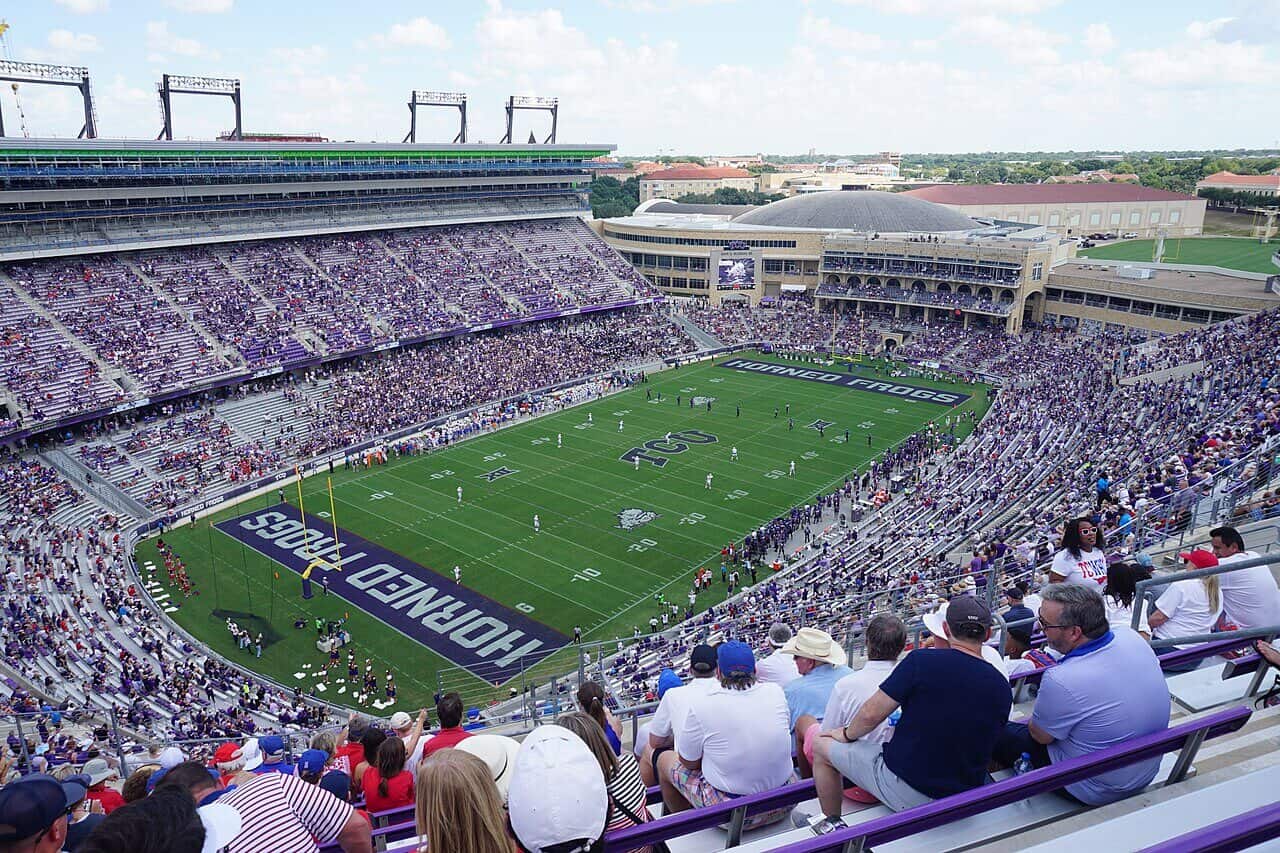
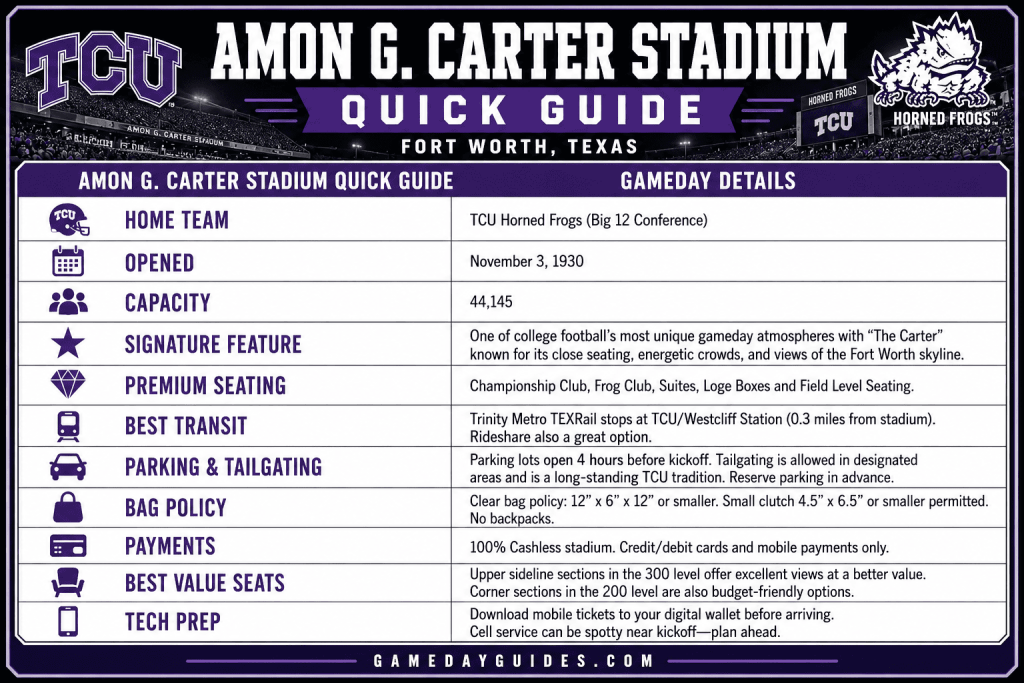
Best Seats at Amon G Carter Stadium
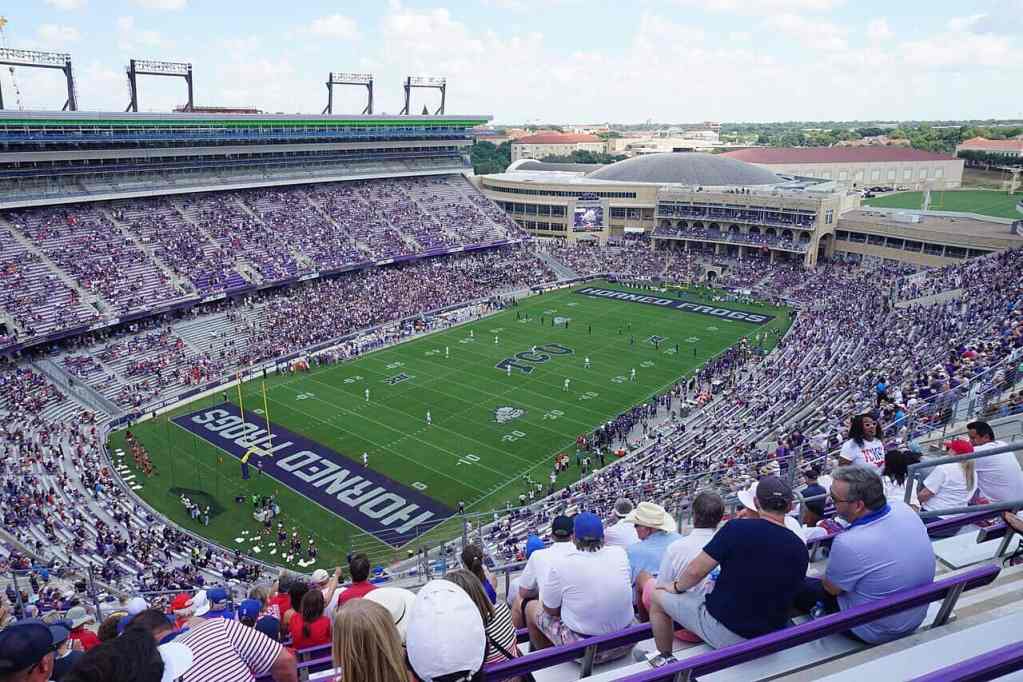
The Carter has been standing on TCU’s campus since 1930, but almost nothing you’ll see on a Saturday is original. A $164 million teardown-and-rebuild between 2010 and 2012 gutted everything except the bones, and a $100-million-plus east side expansion added two more levels of premium space before the 2020 season. What’s left is a stadium that feels older and warmer than it actually is — collegiate Gothic brick, natural Bermuda grass, a bowl small enough at 46,000 that the noise has nowhere to go but down onto the field.
Keep in mind, this is Texas, and the early-season games can be genuinely brutal if you’re not ready for the heat. It’s also a stadium where a huge share of the good seats aren’t really available to a visitor — donor priority points and season tickets lock up the west sideline and most of the premium inventory. That constraint shapes everything below, so here’s where a first-timer should actually be looking.
Seating Overview
The Carter is a compact, four-sided bowl with the field running roughly north–south and the Horned Frogs on the west sideline. That single fact drives most of the seating math here: the west side is the home sideline, the expensive side, and the side where premium inventory stacks up. The east side is where the students are, where the visiting bench sits, and where the newest structure — the 2020 Legends addition — towers over everything.
Because the bowl is small by Big 12 standards, the sightline gap between a great seat and a mediocre one is narrower than at a 100,000-seat stadium. You’re rarely far from the action. What varies most is sun exposure, atmosphere, and how much you paid to be there.
Best Non-Premium Seats
The west sideline lower bowl, low 100s. This is the home side, straight across from the TCU bench, and it’s the seat most Horned Frog season ticket holders have been sitting in for a decade. You get the full width of the field, the band and Showgirls in your sightline, and the best angle for watching a drive develop. The tradeoff is availability and price — these go to renewals and priority-point holders first, so on the secondary market you’re bidding against the same people every week.
The 130s and low 100s in the corners, particularly the field-level sections. TCU designates a handful of sections at field level — 101, 102, 107, 108, 109, 120, 121 and 128 — that put you close enough to hear the linemen. The corner angles cost you a little on the deep-ball read, but for a first-timer chasing the college football feeling rather than the coach’s-tape view, the proximity is worth more than the geometry.
The east sideline lower bowl, the 120s. Sections 122 through 127 are general admission student seating, which means the 120s block is the loudest stretch of the stadium. Sitting adjacent to it — rather than in it — is one of the sharpest plays in the building: you get the noise, the chants, and the third-down surge without needing a student ID. It’s also the side where a visiting fan is most likely to feel outnumbered, which is either the point or the problem depending on who you’re pulling for.
Best Value Seats
The upper rows of the north end zone. End zone seats get dismissed reflexively, but at a stadium this small, the north end upper rows put you high enough to read the whole field and cheap enough that you’re not agonizing over it. You lose the sideline depth perception on run plays. You gain a straight-on view of every red zone snap at a fraction of the west sideline price, and at The Carter the elevation is modest enough that you never feel exiled.
The east upper deck above the student section. This is the best noise-per-dollar in the building. You’re stacked above the loudest section in the stadium, high enough to see everything, and the newer east side structure means the concourse behind you is in better shape than the west upper. Downside: it’s a climb, and on a hot afternoon there’s not much between you and the sky in the lower rows of the deck.
Cheapest Way In
The upper corners, either side. These are the last rows to sell and the first to get discounted on the secondary market as kickoff approaches. Sightlines are honestly fine — the bowl isn’t tall enough to make the top rows punishing — and you’re inside the same atmosphere as everyone else. The real cost is walking distance from the gate to your seat and the concourse queue at halftime.
The visiting-fan sections in the north end. TCU designates blocks in the upper north end zone for visiting supporters, and they’re typically the cheapest reserved tickets released for a given game. If you’re traveling in for a Big 12 road trip and want to be around your own people rather than isolated in a sea of purple, this is the buy. You’re a long way from the field and the view is dead-on rather than angled, but you’ll have company.
Our Pick
The east sideline lower bowl just outside the student block — sections in the 120s that aren’t 122 through 127. It’s the loudest part of the stadium you can buy into without being enrolled, the sightline is a true sideline view, and it costs meaningfully less than the mirror-image seat on the west side.
Heat & Shade at The Carter
Fort Worth in early September is no joke, and The Carter is an open-air bowl with a grass field radiating heat back at you. Kickoff temperatures in the mid-90s for a non-conference opener are ordinary, not exceptional, and the metal bench seating in parts of the bowl holds that heat.
The durable fix is not chasing a particular side of the stadium — it’s checking the kickoff time before you buy. TCU schedules a lot of evening kicks in September precisely because of this, and a 7:00 p.m. start is a completely different experience from a 2:30 p.m. one. If you’re stuck with an afternoon game, get up under the upper deck overhang where the structure genuinely covers you, bring the one unopened bottle of water TCU allows through the gate, and use the refill stations on the concourse. Umbrellas are prohibited inside the stadium, so shade has to come from architecture, not equipment.
What to Avoid (and What’s Worth Trying Once)
The lowest rows of the lower bowl in the corners. They sound great and they photograph well, but at field level in a corner you’re looking across the field at an angle that flattens everything past the far hash. Anything happening on the opposite sideline becomes guesswork. You’re paying a premium for proximity and giving up the ability to actually follow the game.
The first few rows of any upper deck section on a hot afternoon. No overhang above you, full exposure, and the metal is doing its thing. If you’re buying upper deck for a day game, go higher, not lower — the opposite of your instinct.
Worth it once: the student section fringe on a night game against a ranked Big 12 opponent. The Frog Horn goes off at 120 decibels behind the end zone after every TCU score, the Riff Ram chant rolls through the bowl, and the students never sit down. Your sightline is a general admission bench and your legs will hurt. Do it anyway, once.

Premium Seating & Clubs at Amon G. Carter Stadium
TCU’s premium landscape splits cleanly along the two renovation eras. The 2012 west side rebuild produced the club and suite inventory on the home sideline; the 2020 east side expansion stacked a whole new premium tier above the upper deck opposite it. Most of this runs through the Frog Club and priority points rather than a public ticket window, so treat what follows as a map of what exists rather than a shopping list.
The Best Premium Experience
The third-level club on the east side — completed in 2020 as part of the east expansion, currently branded the Legends Club — is the one that’s genuinely of this building rather than of premium seating generally. It sits above the upper deck on the east side with roughly 1,050 club seats, a climate-controlled lounge behind them, and covered outdoor chairback seating in short eight-row sections just outside the doors.
What makes it specific to The Carter is the view backwards: a 100-foot outdoor balcony looking over Frog Alley, the TCU campus, and the downtown Fort Worth skyline. At sunset on a night game, that balcony is the best real estate on campus. Access runs from gates opening through post-game.
Best Value Premium
The loge boxes attached to that same east side club. There are 48 of them, tucked toward the end zone ends of the Legends level in sections 323 through 326 and 335 through 338, and they come with their own private club in addition to the main lounge. This is the call a friend would make for you: you’re getting the same covered, elevated, climate-controlled experience as a suite holder, in a fixed group setting that suits four to six people, at a fraction of what a full suite costs. If you’re splitting the bill with three friends rather than expensing it, this is the tier that over-delivers.
Other Premium Options
The second-level club on the west side — currently the Champions Club, from the 2012 rebuild — is the largest premium space in the stadium with roughly 2,400 club seats and a lounge behind them, sitting directly on the home sideline. It’s the traditional donor seat, and the food spread includes rotating guest chefs from around Fort Worth.
The south end zone club, above the 100 level in sections labeled SC1 through SC4, offers the same amenity package from a straight-on end zone angle. It’s the smallest of the club footprints and the easiest one to actually get into.
The 100-level suites on the west side, in the 103 through 106 range, sit at midfield on the home sideline with concierge service — the most expensive sightline in the stadium.
Suites & Group Options
Twenty-two luxury suites came with the 2020 east side expansion, joining the existing west side suite inventory. These are almost entirely corporate and long-term donor holds, sold on a season basis rather than game-by-game, though single-game availability occasionally surfaces through third-party hospitality. Group ticket packages for non-premium blocks are handled directly by TCU. For anything premium, the Frog Club at 817-257-7700 is the only real door in.
Amon G. Carter Stadium Capacity & Seating Chart
Amon G. Carter Stadium seats 46,000 for TCU football, with an all-time attendance record of 53,294 set against Colorado in the 2023 season opener. The playing surface is natural Tifway 419 Bermuda grass, named Moncrief Field since 2003.
The bowl is laid out in three tiers. The 100 level is the lower bowl, running 101 through 128 continuously around the field, with the west sideline in the low 100s, the north end zone through the 110s, and the east sideline in the 120s — including general admission student seating in 122 through 127. The 200 level covers the west side club and the seating above it. The 300 and 400 levels sit on the east side, topped by the Legends level from the 2020 expansion. The Horned Frogs occupy the west sideline; visitors are on the east.
Here is the seating chart for TCU Fooball.
Getting the Best TCU Football Tickets
TCU’s ticket market is two markets wearing one coat. Big 12 home games against Texas Tech, Baylor, and whichever ranked visitor is in town are near-sellouts where the secondary market runs well above face and doesn’t drop. Non-conference September games against FCS or Group of Five opponents are the opposite — they sell out on paper because season ticket holders own the seats, but a meaningful chunk of those seats hit the resale market and soften considerably in the last 48 hours.
Two specific market quirks are worth knowing. First, TCU’s season-ticket base is large and heavily local, which means late-week resale flooding is real for weeknight and low-appeal games — waiting is genuinely rewarded there in a way it isn’t at most Big 12 programs. Second, the Armed Forces Bowl plays at The Carter in late December, and bowl tickets follow completely different demand logic than the regular season; if the matchup is regional, prices hold, and if it isn’t, the building becomes one of the cheapest bowl tickets in the country.
Get your TCU Football tickets here through our partner Vivid Seats.
Amon G. Carter Stadium Bag Policy
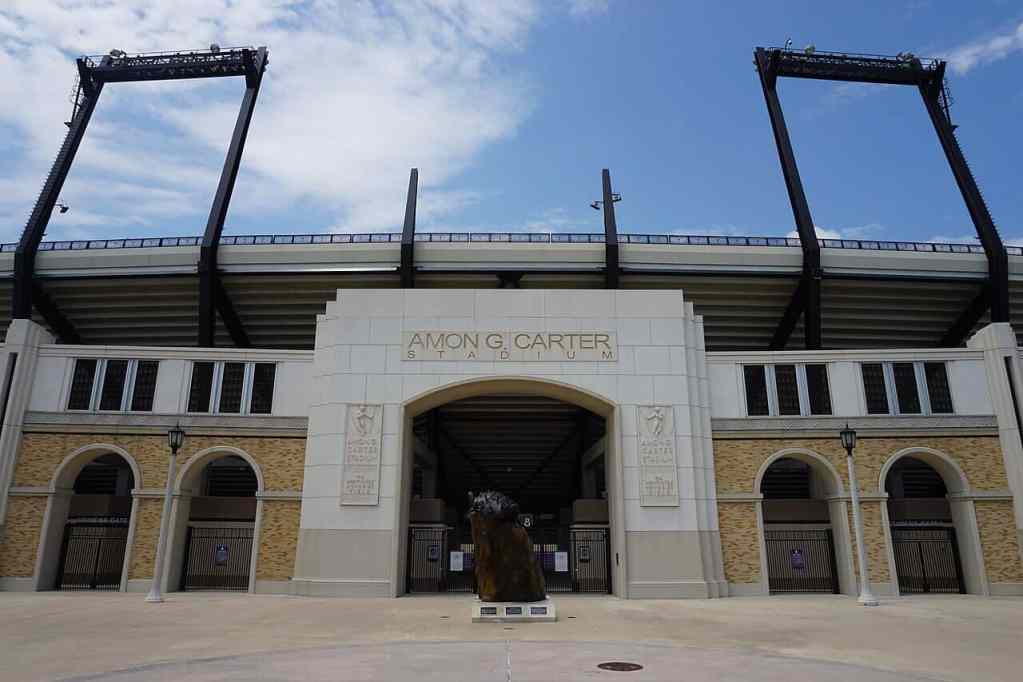
TCU enforces a clear bag policy across all athletics facilities. What gets in: clear plastic, vinyl, or PVC bags not exceeding 14 inches by 14 inches; a one-gallon clear plastic freezer bag; and a small clutch roughly the size of your hand, which can be carried in addition to one clear bag. Backpacks, diaper bags, and anything similar are turned away regardless of what’s inside. Medically necessary items are the standing exception, subject to inspection at the gate.
Everyone passes through a metal detector before the ticket scan, and bags get a second look, so the smaller and clearer your bag, the faster your entry.
Key Venue Policies to Know
No re-entry. This is the one that catches people, and it’s a relatively recent change tied to public beer sales inside the stadium. Once you’re in, you’re in. Two gates — Gate 4 on the west and Gate 8 on the east — handle medical exits with a scan-out so the ticket can be reused. Plan your tailgate accordingly, because you can’t duck back out to the lot at halftime.
No concealed or open carry. Texas open-carry law does not extend onto the TCU campus, and the university prohibits firearms of any kind including permitted ones. Out-of-state visitors used to Texas norms get surprised by this.
Tobacco-free campus. No smoking or tobacco anywhere in the stadium or on TCU grounds — not the concourse, not the lots.
No umbrellas, no strollers, no outside food or drink. One unopened bottle of water per person is the sole exception, and there are refill stations on the concourse. Given how hot September games get, bring it.
Personal signs are allowed up to 18 by 24 inches. Banners are not, and cannot be hung inside the stadium.
Is Amon G. Carter Stadium Cashless?
Completely. Every point of sale inside TCU athletics venues takes cards, Visa gift cards, and contactless payment including Apple and Google Pay, and none of them take cash. Don’t plan around an ATM run. Beer service inside the stadium runs from three hours before kickoff — starting out in Frog Alley — until the beginning of the fourth quarter, with a two-drink limit per transaction and ID checks for anyone who looks under 30.
Accessible seating is distributed throughout the stadium rather than concentrated in one block, and the ticket office handles placement directly. ADA parking is in the Lot 5 Garage at West Cantey Street and Stadium Drive, requires a state-issued hang tag or plate, runs $30 per space, and is limited enough that arriving early matters. Elevators are located at the north and south ends of the west concourse and on the east concourse by the Gate 8 entrance, with escalators near the middle of the west concourse. Guest services near section 102 runs golf cart shuttles to adjacent lots and stocks assistive listening devices — a genuinely useful service that most stadiums this size don’t offer.
Full policy details are published in TCU’s football A–Z policy page.

Getting to Amon G. Carter Stadium
The Carter sits at 2850 Stadium Drive, right in the middle of TCU’s campus in a residential neighborhood about 15 minutes southwest of downtown Fort Worth and roughly half an hour from DFW International. Driving is the default here — Fort Worth’s transit network isn’t built for a stadium run — but the smart version of driving involves parking somewhere other than campus.
Amon G. Carter Stadium Parking
Nearly every on-campus lot at The Carter is donor parking, sold on a season basis through the Frog Club, with 2026 passes running from $200 for the Molly Reid Garage up to $2,500 for an RV space in Lot 13. If you don’t have a pass, campus is effectively closed to you — TCU sets a perimeter and enforces it.
The parking hack: two churches offer free game day parking with free shuttles. Doxology Bible Church at 4805 Arborlawn Drive and Travis Avenue Baptist Church at 800 West Berry Street both open their lots at no charge, and TCU runs free shuttle service from them starting three hours before kickoff, with the last shuttle leaving the stadium 45 minutes after the game ends. The Doxology shuttle drops just outside Lots 1 and 2; Travis Avenue unloads at the Tom Brown Pete Wright lot. This is buried on the Frog Club parking page and almost nobody outside the season ticket base knows it exists.
If those fill, paid options with the same shuttle service run from Paschal High School on Forest Park Boulevard, University United Methodist and University Baptist on the Berry Street corridor, and St. Stephen’s Presbyterian on McPherson. Last i checked it was around 20 bucks, but that can always rise.
Getting out is its own project. Fort Worth PD directs traffic in fixed one-way patterns off campus after every game, and Stadium Drive between West Cantey and Bellaire Drive North closes entirely on game days. Every lot has an assigned exit direction posted, and they’re enforced — you don’t get to pick your route home. Donor lots must clear three hours after an early kickoff or 90 minutes after a night game, whichever hits 11:00 p.m. first, per city ordinance.
Public Transit
Trinity Metro’s Route 007 bus connects downtown Fort Worth to TCU’s campus, boarding at the Intermodal Transportation Center or near the Omni downtown and dropping at University Drive and Berry Street, a short walk from the stadium. It’s genuinely useful if you’re staying downtown and don’t want to deal with the postgame traffic funnel. The catch: Trinity Metro sets the schedule, not TCU, and service isn’t guaranteed to line up with every kickoff time — particularly late night games. Check the schedule the day before rather than assuming.
Rideshare
Uber and Lyft are restricted to a single designated zone: the Harrison Lot at the corner of West Berry Street and Stadium Drive, adjacent to Lot 8. Taxis use a different corner, at Stadium Drive and Bellaire Drive North. Drivers who don’t know the game day rules will try to drop you somewhere else and get turned around, so set your pin manually to the Harrison Lot before you book. Postgame surge is steep and the pickup zone gets congested — walking ten minutes east on Berry before requesting is the standard workaround.
Walking from Nearby Neighborhoods
If you’re staying anywhere along the Berry Street corridor or in the Bluebonnet Circle area, the stadium is a walk, not a drive. Same for much of the immediate campus neighborhood. Given the parking situation, staying somewhere you can walk from is worth paying up for.

Frog Gameday Insider Tips & Hacks
TCU game day is more compressed than at the sprawling college football cathedrals — the whole thing happens in a few blocks, and the main event before the main event is a street party rather than a parking lot. Here’s what regulars know that the stadium website won’t tell you in one place.
Stadium History and TCU Tradition
The Carter opened on October 11, 1930 with a 40-0 win over Arkansas in front of 22,000 people, and for eight decades it grew by accretion — 8,500 seats added to the east grandstand in 1948, an upper deck and two-story press box in 1956 topped with a 60-by-120-foot purple and white “TCU” spelled out in the bleachers, visible from the air. Dutch Meyer won national championships here in 1935 and 1938. Sammy Baugh, Davey O’Brien, Bob Lilly, and LaDainian Tomlinson all played on this field.
Then in December 2010, TCU imploded the west side upper deck. The stadium you walk into today is essentially a 2012 building wearing a 1930 name, funded entirely by donor money with no bonds or debt taken on. Worth knowing before you tell someone you’re visiting a 95-year-old stadium.
Amon G Carter Renovations
The 2010–2012 rebuild cost $164 million and did something unusual: instead of tucking concessions and restrooms under the seating bowl the way most college stadiums do, the architects opened the main concourse to the field. You can get a beer and still see the game. It’s the single best design decision in the building and you notice it within five minutes of walking in.
The 2020 east side expansion added over $100 million of premium space above the upper deck — a club level, 22 suites, 48 loge boxes, and that 100-foot balcony over Frog Alley. It also permanently changed the skyline of the stadium from the outside, which is why photos from 2015 and 2025 look like different buildings.
Frog Alley Is the Whole Pregame
Three hours before kickoff, TCU closes Stadium Drive and turns it into Frog Alley — a purple-painted street party running the length of the east side of the stadium. Setup starts six hours out. It’s free and open to anyone, ticket or not.
Inside it: Carter Corral is the kids zone with inflatables and yard games, Riff Ram Row is where the giveaways and product samples live, and Stadium Social is the bar, food truck, and live music stretch. Teardown begins 30 minutes before kickoff.
Arrival Timing That Actually Works
Parking lots open five hours before kickoff. Frog Alley opens at three hours. Gates open 90 minutes out. Will call opens five hours out at Gate 10, with visiting team will call at Gate 6.
The sweet spot for a first-timer is arriving about two and a half hours before kickoff: you catch Frog Alley at full strength, you’re positioned for the Frog Walk, and you’re through the gate before the security line stacks up in the last 45 minutes.
The Frog Walk Is the Thing to Actually Show Up For
Roughly two hours before kickoff, the team arrives and walks in through the crowd on Stadium Drive in front of Schollmaier Arena, met by the marching band, cheerleaders, and the TCU Showgirls. It’s the most concentrated dose of TCU game day in one place, and it takes about ten minutes. Get there fifteen minutes early and stand on the arena side for the better angle.
Happy Hour Before Kickoff
From the moment gates open until 30 minutes before kickoff, the Taste of Funkytown concession stands run a happy hour with food and drink items at a steep discount from the regular menu. Almost nobody who arrives at the last minute knows this exists, and it’s a real reason to get in early rather than lingering in Frog Alley until kickoff.
What to Eat Inside The Carter
TCU brings in actual Fort Worth restaurants rather than relying on generic stadium fare. Railhead Smokehouse handles barbecue, Bobby’s Fajitas does the Tex-Mex, Chicken Express is the local fried chicken institution, and Buffalo Bros — a campus fixture on Berry Street — has a stadium presence too. The Taste of Funkytown stands cover standard game day food at the lower end of the price range.
The barbecue lines are the longest and slowest in the building. Go at the end of the first quarter, not halftime, and don’t try it during the pregame rush.
Beer Rules Worth Knowing
Sales start three hours before kickoff out in Frog Alley and continue inside, ending at the beginning of the fourth quarter. Two drinks maximum per transaction. TCU checks ID for anyone who looks under 30, and there are ID stations around the concourse where you can pick up a wristband in advance — do that early and skip the ID check at every subsequent beer stand.
The Frog Horn and Riff Ram
Behind the end zone sits a purple-painted train horn that has been blasting 120 decibels after every TCU score since 1994. It is louder than you expect. If you’re bringing small children, that’s the thing to warn them about.
The Riff Ram chant dates to the 1920s and rolls through the stadium constantly: “Riff, Ram, Bah, Zoo / Lickety, Lickety, Zoo, Zoo / Who, Wah, Wah, Who / Give ’em Hell, TCU!” It’s mostly individual syllables and you’ll have it by the second quarter. Watch the videoboard for the ending — a well-known Frog delivers the last line.
Fireworks go off at the 90, 60, and 30-minute warnings before kickoff, when the team takes the field, at halftime, when SuperFrog enters, and after every TCU score. Sometimes after a win, too.
Wear the Right Color
TCU runs color-block games, and they change week to week — purple for most, white for one or two, black for a themed night game, and occasionally a split where the east side wears purple and the west wears white. The schedule gets published before the season on TCU’s gameday pages. Showing up in the wrong color isn’t a crime, but you’ll notice, and the split games look genuinely striking from the upper deck.
Families & Kids at The Carter
Bleacher Creatures is the best-kept secret in the building for anyone with kids 12 and under. Meet at the southeast corner of the stadium by the videoboard 30 minutes before kickoff, and participants get a free jersey and run onto the field before the team comes out. Free, no advance signup mentioned, and it’s the kind of memory that makes a kid a fan for life.
Frog Alley’s Carter Corral covers the pregame with inflatables, face painting, and yard games. Family restrooms are on every level. Note the hard limits, though: strollers are not permitted inside the stadium, so you’re carrying or walking. And the Frog Horn is loud enough that ear protection for toddlers is a reasonable call.
Autographs & Player Access
The Frog Walk about two hours before kickoff is the realistic window — players walking through a crowd on the way in. Position yourself along Stadium Drive in front of Schollmaier Arena early and stand at the rope on the arena side. Postgame access on the field isn’t a thing for general ticket holders; the pregame walk is the shot.
Tailgating at TCU
TCU tailgating is fundamentally different from Texas A&M or Oklahoma, and it’s worth understanding before you plan around it. Single-space tailgating happens in the donor lots — Lots 1, 2, 3, 4, and 13 are the big ones — which means you need a season parking pass to have a spot at all. If you have one, the rules are strict: nothing in driveways, roadways, walkways, or landscaping; no kegs; no selling alcohol; personal containers only, no glass. Everything must be secured and extinguished before you go into the stadium.
For visitors without a pass, the two real options are REVELxp, which runs full-service premium tailgate packages in front of Schollmaier Arena, or skipping tailgating entirely and doing Frog Alley plus a Berry Street bar instead. Honestly, for a first-timer, the second option is better — Frog Alley is more fun than most tailgate lots and costs nothing.
The Team Store Play
The Fraley Family TCU Team Store is on the west side of the stadium, with satellite shops on the north end zone concourse and in the southwest corner, plus a merch trailer outside Gate 10 by Riff Ram Row. The trailer is the move — it’s outside the gates, so you don’t need a ticket to hit it, and it’s dramatically less crowded than the main store during the pregame crush and at the final whistle.
The Riff Ram App
TCU’s official app is called Riff Ram, and it handles mobile tickets, schedules, scores, and stadium information. Tickets are fully digital and there are no paper options at the gate, so download it before you leave home rather than fighting stadium wifi in the entry line. There’s an open wifi network throughout the stadium, but on a sellout it’s exactly as reliable as you’d expect.
Separately, TCU police run a Frog Shield app that routes issues straight to the game operations command center — useful to have if you’re bringing a group.
Exit Strategy
The concourse-open-to-field design that makes the stadium great during the game works against you at the end of one, because everyone can see the clock and everyone moves at once. If you’re in the upper deck, start down with three minutes left in a decided game — the ramps back up badly.
Driving out, your exit direction is dictated, not chosen: every lot has a mandated turn posted and enforced by Fort Worth PD. Look it up before you park so you know which direction you’re being pushed. If you took the shuttle from Doxology or Travis Avenue, you have 45 minutes after the final whistle before the last bus, which is plenty if you leave promptly and tight if you linger.
Photo Spots Worth Finding
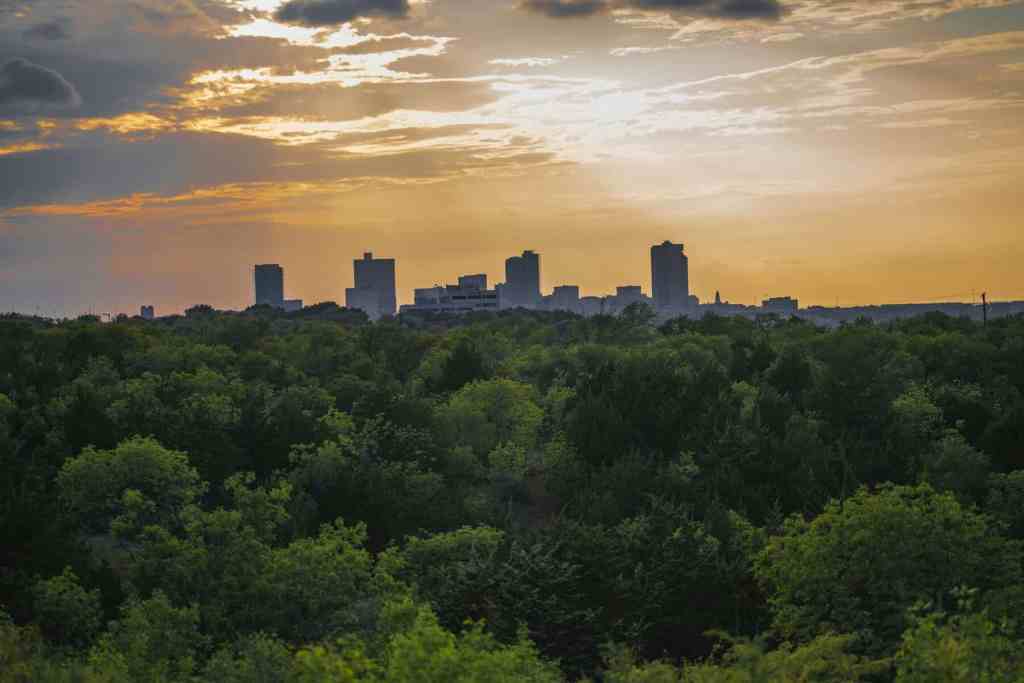
The best exterior shot is the east side of the stadium from Stadium Drive during Frog Alley, with the 2020 expansion looming over the purple-painted street and the crowd filling it. Inside, the northwest corner of the upper concourse gives you the bowl with downtown Fort Worth’s skyline behind it — best about 20 minutes before a night kickoff, when the stadium lights are up and there’s still color in the sky.
Venue Quirks
The concourse is unusually wide and the signage is genuinely good, which makes The Carter one of the easier Big 12 venues to navigate cold. Restroom lines are manageable except at halftime. First aid rooms are on both main concourses, near section 102 on the west and section 125 on the east.
The one thing that consistently surprises people: no artificial noisemakers of any kind. No air horns, no thundersticks, no musical instruments, nothing you shake to make noise. TCU enforces it.
Things to Do in Fort Worth
If you’re building a weekend rather than a day trip, Fort Worth genuinely has it. The Cultural District — about ten minutes from campus — holds three world-class museums within walking distance of each other: the Kimbell, the Modern, and the Amon Carter Museum of American Art, funded by the same newspaper publisher the stadium is named for. Standing in his museum on Saturday morning and his stadium on Saturday night is a genuinely satisfying way to spend a day.
The Stockyards run twice-daily cattle drives down Exchange Avenue and house Billy Bob’s Texas, which bills itself as the world’s largest honky-tonk. It’s touristy and it’s also completely worth it if you’ve never done it. Sundance Square downtown is the walkable restaurant and bar core, and it’s where you’d stay if you wanted to be in the middle of the city rather than near campus. Fort Worth has a great downtown area. Highly recommend.

TCU Gameday Scene: Bars and Restaurants
TCU’s game day culture doesn’t look like the rest of the Big 12, and the reason is geography. This isn’t a college town where a stadium sits alone in a field surrounded by 40,000 tailgaters — it’s a campus embedded in a real city of nearly a million people, fifteen minutes from a downtown with actual bars and a historic Stockyards district that predates the football program by half a century. That changes the whole rhythm of a Saturday.
The practical version: at TCU, the bars beat the tailgate. Donor-only campus parking means the lot scene is largely closed to visitors, and the school has deliberately poured its energy into Frog Alley instead — a free, three-hour, open-to-everyone street party on Stadium Drive with food trucks, live music, and the Frog Walk in the middle of it.
Combine that with the fact that TCU plays a lot of night games, and the standard Frog Saturday looks like this: brunch or lunch somewhere on Berry Street or University Drive, drinks at a campus bar or a West 7th patio through the afternoon, Frog Alley for the last couple of hours, then into the stadium. Afterward, everyone spills back out to the same districts, and West 7th in particular turns into the postgame gathering point — when TCU made the national championship game, Crockett Row closed the street and threw a block party for it.
Three districts matter. Campus and Berry Street is the student and walkable zone, running east from University Drive with Bluebonnet Circle just south of it — cheap, loud, young, and close enough to walk to the stadium. West 7th and Crockett Row, about ten minutes north, is where young alumni and everybody with a car goes: dense, patio-heavy, and the default postgame destination. The Stockyards, twenty minutes north, is the tourist and out-of-town-fan play — honky-tonks, cattle drives, and a genuinely distinct Fort Worth experience that has nothing to do with football and is absolutely worth building a Saturday morning around.
Best Pregame & Postgame Bars
The Pub (University Pub) is the TCU bar in the most literal sense — a longtime Frog fan institution near campus, packed on game days, unpretentious, and the place where the alumni who’ve been coming for twenty years end up. Walkable from the stadium.
The Poop Deck on Bluebonnet Circle is the student-heavy option, complete with a student discount that guarantees a crowd. Divey, cheap, loud, and about as close to a campus bar as Fort Worth gets. Walkable.
Lot 12 Rooftop Bar, on top of the Hyatt Place Fort Worth/TCU, was purpose-built for Frogs game day — skyline views, big screens, and a layout designed around watching rather than shouting over each other. It’s the celebratory option rather than the rowdy one, and it’s the best place in the neighborhood for an afternoon drink before a night kick.
Dutch’s Hamburgers on University Drive is named for Dutch Meyer, the coach who won TCU’s national championships in the thirties, and it’s the closest thing to a shrine that also serves beer. Burgers, patio, purple everywhere, and about a ten-minute walk from the stadium.
The Social House and Concrete Cowboy anchor the Crockett Row scene on West 7th. Both go hard on TCU game days with screens everywhere and indoor-outdoor space, and both are where the postgame crowd lands. Ten minutes by car, and Crockett Row’s garages make parking manageable.
Best Restaurants Near TCU and in Fort Worth
Joe T. Garcia’s on the North Side is the one non-negotiable. It’s a Fort Worth institution operating since 1935, an enormous walled garden and patio complex, cash-and-Tex-Mex simplicity, and on game days the tables go out with purple and white tablecloths. It’s the alumni tradition. There’s no reservation system and the line is part of the experience — go early or go after the game.
Fuzzy’s Taco Shop started here, in the original location by campus, before becoming a national chain. Baja tacos, breakfast served all day, dirt cheap. If you’re facing an 11:00 a.m. kickoff, this is the answer.
Ol’ South Pancake House near I-30 and University has been running since 1962 and is open 24 hours. German pancakes, an early-morning crowd of every demographic in Fort Worth, and the correct choice before a morning game.
Heim Barbecue is the modern Fort Worth barbecue benchmark — bacon burnt ends are the signature, and the Magnolia Avenue location puts you in the Near Southside, which is worth a walk around either way. Mid-range, worth the detour, and the line moves faster than the Austin equivalents.
Buffalo Bros on Berry Street is the campus staple: wings, pizza, New York-style slices, and a permanent TCU crowd. It also has a stand inside the stadium, but the Berry Street original is the real one and it’s a short walk from the gates.
Hotels Near Amon G. Carter Stadium
Fort Worth has more hotel inventory than a college football weekend needs, which is the good news — you’re not fighting the scarcity you’d hit in a small college town. The bad news is that almost none of it is walkable to the stadium, and the handful of properties that are get booked early for the marquee Big 12 games. For a Texas Tech or Baylor weekend, book two to three months out; for a September non-conference game, you can wait.
Best Areas to Stay
The TCU campus area, along University Drive and the Berry Street corridor, is the only place you can genuinely walk to the stadium from. It’s residential, quiet outside of game day, and thin on hotels — a handful of properties, all of which know exactly what they have. Best for anyone who wants zero transportation logistics.
The Cultural District and Medical Center area, about ten minutes northwest, is the sweet spot for most visitors: a cluster of hotels, three major museums, and Dickies Arena, with an easy drive or short rideshare to campus. This is where you stay if you want a real Fort Worth weekend rather than just a football game.
Downtown and Sundance Square, roughly fifteen minutes north, gives you the most restaurants and bars within walking distance of your room, plus the Route 007 bus straight to campus. Good for groups who’ll be out late and don’t want to drive.
The Stockyards, twenty minutes north, is the destination play — the most distinctly Fort Worth place to sleep, and the furthest from the stadium. Worth it if the trip is about the city as much as the game.
Hotel Recommendations
Hyatt Place Fort Worth/TCU on Sandage Avenue is the obvious first call and it isn’t close. It sits within walking distance of the stadium, it has Lot 12 Rooftop Bar on top of it — a purpose-built TCU game day space — and it’s one of the six lots on TCU’s official free game day shuttle route, meaning a bus picks up at your hotel and drops you at Tom Brown Pete Wright. That combination doesn’t exist anywhere else in Fort Worth. The tradeoff is that it’s a select-service hotel, not a luxury one, and it books up for the big games well before you’ll think to look.
Bowie House, Auberge Collection on Camp Bowie Boulevard is the splurge. It’s the newest luxury property in the city, in the Cultural District within reach of the museums, with a spa and a restaurant that locals go to independently of the hotel. From the outside it reads as an office building, which throws people; inside it’s the best-appointed room in Fort Worth. Fifteen minutes to campus. You’ll be driving or riding to the game.
Hotel Dryce on Byers Avenue is the design-forward mid-tier pick, a small property near Dickies Arena with a strong lobby bar, a serious shower, and rooms that lean minimalist to the point of having no closet. The staff is the reason people come back. Walk to the Cultural District, short ride to the stadium, and it’s the most interesting room in this price range.
Omni Fort Worth Hotel downtown is the big-box option, and it earns its spot for one specific reason: it’s a TCU athletics hotel partner and it sits near the Route 007 bus that runs to campus on game days. If you’ve got a group, want everyone in the same building, and want to walk to dinner without a car, this is the practical answer. It’s a large convention hotel and feels like one.
Hotel Drover, Autograph Collection in the Stockyards is the one to book if the weekend is really about Fort Worth. Mule Alley setting, western design done seriously rather than as costume, a pool and patio scene that’s a destination on its own. It’s twenty-plus minutes from the stadium and you will need a rideshare each way. That’s the trade — you’re choosing the city over the convenience.
Courtyard Fort Worth University Drive is the comfortable middle: a mile from the stadium on the corridor where the pregame restaurants are, standard Marriott execution, pool, and the kind of predictability that matters when you’re bringing family. Nothing surprising about it, which is the point.
Budget Options
SpringHill Suites Fort Worth University sits a mile and a half out on the University Drive corridor and consistently comes in well under the campus-adjacent properties while offering suite layouts and free breakfast. The tradeoff is that you’re driving or riding to everything, and the location is functional rather than pleasant.
Extended Stay America Suites Fort Worth Medical Center is the genuinely cheap option, with in-room kitchens that make it a reasonable pick for a family or a group splitting costs over a weekend. Rooms are basic and the property is aging — you’re paying for a kitchen and a bed near the Cultural District, not for the experience.
Why You Should Go
The Carter isn’t the biggest or the loudest stadium in the Big 12, and TCU will tell you as much. What it has is a rebuilt bowl that’s genuinely well designed — the open concourse alone puts it ahead of buildings that cost twice as much — sitting in the middle of a city that gives you something to do for the other twenty hours of your Saturday.
You get a real college football atmosphere with history and tradition behind it, a street party, a train horn, and a chant from the 1920s, and then you get the Stockyards, three world-class museums, and a downtown worth walking. Very few college football weekends give you both. This one does.
Check out all of our College Football Guides as well as these:
American Airlines Center in Dallas
Written by Brad Richards. Founder of Gameday Guides. This guide includes insights from personal visits as well as updated info from team sources, fan forums, and stadium policies. We aim to help you plan with confidence — enjoy your gameday. If you have any tips, if we missed anything or you have a question, don’t hesitate to shoot us an email.