
Explore other football grounds in the Premier League and around Europe!
Best Seats at Anfield
There are bigger grounds in England and there are newer ones, but there is nothing quite like Anfield. Home to Liverpool since the club was founded in 1892, it sits in a tight terraced corner of L4 where the streets still funnel a sea of red toward four stands that have watched more European nights than almost anywhere on the continent.
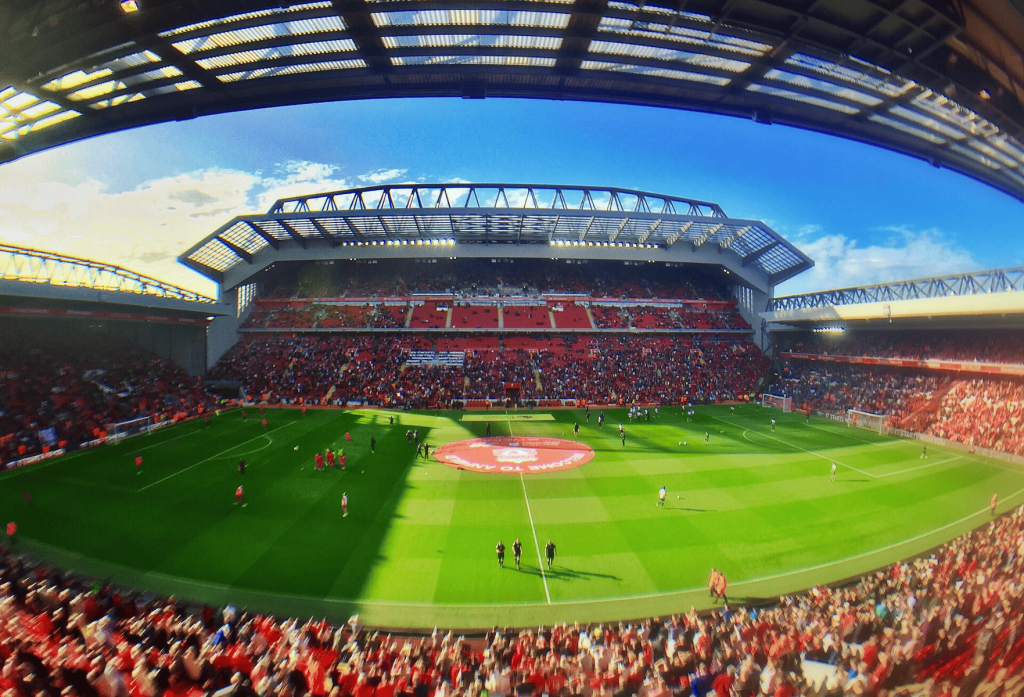
The honest reality is that it isn’t a perfect modern bowl with a seat-back cup holder and a clear sightline from every chair — it’s an old ground that grew outward over 130 years, and some seats show their age. But on the right night, when the Kop is in full voice and “You’ll Never Walk Alone” rolls around the bowl with the scarves up, it’s as good as sport gets anywhere in the world. Here’s how to pick where you sit.
Seating Guide
Four separate stands, four eras of construction, no continuous bowl — that’s the first thing to understand about reading an Anfield seating plan. The Main Stand runs one touchline and holds the tunnel, the dugouts, the directors’ box and the press; the Sir Kenny Dalglish Stand faces it and carries most of the executive boxes. The Kop sits behind the south goal, the Anfield Road Stand behind the north, and Liverpool traditionally attack the Kop in the second half.
What separates a good seat from a bad one here isn’t distance — every stand is close. It’s whether a neighbouring roof cuts into your eyeline, and whether you’ve landed in a rail-seating block where everyone around you stands for ninety minutes. Both are predictable from the block number.
Best Non-Premium Seats at Anfield
The Kop, middle blocks (203–206). Far enough back to read the shape of the game, deep enough in that the songs start around you rather than reaching you second-hand. These are rail-seating blocks, so you’ll stand throughout — that’s the trade, and for most first-timers it’s the point.
Main Stand lower, central blocks (L5–L9). The cleanest view in the ground. The 2016 redevelopment removed the old supporting pillars and took this from Anfield’s worst-obstructed seating to its best, and the blocks nearest halfway put you close enough to hear the touchline. Much quieter than the Kop.
Sir Kenny Dalglish lower, central (KK–KM). Side-on, low, opposite the tunnel, the whole pitch square in front of you. The crowd skews older and long-tenured, so you trade noise for an unobstructed watch and a seat you can actually stay in.
Best Value Seats
Sir Kenny Dalglish upper (CE3–CE7). The upper tier of the old Centenary Stand prices below the marquee areas and gives a clean side-on view from the halfway line. Not a singing section — plenty of regulars who’d rather watch than chant.
Anfield Road upper, central (AU4–AU5). The newest seats in the ground, elevated behind the goal and looking straight down the pitch at the Kop — the view you’ve watched on television for forty years, from the other side. Worth knowing before booking: the upper tier isn’t licensed for standing, so you’ll be asked to sit.
Cheapest Way Into Anfield
Lower Anfield Road (AL1–AL5). The gentlest rake in the ground and the most attainable home seats when anything reaches general availability. The atmosphere swings with the fixture because the away allocation sits in the same tier — which cuts both ways, since a lively away following lifts the whole end.
Cup ties and the early rounds. Liverpool price the opening rounds of the domestic cups well below league fixtures and the ground is far easier to get into. If your priority is being inside Anfield rather than seeing a specific opponent, this is the cheapest honest route in.
Our Pick
Central Kop, blocks 203–206, a good way back from the front. You’ll be inside the noise rather than beside it, you’ll still see the far end, and you’ll be in the stand the rest of the ground takes its lead from. The caveat is real — these are among the hardest tickets in English football — so if the ballot doesn’t land, the upper Anfield Road blocks looking back at the Kop are a better fallback than a corner seat you can’t see out of.
The View From Your Seat: Blocks to Avoid at Anfield
The back rows of blocks 202, 208, 304, 305 and 306. The rearmost seats at the top of the Kop sit under the roof, so high balls toward your end vanish for a second or two and the shallow angle flattens the far half of the pitch.
The back of CE9, and blocks U1 and U9. CE9 sits where the neighbouring roofline intrudes on the Sir Kenny Dalglish upper tier; U1 and U9 are the outer Main Stand upper blocks, clipped by the roofs of the Kop and the Anfield Road End. None are unusable — they’re the seats where you read part of the game off the crowd’s reaction.
Worth it once anyway. The very back of the Kop is not the best seat at Anfield and nobody sitting there thinks it is. It’s also twelve thousand people singing in a stand built in 1906. Take the sightline hit once.
Safe Standing at Anfield: Where You Can Stand
Anfield holds a Safe Standing Licence covering roughly 13,300 rail seats, and this is the most useful thing to know before choosing a block. Rail seating covers the Kop’s lower and middle blocks (102–108 and 202–208) and the lower Anfield Road tier — there you can stand for the full ninety minutes. Everywhere else, including the entire upper Anfield Road tier, is not licensed, and stewards will ask you to sit outside goal celebrations and other significant moments.
Read it both ways. Want the full Kop experience? Target a rail block deliberately. Bringing someone who can’t stand for two hours? The top of the Kop (304–306) and the two side stands are where you watch sitting down without friction.
Premium Seating and Hospitality at Anfield
With general admission as scarce as it is, an official hospitality package has become the most reliable way for an overseas visitor to actually get inside Anfield — and unlike a ballot, it’s a straightforward transaction. Lounges sit in the Main Stand, the Sir Kenny Dalglish Stand and the redeveloped Anfield Road End, all open three hours before kick-off, all home supporters only.
The Best Premium Experience
The Founders Lounge, Anfield Road Stand. Named for John Houlding, who founded the club in 1892, this is the top of the official range — five-star dining, a pitch view from the first-floor lounge itself, elevated padded seats behind the goal, and access from three hours before kick-off until an hour after. Entry is via the Anfield Road Reception. One detail that catches visitors out every season: the dress code is business casual and football shirts and trainers are not permitted. Smart jeans are fine; a home kit will not get you in.
Best Value Premium
Brodies Sports Bar, Anfield Road Stand. The pick for most visitors. A first-floor matchday sports bar with complimentary street food before kick-off, one free drink at half-time, a former Liverpool player dropping in, and an hour of post-match access while the streets clear. Your seat is in the Anfield Road middle tier, looking straight across at the Kop. Two honest notes: the bar itself is a cashless pay bar, and the room gets rammed — seating is at a premium, so arrive early rather than strolling in at half two.
Other Premium Options
The Anfield Beat Lounge in the Main Stand lower tier leans on Liverpool’s music heritage and runs smart casual, so home shirts are welcome. The Carlsberg Dugout is the livelier sports-bar option. The Beautiful Game and the Chemistry Lounge are the fine-dining rooms paired with elevated Main Stand seats, and the Boot Room Restaurant bundles dinner with museum entry. The Premier Club sits in the Shankly or Paisley suites with more central seating around the penalty area.
Two hospitality venues sit outside the ground entirely and are worth knowing about: the club sells packages at The Sandon, the pub where Liverpool FC was formed in 1892, and at the restored Grade II-listed Victorian Conservatory in Stanley Park, a two-minute walk from the turnstiles. Neither appears in the usual roundups.
Executive Boxes and Group Options
The executive boxes are concentrated in the Sir Kenny Dalglish Stand, seat around ten, and open a few hours before kick-off with dining and a hosted bar — the standard route for corporate days and milestone birthdays, booked through the club’s hospitality team. Worth flagging if you’re building toward regular attendance: from 2026/27, hospitality purchases no longer earn match credits, so buying your way in doesn’t build loyalty toward future members’ sales.

Anfield Seating Plan
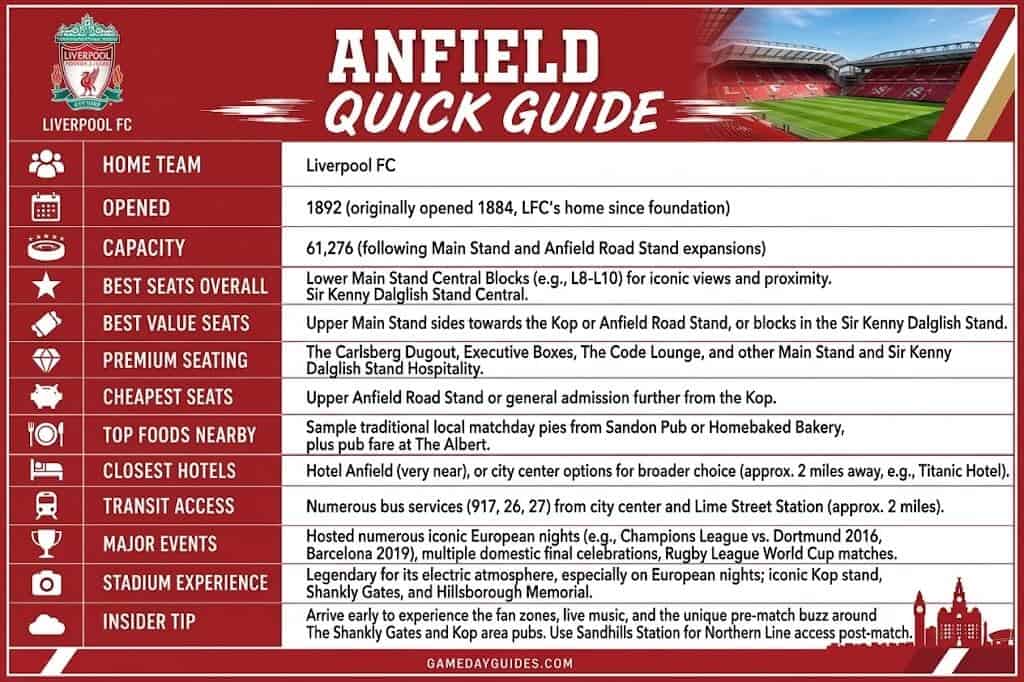
Anfield now holds 61,276 after the Anfield Road Stand expansion wrapped up in 2024, making it one of the largest club grounds in the Premier League. The stadium is split across four stands—the Main Stand, the Kop, the Sir Kenny Dalglish Stand, and the Anfield Road End—and the atmosphere on matchday is as legendary as the ground itself. You can explore the full Anfield Seating Chart here: https://map.3ddigitalvenue.com/liverpool.
Getting Liverpool Tickets at Anfield
There is no meaningful general sale at Anfield, and this is the part most guides get wrong. Around 37,000 seats sit with season-ticket holders and the rest goes to All Red members through a credit-based ballot, not a queue. Buying a membership doesn’t let you click and buy — you register for a ballot, and your access depends on how many home games you’ve attended recently. Sales run twice a season, in July for fixtures up to 31 December and in November for the rest, so a membership bought in October is too late for a March match. Highest credit balances get guaranteed seats; middle tiers get ballot access to a subset of league games; newcomers get the fewest.
That leaves three routes for a visitor. The official Ticket Exchange, where season-ticket holders resell at face value, is the best value and worth watching in the days before a game. Official hospitality is the only route with real certainty. And the early cup rounds are easier across the board. Ignore the touts working the streets — entry is NFC-based and a photographed ticket won’t open a turnstile.

Anfield Bag Policy
Anfield runs an almost no-bag policy. The only bags permitted are a small handheld bag no larger than A5 — 148.5 x 210mm, roughly a folded magazine — and a clear LFC superstore carrier bag containing store purchases only. Backpacks, holdalls, luggage and seat cushions are refused at the turnstile, and every permitted bag is searched. Oversized bags are allowed only at the club’s discretion for medical equipment; email disability@liverpoolfc.com at least 48 hours ahead and bring the approval with you.
There is an official bag drop, run by the LFC Foundation at Christ Church, 157 Hartnup Street, L5 1UW, about five minutes’ walk from the Kop. Bags up to holdall size cost £5, suitcases £10, card only, proceeds to the Foundation. It opens three hours before kick-off and closes an hour after the whistle. If you’re arriving straight from Lime Street with luggage, that solves the whole problem.
Key Policies to Know
Anfield entry is NFC, and screenshots do not work. Tickets must be downloaded into the official Liverpool FC app or your phone’s wallet and tapped on the reader like a contactless card, with a limit of four per device. Download at your hotel — with 61,000 phones on the local masts, data around the ground crawls exactly when you need it.
The ground is fully cashless. Every bar, kiosk and store inside takes card or contactless only, and most surrounding pubs are card-preferred too.
No smoking or vaping anywhere, enforced by ejection. That includes vapes and includes the concourses.
Accessibility. Accessible toilets sit in every stand, with a sensory room in the Sir Kenny Dalglish Stand and wheelchair positions across the Main Stand — blocks L8 and L9 in particular — and the Kop. Two things to plan around: there is no lift access to the upper Anfield Road tier, and the Kop is steep and narrow. Home accessible entry for the lower Anfield Road is gate DA4; away accessible entry is gate DA6 on Anfield Road. Contact the disability team on 0151 264 2500 before you travel.
For all policies check out the Liverpool FC policy page.
Getting To Anfield
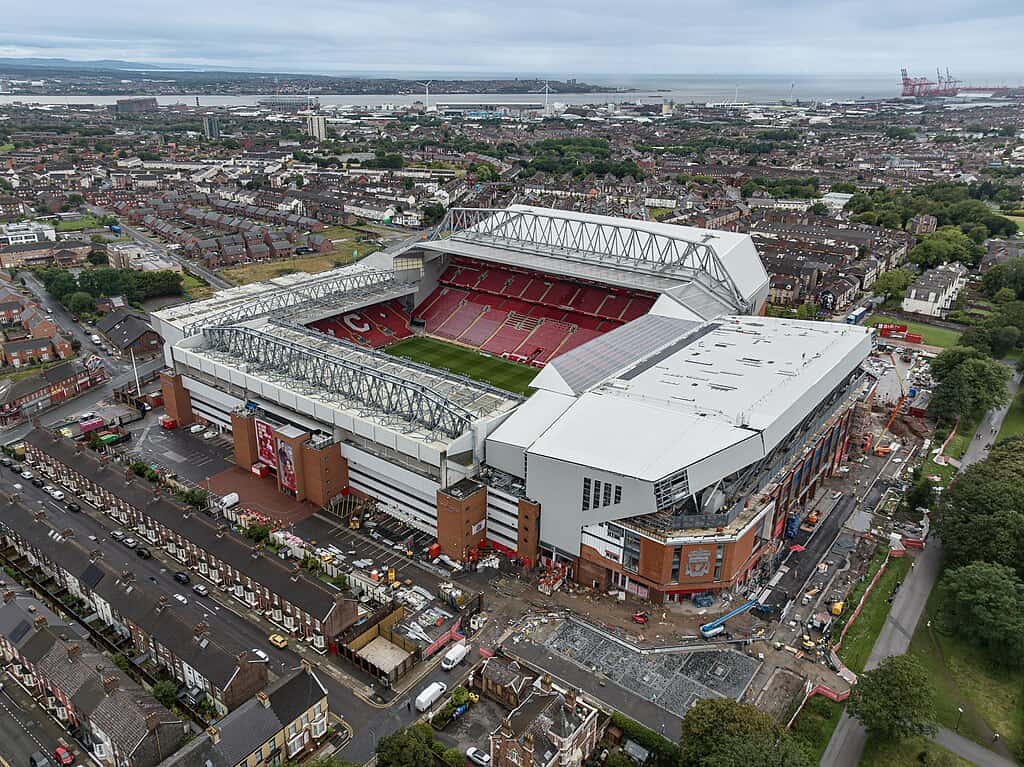
Anfield sits about two miles north of Liverpool city centre, in a residential area with limited parking, so public transport is comfortably the easiest way in and out.
Train + Soccerbus: Take a Merseyrail Northern Line train to Sandhills or Kirkdale, then the dedicated Soccerbus shuttle that runs to Anfield from a couple of hours before kick-off. Ask for a return to Anfield when you buy your rail ticket and the shuttle is usually included. It’s the cleanest way to dodge the post-match road snarl.
Bus: Frequent services run from the city centre — routes 26 and 27 from Liverpool ONE and the 917 among them — dropping near the ground on Walton Breck Road in roughly 20–25 minutes. Expect queues both ways close to kick-off and full-time.
Taxi / Rideshare: A cab or Uber from the city centre runs around £8–12 and 10–15 minutes off-peak, more on matchday with surge pricing and road closures. Have your driver drop you a street or two back from the tightest cordons and walk in, and agree a pickup point away from the crush for the way out.
Driving & Parking: Parking near the ground is genuinely difficult — residents’ permit schemes are strictly enforced. Pre-book through the official Stanley Park car park (around £12–15) or a vetted JustPark driveway, or use a park-and-ride further out. Treat the cheap “park on my drive” offers near the ground with caution, and budget time for slow post-match traffic whatever you choose.
Walking: It’s a 35–45 minute walk from the city centre through residential streets, with Stanley Park separating Anfield from Goodison Park — the two grounds sit famously close together. On a dry day it’s a fine way to soak up the build-up; in typical Liverpool weather, take the bus..
Top Tips For Matchday at Anfield
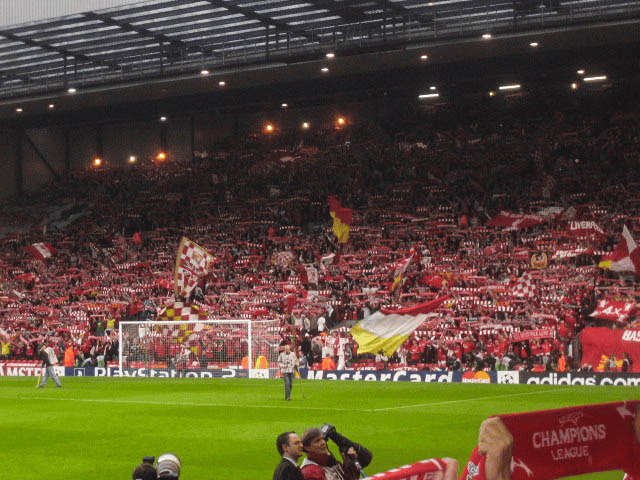
A matchday at Anfield is one of the best experiences in all of sport, and it doesn’t start at the turnstile — for locals it builds across the whole day, through the pubs, the murals, the songs in the street and the slow tide of red heading up toward the ground. The single biggest mistake a first-timer makes is turning up just before kick-off and missing most of what makes the place special. Get the logistics right, arrive early, and treat it as a day out rather than a 90-minute appointment.
Anfield Through the Years: The Ground and the 2024 Expansion
Anfield was Everton’s ground first. It opened in 1884 and Everton played here for eight years until a rent dispute with landlord John Houlding split the club — Everton left for Goodison Park across Stanley Park, and Houlding founded Liverpool FC in 1892 to fill the ground he still owned.
The Kop was built in 1906, named after Spion Kop, the hill in the Boer War where a Lancashire regiment took heavy losses. It was terracing until the Taylor Report forced all-seater grounds after Hillsborough, and even seated it stayed the largest single-tier stand in Britain until Tottenham’s new stadium opened.
Two rebuilds in eight years transformed it. The 2016 Main Stand redevelopment added a third tier, removed the old view-blocking pillars and took capacity past 54,000. The Anfield Road expansion followed — begun in 2021, delayed when the original contractor collapsed mid-build, completed during the 2023/24 season with a new upper tier adding 7,000 seats and taking Anfield to 61,276.
And that’s the ceiling. The club has ruled out further expansion: houses sit directly behind the Kop and the Sir Kenny Dalglish Stand, the road network can’t take more, and there’s nowhere left to build without knocking down a church. You’re walking into the finished version of a ground that grew outward for 140 years and finally ran out of room — which is exactly why it feels the way it does.
A Short History of Liverpool FC
The club was born out of an argument about rent. When Everton walked out in 1892, Houlding was left with a stadium and no team, so he founded one. Liverpool won the Second Division in their first full season and the league title by 1901.
Bill Shankly is where the modern club starts. He arrived in 1959 with Liverpool in the Second Division and a ground he called derelict, and left in 1974 with three league titles, the FA Cup, a UEFA Cup and the Boot Room culture that ran the club for the next twenty years. Bob Paisley, promoted from within, then won three European Cups in five years.
The European record defines Anfield’s reputation. Liverpool have won more European Cups than any other English club, and the comebacks — Saint-Étienne in 1977, Olympiakos in 2004, Barcelona in 2019 — all happened here, in front of the Kop. That’s why people talk about European nights differently than league games.
Twenty league titles, with thirty years of nothing in the middle. The drought after 1990 ended in 2020, and that gap explains a lot about how the crowd behaves — there’s a generation here who grew up on stories rather than trophies.
You’ll Never Walk Alone: Where the Anthem Came From
It’s a show tune from 1945. Rodgers and Hammerstein wrote “You’ll Never Walk Alone” for the musical Carousel, where it’s sung to a widow at the lowest moment of the story.
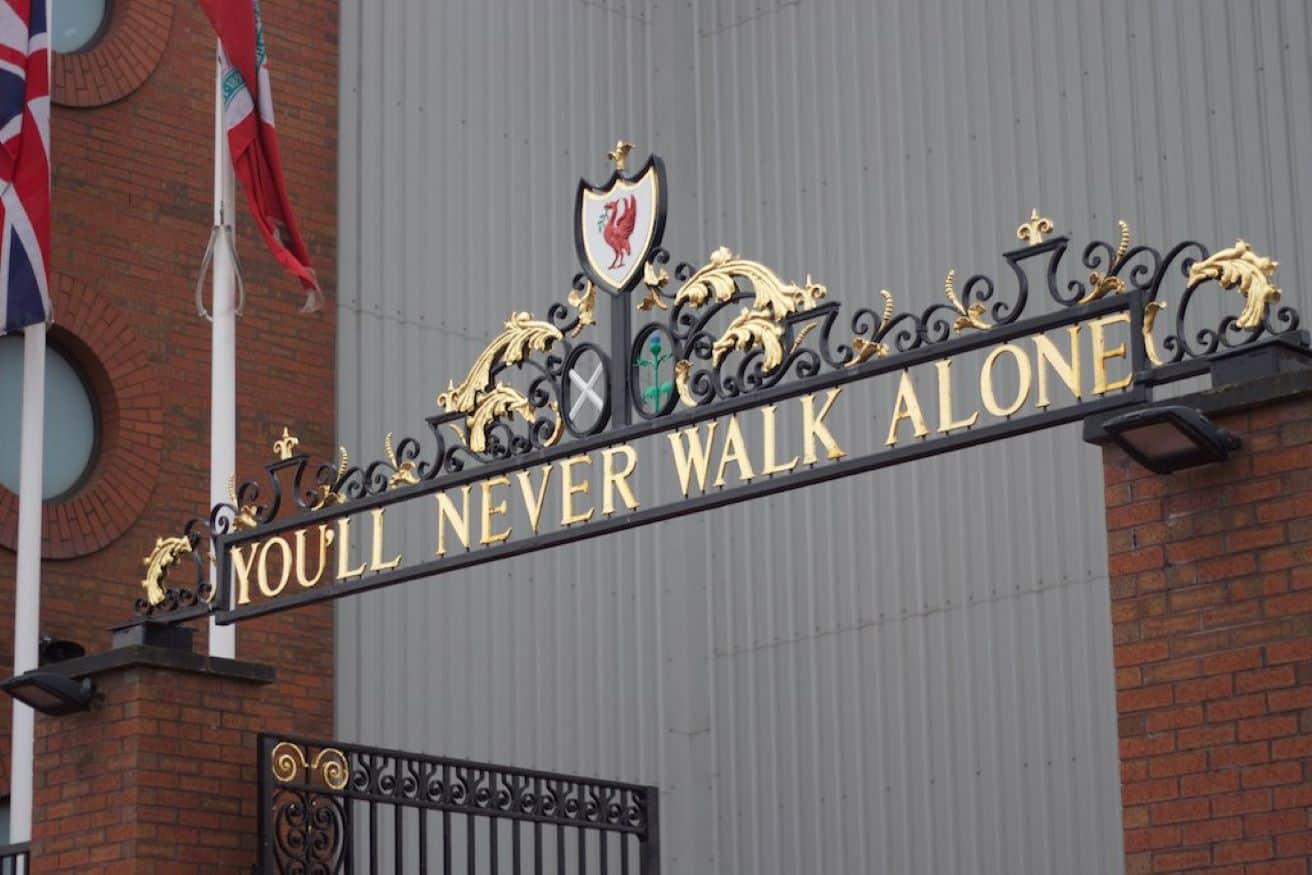
Liverpool’s own Gerry and the Pacemakers took it to number one in 1963, and the Kop — which sang the chart hits before kick-off in those days — kept singing it long after it dropped off the charts. It’s been the club’s anthem ever since, written into the crest and forged across the top of the Shankly Gates.
Learn the words before you go. It plays just before kick-off with the whole ground singing and scarves held up, and it’s the defining ninety seconds of the day. Thirty seconds to learn, and it matters enormously to the people around you.
Arriving at Anfield: Timing and Turnstiles
Get there two to three hours out. Turnstiles open two hours before kick-off, every adult is searched, and queues build hard for marquee fixtures — and the atmosphere outside builds over hours, not minutes.
Check the block letter on your ticket before you pick a turnstile. Entry is split by stand and tier, and your turnstile bank can sit at the far end of the stand from your seat by design. Walking the wrong way round a packed ground costs you fifteen minutes.
Food and Drink at Anfield
Eat outside the ground, not on the concourse. Cross from the Kop to Homebaked on Oakfield Road, a community-owned bakery whose pies are named after Liverpool figures — order the Shankly, and the profits go back into the neighbourhood.
Check Homebaked’s hours before you build your day around it. It shuts at 3:30pm and it’s closed on Sundays, so a Sunday afternoon or evening kick-off means no pies. Nobody writes this down and plenty of people walk up to a closed shutter.
Beat the half-time crush by going early. Concourse and toilet queues across a 61,000 crowd at the interval are brutal — go a few minutes before the whistle, or sort yourself before kick-off.
Hillsborough, the Shankly Gates and Paying Respects
The Hillsborough Memorial sits on 97 Avenue, the tree-lined path in front of the Main Stand running from Walton Breck Road through to Stanley Park. It honours the 97 supporters who died as a result of the crush at the 1989 FA Cup semi-final — a disaster that reshaped English football and led directly to all-seater grounds. The avenue was renamed from 96 Avenue in 2021, after Andrew Devine died 32 years on from injuries sustained that day and a coroner ruled him the 97th victim. Getting that number right matters here more than almost anything else in this guide.
This isn’t a photo backdrop. Stop, read it, take it in quietly. Locals will tell you the same.
The Shankly Gates and the statue are the other two stops. The gates carry “You’ll Never Walk Alone” across the top in wrought iron; the Shankly statue stands in front of the Kop with “He Made The People Happy” on the plinth. Paisley Square sits at the corner where the Kop meets the Main Stand.
Do your photography here, and do it before kick-off. The gates, the statue, the murals along Anfield Road — all of it is a pre-match job, and once the whistle goes the phone goes away. Supporters around you expect you to watch the game rather than film it, and you’ll enjoy it more.
The Anfield Stadium Tour and the LFC Story Museum
The tour is the best-value thing at Anfield and it’s not close. You get the home dressing room, the press room, the players’ tunnel and the “This Is Anfield” sign above it — Shankly’s idea, to remind his players who they were playing for and the opposition who they were playing against. Unlike on a matchday, you can reach up and touch it.
It runs seven days a week except matchdays, paired with the LFC Story museum, and it’s the answer for anyone who can’t get a ticket. Book ahead through the club’s official tours site; walk-ups on a busy weekend are a gamble.
Combine it with Goodison Park. Everton moved to Bramley-Moore Dock in 2025, but Goodison still stands across Stanley Park, now home to Everton Women and the academy and running its own heritage tours. The walk between the two grounds takes about fifteen minutes and is a strange, brilliant thing to do — two of English football’s oldest stadiums, in sight of each other, in a residential neighbourhood.
The Anfield Exit Strategy
Decide up front whether you’re a sprinter or a stroller. The streets are residential and bottleneck fast. Either move the second the whistle goes or — the better play — stay put fifteen minutes and walk out relaxed. Leaving with everybody at once is the one approach that doesn’t work.
Go back to the pub. Most places around Anfield stay open after the match, the traffic is dire regardless, and you lose nothing by waiting it out.
Remember the 917 return stop is on Walton Lane, not your drop-off point, and that the 501 to Lime Street runs post-match only from the same area.
Bringing Kids to a Liverpool Match
Every child needs their own ticket and seat, babies included. It’s an all-ticket ground with no exceptions, and under-16s must attend with an adult.
Sit in the Sir Kenny Dalglish Stand, not the Kop. There’s a family activity zone at the back of the Anfield Road End with quizzes before the game, but it comes with no seats — you’ll still be sitting elsewhere, so allow time. The calmer blocks at either end of the Sir Kenny Dalglish upper tier are the easier watch for younger kids.
Think hard about which fixture. The derby and the Manchester United game are boisterous in a way a six-year-old may not enjoy. A midweek cup tie is a far better first match.
Merch, Scarves and What Marks You as a Tourist
Hit the club store when you first arrive, not before kick-off. It’s the biggest club store in the world and it’s mobbed in the hour before the game.
Don’t buy the half-and-half scarf. The “Liverpool v [Opponent]” tourist scarf marks you out instantly. Buy a plain red scarf, or pick up the Red All Over The Land fanzine and a pin badge from the street sellers.
Bring a few quid for the matchday programme, sold by vendors outside the ground. It’s the traditional English football souvenir and it’ll mean more in ten years than a scarf with two crests on it.
Advice for Away Fans at Anfield
You’re in the lower Anfield Road tier, blocks AL6–AL9, an allocation of around 3,000 behind the goal, with accessible entry at gate DA6 on Anfield Road.
The Arkles on Anfield Road is your pub — the traditional mixed house and the standard call for visiting supporters. Most other ground-side pubs are effectively home-only.
Keep colours covered walking past The Albert or The Sandon. Those are home territory in a way that isn’t negotiable, and police will step in if away fans drift into the wrong streets. Liverpool isn’t a hostile away day, but the geography matters.
Anfield Quirks First-Timers Get Wrong
Flags and banners will block your view before kick-off, in several areas of the ground, during the warm-up and the anthem. It’s a tradition rather than an inconvenience, and it clears by kick-off. The club’s own banner policy is strict in the other direction: national flags, political statements and anything reading as a call to action get removed by stewards, including items that seem entirely inoffensive.
If you’re in the Kop, you stand and you sing. It’s the vocal engine room of the stadium, not somewhere to sit quietly and observe. The regulars will notice, and you’ll feel it.
Things to Do in Liverpool
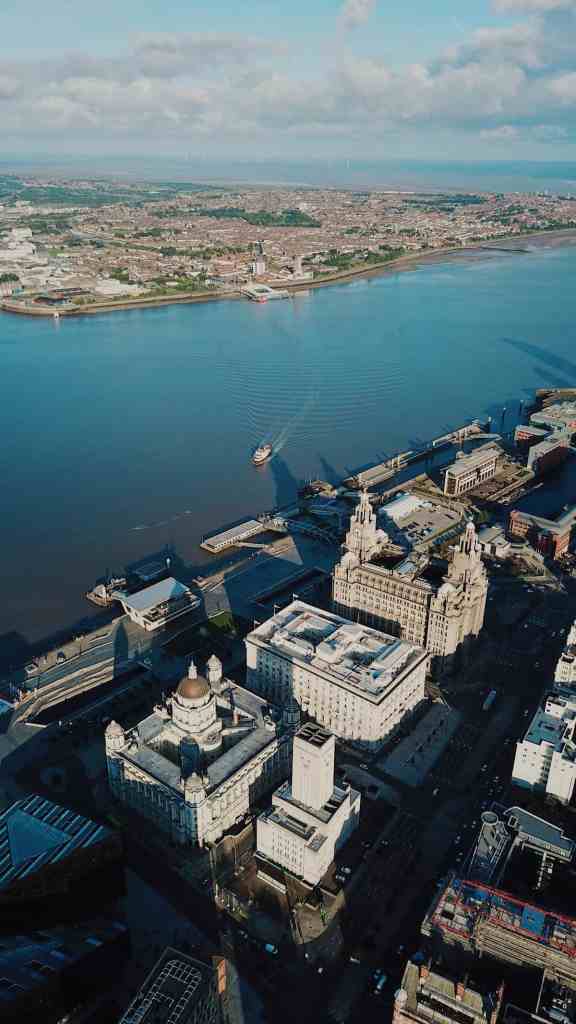
If you’re making a weekend of it, the city centre is built for exactly this — compact, walkable and stacked with things worth an afternoon. The Beatles Story is an immersive museum tracing the band’s life and times, and the Cavern Club on Mathew Street, where they played in their early days, still runs live music daily. Albert Dock is a UNESCO World Heritage site on the waterfront with Tate Liverpool, the Merseyside Maritime Museum and the Museum of Liverpool clustered around it. Liverpool Cathedral is one of the largest in the world and you can climb the tower for the view. For a post-match evening, the Baltic Triangle around Cains Brewery Village is the city’s current answer for street food and drinking — note that Baltic Market itself is closed Mondays and Tuesdays.
Hotels Near Anfield
The Anfield area itself is residential with very little lodging, so most visitors base themselves in Liverpool city centre and travel up for the match — which is no hardship, because the centre is compact, lively and packed with bars, restaurants and culture. Gameday weekends, especially around the big fixtures, do sell out, so book several weeks ahead for a Saturday match and earlier still for a derby or European night.
Best Areas to Stay
The city centre and waterfront is the obvious base: walkable, full of restaurants and nightlife, and a straightforward 15–25 minutes from Anfield by taxi or bus. The Ropewalks and Bold Street quarter puts you in the middle of the best independent eating and drinking. The Royal Albert Dock and the waterfront is the scenic, slightly calmer option, close to the Beatles Story and the museums. The Georgian Quarter up by the two cathedrals is quieter and characterful. If you’d genuinely rather wake up within walking distance of the ground, there’s a small cluster of lodging right by Anfield, but you’ll trade the city’s food and nightlife for it. Here are some places to take a look at:
The Dockside Landmark — Titanic Hotel; A striking warehouse conversion in the historic Stanley Dock, closer to Anfield than most city-centre options and full of industrial-waterfront character. Mid-to-upper range, with its own bar and restaurant — a good middle ground between the ground and the centre.
The Boutique Pick — Hope Street Hotel: In the Georgian Quarter between the two cathedrals, this is one of Liverpool’s most characterful hotels, with an excellent restaurant. Mid-to-luxury, ideal if you want to pair the football with the city’s culture.
The Themed One — The Shankly Hotel: A city-centre hotel steeped in Liverpool FC heritage and memorabilia, named for the great man himself. Mid-range and unashamedly for football supporters — a fun base if the club is the whole point of the trip.
The Waterfront Stay — Albert Dock Hotels: Several stylish hotels sit in and around the Royal Albert Dock, well placed for the maritime attractions and an easy ride to the ground. Mid-range, with good restaurants and bars on the doorstep.
Budget Options: The reliable budget play is a Premier Inn or similar in or near the city centre — you give up character and waterfront views, but you get a clean, cheap, well-located bed with straightforward transport to Anfield. A Z Hotel in the centre is another compact, value-focused option if you only need somewhere to sleep between the pub and the match.
Liverpool Matchday: Restaurants and Pubs Near Anfield
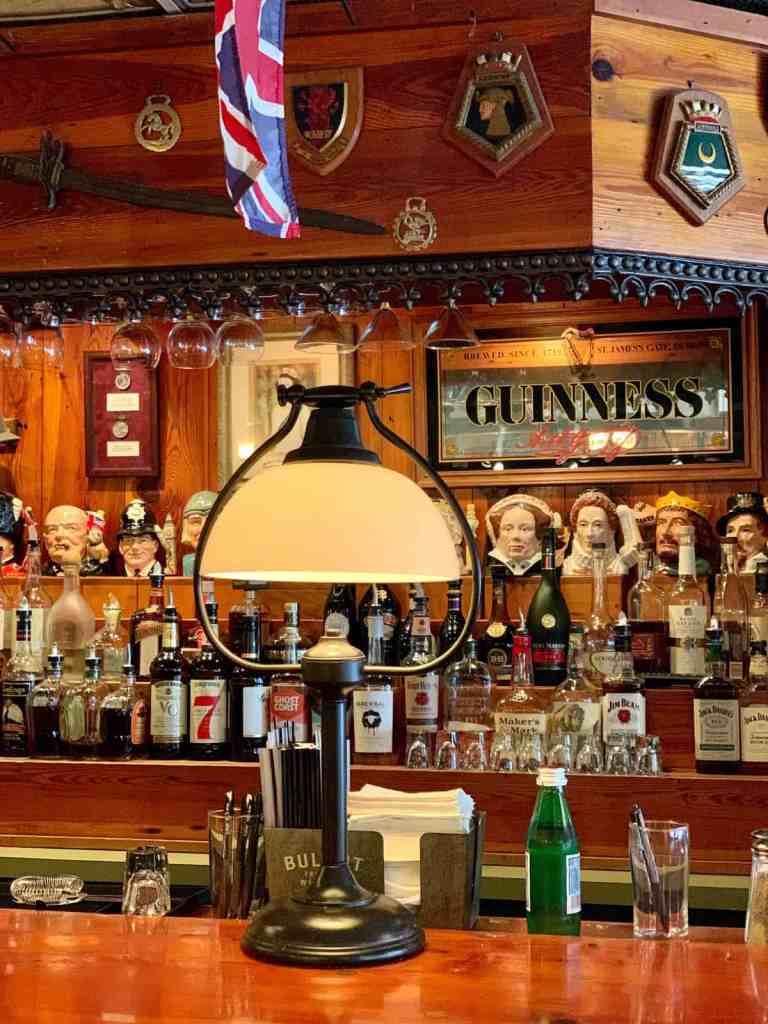
Liverpool does matchday properly. The build-up spreads from the city-centre bars out to the pubs ringing the ground, and the streets around Anfield turn into a sea of red hours before kick-off — vendors, scarves, songs in the road, live music pulling a crowd before anyone’s been through a turnstile. The local rhythm is to arrive early, settle into one pub and let the day build; the stadium-side pubs fill three to four hours out for the big games.
If you only do one thing before the match, stand outside The Albert with a pint at about ninety minutes to kick-off, when the songs start rolling down Walton Breck Road and the ground starts pulling everyone in. That’s the bit people remember.
Best Pregame Pubs
The Sandon is the spiritual one — Liverpool FC was effectively born here in 1892, it’s a three-minute walk from the ground, and it’s loud, historic and rammed on matchday. The Albert sits right under the shadow of the Kop on Walton Breck Road and is a classic matchday boozer. The Park is another long-standing local favourite nearby.
Taggy’s over toward Stanley Park has a huge beer garden, an outdoor screen and regular live sets from Jamie Webster playing the fan anthems — a younger, festival-ish crowd. The Arkles on Anfield Road is the traditional mixed pub and the usual call for away supporters; most of the other ground-side pubs are effectively home-only. Sandon is my choice if i haven’t been in awhile and want to make a go of a big football day.
Best Restaurants in the Area
For eating, the city centre is where to be. Bold Street is Liverpool’s food artery — Maray for Middle-Eastern small plates, Mowgli (the Liverpool-born Indian street-food chain), and Bakchich for Lebanese are all reliable, lively pre-match choices. Lunya does a distinctive Catalan-Scouse crossover near Liverpool ONE. For something more special while you’re in town, The Art School is the city’s fine-dining benchmark, and Panoramic 34 pairs modern British cooking with the best views over the Mersey. Prices run from cheap-and-cheerful on Bold Street up to occasion money at the top end.
Post-match strategy: Most pubs around Anfield stay open after matches for supporters to decompress and discuss the result whilst waiting for transport crowds to clear. Heading back to your pre-match pub for a pint or two after the final whistle is standard practice—you’re socialising and avoiding the worst of the station rush
Why You Should Go
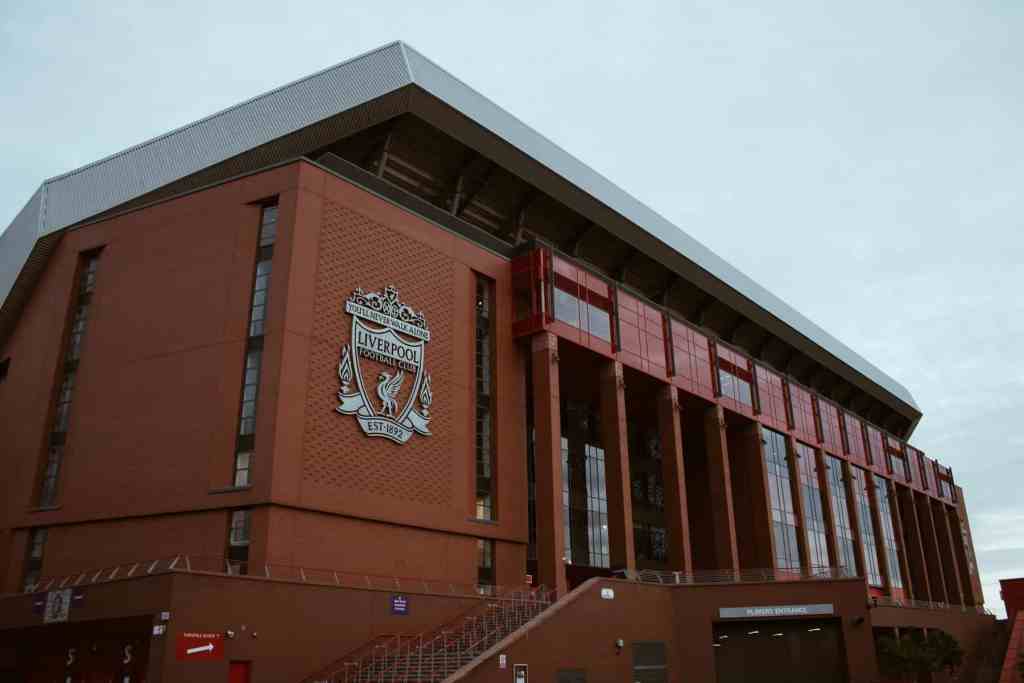
Anfield isn’t the biggest or the newest ground you’ll visit, and on a quiet midweek league game against lesser opposition the atmosphere can dip below its own legend. But catch it right — a derby, a European night, a title run-in — and there is genuinely nowhere in football that does collective noise and emotion better. You’re not just watching a match; you’re standing inside 130 years of history, in a working-class corner of a proud city, singing a show tune from 1945 that somehow became the most moving 90 seconds in sport. Go once, or over and over, do it properly, and you’ll understand why people travel from the other side of the world just to say they were there.
If you’re looking for other great sport journeys in the U.K and around the world check out some of our other guides including Everton’s shiny new home Hill Dickinson Stadium,
Old Trafford and Etihad Stadium
Written by Brad Richards. Founder of Gameday Guides. This guide includes insights from personal visits as well as updated info from team sources, fan forums, and stadium policies. We aim to help you plan with confidence — enjoy your gameday. If you have any tips, if we missed any thing or a question, don’t hesitate to shoot an email.