
Explore all of our NFL Guides to see the Packers on the road!
Best Seats at Lambeau Field
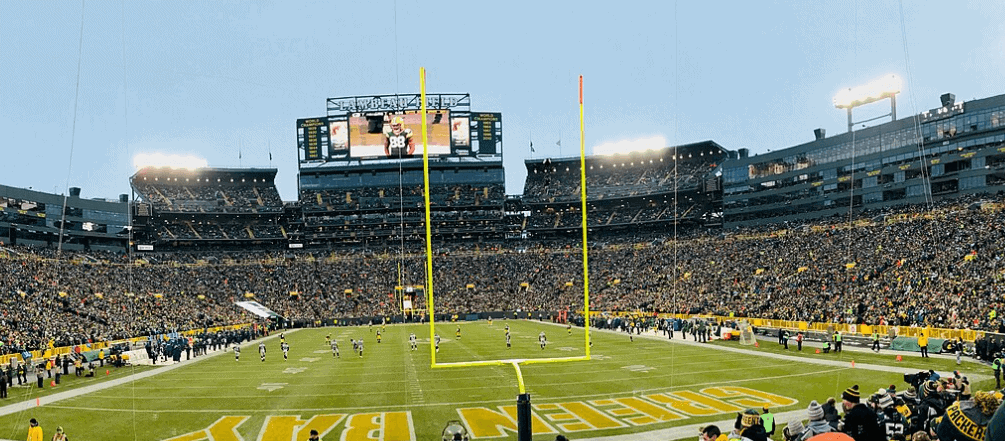
There are louder stadiums in the NFL and there are far newer ones, but there is nowhere in American sport quite like Lambeau Field. The Packers have played here since 1957, on a patch of frozen Wisconsin ground in a city of about 107,000 people that owns the team outright — no billionaire, no relocation threat, just a few hundred thousand shareholders and a season-ticket waiting list with more names on it than the city has residents.
The honest reality is that it’s an old building and it shows a bit. They’ve renovated everything around the bowl and left the bowl itself alone — sixty rows of backless aluminum bench — there is no roof and no shelter, and essentially nothing sells at face value. But on a December afternoon with 80,000 people breathing steam into the lights and the entire town shut down around you, it’s as good as football gets anywhere. Here’s how to do it right.
Best Non-Premium Seats
Lower Sideline, Sections 109–130. This is the real Lambeau experience — close enough to read formations and hear the line calls, in the part of the bowl that has looked essentially the same for seventy years. The tradeoff is price and bench angle: past the high teens in row number you start fighting the pitch of the aluminum.
Even-Numbered Sideline Sections. The Packers’ bench fronts the even-numbered side, which matters if you want eyes on your own team all afternoon rather than the opponent’s. Otherwise the two sidelines are functionally identical, so don’t pay a premium chasing it.
Rows near 23, Anywhere in the Bowl. Row 23 is roughly where the concourse tunnels feed into the lower bowl, so you’re stepping in and out at seat level instead of climbing. If anyone in your group has bad knees or a long walk in them, this is the row range to shop.
Best Value Seats
300-Level Sideline. The smartest ticket in the building. You keep a clean straight-on look at the whole field, you get free run of both the 100 and 300 concourses, and you pay noticeably less than the sideline seats a few rows below you. Most 300-level sections run only 10 to 12 rows, so the walk to food and restrooms is short — which matters more in December than any sightline argument.
300-Level Corners. Same free-access perk, same short walk, materially cheaper than the sideline sections because the angle flattens toward the near goal line. Fine value if you’re there for the building more than the geometry.
Budget / Cheapest Way In
600 and 700 Levels, South End. Here’s the twist most people miss: the cheapest tickets in the house are also some of the most comfortable. These were built in 2013 with actual seat backs and cupholders, unlike every bench below them, and the concession and restroom lines up there are noticeably shorter. You give up real distance from the field, and you’re fully in the wind.
Lower End Zone. Cheap, close, and compromised — the view down the field flattens badly. Worth it for one specific reason covered below.
Our Pick
Take a 100-level sideline seat between the 20s, in the lower rows, if you’re making the trip once and want it to count. If the price makes you wince, slide straight up to the 300-level sideline directly above it and keep almost all of the experience for meaningfully less money.
What to Avoid (and What’s Worth Trying Once)
The Top of the South End Tower. A long climb, a long way from the field, and fully exposed to whatever the weather is doing. The panoramic view is real but distant. Paying up here because the seating is “newer” is the worst comfort-to-sightline trade in the building.
Deep Lower Corners. The sections tucked behind the goal line give you an awkward, flattened angle on the near half of the field. Fine at the right price — never worth sideline money.
Worth It Once — the Lower End Zone. The front rows of the lower end zone are the only place you can realistically catch a Lambeau Leap from a few feet away, and the Packers traditionally attack the south end in the second half. The sightline is genuinely bad. Stand there when they punch one in anyway.
Premium Seating and Club Seats at Lambeau
Premium at Lambeau isn’t about luxury-theater vibes. It’s about temperature. Indoor club seating exists because December here is legitimately hostile, and the choice between four hours on an aluminum bench in ten-degree wind and a heated room with real food becomes very concrete, very fast.
The Best Premium Experience
Indoor Club Seats. Climate-controlled, cushioned individual chairs rather than bench, with lounge access, in-seat service, upscale dining and private restrooms. These are the ones that change a late-season game from an endurance test into a night out. They’re sold primarily on a season basis, so single-game availability is thin and expensive when it exists.
Best Value Premium
Outdoor Club Seats. Individual chairs with backs and cupholders on the sideline — an enormous upgrade over bench — plus full lounge access and in-seat service, at a real discount to the indoor product. You still feel the cold, but you feel it in a proper seat with a warm room a short walk away. For most people this is the right premium call.
Other Premium Options
The all-inclusive club in the south end sits behind glass with theater-style seating, an all-you-can-eat spread on select games and a rooftop deck if you want air — the best premium option for families and anyone who eats their way through a game. The terrace-suite level in the south end is the hybrid: a small block of open-air seats out front with unobstructed views, backed by an indoor climate-controlled space, with food and drink included rather than billed separately like the private suites.
Suites & Group Options
Lambeau’s 168 suites line the east and west sides, hold roughly 12 to 36 guests, and come with climate control, windows that open, parking and concierge service. Split across 20 people the per-head cost is reasonable; for a couple it’s absurd. Contact the Packers’ premium sales office directly — and note that if you buy a club or premium seat on the secondary market, lounge access is not automatically honored. Verify with the team before you pay, because a “club seat” resale listing does not guarantee you the room that makes it worth the price.

Lambeau Field Seating Chart
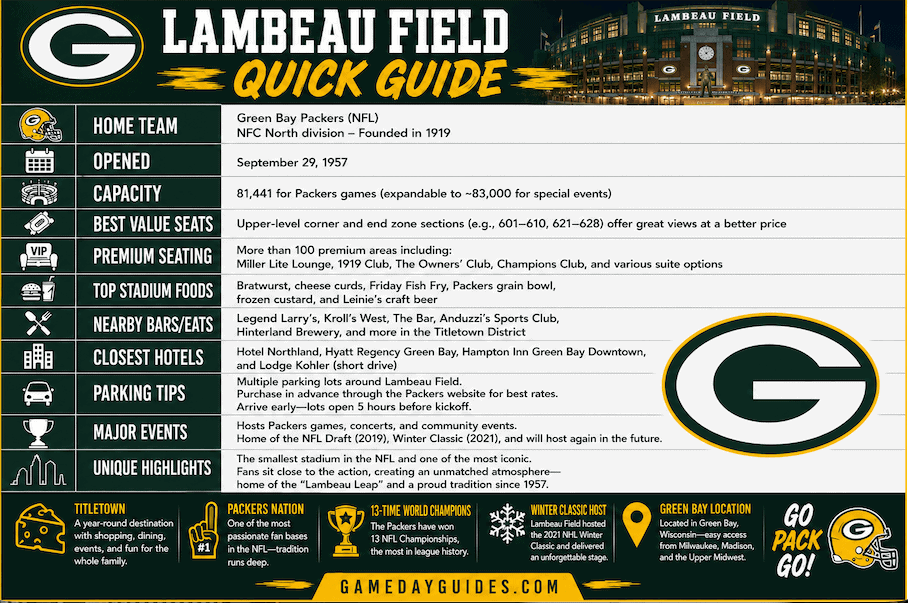
Lambeau Field seats 81,441, which makes it the second-largest stadium in the NFL and, at nearly eight times the seats-to-residents ratio of any other market, the least explicable one. It opened on September 29, 1957 and is the oldest continually operating stadium in the league, expanded nine separate times from an original capacity of 32,500.
Two things about the chart itself. The 300 level is not an upper deck — it sits directly on top of the 100 level, and row 1 of a 300-level section is roughly 61 rows off the field. And south end sections carry an “s” suffix (438s, 636s, 746s and so on), which is how the ticketing system distinguishes the 2013 build from the original bowl. If your ticket ends in “s,” you have a real seat with a back.
You can check out the Seating Chart for Lambeau Field here
Packers Tickets
Here’s the brutal truth: the Packers renew over 99% of season tickets every year and sell out the building before a single seat hits the open market, so there is essentially no face-value path in for a visitor. The secondary market is how you get to a Packers game, full stop.
Prices swing hard by opponent. Division games against the Bears, Vikings, and Lions, plus marquee national draws like the Cowboys or Chiefs, command the steepest resale. The cheapest, most comfortable tickets are usually early-season games against weaker non-conference opponents — and counterintuitively, brutally cold late-December games often soften on resale as casual sellers offload seats they don’t actually want to sit in. If you’re flexible on the date, that’s where the value lives. For the truly patient, the Packers also keep a separate single-seat waiting list that moves faster than the famous decades-long one.
When you’re ready to buy, compare resale prices on Vivid Seats (partner) — for Lambeau the secondary market is the only realistic option, so shopping it well is the whole game.

Lambeau Field Bag Policy
Lambeau enforces the NFL clear-bag standard strictly. You get one clear plastic, vinyl or PVC bag no larger than 12″ x 6″ x 12″, or a one-gallon clear freezer bag, plus one small non-clear clutch up to 4.5″ x 6.5″. Clear backpacks, clear fanny packs and clear cinch bags all count as long as they fit the dimensions and no hardware or décor conceals part of the bag. Regular backpacks, purses and diaper bags are out. There is no bag check on site, so anything non-compliant goes back to your car or in the trash.
Cold-Weather Carry-Ins
This is where Lambeau’s rules are more generous than most people expect. Additional clothing and blankets are fine if carried in loosely. Binoculars are fine. Battery-operated heated clothing is explicitly permitted — heated socks, heated vests, all of it. Seat pads and portable stadium seats with backs are allowed as long as they’re no wider than 18 inches and have no pockets, zippers or concealable areas; oversized seats and anything with armrests are refused. Umbrellas, coolers, strollers, wagons, noisemakers and selfie sticks are all prohibited, as are video cameras and still cameras with lenses over 12 inches.
Is Lambeau Cashless and Other Key Policies
Cashless everywhere. Every concession stand, the Pro Shop, the ticket office, the Hall of Fame, 1919 Kitchen & Tap — card or mobile pay only, on gamedays and non-gamedays. If you show up with cash, the cash-to-card conversion stations are free and load between $5 and $500 onto a card that works anywhere Mastercard is accepted. They’re in the American Family Insurance Gate lobby, on the Atrium floor, and inside 46 Below at Titletown.
Everyone needs a ticket, including infants. No lap-sitting. The Packers’ stated reason is the bench configuration — a child on a lap makes the row impassable for everyone else.
Re-entry depends on kickoff time. For afternoon games (noon to 3:35 p.m. starts) there is no exit and re-entry, period. For evening games the Atrium opens six hours out through the American Family Insurance Gate, and you can leave and come back only if you get your ticket “exit scanned” no later than four hours before kickoff. Miss that window and you’re out for good.
Accessibility: accessible and companion seating throughout the bowl, elevator access to the upper levels, and $50 cashless accessible parking in Lot 4 off Lombardi Avenue and Lot 7 off Valley View Road, first-come, first-served. Guest Services desks sit in the Atrium and under sections 109 and 353. Courtesy shuttle carts run the perimeter of lots 1, 3, 4, 5, 6 and 7 from three hours before kickoff until about 45 minutes after the game. There’s also a Special Exceptions Gate on the northeast side near the ticket office for anyone who’d prefer a more private, discreet screening.
For a full list of policies check the Green Bay Packers website.

Lambeau Field Parking
Green Bay is the smallest market in major American pro sports and there’s no rail option — this is a drive-and-park town, and the single best decision you can make is deciding where the car ends up before you leave the hotel. Most visitors fly into Austin Straubel International (GRB) about ten minutes away, though flights are limited and pricey; the standard workaround is Milwaukee (two hours) or Appleton (30 minutes) with a rental car.
Lambeau Field Parking
Every lot immediately surrounding the stadium is sold out to season parking pass holders, so your realistic options are three. Reserved individual-game parking in nearby lots is bookable in advance through PMI at ticketstaronline.com, and a limited number of digital passes for Lot 15 in Titletown go on sale through Ticketmaster — note that tailgating is not permitted in Lot 15. Private property owners across the neighborhood sell spots at varying prices, and this is the real move. Free street parking is available on many residential streets within walking distance, if you arrive early enough and read the gameday restriction signs.
Parking in Neighborhoods Near Lambeau
The neighborhood lawn-parking tradition is decades old and genuinely part of the day, but the thing to prioritize on the sign isn’t the price — it’s “Easy In / Easy Out.” That means they won’t box you in behind three other cars, which matters enormously when 80,000 people leave at once. Many spots throw in bathroom access and room to tailgate. Bring small bills; the guy taking $40 for his front yard does not have change for a fifty, and unlike the official lots he is not cashless.
Free Gameday Buses
Green Bay Metro runs four free gameday routes for every Packers home game, and for the 2026 season they start five hours before kickoff and run for roughly three hours after the game, leaving Lambeau every 30 minutes. The routes are named Lambeau Leap, QB Sneak, Quick Slant and Cheesehead. The Lambeau Leap route runs from the Metro center downtown and takes 20 to 25 minutes round trip — park in a downtown ramp and ride in, and you skip the residential gridlock entirely. The Cheesehead route runs from the airport, which almost nobody writes about and which turns a rental car into an optional expense.
Lamers Bus Lines also runs a paid express service from hotels, bars and restaurants across greater Green Bay, plus routes from the airport area and from Appleton. Returns start 45 minutes after the game ends.
Rideshare
Downtown is only about a mile and a half away, so Uber and Lyft run cheap outside surge windows. The Packers direct rideshare pickups to the corner of Mike McCarthy Way and Holmgren Way — exit through the American Family, Oneida Nation or Potawatomi Sportsbook gates on the east and south sides and walk out that way.
For drop-offs, the suggested spot is the corner of Shadow Lane and Frank Street, where there’s a sidewalk and police helping people cross. Do not plan to be picked up there after the game; it’s explicitly not a post-game pickup zone, and the area is a parking lot for the better part of an hour.

Lambeau Field Insider Tips
Parking’s sorted and the tailgate’s wrapped. What follows is the stuff that separates people who’ve done Lambeau from people who are about to — the gate that saves you a walk, the free heated bar most ticket holders never find, and the reason your feet go numb in the fourth quarter when the rest of you is fine.
Lambeau Field Weather: What to Actually Expect
Check the forecast, then check the wind. Air temperature undersells a Lambeau game by ten to fifteen degrees once the wind gets across an open bowl with nothing overhead. The National Weather Service office that covers Lambeau is in Ashwaubenon, essentially next door to the stadium, so its forecast is about as local as forecasts get. [Brad — current forecast link goes here.]
September and October are genuinely pleasant. Kickoff temperatures in the early season average in the mid-50s, and the upper rows can be warm in the sun. If it’s your first Lambeau game and you’re weather-sensitive, buy early-season and don’t apologize for it.
November through January is a different sport. Late-season kickoffs average right around freezing, and sub-20 gamedays with biting wind are routine in December. The 1967 Ice Bowl kicked off at 13 below with wind chills in the minus-30s and remains the coldest game in NFL history — the referees couldn’t use their whistles because the metal stuck to their lips. You won’t get that. You will get cold in a way that’s hard to describe until you’ve felt it.
Snow is a feature, not an emergency. Games are essentially never postponed for it, the Packers hire hundreds of shovelers to clear the bowl, and a snow game at Lambeau is the thing people fly in hoping for. Dress like you’re staying outside for five hours, because you are.
Beating the Cold in the Bowl
Put a flattened piece of cardboard under your feet. The benches are cold, but it’s the concrete underneath that quietly drains the heat out of you. One layer between your boots and the frozen slab is the difference between numb toes in the third quarter and feet you can still feel at the final whistle. This is the veteran move and it costs nothing.
Rent a seat back for $10. They’re available on level 1 at the Oneida Nation, Fleet Farm and Kwik Trip gates, near sections 111 and 113, and on level 3 across from sections 353 and 354. Payment is cashless. Refunds are available at the point of purchase until kickoff, so grab one and return it if the weather turns mild. If your ticket ends in “s” you’re in the south end and don’t need one.
Wear a fleece vest backwards under your jacket. The local trick: reverse the vest so the pockets sit against your lower back, then drop jumbo hand warmers in them. That parks the heat over your kidneys and radiates it through your core instead of just warming your hands.
Heated clothing is allowed, so use it — but get in line earlier. Battery-operated jackets, vests and socks all pass security, as do loose blankets and extra layers carried in by hand. The Packers do warn that heated gear can trigger additional screening at the metal detectors, so give yourself a few extra minutes at the gate. The rookie mistake is showing up in a jersey and jeans thinking you’re tough enough.
Lambeau Field Tours & the Packers Hall of Fame
Do the Atrium the day before, not on gameday. The Pro Shop and the two-level Hall of Fame are worth real time, and on a Sunday they’re a zoo. Knock them out Saturday and walk in clean.
Stadium tours don’t run on home gamedays at all. They do run the day before and the day after a home game, so build them into the weekend rather than the afternoon. Tours are posted for booking 30 days ahead of a given date and they sell out on game weekends.
The Lambeau Tour. The Classic Tour is 60 minutes and about half a mile of walking — Atrium, east-side premium areas, the team tunnel and field level, around $23 for an adult. The Champions Tour adds the end zone club levels at 90 minutes. The Legendary Tour runs two hours and adds the Lee Remmel Press Box and the visiting team locker room. All three include field-level access, though you don’t set foot on the grass. Hall of Fame admission is separate unless you buy a combo.
Home game weekend pricing is higher, and it’s combo-only. Tours the day before and after a game are sold packaged with Hall of Fame admission rather than standalone, and the whole schedule prices up. A weekday visit in the offseason is dramatically cheaper for the same route.
Brown County residents get a discount that must be bought in person. If you’re local, don’t book online — you’ll pay the full rate and a $7 convenience fee on top.
What’s New at Lambeau Field
The video boards are enormous now. The 2023 project doubled the north and south end boards from 110 feet wide to 220 feet, in 4K, with about 24,500 square feet of new LED across the building. In the corners and the deep end zone seats, they’re no longer a consolation prize.
Third-level concessions are grab-and-go. All ten upper concourse stands were converted to a walk-in, grab-what-you-want, tap-and-leave format. Lines up there move dramatically faster than they used to, which is the actual argument for the 300 and 700 levels in cold weather.
The north gate is now the UW Health Gate. Renamed in May 2026 as part of a new partnership, it sits on the north side near Lombardi Avenue and serves the club and suite levels plus the rooftop viewing platform. If you’re holding a premium ticket and following old directions to the “Bellin Health Gate,” that’s the one.
A Sensory Activation Vehicle parks in the Atrium. New for 2026, in partnership with KultureCity — a quiet space to reset away from the crowd and noise, available from the preseason opener through the end of the season. Sensory bags and noise-canceling headphones are also available to check out at Guest Services.
Lambeau Field History: When It Was Built and Why It’s Named That
It opened as City Stadium in 1957 and cost $960,000. The renaming came in August 1965, after Curly Lambeau — the Packers’ founder, a Green Bay native who played for Knute Rockne at Notre Dame in 1918 before a bout of tonsillitis ended his college career and sent him home.
The famous benches aren’t original, and the Ice Bowl wasn’t watched from aluminum. Lambeau had wooden bleachers for its first twelve seasons, including December 31, 1967. They were swapped for aluminum before the 1969 season and bolted to the same brackets that held the wood — a $350,000 job, nearly a third of what the whole stadium cost to build. The Packers’ own historian has publicly corrected the team’s media guide on this one, so if you see “the same benches since 1957” elsewhere, that’s where it came from.
Nine expansions have taken it from 32,500 seats to 81,441. The two that reshaped the building were the $295 million redevelopment finished in 2003, which built the Atrium and made Lambeau a year-round destination, and the $312 million south end project from 2011 to 2015 that added roughly 7,900 seats and closed the bowl at the top.
Lambeau has never sold naming rights, and that’s deliberate. The stadium is owned by the City of Green Bay and the team is owned by its shareholders, which removes both the incentive and the mechanism to sell the name. Individual gates carry sponsors. The building doesn’t. It’s one of the last in American pro sports where that’s true.
Yes, it’s fully outdoors. No roof, no dome, no retractable anything, no covered concourses in the bowl. The playing surface is a Kentucky bluegrass and synthetic-fiber hybrid, and the only enclosed spaces are the Atrium, the club and suite levels, and the south end premium areas.
Tailgating at Lambeau Field
Your setup has to fit a 9-by-6-foot space directly behind your car. That’s the rule in every Packers-operated lot, and it’s enforced to keep vehicle and pedestrian lanes clear. Charcoal and propane grills are fine; recreational wood fires and turkey fryers are not.
Tailgating ends at kickoff, and it ends in Titletown before it starts. Tailgating is not permitted in Titletown lots at all, including the pre-purchase Lot 15. If tailgating is the point of your trip, that determines where you park.
Break your setup down before you walk to the gate. Leaving a canopy and chairs out while you’re inside is a violation, not a tradition. Separate containers for hot coals, recyclables and trash are provided in the lots.
If you’re not grilling, the Johnsonville Tailgate Village is the substitute. Food, drinks, ATMs and charging stations in the east lot, no cooler required.
Arrival, Gates & Getting In
All gates open two hours before kickoff. Use the gate printed on your ticket — it’s routed for the shortest walk to your section, and at Lambeau that’s a real saving because the bowl has no interior cross-connection at every level.
South end ticket holders should use the Potawatomi Sportsbook Gate. If your section number ends in “s,” that’s the one with escalators and elevators straight up to your level. Walking around to a west-side gate costs you ten minutes and a climb.
The upper concourse is reachable by ramp from three gates. Oneida Nation, Kwik Trip and Fleet Farm all have walk ramps. Elevators are near the Gameday Store on the west side, in the center of the Atrium, and near the Oneida Nation Gate on the east.
Download your ticket before you leave the hotel. Everything is mobile-only, and cell service buckles when 80,000 phones hit the same towers — usually right at halftime, which is also when you’ll want to text your group. Agree on a landmark meetup spot before you split up.
Food & Drink at Lambeau Field
The Miller Lite Endzone Bar is the best-kept secret in the building. It’s a climate-controlled bar behind section 100 in the north end, capacity near 400, with a full bar and TVs — and it is open to any ticket holder, not just premium. It opens two hours before kickoff and stays open through the game. In a stadium where the pitch for club seats is “somewhere warm to stand,” a free heated room most fans never find is worth knowing about. The Packers Radio Network pregame show broadcasts from it starting two hours out.
There are no drinking fountains on the outdoor concourses. The pipes would freeze. The only fountains are in the Atrium, and the only free water inside the bowl is a cup of tap water on request at the Verizon Loft bar on the third floor or the Bar & Grill bar at section 354. Hydrate before you walk in or plan to buy bottles.
Hit the concourse mid-quarter, never at the halftime stampede. Same for restrooms — the lines nearest the 50-yard line are brutal, and walking a few sections toward an end zone drops the wait off a cliff.
Most of the people serving you are volunteers. The concession stands are staffed by local nonprofits raising money, and a share of every dollar goes back to them. Tip accordingly, and don’t be surprised when the person handing you a brat asks how your day is going and means it.
Packers Traditions Every First-Timer Should Know
The Lambeau Leap is the reason to sit in the end zone. It started here in 1993 and it’s still the only celebration in the league where the players end up in the crowd. The Packers traditionally attack the south end in the second half.
The fans own the team, literally. More than half a million shareholders, no owner, no relocation leverage. It’s why the waiting list is measured in decades and why the building feels less like an asset and more like a civic institution.
Mind your colors, and own it if you’re repping a rival. Green and gold is the uniform, and opposing colors stand out at Lambeau more than almost anywhere in the league. You won’t be in any danger — Packers fans are famously welcoming — you’ll just be extremely visible.
Section Yellow is the sober section. On level 1 near the Kwik Trip Gate at section 112, open from two hours before kickoff to the end of the game. It’s a group of fans who stay drug and alcohol free and welcome anyone who wants the game without the drinking culture around it.
Bringing Kids to a Packers Game
Register for a Lost Person Prevention wristband on the way in. It’s coded with your seat and contact information, and it takes two minutes at Guest Services in the Atrium or the Fan Assistance booths at sections 109 and 353.
Family restrooms are at sections 111, 134 and 431, plus the Atrium and multiple south end levels. Nursing rooms are in the Atrium year-round and on the fourth floor club level on gamedays, and an adjustable adult changing table is in the Atrium family restroom on level 1.
Titletown is where you send the people who aren’t going to stand around a grill for four hours. The 34-acre district west of the stadium has a full-size football field, a playground, an ice rink in winter and a free sledding and tubing hill. It’s the pressure valve for a family trip.
Remember that everyone needs a ticket. There’s no free-under-two policy here. Budget for the infant.
Autographs & Player Access
Training camp is the real access window, not gameday. Open practices in late July and August are free, and the Packers’ bike tradition — kids lend players their bikes for the ride from the locker room to the practice field — is the single most Green Bay thing in the NFL.
On gameday, warmups are your shot. Get in when gates open two hours out and go down toward the tunnel end; the player entry tunnel is beneath section 131. After that, players are gone and you’re just standing in the cold.
Packers Pro Shop & Merch
Skip the in-stadium markup for basics. If you just need a beanie, a hoodie or green-and-gold layers to blend in, a local Walmart or Fleet Farm on the way into town is stocked wall to wall with licensed Packers gear at a fraction of Pro Shop prices.
The Pro Shop flagship is in the Atrium and open year-round. Inside on gameday there’s also a Gameday Store under section 120 on the west concourse, nine smaller Pro Shop stands across the concourses, and a New Era kiosk near section 135 — all far less crowded than the flagship.
Best Photo Spots at Lambeau Field
Shoot the Lombardi and Curly Lambeau statues two hours early or after the game. They’re the signature shot and they get swarmed starting about 30 minutes before kickoff. There’s no good in-between.
The Atrium interior is the weather-proof option. Glass, height, and the Hall of Fame entrance make it the one place you can get a real Lambeau photo without frozen hands, and it’s open to ticketed guests until 45 minutes after the game.
Exit Strategy: Beating the Post-Game Gridlock
Don’t sprint for your car. The residential streets seize up for the better part of an hour, and several convert to one-way after the game — Mike McCarthy Way runs one-way eastbound toward Ashland Avenue, and Oneida Street and Ridge Road both go one-way northbound. You will not outrun this.
Wait it out with a drink instead. Walk to Titletown or Stadium View, give it 90 minutes, and you’ll get back to the hotel at roughly the same time you would have anyway — except you’ll have spent it sitting down rather than staring at brake lights.
If you parked in a yard, walking beats driving. People on foot clear the neighborhood faster than cars do, every single time. That’s the quiet argument for lawn parking over a lot.
Lambeau Field Quirks Nobody Warns You About
Charge your phone at the Verizon Loft. Level 3 of the Atrium has charging stations and battery packs you can check out — the only place in the building where you can borrow a battery rather than stand next to an outlet. More stations are in the Atrium behind the elevators and in the Johnsonville Tailgate Village.
Text (920) 645-2300 to report a problem in the stands. Fan conduct issues get handled by text rather than by flagging down staff, and the number is posted throughout the stadium.
The designated driver signup closes at the end of the first quarter. Register at Guest Services or via the QR codes at sections 112, 109 and 353 and you’re entered for team prizes. Show up in the third quarter and you’ve missed it.
Concerts at Lambeau Field
The stadium is now a real summer concert venue. Luke Combs played two consecutive nights in May 2026, and the bowl gets configured with floor seating and a general admission pit.
Concert rules are gameday rules with two catches. The same clear-bag policy and carry-in list apply, but field-level and pit ticket holders have to collect a wristband before they’re allowed onto the floor, and several gates — including the UW Health Gate — close for concert entry, so check which one your ticket routes you to rather than heading for the gate you know.
Things to Do in Green Bay
For families, Bay Beach Amusement Park runs classic rides and a vintage Ferris wheel at famously cheap prices — and it’s the local institution, not the tourist one.
If you want to be outside, the Fox River Trail runs for miles along the water for walking, running or biking, and it starts downtown.

Hotels Near Lambeau Field
Green Bay is the smallest market in the NFL and the hotel math reflects it. Inventory is genuinely thin, home weekends sell out months ahead for marquee and late-season games, and you should expect two-night minimums, prepaid rates and prices that run two or three times a normal weekend. Book as early as you possibly can.
Here’s what makes lodging different on a Packers trip than almost any other NFL city: because the gameday traffic and neighborhood parking are a real hassle, and because late-season cold is no joke, where you stay changes your day more here than it does anywhere else. A walkable hotel buys you out of the parking scramble and the post-game gridlock entirely.
Best Areas to Stay
Titletown, directly across the plaza from the stadium, is the walk-to-the-gates option and the one to pay up for if you can. Downtown Green Bay, about a mile and a half northeast, gives you restaurants and bars around your hotel at night plus a short rideshare or the free Lambeau Leap bus to the gates. Appleton, 30 minutes south, is the standard overflow when Green Bay is full or gouging.
Hotel Recommendations
Lodge Kohler is the crown jewel — a Kohler-built hotel directly across from Lambeau with a spa and a rooftop restaurant looking straight at the stadium. It’s luxury-tier and you’ll pay for it, and game weekends need to be booked directly with the hotel rather than through an aggregator. Nothing else in the NFL puts you this close in this much comfort.
SpringHill Suites Green Bay and the Hilton Garden Inn Green Bay are the solid middle within walking distance. The Hilton’s ten-minute walk takes you past the Packers’ outdoor practice fields and the Don Hutson Center, which is a treat in itself if you time it during camp.
The Hotel Northland, Autograph Collection is the upscale historic pick downtown — a beautifully restored 1924 landmark with real character, and the right call if you’d rather have dinner and drinks within walking distance of your room than the stadium.
The Hyatt Regency Green Bay by the convention center is the dependable full-service downtown option, easy rideshare to the game, no surprises in either direction.
Tundra Lodge is the family answer — a waterpark resort that turns a football trip into something the kids will actually look forward to. It’s a drive to the stadium and the rooms are dated, but nobody books it for the rooms.
Budget Options
Baymont by Wyndham and the Quality Inn Stadium Area deliver real savings for a short drive in and a generic stay. You’re trading atmosphere and walkability for money, which is a fine trade if the game is the whole point. If you’re booking outside walking distance, ask whether the hotel runs its own gameday shuttle before you reserve — several do, and it saves you the entire parking headache.

Packers Gameday in Titletown: Bars, Tailgating & the Scene
Gameday in Green Bay doesn’t have an off switch. By mid-morning the lots are smoking with brats, homeowners are waving cars onto their lawns, and the smell of charcoal hangs over the whole neighborhood. Fans drift between tailgates for hours before the slow walk to the gates about two hours out. The tailgate is the culture here — but if you’re not grilling in a lot, the bars along Holmgren Way are where everyone else gathers to eat, drink and get loud. Afterward, win or lose, the party rolls right back into those same lots and bars while the traffic untangles itself.
The newest piece is the Titletown District, 34 acres the Packers built just west of the stadium on what used to be parking. It’s anchored by Lodge Kohler and Hinterland Brewery, but the heart of it is the public green — a full-size football field, a playground, a winter ice rink and a free tubing hill. On gameday it’s where families and non-tailgaters land.
Best Pregame & Postgame Bars
Stadium View on Holmgren Way is the biggest bar in Green Bay, with the best Lambeau view from that side, a huge event space and live music. Get there early because it packs out, and it’s the obvious place to wait out the post-game traffic.
The Bar on Holmgren Way is essentially Packers headquarters — 28 taps, a fire-pit patio, a free gameday shuttle and wings people plan around. Across the street, Anduzzi’s Sports Club brings a wall of TVs and a rooftop deck built for pregame.
Kroll’s West across from the stadium is the institution — order the butter burger and you’ll understand why it’s been here for generations. Fair warning: it’s leaned hard into the tourist trade in recent years and the service is inconsistent. Go for the burger and the history, not the meal of the trip.
1919 Kitchen & Tap inside the Atrium pours 40-plus beers and opens hours before kickoff for ticketed guests. No gameday reservations, and the Friday fish fry is legitimately good.
Hinterland Brewery in Titletown is the one for people who’d rather have a proper beer and a table than a wall of TVs.
Best Restaurants in the Area
Republic Chophouse downtown handles a serious steak dinner — dinner only from 5 p.m., and worth a reservation on a game weekend.
Hagemeister Park, named for the field where the Packers played their first game in 1919, is the strong all-arounder downtown with a patio on the river.
Plae Bistro has racked up best-fine-dining honors for years — but it’s closed Sundays, which rules it out for most Packers gamedays. Make it your Saturday night.
Green Bay Distillery on Mike McCarthy Way is walkable from the stadium and sells organized parking, though it’s closed Mondays.
And do not leave Wisconsin without a proper supper club, a Friday fish fry and a brandy old fashioned. It’s as much a part of the trip as the game.

Why You Should Go
Lambeau Field isn’t the newest, the warmest, or the easiest stadium to get to — and that’s exactly the point. It’s a piece of living football history in a small Wisconsin city where the whole town owns the team and treats every home game like a holiday. You absolutely have to go once, sit in the cold with 80,000 people who would be nowhere else on earth, and you’ll understand why fans call this the best gameday in the NFL. It’s worth every mile. Go Pack Go.
Here are some other guides to check out:
American Family Field in Milwaukee
Ford Field in Detroit, Soldier Field and Minnesota
Written by Brad Richards. Founder of Gameday Guides. This guide includes insights from personal visits as well as updated info from team sources, fan forums, and stadium policies. We aim to help you plan with confidence — enjoy your gameday. If you have any tips, if we missed any thing or a question, don’t hesitate to shoot an email.