

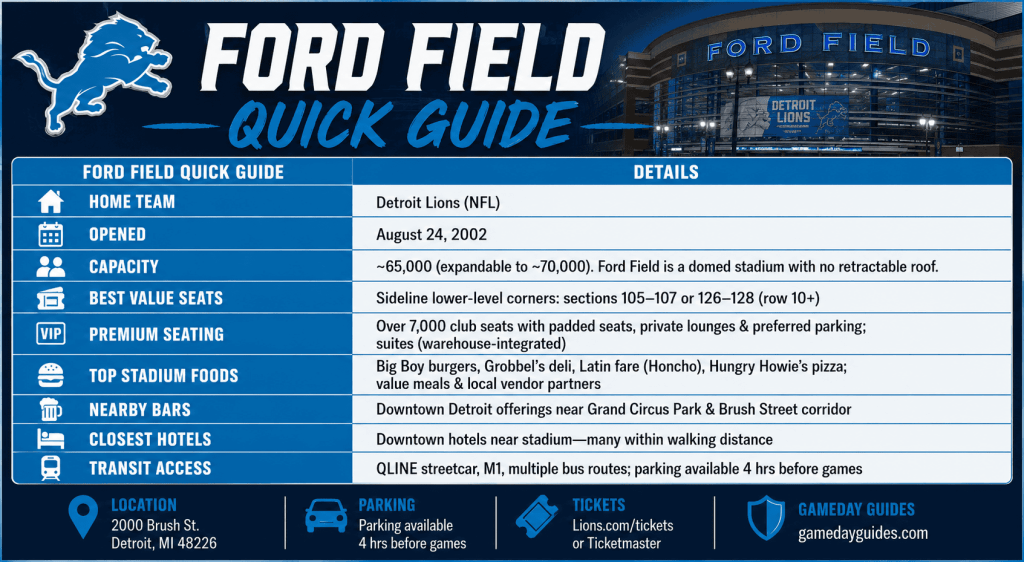
Best Seats at Ford Field
The dome is the least interesting thing about Ford Field. The stadium was built around the bones of a 1920s Hudson’s warehouse and dropped partly below street level so it wouldn’t crowd downtown, with a translucent roof and a glass wall that let real daylight onto the field.
Capacity is 65,000, and when the place is full the roof traps every decibel — a fired-up Lions crowd here is one of the loudest environments in the league. One honest heads-up before you pick seats: it runs warm inside, so leave the heavy coat in the car.
Seating Overview
Ford Field is a single continuous lower bowl (sections 100–141, with 100 and 141 flanking the player tunnel), a mezzanine and club ring in the 200s, and an upper deck in the 300s. The design skipped the usual double-decker club tier and stacked the suites along one side only, which pulls the upper deck lower and closer to the field than at almost any other NFL stadium. Home bench fronts the 104–108 range; the visitors sit across at 125–129.
Football math applies here as it does everywhere: sideline beats end zone, and elevation beats proximity. The wrinkle at Ford Field is that the cheap seats are unusually good, so the gap between a $250 ticket and a $60 one is smaller than the price suggests.
Best Non-Premium Seats
Sections 105–107 and 126–128 (lower bowl, midfield). Dead-on at the 50, every play developing in front of you, and the fullest dose of dome noise on third down. Get above roughly row 10 so the sideline scrum of players, coaches and photographers isn’t in your sightline — and know you’re paying the highest non-premium price in the building for it.
The lower sideline off the 50. The sections flanking midfield hold nearly the same angle for meaningfully less money, and you’re still close enough to hear pads pop. You’re working one end zone at a slant, so goal-line plays at the far end get harder to judge.
Lower end zone behind the goals. Blocking schemes and route concepts read better from behind the posts than from anywhere else in the stadium, at roughly half the midfield price. The catch is obvious: for most of the game the ball is 80 yards away and you’re reading jersey numbers.
Best Value Seats at Ford Field
The upper sideline in the 300s is the quiet steal here. Because the upper level sits lower and steeper than at most stadiums, the sightlines stay clean and the video boards are easy to track, and you’ll often pay a fraction of lower-bowl rates for a better view of the whole field. Target the lower rows of the upper sideline rather than the corners, and accept that you’re a long way from the field-level energy — plus a longer walk to the concourse at halftime.
Cheapest Way Into Ford Field
Standing-room-only is the lowest-cost ticket, and it works if you don’t mind three hours on your feet. You can roam, change angles, and hit food stands without missing much. The real downsides are tired legs, taller fans drifting into your view at the worst moments, and no seat if the game goes long. One thing the resale sites won’t tell you: go with at least one other person. The consensus among Lions regulars is that SRO is a tag-team job — one of you holds the rail while the other makes the beer and bathroom run, because an unattended spot is gone.
Our Pick
Lower bowl at the 50 — sections 105–107 or 126–128, row 10 or higher. Textbook angle, enough elevation to see over the bench, and the full wall of noise. If that’s outside the budget, the lower rows of the upper sideline are the value version of the same view and they genuinely hold up.
Is Ford Field a Dome?
Yes — fixed roof, fully enclosed, climate controlled. Weather never factors into a Lions game, which is why the stadium draws so many winter and shoulder-season events. What people don’t expect is how bright it is: frosted glazing between the bowl and the roof plus the southeast glass wall let daylight in, so a one o’clock kickoff doesn’t feel like a bunker. It also runs warm, so dress like you’re going indoors, not like you’re going to Detroit in December.
What to Avoid (and What’s Worth Trying Once)
Back rows of the lower bowl, under the overhang. The club level above cuts off the main video board, so you’ll spend replays twisting around or watching on your phone. Stay in the lower-to-middle rows of those sections if the big screen matters to you.
Upper deck corners. Cheap for a reason — a severe angle and lost plays on the far side. Unless it’s the last inventory available, spend the same money on the upper sideline.
First few rows behind the benches. Player proximity sounds great until you realize coaches, staff and photographers are standing between you and the field for four quarters. Fun for ten minutes, frustrating for a game.
Worth it once — SRO when the building is loud. The sightlines aren’t built for it, but standing through a night game with the roof holding in 65,000 people is the closest the NFL gets to a college atmosphere. Do it once, with a partner.

Premium Seating Options
Ford Field’s premium tier runs from a new all-inclusive club up to field-level tunnel access, and the marquee products sell out on reputation and stay sold out. Two of the four are waitlist-only right now, which shapes what’s realistic to chase.
The Best Premium Experience
The 1934 Club, new for the 2026 season. This is the current headline product and the one with actual availability, since the tunnel-level spaces are closed. Entry opens three hours before kickoff — a full hour before the public gates — with a rotating chef-curated menu and unlimited beer, wine, spirits and non-alcoholic drinks included. A game ticket is separate and sold on a deposit basis, so it’s a commitment rather than a walk-up splurge.
Best Value Premium
Delta Loge Boxes. Four to six seats, all-inclusive food and drink, a dedicated attendant, VIP parking and Delta Club level access — most of the suite experience without booking a full suite or a full season. The other perk that matters if you’re a Detroit regular: loge holders get priority access to Ford Field concerts and events, which is worth real money in a building that books this heavily.
Other Premium Options
The MGM Tunnel Club is the crown jewel and it’s sold out with a waitlist — field level behind the end zone, all-inclusive menu, in-seat service, and a direct view of the players walking out of the tunnel a few feet away. Dream Seats are also sold out: black leather recliners above the player tunnel in sections 100 and 141, with personal HD screens, full South Club access and mobile-order pickup in section 137. The Delta Club level in the 200s and the Comerica Gridiron Club on Level 3 are the broader club-seat products; confirm what’s all-inclusive for your specific game, because Ford Field doesn’t run every space the same way for every event.
Suites & Group Options
Suites seat 8 to 50 with all-inclusive catering, VIP parking, a private entrance and a dedicated attendant. Lions suites cover home games; Ford Field suites cover concerts, family shows and special events, and rent separately.
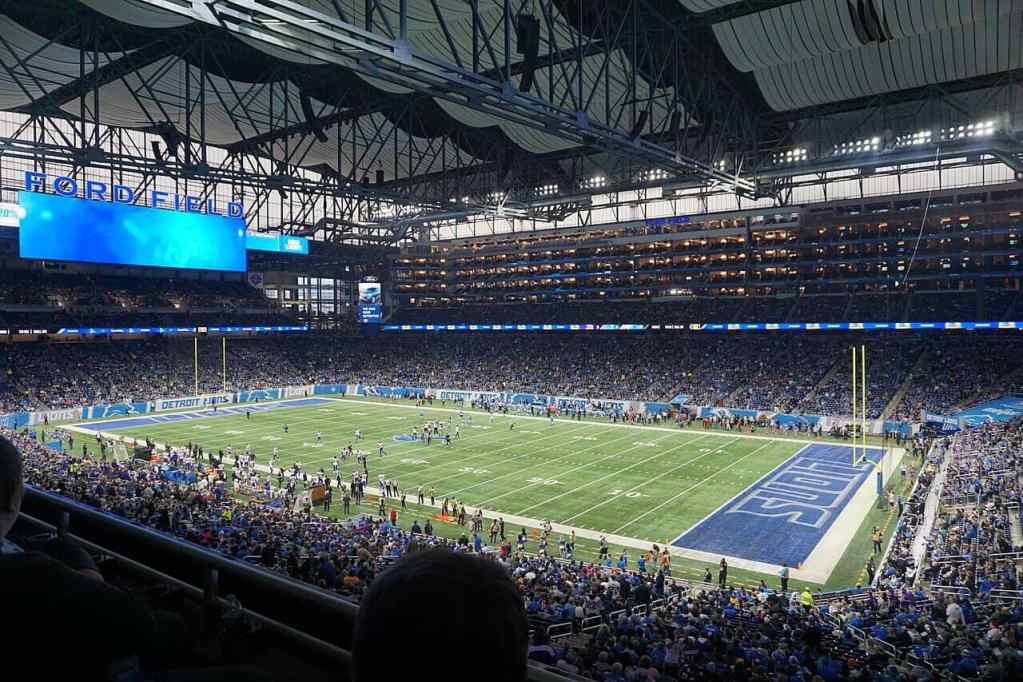
Ford Field Seating Chart and Capacity
Ford Field seats about 65,000 for football, expandable to roughly 70,000, and it converts to around 78,000 for basketball in the round — which is how the building can host a Final Four.
Three levels: the 100s are the lower bowl running continuously 100 through 141, the 200s hold the mezzanine and club seats, and the 300s are the upper deck. The quirk worth knowing before you read the map is that the suites sit on the south side only, built into the old warehouse, rather than ringing the bowl — that’s why the upper deck sits lower here than the numbering suggests, and why “300 level” isn’t the punishment it is elsewhere. Sections 100 and 141 sit above the player tunnel.
For current section, row and seat details see the official Ford Field Seating Maps as well as the Lions Interactive Seating Chart.
Getting Detroit Lions Tickets
Lions season tickets sold out ahead of the 2026 season, so almost everything a visitor buys comes off the resale market. Division games, primetime windows and the Thanksgiving game price like postseason games and rarely soften — for those, buying early beats waiting. The dips come on lower-interest matchups late in the week, when season-ticket holders dump inventory they can’t use; that’s your best shot at below-face pricing, especially in the upper bowl.
You can get Lions Tickets through our partner Vivid Seats or at least compare it to other secondary sites to get the best value.
Ford Field Bag Policy
For Lions games, Ford Field runs the NFL clear-bag policy. You can bring one clear plastic, vinyl or PVC bag up to 12″ x 6″ x 12″, or a one-gallon clear freezer bag, plus a small clutch, camera case or binocular case no larger than 4.5″ x 6.5″. Backpacks, cinch bags, fanny packs, purses larger than a clutch, briefcases and luggage of any kind are refused.
The rule that catches families every game: strollers, infant car seats and diaper bags are all prohibited, clear or not. There is no bag check, so anything turned away has to go back to your car or in the trash. Medically necessary items are permitted after inspection — contact Guest Services at 313-262-2000 in advance if you need an accommodation. Non-NFL events at Ford Field run a different, looser policy, so check that specific event rather than assuming the clear-bag standard applies.
Is Ford Field Cashless? (and other Key Policies)
No outside food or drink. Cans, bottles, boxes and flasks are all on the prohibited list, and that includes empty bottles you plan to refill. Also worth knowing before you get to the gate: seat cushions, selfie sticks, flashlights, large umbrellas, noisemakers and cameras with lenses longer than five inches are all turned away.
Cashless everywhere. Cards, Apple Pay, Google Pay and Samsung Pay work at every point of sale. If you brought cash, the cash-to-card machines are at Gate A (Section 100), Gate G (Section 112), Gate D (Section 127), Section 231 and the Delta Club lobby, with a $5 minimum.
No re-entry. Leave the building and you’re done for the day. The designated smoking areas are outdoor spots off Gate D at Section 128/129 and Gate E at Section 225, and they open when gates open.
Accessibility: Ford Field has a strong accessibility reputation, with wheelchair-accessible platforms at the top of most sections across all levels and folding chairs provided for companions who want to sit beside a wheelchair user. Elevators serve the upper levels, and accessible parking is available on a first-come basis in the Ford Field Deck and adjacent lots for guests with the proper permit.
Policy Link: Detroit Lions Official Ford Field Policies

Getting To Ford Field
Ford Field sits in the middle of downtown with no surface lots of its own, which flips the usual stadium math: driving is fine, but where you park decides how your night ends more than how it starts.
Ford Field Parking
Official lots and decks adjacent to Ford Field and Comerica Park open about four hours before kickoff, first-come, and they’re the expensive option — figure $40 to $80 within a short walk on a Lions Sunday, higher for marquee dates. Book ahead through ParkWhiz, which Ford Field links directly, or SpotHero, rather than gambling on day-of rates. Greektown lots run cheaper for a 5-to-10-minute walk, and Eastern Market is the budget end. No tailgating and no re-entry in any lot next to the stadium.
The Financial District play: book a garage down near Lafayette instead of one by the stadium. It’s a slightly longer walk in, but it puts you next to the Lodge Freeway (M-10) entrance and lets you skip most of the post-game crawl. The other move locals swear by is skipping downtown entirely — park up in Midtown around Wayne State or John R and ride the QLine in.
The MGM Grand warning: the casino’s free parking is genuinely free and genuinely a trap. Fans routinely sit in that garage for up to two hours after the game lets out. Free isn’t free if you can’t leave.
QLine & the People Mover
Both are free. The QLine streetcar runs Woodward Avenue and stops within a few blocks of Ford Field, connecting you to Midtown parking, the museums and a long strip of bars. The Detroit People Mover is the elevated one-way loop around downtown — Grand Circus Park and Broadway stations are the closest to the stadium, and a full circuit takes about 15 minutes. Fares were dropped in 2024 and it remains free to ride, so ignore the 75-cent figure still floating around older guides. The People Mover packs out immediately after games; give it 20 minutes and walk a station further out for a calmer ride.
Rideshare
Uber and Lyft pickup and dropoff runs on the east side of the stadium near Brush Street. Expect $12–18 from most downtown addresses off-peak, with surge hitting two to three times that in the twenty minutes after the final whistle. Walk three or four blocks away from the stadium footprint before you request, or schedule the pickup for half an hour after the game — either beats paying $40 for a ten-minute ride.
From Detroit Metro Airport (DAX)
The Detroit Air Xpress runs nonstop between DTW and downtown, boarding near 1119 Washington Boulevard between Michigan and State. Tickets are $6 in advance or $8 onboard, and buses run 16 round trips a day from 3:30 a.m. to 11 p.m. Budget 45 to 50 minutes, not the 20 you’d guess from a map — DTW is about 20 miles out and the coach makes both terminals. From the downtown stop, most hotels and Ford Field are a walk, a People Mover ride or a short rideshare away
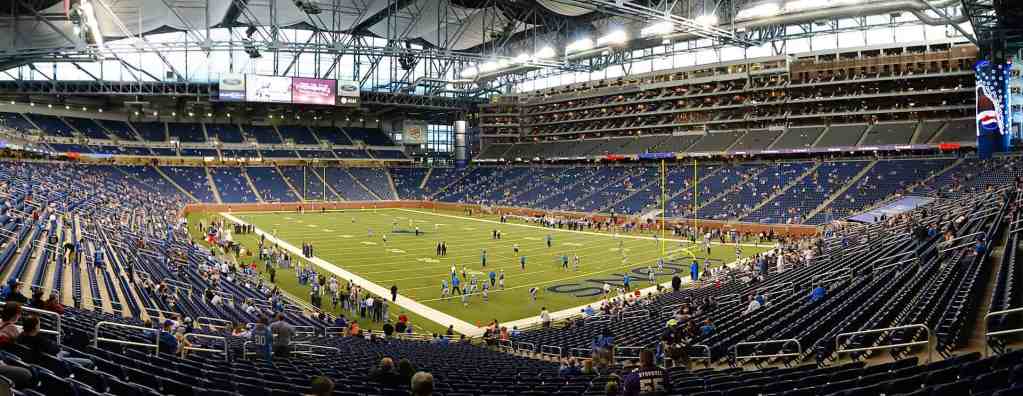
Ford Field Insider Tips
Ford Field rewards people who know the building: a weatherproof stadium, a downtown packed with bars that will drive you to the gate, and a handful of specifics that save real money. Here’s what actually matters.
The Hudson’s Warehouse — the Most Unusual Building in the NFL
Walk the south concourse before you find your seat. The stadium was built into a six-story 1920s Hudson’s warehouse along the south sideline, and that brick building still holds suites and offices — you can see the exposed brick and industrial bones up close from the concourse. No other NFL stadium is built like this.
Head to the southeast corner for the atrium. Seven stories of open space inside the old warehouse, ending in a glass wall that frames the downtown skyline. It’s the best photograph in the building and almost nobody visiting for the first time knows to go look for it.
What Time Does Ford Field Open on Game Day?
Gates open two hours before kickoff for general admission. Premium and club ticket holders get in an hour earlier. Parking facilities open around four hours out.
Skip Gate A’s corner lines. Gate A and Gate G carry the most volume, and the stadium’s own advice is that the center entrance lanes at Gate A sit unused while the corner lanes back up. Aim for the middle, or use a smaller gate near your section — the gate reference guide on fordfield.com maps section to gate.
Comerica cardholders have their own door. There’s a dedicated entrance at the north end of Gate A for anyone holding a Comerica credit or debit card. Show the card, walk in. It’s the single most under-used shortcut in the building.
Power Hour: the Best Time to Eat and Drink
Get in early and eat during Power Hour. Ford Field discounts food, beer and cocktails from the moment gates open, two hours before kickoff — it’s the best value window of the day by a wide margin.
Know the cutoff. The pricing ends an hour before kickoff and the registers flip automatically, so getting in line at five minutes to the deadline often means paying full price by the time you reach the front.
Power Hour isn’t just cheap drinks. The Corner Bar at section 224 runs specials, there’s live music at Social outside section 129 near Gate D, a DJ in the Gate A atrium, and the Honolulu Boom drumline works the concourses before finishing with a set in the atrium.
Ford Field Food & Drink
Buy food mid-second quarter, not at halftime. The halftime rush forms fast; go with about six minutes left in the half and you’re back before the band.
Use the Mashgin self-checkout units. There are 63 of them scattered through the building — you put items on the pad, it recognizes everything at once, you tap and go. Look for them at the Lions Loyal Marketplaces (sections 100 and 120), The Cooler (sections 112 and 234), and sections 115, 117, 119, 217, 220, 228 and 242.
The walk-out Express Shops are faster still. Sections 139 and 226 run camera-based checkout with no register at all: grab what you want and leave.
Mobile order and pick up. Order in the Lions app, then collect at sections 109, 117, 124, 137, 217, 224, 229, 302 or 308. This is the single biggest time-saver in the fourth quarter.
The real Coney move is outside the stadium. You can get a Coney dog inside, and it’s fine. But Lafayette Coney Island and American Coney Island sit literally next door to each other on West Lafayette Boulevard downtown, and eating one at each to pick a side is a Detroit rite of passage — cheaper and better than anything on the concourse.
Ford Field Traditions & Noise
Learn the fight song line. When the Lions score, the building sings “Forward down the field!” Know it or stand there while 65,000 people belt it around you.
Bring real ear protection, and not just for the kids. Third-down defensive noise in a sealed dome is punishing, and adults in the lower bowl regularly leave with their ears ringing. High-fidelity musician’s earplugs let you take in the wall of sound without paying for it the next day; a popular move on the Lions subreddit is a cheap pair of electronic earmuffs, which amplify conversation and cut the crowd spikes automatically.
Getting Out: Post-Game Traffic
Leave the People Mover alone for twenty minutes. It packs out the moment the game ends. Walk a station further from the stadium or wait it out with a drink.
Park toward the freeway, not toward the stadium. Anything that puts you next to the Lodge or the Chrysler on-ramp gets you moving while the streets around Brush are still gridlocked.
Best Photo Spots at Ford Field
The southeast atrium in daylight. Old warehouse brick in the foreground, downtown skyline through the glass wall. Best on an afternoon kickoff when natural light is pouring in.
Pride Plaza on Brush Street before you go in. It’s the free official Lions zone with food trucks, music and games, no game ticket required, and it’s the most alive the exterior of the stadium gets.
Bringing Kids to a Lions Game
Leave the stroller at home, not at the gate. Strollers, car seats and diaper bags are all prohibited and there’s no bag check to leave them in.
Find the Cub Club Locker Room at sections 234/235. Free face painting for all kids next door at section 234, plus a Dan Campbell Zoltar machine. It’s open during home games through the end of halftime, and a parent has to be present.
Plan around the noise. See the earplug note above — a sealed dome at full volume is a lot for small ears.
Autographs & Player Access
Game day is a long shot. NFL sidelines are tightly controlled; signatures depend entirely on having lower-bowl seats near the tunnel during pregame warmups.
Training camp is the real opportunity. The Lions hold camp at the Meijer Performance Center in Allen Park from late July into late August, and selected players sign for fans after the open practices. Camp practices are free but ticketed, capped per person, and they disappear within hours of release — watch detroitlions.com/trainingcamp for the schedule and on-sale date, and get there well before gates open, because the autograph line forms first.
Tailgating Near Ford Field
There’s no tailgating at the stadium, so go to Eastern Market. Detroit’s biggest and most iconic Lions tailgate happens there — food trucks, music, hundreds of spots, and a scene worth arriving early for.
Take the shuttle, don’t walk it. Cheap shuttle buses run continuously from Eastern Market to the stadium gates and back, which matters more than you think after a few hours of day-drinking; it’s roughly a mile on foot.
Or let a bar drive you. Several Detroit bars run game-day shuttles if you eat and drink there first — The Old Shillelagh in Greektown is the rowdiest of them and runs a constant free shuttle, and Nemo’s in Corktown is the legendary version, a burger and a few bucks for a ride straight to the gate with no parking hunt at all.
Lions Supply Team Store & Merch
The Lions Supply stadium store is the main shop, and Lions Loyal members get 20% off retail locations on game day. Independent gear sellers set up outside the stadium if you want a “Detroit vs. Everybody” shirt instead of a jersey.
Venue App & Mobile Tickets
Download the Lions app on hotel wifi, not at the gate. Tickets are digital only, and the in-building network fights 65,000 phones. The app also handles mobile ordering, in-game info and upgrade offers.
Text 313-513-8398 to report a problem. Ford Field’s Text Assist line reaches stadium operations directly on game and event days, and it’s discreet.
Concerts & Events at Ford Field
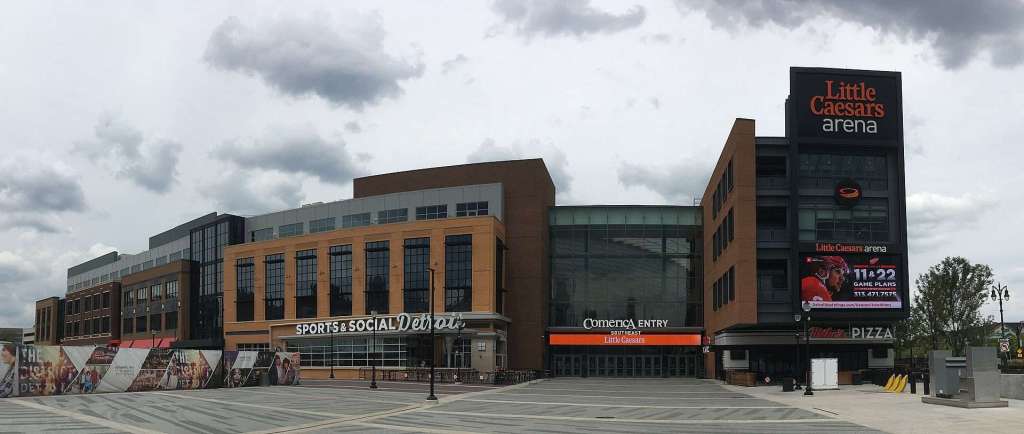
Ford Field runs one of the busiest event calendars in the Midwest — major concert tours, Monster Jam, Supercross, the MHSAA state football finals and marching band finals, and the MAC championship game. The enclosed setup is the draw: a summer tour date or a March event here is completely weatherproof, which is part of why big acts route through Detroit. The long-running Detroit bowl game ended after the 2025 season, so the December college fixture is gone for now. And no, Ford Field doesn’t host baseball — that’s Comerica Park, directly next door.
Concert seating works differently. Most shows use an end-stage setup, so the football logic inverts: floor and lower-bowl sections facing the stage are prime, sections behind the stage are partly or fully blocked, and the far upper corners rarely justify the price. Production designs vary by artist, so check the event-specific map before buying. Bag rules also loosen for non-NFL events — Ford Field’s standard event policy allows small non-clear bags up to a posted size, and people get caught out assuming the clear-bag rule always applies.
Ford Field and the 2027 NCAA Final Four
Ford Field hosts the 2027 NCAA Men’s Final Four, with the national semifinals on Saturday, April 3 and the championship on Monday, April 5, 2027. Michigan State is the host institution. It’s Detroit’s first Final Four since 2009, when 72,922 packed the building for the title game — still the tournament’s attendance benchmark.
Seating flips entirely for basketball: the court goes in the middle of the field, so the sections along the long sides of the court become the premium views while the seats behind the baskets and in the far upper corners are the atmosphere-over-sightline zone. That’s where the deals live if you care more about being there than tracking the ball.
The NCAA’s Ticketmaster lottery for upper-level seats closed in May 2026 with winners notified in the fall, so for most fans the secondary market is the realistic route — check our partner Vivid Seats against the other resale sites as the dates approach. Everything below on getting there and staying applies, but book lodging far earlier than you would for a Sunday in November, because downtown sells out hard for that weekend.
Make a Weekend of It: Things to Do in Detroit
If you’re flying in or making a weekend of the game — or filling the days around the 2027 Final Four — the city rewards an early arrival, and most of the good stuff is a short, free QLine ride up Woodward. The Detroit Institute of Arts is the heavyweight, anchored by Diego Rivera’s massive Detroit Industry murals and a collection deep enough to lose an afternoon in. A few minutes away, the Motown Museum at Hitsville U.S.A. is the birthplace of the Motown sound and a real pilgrimage for any music fan. Back downtown and walkable from the stadium, the Detroit RiverWalk gives you wide-open views across to Windsor and a clean stretch to walk off a pregame meal. And if the timing lines up, a show at the restored 1928 Fox Theatre is one of the prettiest rooms in the city.
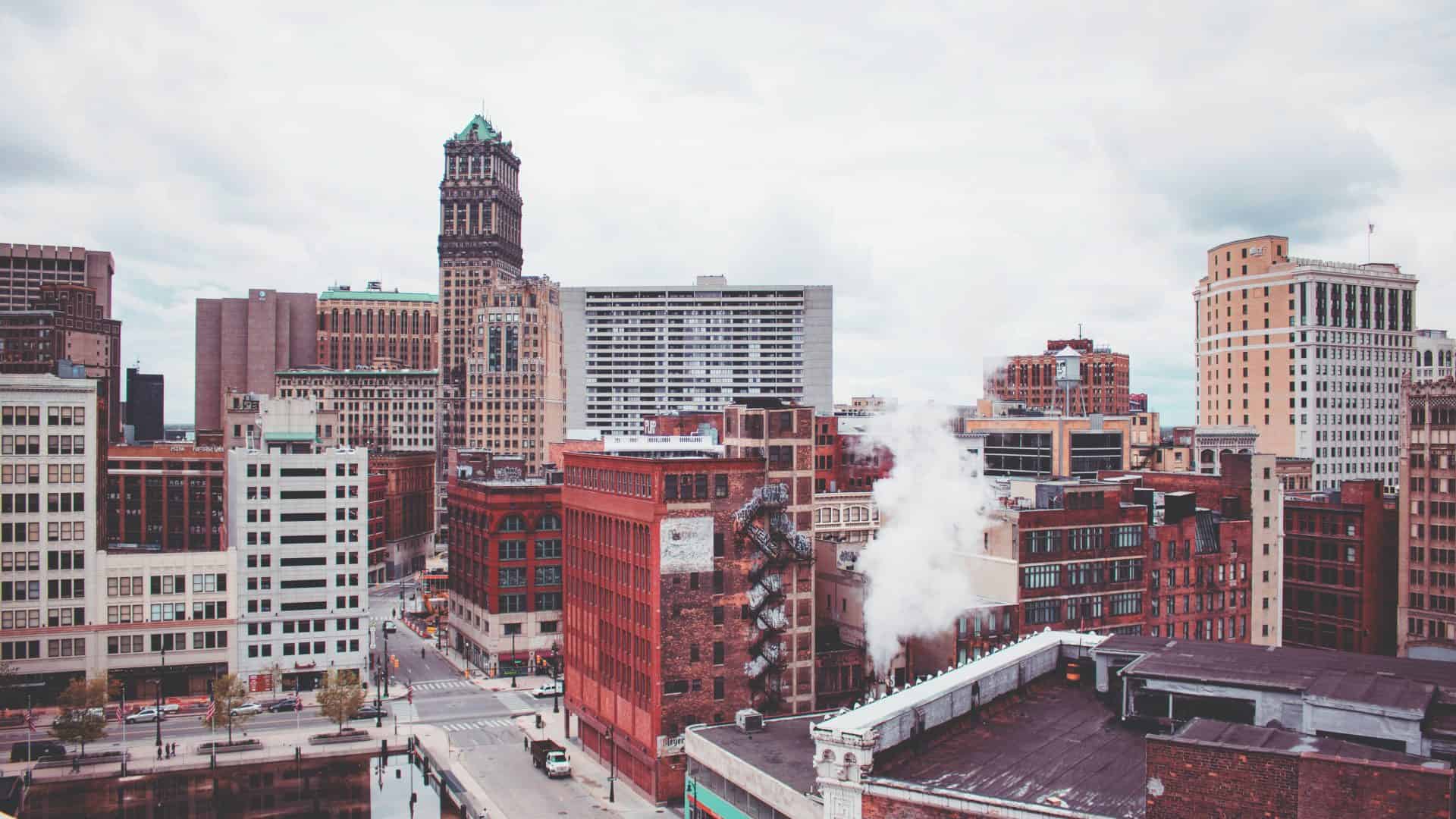
Hotels Near Ford Field
Downtown is the obvious call: you’ll be within walking distance of Ford Field, Comerica Park and Little Caesars Arena, and the district actually stays busy after a win. For the Final Four weekend and any Thanksgiving or primetime game, book months out.
Best Areas to Stay
Greektown, five to ten minutes east on foot, is the closest concentration of hotels to the stadium and the liveliest pregame strip. The core along Woodward, between Grand Circus Park and Campus Martius, puts you on the QLine with the best restaurants and the boutique hotels. Corktown, a couple of miles west, is quieter and more interesting food-wise, but you’re relying on a rideshare or a bar shuttle to get to the gate.
Hotel Recommendations
Closest to the gate: the Hilton Garden Inn Detroit Downtown on Gratiot is about a five-minute walk, straightforward and reliable, and it means never thinking about parking. Be warned that valet runs steep and gets charged per night regardless of when you actually leave.
Boutique and character: the Shinola Hotel on Woodward is the upscale pick — walking distance to all three venues, with the strongest in-house bar and restaurant scene of any hotel here. The Siren Hotel on Broadway is the design-forward option in a restored 1920s building; it’s got real personality and the Candy Bar downstairs, though service can be uneven.
Casino and convenience: Hollywood Casino at Greektown puts dining, gaming and a short walk to the stadium under one roof, and it sits right by a People Mover stop. Rooms are dated for the price, but the location and the parking are the point.
Room to spread out: ROOST Detroit in the restored Book Tower is the best-looking place to stay downtown, apartment-style with full kitchens — ideal for a group or a multi-night Final Four trip. The rooftop bar carries into the rooms on warm nights, so ask for a floor away from it. Element by Marriott at the Metropolitan on John R is the more practical version of the same idea, walkable to both stadiums with breakfast included and the Monarch Club on the roof.
Something different: the Detroit Foundation Hotel occupies the city’s old fire department headquarters on Larned, and the Apparatus Room downstairs is a genuinely good restaurant rather than a hotel one. It’s a longer walk to the stadium — about 15 minutes — which is the trade.
Budget Options
The Courtyard by Marriott Detroit Downtown on Jefferson runs cheaper than the core hotels for a slightly longer walk and river views. If price is the only variable, DTW airport hotels are dramatically less, but you give up the walkability and the postgame scene and you’re tied to the DAX shuttle or a rental.
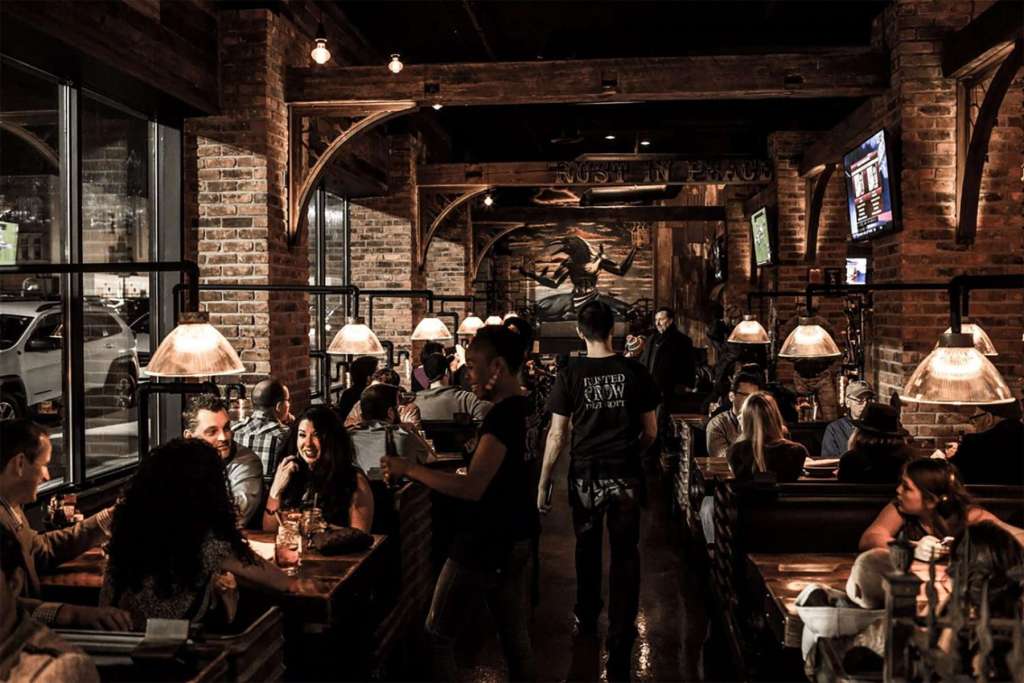
Bars and Retaurants Near Ford Field
Detroit Lions Gameday: Bars & Restaurants Near Ford Field
Downtown Detroit turns into one connected district on a Lions Sunday. Greektown fills first and loudest, the stretch around Comerica Park and Little Caesars Arena runs a close second, and Corktown holds the older, quieter version of the same tradition. The rhythm most people follow: eat somewhere with a shuttle or a short walk, drink through Power Hour pricing once you’re inside, then flow back out into the same bars afterward — which, after a win, is the best part of the day.
Best Pregame & Postgame Bars Near Ford Field
The Old Shillelagh — three floors of Irish pub in Greektown, the rowdiest pregame in the city, with a free shuttle to the gate.
Tin Roof — on Adams by Comerica Park, live music and a rooftop patio with a view over the district.
Firebird Tavern — two stories on Monroe in Greektown, more relaxed than its neighbors, good food, easy walk in.
Elwood Bar & Grill — the little art-deco diner-bar on Adams that got moved two blocks to make room for Comerica Park. Limited hours midweek, open on Sundays, and a Detroit institution.
Bookie’s Bar & Grille — on Cass, multi-floor, big screens, and a game-day special that regulars quote by heart.
Best Restaurants Near Ford Field
Lafayette Coney Island and American Coney Island — the two-doors-apart rivalry on West Lafayette. Order at both, pick a side, argue about it forever.
Nemo’s Bar — Corktown burger institution across from the old Tiger Stadium site, walls covered in Detroit sports history, and a shuttle to the game.
Harry’s Detroit Bar & Restaurant — on Clifford near Little Caesars Arena, fourteen TVs and a surface lot that doubles as event parking. Get there early and it solves dinner and parking at once.
Detroit Beer Co. — the brewpub that’s been the default pregame near the stadium for two decades.
Hockeytown Cafe — on Woodward, sports-themed and unapologetic about it, and the easiest place to feed a group before kickoff.
Pride Plaza
Tailgating isn’t allowed in the lots next to Ford Field, but the city makes up for it. Pride Plaza on Brush Street is the free official Lions zone with food trucks, music, and fan games just outside the stadium, and Eastern Market hosts Detroit’s biggest and most iconic tailgate a short distance away — food trucks, music, and the kind of scene worth arriving early for.

Why You Should Go
Ford Field delivers one of the best dome atmospheres in the NFL, and when the Lions are rolling, the energy is unmatched. The sightlines are legitimately good from almost anywhere in the stadium, the food scene has improved dramatically with local vendors, and the crowd knows how to bring the noise without being obnoxious. If you’re looking for a solid gameday experience that balances comfort, affordability, and playoff-level energy, this is worth the trip—especially now that the Lions are actually good.
Check out all of our NFL Guides and these local and regional stadiums:
Comerica Park and Little Caesars Arena
Written by Brad Richards, Founder of Gameday Guides. This guide is built using personal visits, fan feedback, official resources, and top travel sites — all aimed at helping you make the most of your visit. If you’ve been, we’d love to hear what helped you most.