


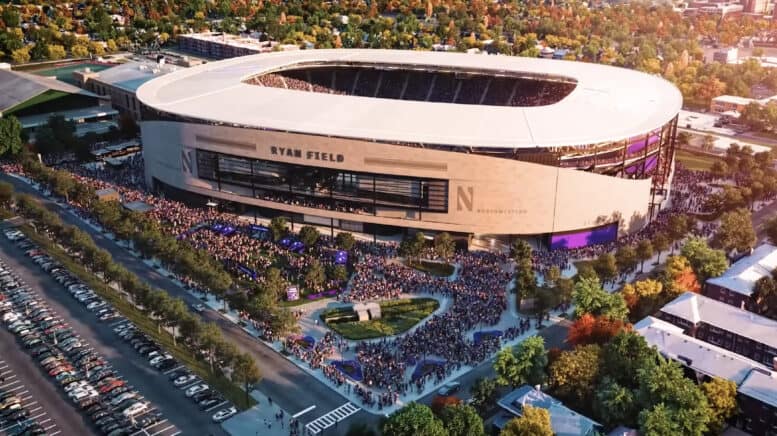
Northwestern is opening the most expensive stadium in college football history, and it doesn’t look like anything else in the sport. The new Ryan Field in Evanston is an $862 million rebuild on the exact footprint of the old one — a 35,000-seat bowl with a canopy stretched over every single seat, engineered so that the cheap seats aren’t really cheap seats anymore. It’s smaller than what it replaced by about 12,000 seats, and that’s the entire point: fewer people, closer to the field, louder. The Wildcats are calling it “Chicago’s Big Ten Stadium,” and the opening is one of the most anticipated debuts in college football.
One honest thing up front: nobody has watched a football game here yet, including us. The stadium’s first game is Friday, October 2, 2026 against Penn State, and this guide is built from Northwestern’s confirmed designs, the published specs, and the parts of a gameday we can verify — how to get there, where to stay, what the scene around the stadium looks like. Where we’d normally hand you exact sections and seat rows, we can’t yet, and we’re not going to invent them. We’ll be there once it opens and we’ll rewrite this with the real thing. If you get there first, tell us what you find.

When Do Games Start at Ryan Field?
This trips people up, so let’s clear it immediately. Northwestern’s first two home games of 2026 are not at the new Ryan Field. South Dakota State (September 5) and Colorado (September 19) are being played at Northwestern Medicine Field at Martin Stadium, the temporary lakefront venue on campus that has hosted Wildcats football during construction. Those are sold separately and are a completely different experience — smaller, right on Lake Michigan.
The new Ryan Field opens with the Big Ten home slate. Five games there in 2026: Penn State on Friday, October 2 (the inaugural game, a primetime affair), Ball State on October 10 (Homecoming), Rutgers on October 24 (Family Weekend), Iowa on November 7, and Illinois on November 28 — the regular-season finale and the Land of Lincoln Trophy rivalry. If you’re buying tickets for early September expecting the new building, double-check the venue before you book.
Best Seats at the New Ryan Field (We Think)
Here’s what makes seat selection here different from every other stadium guide you’ve read: this building was engineered specifically to erase the gap between the good seats and the bad ones. Northwestern’s design team spent extra money on a heavier structural steel frame for one reason — to push the upper levels forward and down, so that, in the words of the developer, every seat gets a “better-than-TV” view. Whether they pulled it off is something we’ll only know from a real seat in a real game. But the intent changes how you should think about buying.
The other defining feature is the canopy. A roof structure covers all 35,000 seats while leaving the field open to the sky. That does two things: it largely takes weather out of the seat-selection equation (you’re not choosing a section to dodge rain or a low autumn sun the way you would elsewhere), and it’s designed to trap and amplify crowd noise. So the usual logic — pay up for the lower sideline, avoid the exposed upper deck — only half applies here. The upper levels in a compressed, canopied bowl like this should be far better than the upper deck you’re picturing.
The Sidelines Are Still the Sidelines
The lower sideline is what most fans will want and what will price accordingly. Along the two sidelines at the lower level is where the “better-than-TV” promise should hit hardest — closest to midfield, closest to the action, the seats the whole building was designed around. The tradeoff is straightforward: this is a brand-new premium stadium with only 35,000 seats and huge first-year demand, so expect these to be the priciest non-premium seats in the house.
The upper sideline is where we’d point value-minded buyers first. In a bowl this compact, with the canopy overhead and the decks pushed forward, the upper sideline should deliver a genuinely good sightline for meaningfully less money than the lower level. Every other stadium guide tells you to avoid the upper deck; the physics of this particular building suggest that advice may not travel here. We’ll confirm once we’ve sat in one.
The end zones are a different calculation, and one of them is unlike anything in college football — see below.
The Wildcat Wall: The South End Zone
The south end zone is the single most distinctive thing about this stadium, and you should understand it before you buy anywhere near it. Northwestern built the Wildcat Wall — college football’s first European-soccer-inspired safe-standing supporter section. Picture the “kop” end at an English football ground: 2,000 students on a steep 33-degree rake, standing, leaning out over the end zone, engineered to be a wall of noise aimed straight down the field. There are safety railings and seats for anyone who needs them, but the design intent is a standing, roaring student mass, complete with glowing wildcat eyes built into the section.
If you’re a Northwestern student or a fan who wants the loudest, most visceral corner of the building, this is it, and it may become one of the best atmospheres in the college game. If you’re a visiting fan, a family, or anyone who wants to sit and calmly watch a football game, know what you’re buying near that end. It’s the point of the section, not a flaw — but it’s not a relaxed afternoon.
Our Pick (For Now)
Until we’ve actually been (hey Northwestern invite me), our honest recommendation is provisional, and we’d rather say that than fake certainty. If you want the view the architects obsessed over and the budget allows, take the lower sideline near midfield. If you want the smart-money seat, gamble on the upper sideline — everything about this building’s engineering says it should overdeliver for the price. We’ll firm this up with specific areas the moment the first games give us something real to go on.

Premium Seating & Clubs
Roughly 10% of the seats here are premium, and Northwestern expects them to generate close to half the football revenue — this is a stadium built around hospitality, with four distinct club environments, all designed by the Rockwell Group. Names and access rules on brand-new clubs shift, so treat these as the current picture and confirm specifics with the team.
The best premium experience is the club built for Chicago’s business crowd — a sideline-level hospitality space with a private garden entrance, an outdoor patio, refined interiors, and all-inclusive food and beverage pitched to rival the city’s better restaurants. It’s the corporate-entertainment showpiece of the building, and it’s priced and positioned accordingly.
The best-value premium play is the club aimed at recent alumni and younger fans — and it’s the one we’d actually steer a friend toward. It’s billed as the most affordable premium seat in the building while claiming some of the best sightlines, with padded club seats, cupholders, a 30-foot glass wall, and Northwestern-heavy décor. There’s a discounted member rate for recent graduates and loyalty pricing for long-tenured season-ticket holders. If you want the premium experience without the corporate price tag, start here.
Other premium options run deeper than most college stadiums offer. There’s a high-energy, field-adjacent club that puts you about as close to the action as the building allows, plus a slate of group and social spaces — field-level bars, scoreboard terraces, end zone patios, and party decks — scattered around the bowl. It’s genuinely worth knowing these exist even if you never buy one; this is closer to an NFL premium menu than a traditional college one.
Suites and group spaces are handled through eight private in-bowl hospitality areas hosting groups from 25 to 250, plus a dedicated private-tailgate option on the grounds with full pregame and halftime service. These book through Northwestern’s premium and group-sales team, and the same spaces are rented for non-gameday events year-round.
Ryan Field Seating Chart & Capacity
The new Ryan Field seats 35,000, down from roughly 47,000 at the old stadium and the smallest football venue in the Big Ten by design. It’s a compact bowl with the seating decks engineered forward and down, ringed by the premium club levels, and topped by a canopy that covers every seat while leaving the playing field open-air. The student supporter section — the Wildcat Wall — anchors the south end. Because seat selection for season-ticket holders is still rolling out, the official interactive seating map, renderings, and the current section layout live at the stadium’s official site: newryanfield.com. That’s the best look most of us will get until the doors open in October.
Getting the Best Tickets
Everything about this stadium points to firm prices, at least in Year 1. It’s brand-new, it’s small, there are only five games here all season, and the opener against Penn State is a primetime, first-ever-game event that will draw curiosity demand from well beyond the fan base. Expect the Penn State opener (Oct. 2) and the Illinois finale (Nov. 28) to be the hardest, priciest tickets. The middle of the home slate — Ball State on Homecoming (Oct. 10) and Rutgers on Family Weekend (Oct. 24) — should be your softer, better-value entry points if you just want to get inside the building this season.
Season tickets are moving through Northwestern’s priority process, so for most single-game buyers the secondary market is the path. Vivid Seats is our partner for Northwestern and Big Ten tickets, and worth checking against face value once games get close. One more time, because it matters: the September games at Martin Stadium are sold separately and are not this stadium.

Ryan Field Bag Policy
This is the section where a brand-new building leaves the most gaps, so here’s the honest state of it: Northwestern hadn’t published the full operational A-to-Z policy set for the new stadium as of this writing. Below is what to reasonably expect based on Big Ten norms and the old Ryan Field’s rules — but confirm the specifics on the official site before you travel, because these are exactly the details that get finalized close to opening.
Bag policy. Expect a clear-bag standard in line with the Big Ten and the NFL — a single clear plastic, vinyl, or PVC bag around 12″ x 6″ x 12″, plus a small clutch. That’s what the old Ryan Field enforced, and it’s the direction nearly every major venue has gone. No standard backpacks. Confirm exact dimensions on the official site once the gameday guide posts.
Cashless. Plan for a fully cashless building, with cash-to-card kiosks available if you’re carrying bills. The old stadium had already moved this direction and new venues are cashless as a rule.
Accessibility. This is one area where Northwestern has made strong, specific claims: the stadium is designed with nearly twice the ADA-required accessible seating, distributed across levels, consistent with the university’s push to make its venues among the most accessible in college sports. If accessibility is a factor for your group, this building should be a notable step up.
Full, confirmed policy details will live at the official site — check newryanfield.com as your game approaches.

Getting to the New Ryan Field
Read this section carefully, because getting to this stadium is genuinely different from most college venues, and the wrong plan will cost you. Ryan Field sits in a residential neighborhood at Central Street and Ashland Avenue in Evanston. The entire, contentious approval process for this stadium centered on traffic and parking, and the result is a gameday operation — run by Oak View Group — built explicitly to keep event traffic out of the surrounding neighborhood streets. The takeaway for a visitor: do not plan to drive up and park near the stadium. Plan around transit.
Take the Train
Two rail stations sit within walking distance of the stadium, which is rare for a football venue and makes transit the clear best option. Metra’s Union Pacific North Line stops at the Central Street station, and the CTA Purple Line stops at Central, both a short walk from the gates. From downtown Chicago, the Metra UP-North line runs from Ogilvie Transportation Center up to Evanston; the Purple Line connects through the CTA system via the Howard terminal. If you’re staying in the city and making a day of it, this is faster, cheaper, and far less stressful than driving, and it drops you steps from the action.
The smart play is to use both. Metra is meaningfully faster from downtown but runs on a strict, less frequent timetable, so take it up to make kickoff and check the return schedule before the game so you know your windows. The Purple Line is slower but runs constantly, which makes it the better flexible option for heading home whenever you actually leave — no sprinting for a train after a primetime finish. Metra up, Purple Line as your no-stress backup out.
Rideshare
Uber and Lyft work, but expect surge pricing around kickoff and after the final whistle, and expect designated rideshare zones rather than a drop-anywhere free-for-all — the stadium plan calls for specific pickup and drop-off points on the east and west sides of the venue. If it’s crowded, have your driver drop you a few blocks out and walk the rest; you’ll beat the queue.
Ryan Field Parking
If you must drive, the honest guidance is to park away from the stadium and use a shuttle or your own two feet. The gameday plan routes event parking to remote lots — on Northwestern’s campus and in downtown Evanston — with shuttle service to the stadium, precisely so that non-permit cars don’t fill the neighborhood streets (which are restricted on game days and enforced). The old stadium’s lots are gone, and the new parking operation was still being finalized in 2026, so confirm the current official parking and shuttle details before you go rather than trusting older stadium-parking pages, which are out of date.
Just Walk
If you’re staying in downtown Evanston — where most of the hotels are — the stadium is roughly a mile north, a walkable 20 minutes or so on a nice fall afternoon, and an easy way to skip the transportation puzzle entirely.
Northwestern Gameday Insider Tips & Hacks
We don’t have a season of hard-won, been-there tips yet — that’s the honest truth for a stadium that hasn’t opened. What we can give you is the full picture of what you’re walking into, the Northwestern traditions that carry into the new building, and the specific things worth planning around in a Year 1 operation. We’ll pack this out with the real stuff once we’ve done a gameday here ourselves.
First, What You’re Actually Walking Into
Before the tips, understand the building, because it’s the story. The new Ryan Field is the most expensive stadium ever built for college football — roughly $862 million, privately funded, opening exactly 100 years to the site of the original stadium that stood here from 1926. Northwestern didn’t spend that money to build bigger. They built smaller: 35,000 seats, down about 12,000 from the old stadium, and the smallest venue in the Big Ten. The whole thesis is fewer people, closer to the field, louder.
The design choices all serve that idea. Northwestern paid up for a heavier structural steel frame specifically to push the seating decks forward and down, chasing what the developers call a “better-than-TV” view from every seat — the intimacy of an arena at the scale of a stadium. A canopy covers all 35,000 seats while leaving the field open to the sky, both to shield fans from Chicago weather and to trap crowd noise into a genuine home-field weapon. The interiors were done by the Rockwell Group, the same design firm behind high-end hospitality spaces, and the building is targeting LEED Gold certification. It’s physically larger than the old stadium by hundreds of thousands of square feet despite holding fewer fans — the extra room went into 200,000 square feet of plazas, clubs, and open space wrapped inside the ticketed perimeter.
The signature piece — and the thing that makes this stadium genuinely first-of-its-kind — is the Wildcat Wall, the south end zone student section modeled on European soccer’s safe-standing supporter terraces. Two thousand students on a steep 33-degree rake, standing and leaning over the end zone, with glowing wildcat eyes built into the structure. No other college football stadium has imported this idea, and if it works the way Northwestern hopes, it’ll be one of the defining atmospheres in the sport.
One piece of background worth knowing as a visitor: this stadium was fought over. It sits in a residential Evanston neighborhood, and its approval was contentious — neighbors raised real concerns about traffic, parking, and noise, and the final plan reflects hard limits negotiated with the city. That’s why the gameday operation (run by Oak View Group) leans so heavily on transit and remote parking, and why you should take the getting-there advice above seriously rather than assuming you’ll just drive up and park.
Walk With Us, the Wildcat Dash, and the Traditions That Travel
Northwestern’s signature pregame ritual is “Walk With Us,” and it starts about two and a half hours before kickoff. Fans line Walker Way — the road between the stadium and Welsh-Ryan Arena, named for the late coach Randy Walker — alongside the Northwestern University “Wildcat” Marching Band, which forms a tunnel and plays the fight song as the team arrives. It’s the emotional front door to a Wildcats gameday, and the first thing a first-timer should build their arrival around.
The Wildcat Dash is the freshman rite of passage: before the Big Ten home opener, the incoming freshman class floods the field and sprints out of the tunnel to lead the team onto the turf. Here’s the fun wrinkle in 2026 — Northwestern’s Big Ten home opener is the Penn State game on October 2, which is also the very first game in the new building. So the freshman dash and the stadium’s inaugural night should land on the same primetime stage. Worth watching for if you’re there for the opener.
A few in-game traditions to be ready for. On defense, especially on third down, the whole crowd throws a hand up in the wildcat claw and lets out a low Growl to rattle the opposing quarterback’s cadence. Right before kickoff, students pull out their keys and rattle them in unison for Keys at Kickoff — a metallic roar through the bowl. After first downs, the band plays the tag of the “Push On Song,” ending in a shouted “Go ‘Cats!” And if the Wildcats win, the clock tower on south campus glows purple that night — a nice thing to catch on your walk back to the train.
The Tradition That’s Gone: Lake the Posts
Here’s a piece of lore older alumni will still tell you about. Starting in 1982, after a big upset, Northwestern students would storm the field, tear down the goalposts, march them roughly a mile down Central Street, and heave them straight into Lake Michigan — a ritual known as “Lake the Posts.” The university eventually killed it over safety and the mounting cost of replacing steel goalposts, and with an $862 million stadium now on the site, it’s permanently retired. But it’s the kind of story that tells you what this fan base is capable of when the moment’s right, and it’s a fun bit of history to know walking in.
Getting In Early: The Plazas Are the New Tailgate
The new stadium wraps 200,000 square feet of parks and plazas inside the ticketed perimeter, and Northwestern designed the pregame around them: a family festival park pitched as an “NFL-style” experience, a plaza with pop-ups from some of Chicago’s better restaurants, a student plaza with food and live music, and a community tailgating zone. This is a real shift from the old parking-lot tailgate, and in Year 1 the move is to arrive well before kickoff and actually work the plazas — the pregame is now inside the gates.
A note for old-school tailgaters: traditional lot tailgating is being reshaped by the neighborhood’s parking restrictions and the move to remote/shuttle parking. If backing your own setup into a lot is central to your gameday, look into Northwestern’s official ticketed and group tailgate options rather than assuming you’ll find a spot.
The Year 1 Reality: Plan Around a Brand-New Operation
This is the part most guides won’t tell you, because most guides are written after a stadium has its kinks worked out. This one won’t. A brand-new building with a brand-new operator means the first several games will have rough edges, and a little preparation saves you real headaches.
Load your tickets into your phone’s wallet before you leave the hotel or board the train. New stadiums are notorious for overloaded Wi-Fi and spotty in-building cell service on opening weekends, and the last place you want to be discovering that is at the gate with a barcode that won’t load. Add it to Apple or Google Wallet in advance so it works offline.
Stick rigidly to the clear-bag rule and don’t test the staff. A new security team working its first games will be by-the-book, with no benefit of the doubt for a borderline purse. Bring a compliant clear bag (expect the standard 12″ x 6″ x 12″) or no bag at all, and you’ll walk through while others get turned around.
Locate the cash-to-card kiosks before you get in a concession line. The building will be fully cashless. If you’re carrying bills — or bringing along someone who prefers cash — find the reverse-ATM kiosks on the concourse first and convert to a card so you’re not holding up the line or missing kickoff.
Know where guest services is. In any new stadium, people get lost, seats get misidentified, and scanners glitch. Pinpoint the guest-services station nearest your gate on the way in, so if something goes sideways with your ticket or seat, you know exactly where to go instead of wandering the concourse.
Families, Kids, and the Wildcat Wall Buffer
This building leans family-friendly — the accessibility investment is real (nearly twice the ADA-required seating), the festival park is aimed squarely at kids, and Rutgers on October 24 is Family Weekend. Confirm the free-ticket age cutoff and stroller rules with the team before you go, since those specifics weren’t fully published as of this writing.
One concrete piece of advice if you’re bringing small kids or just want a calmer afternoon: avoid buying seats in the sections immediately adjacent to the south end zone. That’s the Wildcat Wall — a loud, standing, visceral student section by design. It’s a phenomenal thing to experience, but it’s not where you want a five-year-old for three hours. Check the seating map before you buy on the secondary market.
Photos and the Signature Shots
The canopy architecture and the glowing-wildcat student end are the frames you’ll want, and the surrounding plazas should give you clean exterior angles the old stadium never offered. For a first-timer’s must-do, stand near the Wildcat Wall end for at least one defensive series wherever your actual seats are — seeing that wall of 2,000 standing students up close is the thing you’ll want to have done, even from the far sideline.
It’s Chicago’s Big Ten Team — Use the City
The most underrated part of a Northwestern game is that you’re on Chicago’s North Shore, twenty-some minutes from one of the best cities in the country. Plenty of visiting fans build the whole trip around Chicago and take the Metra up near kickoff. If you’ve got a spare day, spend it downtown — it turns a single game into a genuinely great weekend.

Hotels Near Ryan Field
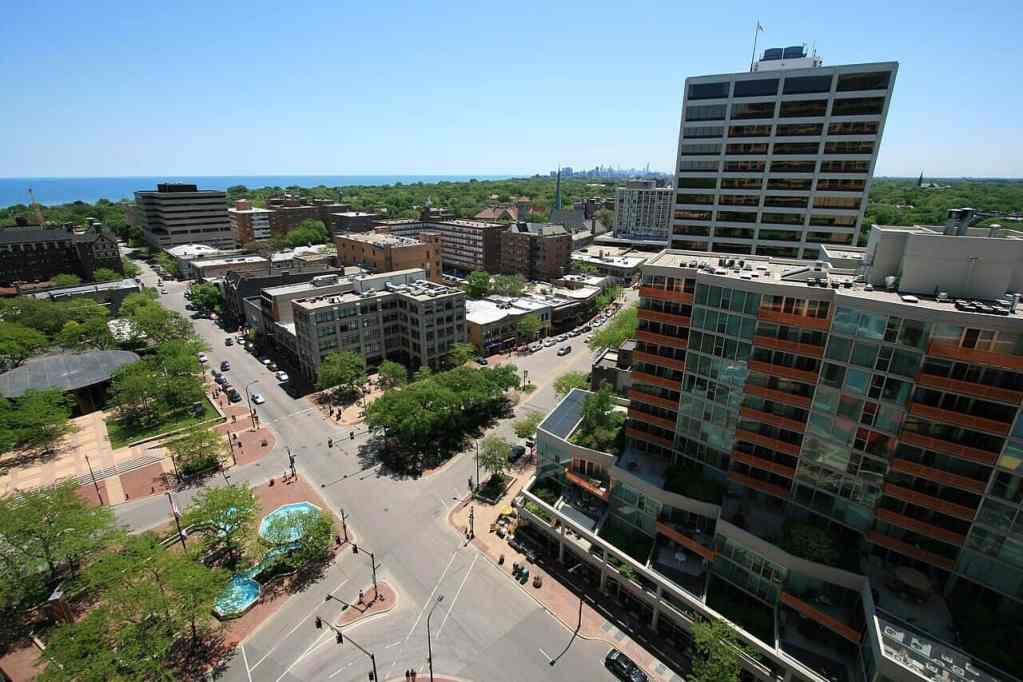
Almost all the good lodging sits in downtown Evanston, roughly a mile south of the stadium and walkable to it, clustered around the Davis Street transit stops. That’s where you want to be: close to the game, close to the best restaurants and bars, and one short train hop or a pleasant walk from the gates. The alternative is to stay in Chicago and make it a city weekend, which plenty of fans do. For the Penn State opener and the Illinois finale, book early — those weekends will move fast.
Downtown Evanston Hotels
The Hilton Orrington/Evanston is the most central choice, a large full-service hotel right in the heart of downtown Evanston with a restaurant on site and walking access to everything, including the train. It’s the easy default for first-timers who want to be in the middle of it.
The Graduate by Hilton Evanston is the boutique, collegiate-themed option near campus — historic building, real character, and a fun bar and porch scene in the evenings. It suits fans who want the college-town atmosphere baked into the stay.
The Hyatt House Chicago/Evanston is our value-and-families pick: suite-style rooms with kitchens, a solid included breakfast, and on-site parking, which is a meaningful perk in this town. Consistently well-run and comfortable for a group.
The Hilton Garden Inn Chicago North Shore/Evanston is a reliable mid-range choice with a pool and an easy walk to downtown, a good middle option if the others are booked.
The GEM Museum Suites Evanston is the sleeper — a small, high-rated boutique with museum-styled interiors, extended-stay-style rooms with full kitchens, free parking, and a genuinely good included breakfast, all close to campus and the transit hubs. If you want something with more personality than a chain, look here first.
Budget Option
The Holiday Inn Chicago North-Evanston consistently runs some of the lowest rates in the area while keeping a clean room and a convenient downtown-Evanston location. You give up some polish, but for a game weekend where you’re barely in the room, it’s a sound way to save.
Northwestern Gameday Scene
The immediate area around the stadium has historically been light on bars and restaurants — this is a residential neighborhood, not a stadium district. The good news is there are two solid clusters within easy reach, and Chicago behind them.
Central Street — Closest to the Stadium
The Central Street corridor is the nearest cluster of places, an easy walk or a couple of minutes from the gates. Bluestone has long been the go-to walkable pregame spot for Northwestern games — a proper sports bar with games on, cracker-thin pizza, and a crowd. Right nearby, Comida does Mexican plates and strong cocktails, and Beer on Central is a terrific little craft-beer bottle shop and taproom where you can drink in-store before you walk over. A bit further west on Central, the Celtic Knot Public House is a genuine Irish pub with a well-poured Guinness and live music some nights, and The Fat Shallot turns out excellent sandwiches and burgers if you want to eat well before kickoff. The Spot, a newer spot on Central, has a full bar and shows games — a welcome addition to a stretch that used to be thin on them.
Downtown Evanston — The Bigger Scene
A short ride or one train stop south, downtown Evanston is where the deeper bench of bars and restaurants lives. Bat 17 is the standout for watching football — a big, upgraded space with a serious burger reputation (the K2 is the order) and games on every screen. For a proper sit-down meal, Trattoria Demi is a beloved, family-run Italian spot that’s one of the highest-rated restaurants in town, and Five & Dime has a fun rooftop that’s a great pregame or postgame hang in decent weather. LeTour Kitchen & Bar is the move if you want something more upscale and date-worthy while you’re in town.
Or Just Go to Chicago
If your gameday plan has room for it, downtown Chicago is right there, and the entire city’s food and nightlife is a train ride away. For a night game like the Penn State opener, some fans do a little of everything — dinner in the city, Metra up near kickoff, and back down after.

Why You Should Go
The new Ryan Field is the most expensive, most ambitious stadium ever built for college football, and it’s trying something nobody in the sport has tried — a canopy over every seat, a bowl engineered so the cheap seats aren’t cheap, and the first European-style safe-standing supporter section the college game has ever seen. Whether it fully delivers is something we’ll only know from a seat inside it, and we’ll tell you straight once we’ve been. But there’s a real argument for getting there in the inaugural season, while every game is the first of its kind and the building still feels brand-new. It’s small, it’s historic, and it’s a twenty-minute train ride from one of America’s great cities. That’s a weekend worth taking.
Explore all of our College Football Guides as well as these Chicago stadiums
Soldier Field and the United Center
Written by Brad Richards. This guide covers a stadium that has not yet opened. It’s built from Northwestern’s confirmed designs, published specifications, and verified logistics — not from a gameday we’ve attended, because no one has attended one here yet. We’ll update it with firsthand detail once the new Ryan Field opens in October 2026. If you beat us there, let us know what we got right and what we missed.