
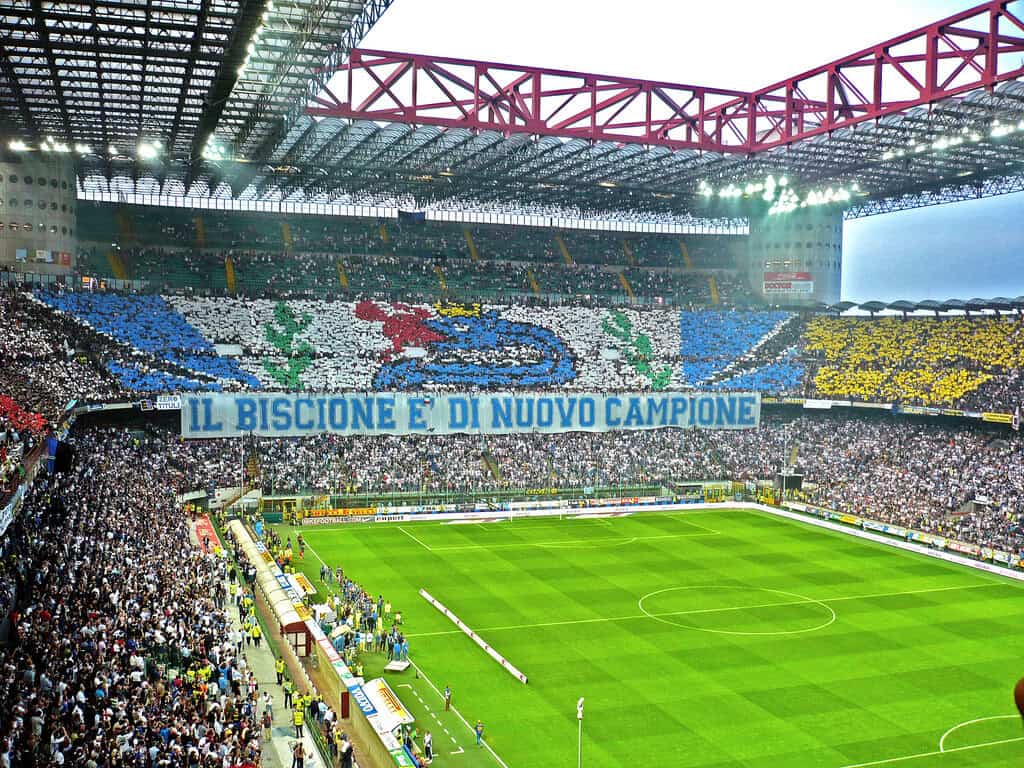

They call it La Scala del Calcio — the La Scala of football — and once you’re standing under those eleven spiralling concrete towers with 75,000 people singing, you understand why. San Siro is nearly a century old, the largest stadium in Italy, and one of the last of the great European cathedrals still doing the job it was built for. It’s also unusual in a way no other big club ground is: two fierce rivals, AC Milan and Inter Milan, have shared it since 1947, taking turns as the home side and staging the Derby della Madonnina inside the same four walls.
Here’s what to know, though — the atmosphere is world-class and the plumbing is from 1990, and the whole place is living on borrowed time. Both clubs now own it and plan to knock most of it down within a few years. If seeing San Siro is on your list, the clock is genuinely running, so let’s get you into the right seat while it’s still here.
Best Seats at San Siro
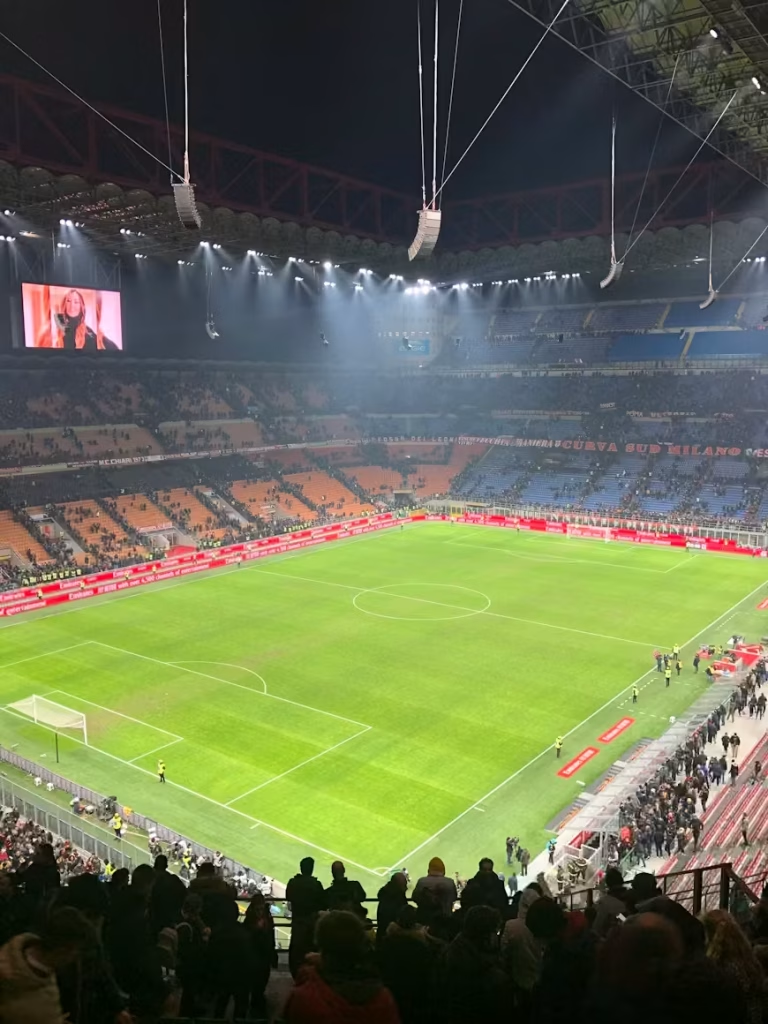
San Siro is a three-tier bowl, and the whole seating decision comes down to two questions: how high up you want to be, and how close you want to sit to the home team’s ultras. The three rings — primo anello (lower/first ring), secondo anello (middle/second ring), and terzo anello (upper/third ring) — stack almost vertically, which is the point. The steepness is what puts you close to the pitch even from up high and what makes the noise feel like it’s coming from every direction. A cantilevered roof covers nearly all the seats (only the very front rows of the lower ring catch rain or low sun), so weather rarely wrecks the experience. Because kickoffs are afternoon or evening and Milan’s climate is mild, you don’t need to think about sun and shade the way you would at a summer baseball park.
Where to Sit for the Best View
The secondo anello (middle ring) on either long side is the sweet spot, full stop. Sit centrally along one of the two sidelines — the Tribuna Rossa (red side) or Tribuna Arancio (orange side) — and you get an elevated, dead-square view of the whole pitch with the roof over your head and both curves in your sightline. This is the tier that balances height and proximity better than anything else in the building, and it’s where you can actually read the shape of the game rather than just watching a wall of bodies.
The primo anello (lower ring), central on a long side puts you closest to the touchline and the players. You’ll feel the pace and hear the benches, and it’s a great seat for a first-timer who wants intimacy over the tactical overview. The tradeoff is a flatter angle — action on the far side can get lost behind near-side players — and the very front rows sit low enough that a surging crowd in front can block sightlines during big moments.
The terzo anello (upper ring) is the cheap, vertigo-inducing top deck, added for the 1990 World Cup on three of the four sides. The view is more distant and the climb up the helical ramps is a workout, but the sensation of the full bowl from up there is genuinely one of the best cheap-seat experiences in Europe. Just aim for a central block — the corners up top give you a real crick-in-the-neck angle.
Best Value Seats
The secondo anello centrale, especially on the orange side (Secondo Anello Arancio Centrale), is the pick that regulars point to over and over. You’re roughly in the €50–90 band depending on the opponent, and for that you get a view that rivals seats costing far more, plus a spot in the heart of the singing without being buried in the ultra sections. If you want the best experience-per-euro at San Siro, this is it.
Cheapest Way In
The terzo anello laterale and corners are the lowest real prices — often around €30 for a mid-table Serie A fixture. You’re high and off to the side, but you’re inside a full San Siro, which is most of the point. The downside is honest: it’s a long climb, the seats are tight, and for a far-corner block you’ll be tracking play at a distance.
The curva (the ends behind the goals) are the other cheap route, usually €35–60, and they buy you atmosphere rather than a clean view. More on those below, because they come with real caveats for a visiting neutral.
Our Pick
If a friend flew in for their first San Siro match, we’d put them in the secondo anello centrale on a long side — the middle ring, dead on the halfway line. It’s the view the building was made for, it’s affordable, and it’s loud without being intimidating. One seat, one recommendation: that’s the one.
What to Avoid (and What’s Worth Trying Once)
The far corners of the terzo anello are the weakest value — you pay a little less than a central upper seat and give up a lot of view, with the near roof pillar occasionally clipping the far corner of the pitch. Unless price is the only thing that matters, spend the few extra euros to move central.
The very front rows of the primo anello look tempting for the closeness but often disappoint: the pitch-level angle flattens the far half of the pitch, and a standing crowd in front of you at a big moment turns your expensive seat into a view of shoulders.
Worth it once — the curva, if you know what you’re getting. The Curva Nord (Inter’s ultras, the green end) and the Curva Sud (Milan’s ultras, the blue end) are where the tifos, the flags and the relentless singing live. As a neutral or a visitor, sitting in a curva is a bucket-list experience for the noise and the choreography — but understand the deal: you’ll stand the whole match, the view of the far goal is poor, and it’s fiercely partisan. Do it for the spectacle at a normal league game if you’re up for it. Do not wander into the wrong curva wearing the other club’s colours, and don’t put yourself there for the derby unless you know exactly what you’re doing.
Premium Seating & Clubs
Premium at San Siro has a wrinkle no single-tenant stadium has: it’s run separately by each club and rebrands depending on who’s home. When Inter host, it’s Inter Hospitality; when Milan host, it’s AC Milan’s Club 1899. Same rooms, different logos, different booking sites — so always match the hospitality provider to the home team for your specific match. Almost all of it lives in the central Tribuna d’Onore (the honour stand behind the dugouts) and the padded orange and red centre tiers.
The Best Premium Experience
The central Tribuna d’Onore is the classic — padded seats on the halfway line, directly behind the benches, with executive lounges and buffet-and-cocktail service attached. It’s the eye-level, inner-circle view the stadium was designed around, and if you want the definitive premium San Siro afternoon, this is the room. For something splashier, both clubs sell a pitchside experience with leather seats right on the touchline and a dedicated lounge — as close to the players as a paying fan gets.
Best Value Premium
The first-tier orange lounge (marketed as the “Sky Lounge Orange” or “Orange Sky Lounge”) is the insider call. You get a comfortable corner lounge with leather seats, monitors and a full-pitch view, plus buffet access before the match and at halftime — for meaningfully less than the pitchside or central Onore packages. It delivers most of the hospitality experience at a fraction of the top-tier price, which is exactly what a value premium seat should do. Packages across the clubs generally start around €280 including catering.
Other Premium Options
There’s more here than most visitors realise. The sky boxes (private skyboxes at the top of the lower ring) and the palchi — leather-seated boxes tucked just below the skyboxes with their own monitors — are the enclosed, climate-controlled options. The Executive Club offers upmarket dining behind a big window onto the pitch, while the Sports Pub recreates a British-style match pub in the first orange tier for a more casual crowd. There’s even a post-match museum/legends lounge with a live DJ set surrounded by legendary shirts — a genuinely fun, only-at-San-Siro touch. Both clubs also sell a VIP historical tram experience, where you ride to the stadium from the city centre aboard a vintage Milanese tram with hospitality on board.
Suites & Group Options
The skyboxes and palchi are the group and corporate play — leather seating, catering, and monitors, booked directly through each club’s hospitality department (inter.it or acmilan.com, matched to the home side). Prices scale with the opponent and the box, and derby or Champions League boxes go fast, so book well ahead.
San Siro Seating Map & Capacity
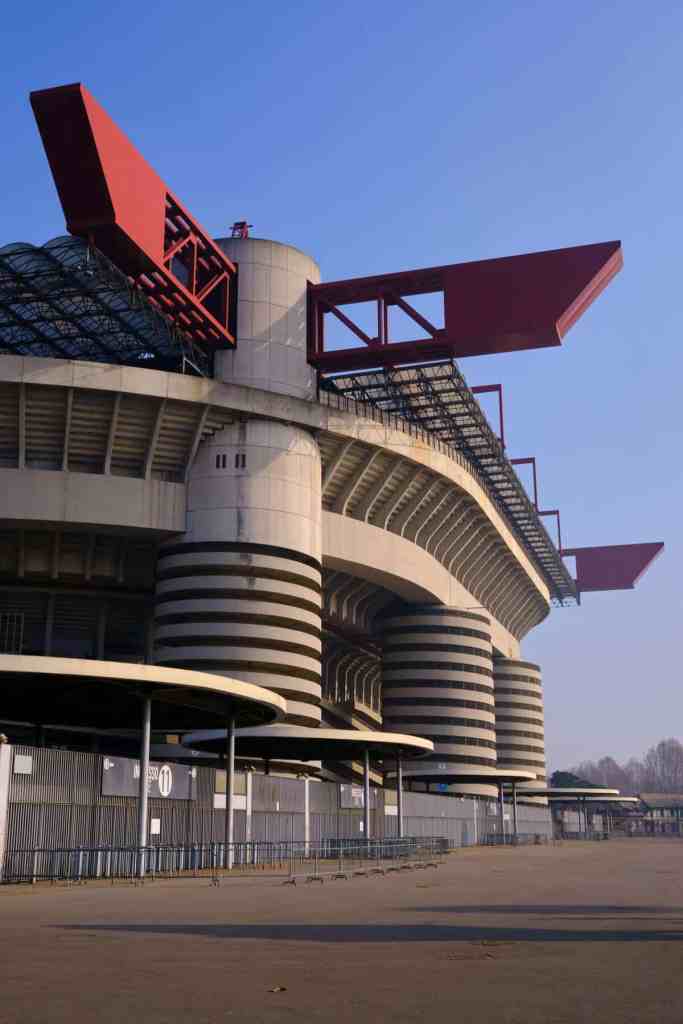
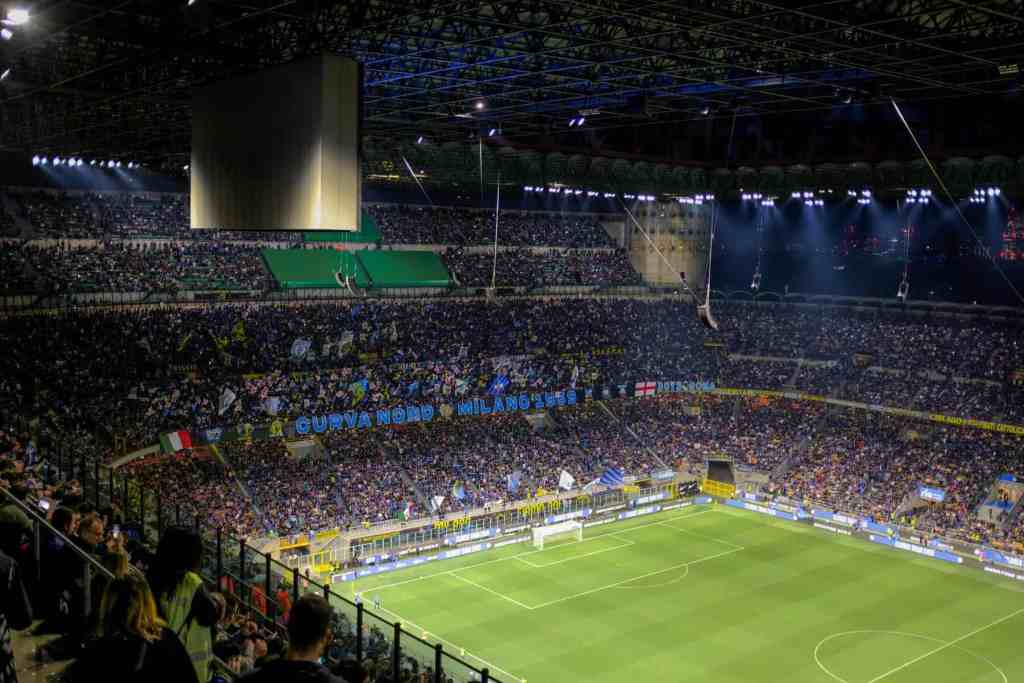
San Siro holds roughly 75,800 for football, making it the biggest stadium in Italy and one of the largest in Europe. The layout is a near-vertical three-tier bowl: two long sides — the Rossa (red) and Arancio (orange) tribunes — each split into primo, secondo and terzo anello, and two ends, the Curva Nord (green) and Curva Sud (blue). The eleven helical concrete towers and the enormous cantilevered roof both date to the 1987–90 rebuild for the 1990 World Cup, and they’re the stadium’s signature silhouette. Because tickets are labelled in Italian by ring and colour, knowing that anello means “ring” and the colours mark the four sides will save you real confusion at the turnstile.
Official seating maps live on the home club’s site for your match — AC Milan or Inter
Getting the Best Tickets
Buy from the home club for that specific match — inter.it when Inter host, acmilan.com when Milan host — because this is the safest route and, for big games, often the only legitimate one. The critical thing to know: Italian tickets are nominative, meaning every ticket carries the buyer’s name and is checked against a matching photo ID at the gate. That single rule makes casual secondary-market buying risky, because a ticket in someone else’s name can be refused at the turnstile unless the seller can legally re-issue it to you.
Ordinary league matches don’t sell out and go on general sale a couple of weeks before kickoff, so those are easy. The Derby della Madonnina, the Derby d’Italia against Juventus, and Champions League knockouts are a different animal — they clear through club members before general sale, and for those, official hospitality is frequently the realistic path in. Skip the touts who work the area around Lampugnano and Piazzale Axum; between the ID rule and the fakes, it’s not worth it.
San Siro Stadium Bag Policy
Keep it small. Anything backpack-sized or larger won’t get in, and the practical limit is roughly a small purse — think no bigger than about 25 cm on any side. There’s no reliable cloakroom or bag check at the stadium, so if you’re arriving with luggage or a day bag, use one of the city’s luggage-storage services before you head over rather than gambling at the gate. All bags get searched, and glass bottles, weapons and anything flammable are out.
Key Venue Policies
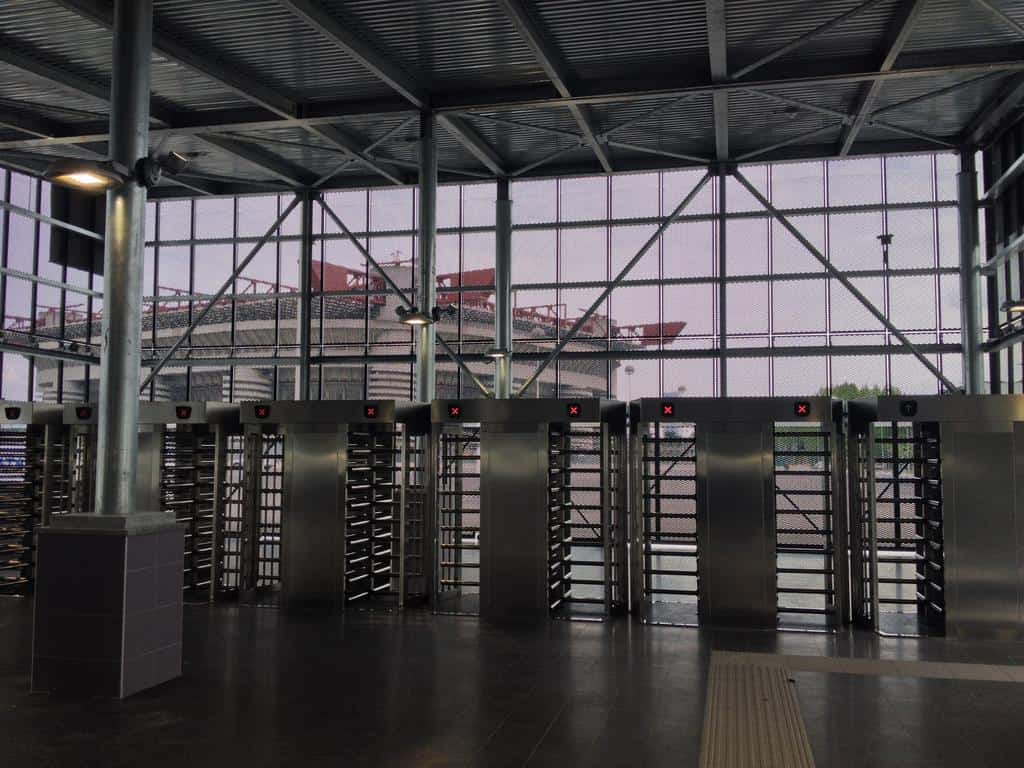
There’s no re-entry — once you leave, you’re out, so sort your food, drinks and bathroom stops before you settle in. Entry is by metal detector, pat-down and the nominative-ticket ID check, so bring the photo ID that matches your ticket and budget extra time at the turnstiles for a big crowd. Smoking is banned throughout. And a straight-talk heads-up that regulars all know: the concourses, bars and bathrooms are dated and under-built for the crowd — long queues and rough facilities are part of the old-cathedral charm, and they’re a real reason to arrive early and go easy on the pre-match liquids.
Cashless or Cash?
Cards and contactless are the safe default across the stadium — hospitality areas are explicitly digital-payment only, and the concessions have moved the same way. Bring a tap-to-pay card or phone and don’t rely on cash.
Accessibility
There’s lift and ramp access to the museum, the stands and the pitchside route, with accessible and companion seating available. Be realistic, though — this is a 1920s structure repeatedly rebuilt, and some older sections are stepped and awkward, with visitor reports of limited access in parts of the stands. If anyone in your group has mobility needs, contact the home club’s ticket office directly in advance to confirm exactly what’s reachable for your match and arrange assistance.
Getting to San Siro
San Siro sits out in its namesake district in the west of Milan, roughly 6 km from the Duomo and the historic centre — well past walking distance, but simple to reach. Its immediate neighbours are the San Siro racecourse (the Ippodromo) right alongside and, a little to the east, the Fiera exhibition grounds and the CityLife towers; the tourist Milan of the Duomo and the Galleria is a metro or tram ride away, not a stroll. The upside is that despite being out of the centre, the ground is very well served by public transport — which is far and away the smart choice on a matchday, when traffic and parking around the stadium turn miserable.
By Metro
The M5 (the lilac line) runs straight to the San Siro Stadio stop, a five-minute walk from the turnstiles — this is the fastest, cleanest option. Coming from the city centre, you’ll usually connect onto the M5 at Lotto or Garibaldi; the M1-to-M5 transfer at Lotto is easier and involves less walking than changing at Cadorna.
By Tram
Tram 16 rolls from the city centre out to Piazzale Axum, right at the base of the stadium. It’s slower than the metro, but this is the romantic way in: the tram fills with fans and chants at every stop, so you arrive already warmed up rather than spat out of an underground station. No line changes, above-ground the whole way, and easily the best transition from the quiet of central Milan into matchday chaos.
Taxi & Rideshare
Taxis and rideshare both work and can drop you near the ground, but expect surge pricing and heavy traffic as kickoff approaches. The move is to be dropped a few blocks out and walk the last stretch rather than sitting in the crawl right at the stadium.
San Siro Parking
You can drive — the A1, A4, A8, A9 and the Tangenziale Ovest all feed in, and there are paid lots near the ground — but honestly, don’t. Traffic and queues build up two hours before kickoff, and clearing out afterward is worse. Unless you’ve pre-booked hospitality parking, transit will get you there and back with far less pain.
Top Tips For Matches at San Siro
San Siro requires a little homework if its your first visit. It’s an old, gloriously loud, slightly rough-around-the-edges giant, and knowing how it works — and knowing it may not be here much longer — changes the whole visit. Here’s what actually matters on the ground.
The Cathedral of Italian Football
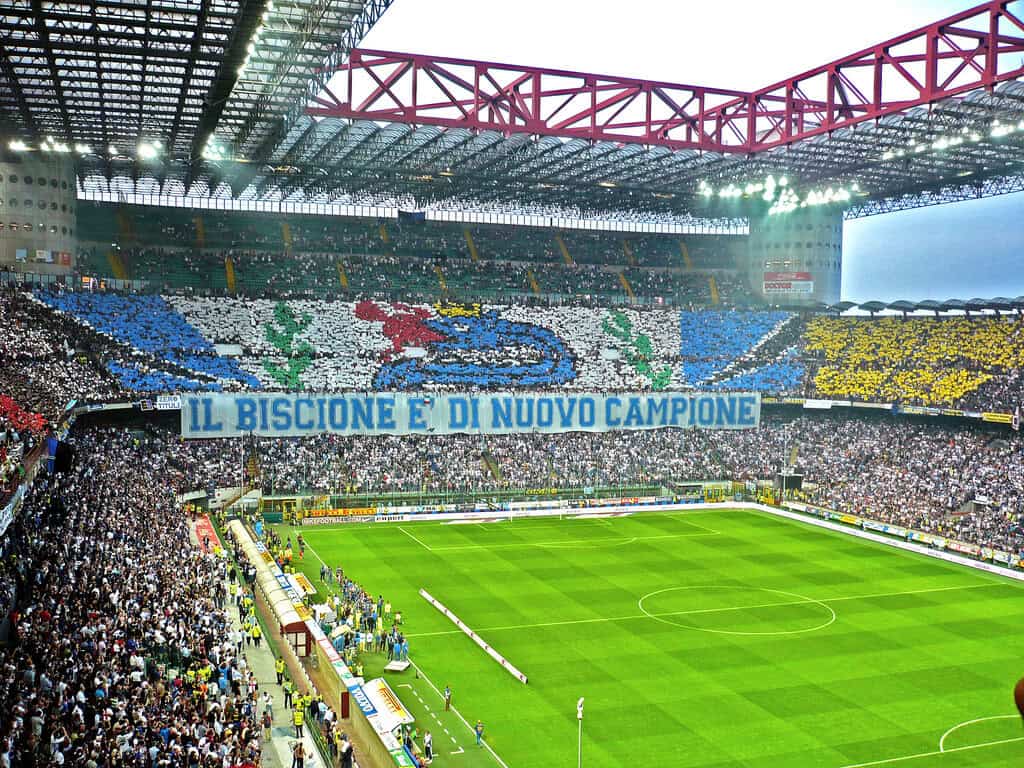
Built in 1926 and rebuilt over and over across a century, San Siro earned its “temple of football” reputation the hard way: European Cup finals, World Cup nights, and decades of derbies so intense that visiting teams genuinely dreaded the trip. The eleven helical towers and the vast red roof from the 1990 rebuild are its face, and the sheer verticality inside — three steep rings pressing down on the pitch — is why the noise hits the way it does. You’re not just seeing a match here; you’re standing in one of the last great old-world football grounds still in full-time use.
See It Before It’s Gone
This is the big one, and it’s real. AC Milan and Inter jointly bought San Siro and the surrounding land from the city in late 2025, and they plan to build a new 71,500-seat stadium right next door (designed by Foster + Partners and MANICA) and demolish most of the current one. The current stadium stays fully open while the new build goes up — it even hosted the 2026 Winter Olympics opening ceremony — so you can still catch matches here for the next several years. The clubs are aiming to move into the new ground around the 2030–31 season, after which the old San Siro comes down, with talk of preserving only a small heritage slice of the second tier. First visible prep work has already begun, and there are ongoing legal challenges and preservation fights that could shift the timeline. Bottom line: if watching a match in the real San Siro is a bucket-list item, treat the next few years as your window.
Two Clubs, One Stadium
A quick orientation on the two tenants. AC Milan — the Rossoneri (red-and-blacks), founded in 1899 — are one of the most decorated clubs on earth, with 19 Italian league titles (Scudetti) and seven European Cups, a continental haul bettered only by Real Madrid. Inter Milan — officially Internazionale, the Nerazzurri (black-and-blues), founded in 1908 — are the city’s other giant, with 21 league titles, three European Cups, and the rare distinction of never having been relegated from Serie A; their 2010 team won the treble under José Mourinho. The stadium’s official name, Giuseppe Meazza, honours a pre-war forward who starred mainly for Inter, which is why older Inter fans still call the ground “the Meazza” while Milan supporters stick with “San Siro.”
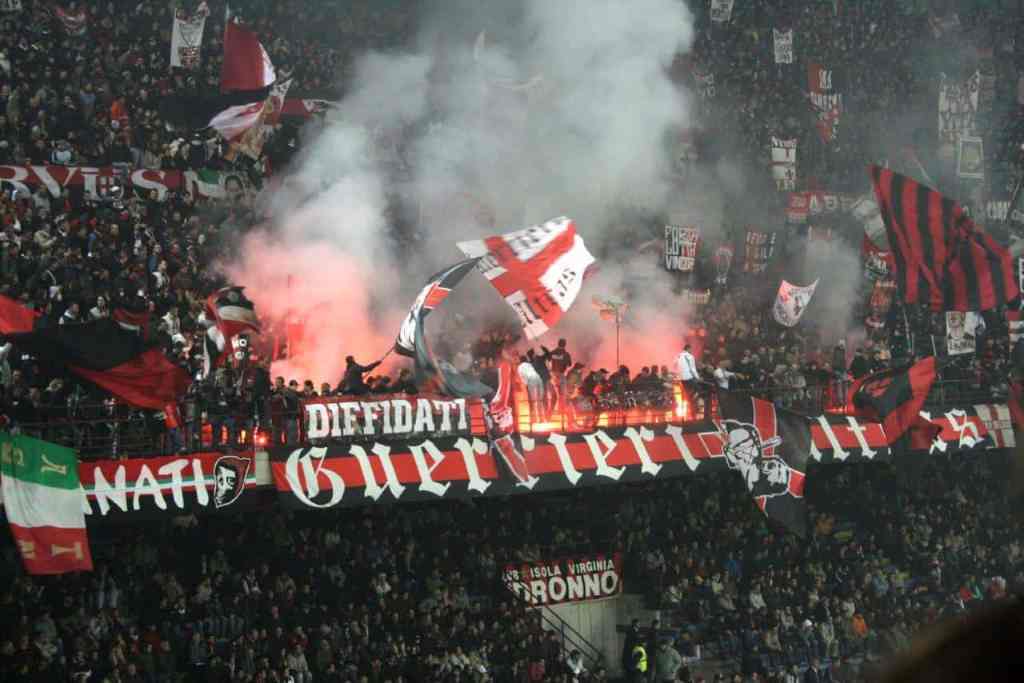
Here’s how the sharing works. Whichever club is the designated home team for a given match runs everything — the ticketing platform, the hospitality brand, the tone of the day — while the seats themselves don’t move. Inter’s ultras hold the Curva Nord (the green end) and Milan’s the Curva Sud (the blue end), so the home side’s curva leads the singing, and away fans are placed at the back of the third tier in the far corner. The one night it all collides is the Derby della Madonnina, when both sets of ultras go full throttle in the same building and the pre-match tifo displays rank among the most spectacular in world football.
When to Arrive
Get there about 90 minutes out. Gates open roughly an hour and a half before kickoff, and given the ID checks, pat-downs and famously slow concourses, early entry is the difference between a relaxed pre-match and a stressed sprint. Arriving early also lets you take in the full bowl before it fills — that first look from an upper tier is the shot people remember.
Eating & Drinking, Inside and Out
The real San Siro street food is the salamella. Skip the generic stadium pizza and eat outside the gates, where the grill vans (chiringuiti) do a panino con la salamella — a butterflied, grilled pork sausage piled with grilled onions and peppers. The trick is simple: follow the thickest clouds of grill smoke on the piazzas, because that’s where the best ones are working. This is the authentic matchday ritual, not an afterthought.
Inside, set your expectations. The concession kiosks do simple, decent fare — panini, piadine, slices of pizza, and Peroni or Moretti beer — reasonably priced by stadium standards at around €5–7 for a panino and a beer. The catch is volume: the bars are small and the lines are brutal, with fans reporting genuinely long waits even for a bottle of water. Eat before you come in, or hit the kiosks the moment you’re through the gates rather than at halftime.
Getting Out After the Final Whistle
The nearby stations become a crush. Everyone funnels toward San Siro Stadio and Lotto and the tram lines at once, so give it 20–30 minutes to clear if you’d rather not fight it. A smart move is to linger — soak up the emptying bowl, let the first wave go — then walk out. If you’re heading for dinner, ride toward the centre and eat in the city rather than hunting for food in the residential streets by the ground.
The local escape hack is to walk to Lampugnano. Instead of squeezing into the closest stations, head roughly 15–20 minutes north to the Lampugnano M1 stop. You bypass the worst of the police cordons, road closures and the packed platforms at the near stations, and you’ll usually walk onto the train with room to sit.
The Photo You Came For
The signature San Siro shot isn’t pitchside — it’s from the mid-tier of the red stands, where you can frame the full bowl with the spiral towers curling up in the background. At night, the exterior lit up is a photo in itself; circle the outside before you go in. The piazza out front, where vendors sell scarves, is the classic “I was here” backdrop.
Songs, Tifos & the Sound of the Place
The curve sing the entire match. Inter’s crowd rolls out “Pazza Inter” and “C’è solo l’Inter,” Milan’s answers with its own anthems, and on a big European night the pre-match Champions League theme under those towers is a full-body-goosebumps moment. The singing is organised and continuous, led from the curve — you don’t need to know the words to feel it, but learning a line or two of the home side’s chant makes you part of it.
Stop halfway up the spiral ramps and listen. As you climb the helical towers to the upper tiers, the curved concrete funnels the chanting and drumming from inside the bowl straight down the ramps at you. It builds a physical hum of anticipation before you’ve even seen the grass — one of those only-here sensory moments most visitors walk right past.
The tifo drops in a strict 60-second window. The huge, stadium-spanning choreography in the curve unfurls right as the Serie A anthem (or Champions League theme) starts to play — and it’s over fast. If you’re in the bathroom line or grabbing a beer during that one minute, you miss the single best visual of the day. Be in your seat, phone ready, before the anthem hits.
The Away Bus Welcome
Want a taste of derby-day or big-match tension without being in the thick of it? Around 75–90 minutes before kickoff, the visiting team’s coach pulls in near the players’ entrance, and it’s usually met by a deafening wall of whistles and jeers from the home ultras waiting outside. Hang near the team-entrance side of the ground at that window and you’ll catch one of football’s oldest intimidation rituals — loud, harmless, and very Italian.
Blend In Like a Local
Buy the pink paper. Pick up a physical copy of La Gazzetta dello Sport — Italy’s iconic pink sports daily — from a newsstand on your way over. Reading it in your seat while you wait for the warm-ups is a time-honoured, old-school San Siro habit, and it marks you as someone who gets it rather than a day-tripper.
Keep your colours zipped on transit. Milan is a safe football city, but the unwritten custom is to keep club kit somewhat concealed on public transport until you’re near the ground. On derby days or high-stakes European nights especially, walking through a rival neighbourhood in full colours is frowned upon — zip the jacket until you see the towers, then let it fly.
Your One Must-Do
Stay in your seat as the teams walk out and just listen. The wall of sound from three vertical tiers at kickoff — before a ball is even kicked — is the single thing that separates San Siro from a modern bowl. Don’t be fishing for your phone when it happens.
Tickets, Apps & the ID Rule
Buy through the home club’s official channel and carry the photo ID that matches the name on your nominative ticket — this is the rule that trips up more tourists than any other. Each club runs its matchday info through its own site and app for mobile tickets and gate assignments, so download the right one (Inter’s or Milan’s) for your match and load your ticket before you leave your hotel Wi-Fi.
Merch & the Team Stores
Casa Milan (AC Milan’s HQ, with a store and club museum) and the Inter Store are the official retail stops, and scarf vendors set up on the piazzas outside on matchday. One honest note: the official shirts aren’t cheap — expect to pay around €170 for a current jersey — so if you want a souvenir on a budget, the outside stalls and scarves are the friendlier play.
The Stuff Nobody Warns You About
The plumbing is the punchline. The bathrooms are few, dated and frequently out of order, and the away section in particular is notoriously under-equipped (fans have reported a handful of facilities for thousands of people). The seats are small and packed in, the stairs up the rings are steep and short on handrails, and there’s no re-entry. None of this ruins the day, but knowing it going in — travel light, go before you sit, keep your expectations set to “1990, not 2026” — turns it into character rather than an unpleasant surprise.
Dress for the bowl, not the street. That giant roof and the steep, enclosed concrete walls block the sun and trap cold, damp air, so on a winter night the inside of the bowl can feel noticeably colder than the streets by the Duomo. Even when the city weather feels mild, bring a thermal layer for an evening kickoff — you’ll be sitting still in the cold for two hours.
Families & Kids
San Siro works fine for football-mad kids, especially in the calmer central long-side tiers away from the curve, where the atmosphere is huge but not intimidating. Steer clear of the ultra ends with young children — the standing, smoke and intensity aren’t built for them. The steep stairs and the crowds mean strollers are a hassle, so plan around that, and the stadium tour (below) is arguably a better first San Siro experience for little ones than a packed derby.
Autographs & Player Access
Your best window is the warm-up, when players are closest to the stands, and pitchside-adjacent lower-tier seats near the tunnel side give you the nearest vantage. Access is limited on matchday itself, so serious autograph hunters often do better around the clubs’ training facilities than at the stadium, but arriving early and getting down toward the front of the primo anello during warm-ups is the realistic in-stadium play.
Not Just Football: San Siro as a Concert Venue
Worth knowing if your dates don’t line up with a match — San Siro is one of Europe’s biggest summer concert venues, and in 2026 it’s hosting a run of huge names. Most of the seating and access advice here still applies: the metro and tram routes, the bag rules and the nominative-ticket ID check all carry over, though pitch-standing configurations change the layout for shows.
The Stadium Tour & Museum
If you can’t get to a match — or want more than 90 minutes inside — the Museo San Siro and Stadium Tour is genuinely special, because it’s the only place on earth you’ll see Inter’s and Milan’s European Cup trophies side by side (ten combined between them). The tour runs most days from Gate 8 (Ingresso 8) and takes you through the dressing rooms, the tunnel and pitchside, for roughly €25–30. Two practical tips: it’s closed or shortened on matchdays, so check before you go, and book the earliest slot of the day for emptier tunnel and dressing-room photos. The one common gripe is over-large tour groups, which is another reason to go early.
If You’ve Got Extra Time in Milan
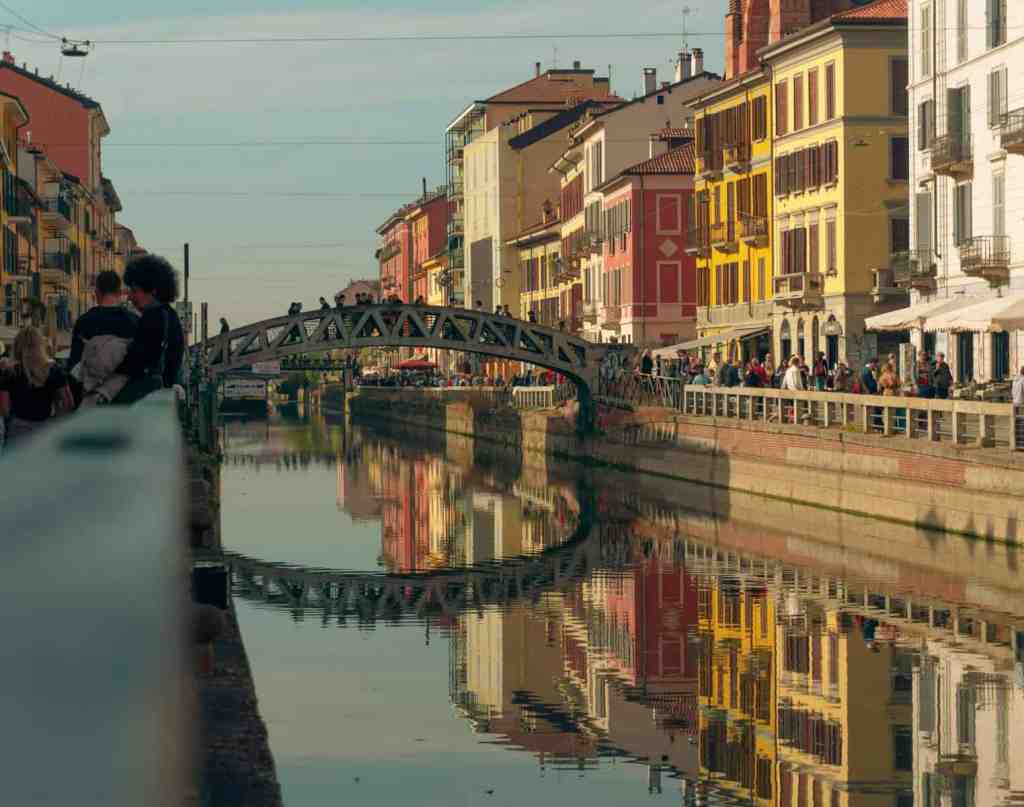
Milan packs a lot into a small centre, and it’s an easy day around a match. The Duomo and the glass-roofed Galleria Vittorio Emanuele II are the postcard core; book ahead for Leonardo’s Last Supper, which sells out weeks out. Brera is the pretty gallery-and-aperitivo quarter, Navigli is the canal-side nightlife district, and CityLife — a short tram ride from the stadium — is the modern skyscraper-and-shopping zone. And right next to San Siro is the Ippodromo horse-racing track, home to Leonardo’s giant bronze horse (the Cavallo di Leonardo) — a genuinely odd, worthwhile ten-minute detour before or after a match.
Hotels Near San Siro
San Siro is out in Milan’s quiet, leafy, residential west — pleasant and safe, but a fair way from the city’s sights. The real decision is whether you want to be near the stadium (easy on gameday, stranded from Milan) or central (a short metro or tram ride to the match, and in the thick of everything else). For most visitors, central wins. Book early for derbies, Champions League nights, concerts, and Milan trade-fair weekends at the nearby Fiera, when rooms vanish and prices jump.
Best Areas to Stay
The city centre (Duomo area) is the default for a first Milan trip — you’re walking distance from the major sights and a straightforward metro or tram 16 ride from San Siro. CityLife is the modern, upscale pick: sleek hotels and restaurants, a genuinely nice neighbourhood, and only a short tram hop from the ground. Sempione / Corso Sempione, along the lilac M5 line, is leafy and full of good restaurants with a direct run to the stadium. Porta Garibaldi / Corso Como is the nightlife-and-shopping choice, about 15 minutes by metro. And Lotto / Fiera, right beside the stadium, is where the practical, get-me-to-the-turnstile business hotels sit.
Hotel Recommendations
The Sheraton Milan San Siro is the standout near-stadium hotel, about a 25-minute walk from the ground, with a pool, spa, and — a fun Inter tie-in — an Argentine steakhouse named for club legend Javier Zanetti. In the CityLife / Fiera zone, the Meliá Milano and the NH Collection Milano CityLife are solid modern four-stars with easy tram access to the match and a nicer neighbourhood to come back to. If you want to be able to walk to kickoff, the B&B Hotel Milano San Siro is a reliable, no-frills choice minutes from the ground. And for staying central while keeping the game easy, anything around the Duomo or Cadorna puts you on the direct tram-16 and M5 routes.
Budget Options
Hotel Lido, right by Lotto metro, is the classic value pick — family-run, spotless, well-reviewed, a three-minute walk to the station with the M5 straight to the stadium, and often happy to hold your luggage after checkout. Hotel Oro Blu, opposite Lotto Fiera metro, is another dependable, affordable base. Both come with the same honest tradeoff: you’re close to the stadium and the Fiera but a metro ride from Milan’s sights, so you’re trading a bit of tourist convenience for a lower nightly rate.
Matchday Scene
Two clubs share this ground, so the gameday feel shifts a little depending on who’s at home. The old Milanese shorthand split them by class: Inter’s supporters were the bauscia — the well-to-do city bourgeoisie — while Milan’s were the casciavit, the “screwdrivers,” the working class. That divide is mostly folklore now, since families and friend groups split by club rather than by neighbourhood, but the labels still get tossed around, and each side’s ultras bring their own songs and colours to the same stands.
What doesn’t shift is the setting: San Siro sits in a quiet, residential stretch of western Milan with no entertainment strip bolted onto it, so a good gameday is less about the streets right outside the turnstiles and more about where you choose to base yourself.
Best Pregame & Postgame Pubs
Baretto 1957 is the pick — an iconic, gritty kiosk-bar right outside the ground on the racecourse side (near Gates 0–1, not far from the Lotto approach), popular enough to sell its own logo’d T-shirts. It pours Moretti and stronger ales, does honest panini, and has a shady garden of outdoor benches; 60 minutes before kickoff it’s electric, and it’s the closest you’ll get to ultra-culture energy without standing in the curve. Just up Via Federico Tesio by the trotting track, the Old Tenconi Pub has been the away fans’ and neutrals’ favourite since Italia ’90 — proper wooden pub interior, a serious tap list, and a view of the stadium from its outside benches (the restaurant La Barchetta next door is a solid sit-down if you book ahead). On the south side by the round ticket hut, Bar-Ristorante Trotto offers a green-awning terrace and a full bar-restaurant, and the pop-up-style Chiringuito Milano and Ortobello kiosks add cocktails and burgers to the pre-match mix.
For your proper drinking, though, the smart play is still to ride in from a better base: CityLife (a short tram away) for something modern, Sempione for leafy cafés and trattorias on the M5, or Navigli afterward for Milan’s canal-side late-night scene. And don’t skip Milan’s aperitivo — an early-evening drink that comes with generous free snacks — which is a far better pre-match ritual than most stadium bars anywhere.
Good Restaurants in the Area
For eating, think Milanese classics and pick your district. The city’s signatures are cotoletta alla milanese (the breaded veal cutlet), risotto alla milanese (saffron risotto), and ossobuco (braised veal shank) — order those and you’re eating Milan. Navigli is the go-to for lively canal-side dinners and later drinks, Brera for a prettier, more romantic sit-down, and CityLife for sleek modern spots a quick tram ride from the stadium. Near the ground itself, a few neighbourhood trattorias and pizzerias (the streets east of the stadium tend to be friendlier and less mobbed than the piazzas out front) will feed you well before you head in — but for the meal you’ll actually remember, save it for the centre.
Why You Should Go
San Siro is a beautiful contradiction: a genuine cathedral of the game with world-class noise and history, wrapped around dated concourses and bathrooms that belong to another era. But the atmosphere — three vertical tiers, two of Europe’s great clubs, and a derby that ranks among the sport’s fiercest — is the kind of thing modern stadiums keep trying and failing to bottle. And it’s on the way out: the clubs plan to demolish it within a few years and move next door. Go now, take a mid-tier seat on a long side, and stand for the walkout. You’ll be glad you saw the real thing while it was still standing.
Explore all of our football guides as well as these:
Santiago Bernabéu (Real Madrid)
Written by Brad Richards. Founder of Gameday Guides. This guide includes insights from personal visits as well as updated info from team sources, fan forums, and stadium policies. We aim to help you plan with confidence — enjoy your gameday. If you have any tips, if we missed anything or you have a question, don’t hesitate to shoot us an email.