

Best Seats at Emirates Stadium
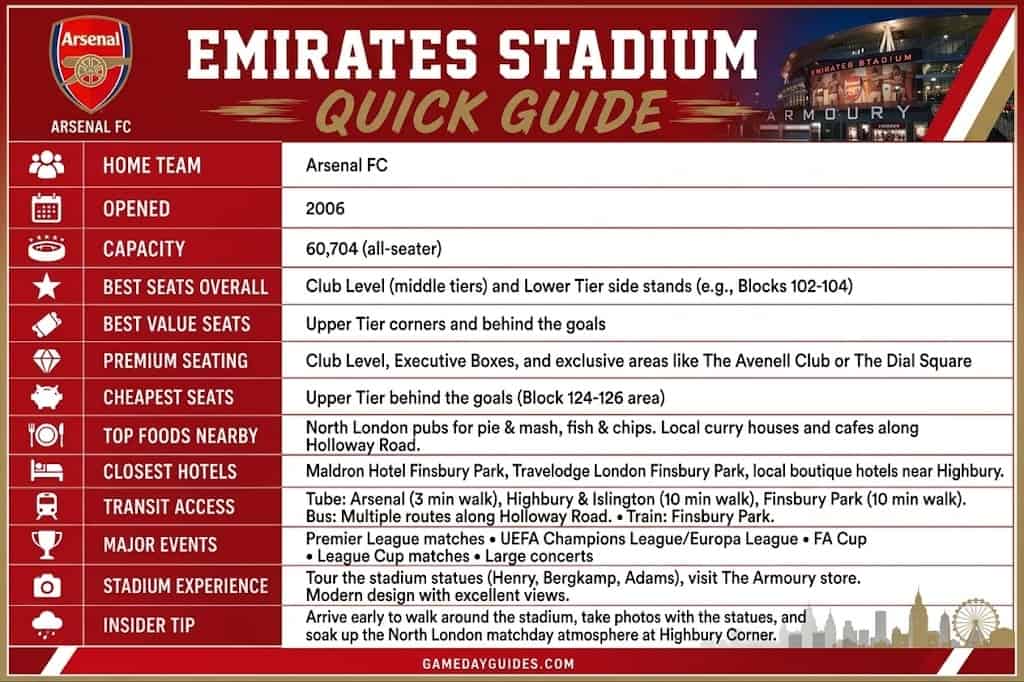
Emirates Stadium is what happens when a club outgrows its spiritual home and builds a glass-and-steel cathedral to replace it. Opened in 2006 in Holloway, North London, a few hundred metres from old Highbury, it holds 60,704 — fifth-largest in the Premier League now that Spurs, West Ham, Manchester United and Liverpool have all gone bigger, which is exactly why you keep hearing talk of an expansion past 70,000.
Demand wildly outstrips supply: the season ticket waiting list runs past 100,000, so getting in takes a plan. What the Emirates does not have is a bad seat. The bowl is steep, enclosed and pillar-free, so what you’re really choosing between is atmosphere, angle and price.
Seating Guide
The Emirates is one continuous bowl with four named stands carried over from Highbury — the North Bank behind the north goal, the Clock End behind the south goal, and the long East and West Stands down either touchline. There are four levels: the Lower Tier (blocks 1–32), the premium Club Level (blocks 41–84), the Executive Box Level above that, and the Upper Tier (blocks 91–134) up top. Blocks run continuously round the ground rather than resetting at each stand, so the West Stand picks up both ends of the sequence — lower blocks 29–32 and 1–4, upper blocks 132–134 and 91–93. The Clock End takes lower blocks 21–28; the East Stand sits between them.
Two things follow from the design. The Upper Tier has a wave to it, rising highest along the East and West Stands and dipping at the corners, where the two big screens sit. And General Admission is split — Lower Tier and Upper Tier only — with Club Level and the boxes sealed off in a band across the middle. You cannot move between them once you’re inside.
Best Seats at the Emirates for View and Atmosphere
Upper Tier, East and West Stands, lower rows. The sweet spot for most visitors. You get the elevated tactical angle — the whole shape of the game in front of you — without Club Level money, and the roof over your head. Prices climb the closer you get to the halfway line, so a block or two off-centre is where the value lives. The East Stand upper has one edge worth knowing: a clean view down over the tunnel and both benches, so you’ll spot substitutions before they happen.
North Bank, Lower Tier. The heartbeat of the ground and the closest thing here to Highbury’s old soul. On a big night you may well stand for the full ninety. The trade-off is a low, behind-the-goal angle that flattens play at the far end — you come for the noise, not the geometry.
Clock End, Lower Tier. The southern short side mirrors the North Bank for proximity and price, and it’s a strong shout if the North Bank has gone. The Ashburton Army — the drum-and-banner group that drives much of the singing — is based at the front of this end. Just know that away supporters sit in the corner beside you.
Best Value Seats
The lower rows of the Upper Tier behind the goals — the top of the North Bank and Clock End — give you a clean, elevated view of the whole pitch for noticeably less than the touchline blocks. You give up the central angle. For a first visit on a sensible budget, it’s hard to argue with.
Cheapest Seats at Emirates Stadium
The cheapest tickets in the house are Lower Tier behind the goals for a Category C fixture — Arsenal price every match A, B or C, with C the lower-profile league games. You’re low and behind the byline, which is as far from a television view as it gets, but you’re close to the grass, among proper supporters, and paying the least Arsenal will let you pay.
Our Pick
For a first-timer who wants the best all-round day, take a lower-row seat in the Upper Tier of the East or West Stand, a block or two off the halfway line. Full sweep of the pitch, a proper read on the game, the roof doing its job, and a price that won’t make your eyes water. It’s the seat we’d hand a friend flying in for their first match without a second thought.
Where Away Fans Sit at Emirates Stadium
The away end at Emirates Stadium is the south-east corner of the Lower Tier, running roughly blocks 20–23 where the East Stand meets the Clock End, entered through turnstiles K and L. The standard Premier League allocation is just under 3,000. Cup ties can push it to 6,000 or more, at which point the club has sometimes split the allocation between the lower blocks and the upper tier directly above rather than handing over the whole lower end.
The view is better than most away ends you’ll sit in — the rake is steep and there’s nothing to see round. The one thing to watch is the back rows, where the overhang of the upper tier can clip the top of your sightline. Food and drink open in the away concourse when the turnstiles do, roughly two hours before kick-off.
Getting a seat here is the hard part. Away tickets are allocated by the visiting club through its own away-points or loyalty scheme, they’re non-transferable, and they are not sold to neutrals — so if you’re travelling in from abroad and want to see a specific opponent’s supporters in full voice, you’re buying a home ticket and watching them from across the corner flag.
Weather & Reality Check
The Emirates is open to the sky, and while the roof covers most seats, there’s very little overhang at the front. That matters less for sun — this is London, after all — and more for wind and rain. On a blustery day, the front few rows of any stand facing into the weather can end up genuinely cold and wet, with rain blowing in under the roofline. If the forecast is grim and you’ve got a choice, sit higher up and further back, where the roof actually does its job. Pack a waterproof rather than an umbrella, which you’ll struggle to use in a packed stand anyway.
Seats To Avoid and The North Bank Lower
The very back of the Upper Tier behind the goals. Cheapest for a reason — high, distant and behind the play. Fine for soaking up a marquee occasion on a budget, underwhelming for a routine league game.
Front row, weather-exposed. A front-row seat sounds glamorous until the rain arrives sideways.
Worth it once — the North Bank Lower for a European night. Not the place for a clean tactical view, and you’ll spend most of it on your feet, but standing in the Lower North Bank for a Champions League knockout with “North London Forever” ringing round the bowl is the Emirates at its absolute best. Every visiting supporter should do it once.
Premium Seating/Clubs at Emirates
Arsenal built the Emirates with hospitality baked into its bones — two unbroken rings of padded seats sit right across the middle of the bowl, on Club Level and the Box Level above it, with the best central pitch views in the ground. Club Level seats come with access to a string of lounges and corner bars (the 49ers, Emirates Lounge, Legends and Champions bars among them), plus pre- and post-match dining options. Crucially, hospitality is sold directly by the club with no membership required, which makes it the most reliable route in for a one-off visitor — more on that below.
The best club — the Diamond Club: The most exclusive space in the building, sitting on the halfway line above the Directors’ Box, with an onyx bar, private dining and the finest views in the house. It’s effectively a members’ world and priced accordingly, but it’s the pinnacle if money is no object.
The standout matchday packages — The Avenell and The Heritage: For buyers who want genuine luxury without a season-long commitment, these are the headline options. The Avenell Club is a stylish private members’ lounge on Box Level (Art Deco styling, a feature bar, a chance to meet an Arsenal legend), while The Heritage offers halfway-line seats paired with fine dining in the Foundry restaurant. Expect to pay well into four figures per person, more for derbies and European nights.
Best value way into hospitality: The entry-level Club Level packages — a padded seat behind the goal or in a corner, plus a food voucher and a drink — are the cheapest way to experience the premium side of the ground. You skip the full restaurant treatment but still get the comfortable seats, the lounge access and a far smoother entry than general admission.
Restaurants and boxes: Sit-down dining runs through the Woolwich Restaurant (halfway-line seats with a three-course meal), Dial Square at the Clock End (post-match dining, with a Chivas bar), the Foundry and the members-only WM. Executive Boxes — the private N5 and N7 suites along the halfway line — seat 10, 12 or 15 and are leased by the match or the season; enquire through Arsenal’s Premium Sales team. Dress codes vary from smart casual to formal, so check when you book.

Emirates Stadium Seating Plan & Capacity
Emirates Stadium holds 60,704 for Arsenal matches, making it the fifth-largest ground in the Premier League and the second-largest in London. That figure has been static since the ground opened in 2006, which is the whole reason expansion talk never quite goes away — Old Trafford, Tottenham Hotspur Stadium, the London Stadium and Anfield have all overtaken it, and the season ticket waiting list is past 100,000.
Here’s the link to the seating plan.
Getting Tickets To Arsenal Matches
his is the part nobody warns you about: at Arsenal, you can’t simply walk up and buy a ticket. General admission seats are sold through the club to members only, and with the ground selling out for almost every fixture, getting in takes a plan. Here’s how it actually works.
You’ll need an Arsenal membership. Standard Red Membership is the one most fans hold — it gets you into the Red ballot for home matches and access to the Ticket Exchange, plus a few non-ticketing perks, for a modest annual fee. Above it sits Silver Membership, which isn’t openly on sale and carries its own multi-year waiting list, and then Gold Membership, which is the season ticket itself — that’s the 100,000-deep, roughly 20-year queue. Memberships are sold per season and the current campaign is typically closed by autumn, so if you’re planning ahead, register your interest for the next season’s membership early. One catch worth knowing: there’s a short delay between buying a membership and being allowed to enter a ballot, so don’t leave it to the last minute.
The Red ballot is the main route in. For each home fixture, a ballot opens roughly four to six weeks beforehand and runs for about 72 hours. It’s a random draw — if applications don’t exceed the tickets available, everyone who entered gets one; for big games, you’re in a genuine lottery. You apply through your online box office account, and you can link friends and family into a “network” to be balloted together.
The Ticket Exchange is your best friend. When season ticket holders can’t attend, they resell their seats at face value through the official Ticket Exchange, the most reliable way to find fairly priced tickets to sold-out matches. It opens to ballot losers first — typically around 5pm on ballot result days — and may expand to all members closer to kick-off. There’s a small admin fee (about 10%) for buyers, but it beats the secondary market. The trick is simple: check it daily, especially before high-demand fixtures, as seats can become available at any time.
Hospitality is the no-membership shortcut. Because hospitality packages are sold directly by Arsenal and require no membership at all, they’re often the most realistic option for a travelling fan on a fixed date — and, handily, they’re frequently the last tickets of any kind still available when everything else has gone. If your trip is locked in and the ballot hasn’t come good, this is the dependable fallback.
Away tickets are essentially off-limits to neutrals — they’re allocated to loyal season ticket holders through an away-points system built up over years of attendance, so don’t plan a trip around getting into the away end.
Upcoming Events At Emirates Stadium
Here is a list of upcoming matches, events and all things happening at Emirates Stadium.

Emirates Stadium Bag Policy
Keep it small or leave it behind. The only bags permitted are those smaller than A4 (21cm × 29.7cm) — think a small handbag or a compact pouch, roughly the size of a school notebook. Standard rucksacks, laptop bags and anything larger will be turned away at the gate, and there’s no bag storage at the stadium, so you’d be stuck. Every bag is searched and tagged at the entrance, and that tag has to stay on. The club’s genuine advice, which is worth taking, is to arrive bag-free wherever possible — it’s the single biggest thing that speeds up your entry. If you’re arriving in London with luggage, leave it at your hotel or use a left-luggage service at King’s Cross before heading north.
Key Stadium Policies
Cashless Transactions: Emirates Stadium is fully cashless—only contactless card payments are accepted at all bars, kiosks, restaurants, and retail outlets inside the venue. Cash will not be accepted anywhere inside the stadium, so bring a card. Outside retail stores and some external programme sellers still accept cash, but once you’re through the turnstiles, it’s card-only.
No Re-Entry Policy: Once you leave Emirates Stadium, you cannot re-enter. If you step outside for any reason, your ticket is done—plan accordingly and make sure you’re inside before kickoff.
Prohibited Items: No outside food or beverages allowed (except empty plastic bottles under 500ml), no professional cameras or recording equipment, no umbrellas, no baby buggies or prams, no large flags or banners without permission, no fireworks, smoke canisters, or laser pointers. Arsenal strongly recommends arriving at least 90 minutes before kickoff to avoid queues and delays at security. Gates open 90 minutes before kickoff, so get there early, travel light, and don’t bring anything you wouldn’t want to lose.
Accessibility: The Emirates is well-equipped for disabled supporters, featuring 241 wheelchair-accessible spaces and viewing areas across the Lower Tier, Upper Tier, and Club Level, all accessible by lift or ramp with stewards available. Key amenities include a Changing Places facility, accessible toilets, a sensory room, and a guide dog facility. Important travel tip: use Finsbury Park or Highbury & Islington stations, both step-free — the nearest, Arsenal, does not offer step-free access. Disability Access members enjoy priority ballot windows (six to eight weeks ahead), a 50% discount, and a complimentary personal assistant, subject to eligibility. Full details are on Arsenal’s disabled supporters page.
To learn more about all updated policies and what to expect on matchdays, visit the official Emirates Stadium policies page here.
Emirates Stadium Top Tips
Emirates Stadium is a modern, efficient ground, so most of the matchday runs smoothly and predictably — but the difference between a good day and a great one comes down to timing, Tube strategy, the local drinking rules, and knowing where to be while everyone else is stuck in a queue. With Arsenal back as champions for the first time in 22 years and the ground selling out week after week, a bit of planning goes a long way.
Emirates Stadium History: From Highbury to 2006
The opening date was July 2006, after 93 years at Highbury. Arsenal played their last game at Highbury in May 2006 and opened the Emirates that July with Dennis Bergkamp’s testimonial. The two grounds are a few hundred metres apart — you can walk between them in under ten minutes.
It cost around £390 million, and the club paid for it in transfer windows. That made it the most expensive stadium in England at the time, and servicing the debt shaped Arsenal’s spending for the better part of a decade. Every conversation about the current squad’s ceiling traces back to that bill.
The site was an industrial estate called Ashburton Grove. That’s where the Ashburton Army supporters’ group takes its name — a nod to the ground’s unglamorous origins as a waste-transfer and council depot site.
Old Highbury is still there, and it’s worth the detour. The listed Art Deco East and West Stand façades were kept and converted into flats as Highbury Square, with the old pitch now a communal garden. Ten minutes on foot from the turnstiles for anyone who cares about where the club came from.
What Makes the Emirates Special
Look up for the Arsenal clock at the Clock End. The rooftop clock is the ground’s signature landmark — carried over in spirit from old Highbury and the frame for the classic Emirates photo.
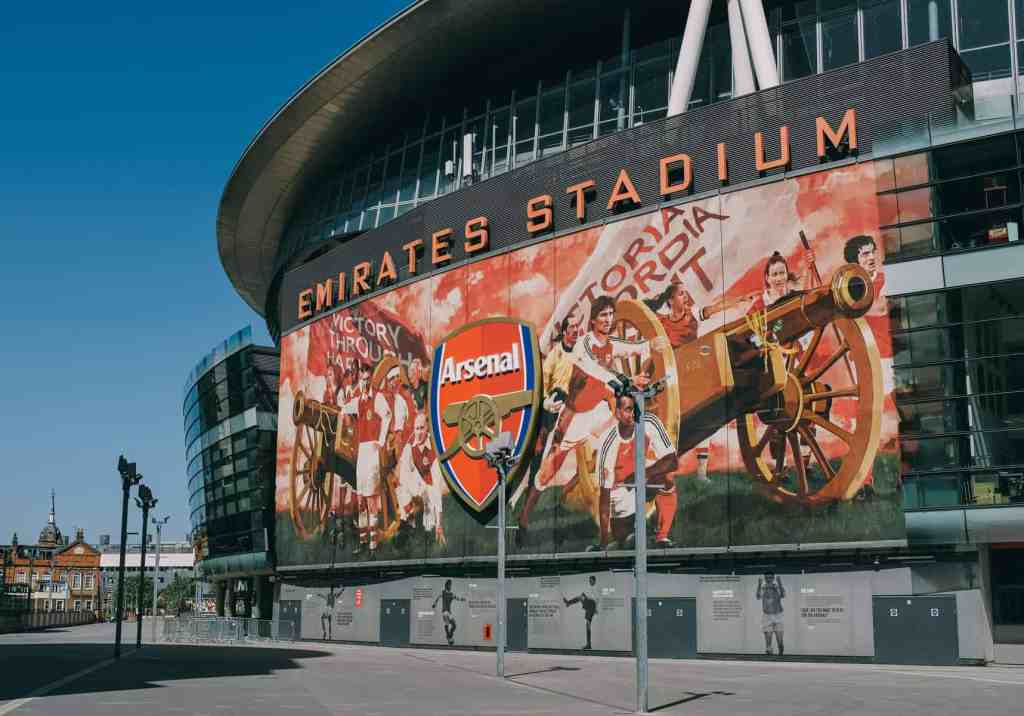
Spot the “Arsenalisation” murals wrapping the exterior. A deliberate effort to stitch the club’s history into a modern ground — worth a slow lap before you head in.
Admire “the Carpet.” The pitch is so immaculate that matchgoing supporters nicknamed it exactly that.
Emirates Stadium Expansion: Will Capacity Reach 70,000?
This is the current situation: nothing has been approved yet. Arsenal has started working again with Populous, the team behind the original design. Recent reports show they are exploring ideas to increase the stadium’s capacity beyond 70,000, and even up to 80,000 in some plans. They are considering changing the shape of the stands and adjusting the seating plan to fit more people while keeping the outer part of the stadium looking mostly the same. There’s also the option of moving to Wembley temporarily during construction.
However, there are significant challenges. No planning application has been submitted, Islington Council has stated that there are no formal discussions happening, and the site is surrounded by houses on almost all sides. The biggest technical challenge is the roof, which is supported by eight points. If they want to add a level to reach 80,000 seats, they would likely need to remove and rebuild the roof, making it a project that would cost as much as building a new stadium instead of just renovating. The cost could reach hundreds of millions.
Arrival, Gates and Turnstiles
Gates open two hours before kick-off, not 90 minutes. General Admission turnstiles open two hours out; Club Level, Box Level, the Directors’ Lounge and Diamond Club open two and a half hours out. Arsenal separately recommend arriving at least 90 minutes before kick-off, which is where the confusion comes from — the gates are open well before that.
Check your turnstile letter and go straight to it. Turnstiles run A through S by stand and the letter is printed on your digital pass. Walking the perimeter looking for a way in on a packed matchday is a twenty-minute mistake.
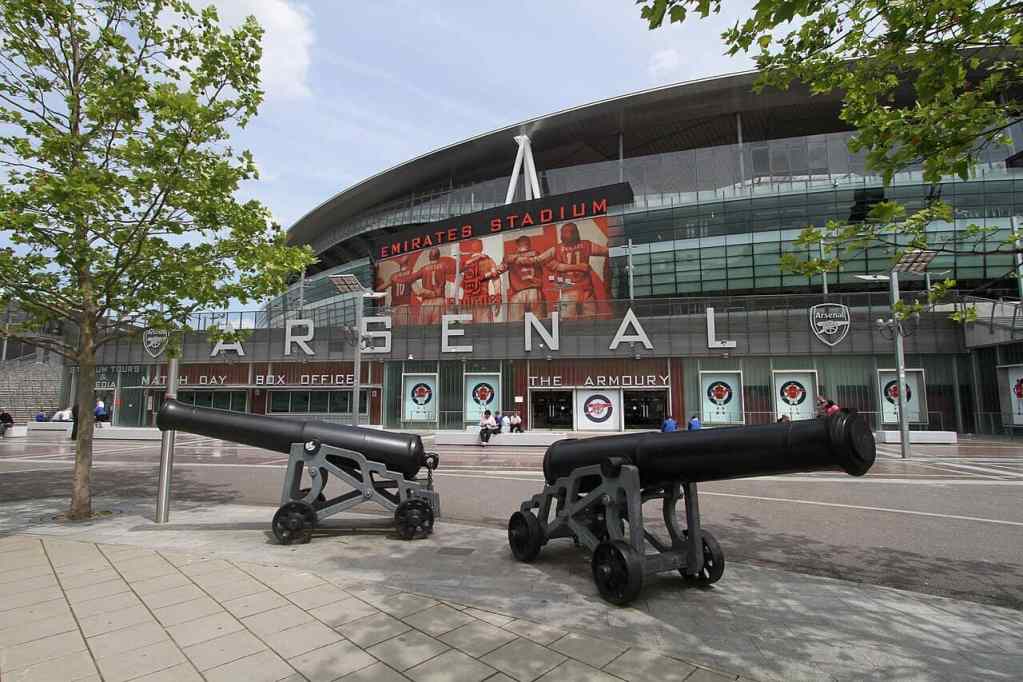
Use the Clock End Bridge, not the busier North Bank Bridge. Coming in from Arsenal station, the Clock End Bridge by the big Arsenal lettering is the same distance with far less of a crush.
Get to the correct entrance first time — you can’t move between tiers. Club Level and premium are sealed off from General Admission once you’re inside. Collecting tickets in person? The box office at Armoury Square by the Clock End gets busy, so build in time.
Left Luggage and Bag Storage Near Emirates Stadium
There is no bag storage at the ground, and the A4 limit is enforced. Anything bigger than a sheet of A4 gets turned away at the turnstile with nowhere to put it — a genuine problem if you’ve come straight from Heathrow or Gatwick with a case.
Book a luggage-storage app instead of backtracking into central London. Services like Stasher and Bounce list shops, cafés and off-licences around Finsbury Park, Highbury and Islington that will hold a suitcase for the day for a few pounds. Book it before you travel — the closest spots fill up on matchdays.
If you’re arriving by train, King’s Cross left luggage is the fallback. It’s two Piccadilly line stops from Arsenal, so dropping a bag there costs you fifteen minutes rather than an hour.
The Pint Rule First-Timers Always Get Wrong
You cannot drink alcohol in view of the pitch. Under UK law — the Sporting Events Act 1985 — you can buy a beer on the concourse but you must finish it there. Stewards will stop you carrying it up to your seat.
Plan your concourse timing around it. Half-time means a quick pint downstairs or a cup of tea in your seat, not a beer while you watch. Visiting fans from the US find this the single most jarring rule of the day.
Emirates Stadium Food & Drink
Go for the pies over the hot dogs. They’re genuinely good, especially on a cold day, and the pie-and-beer combo is the best value in the building.
Use the “Fans First” and “Early Bird” deals. Fans First discounts drinks in the first hour after gates open and again for up to an hour after full time; the Early Bird pie-and-a-pint runs up to 45 minutes before kick-off. Between them, arriving early is cheaper than arriving late.
If all you want is a pint, use the fast-track lanes. There are 59 beer-only lanes across the Upper and Lower Tiers — skip the full-service counters entirely.
Bring a card, because the ground is fully cashless. Every bar, kiosk and retail outlet inside is contactless-only. Cash works at some external programme sellers and outside shops, and nowhere past the turnstiles.
Emirates Stadium Tour and Arsenal Museum
Book a non-matchday tour in advance — peak season sells out. The self-guided tour takes in the dressing rooms, the tunnel and pitchside, with an audio guide voiced by Arsenal figures. Allow two hours if you want to do it properly rather than march through.
The Arsenal Museum covers the club back to 1886 and is the better half for some visitors. It sits alongside the tour and generally stays open later; on many matchdays it’s open until shortly before kick-off even when tours aren’t running.
Don’t plan a tour around a matchday. Tour access is limited or nonexistent when there’s a game on, and operational changes also hit women’s fixtures and event days. Check the date before you book flights around it.
Legends tours are guided by former players and cost more. Worth it if you’re making the trip once; the standard self-guided route covers the same ground for less.
Matchday Traditions & Atmosphere
Be in your seat for “North London Forever.” Louis Dunford’s anthem has played just before kick-off since 2022 — the whole ground stands and sings, and it has genuinely buried the old “library” reputation. If you do one thing here, don’t miss this.
The Ashburton Army sit at the front of the Clock End. The drum-and-banner group that drives a lot of the singing is based in the lower Clock End, not the North Bank — a detail plenty of guides get backwards.
For the biggest block of noise, aim for the North Bank Lower Tier. It holds the largest concentration of vocal support in the ground, and on European nights you’ll be standing for the full ninety whether you meant to or not.
Where to Drink Near the Emirates (Home-Only Rule)
Know that the pubs run home-only door policies on matchday. Places like the Tollington Arms are Arsenal-only, and for Category A fixtures — Spurs, Chelsea, the big European nights — some will ask to see a home match ticket before they let you in.
Away fans: drink centrally, then travel up. There’s no officially designated away pub, and the Blackstock Road strip will turn you away in colours. The common approach is to drink in central London and come up on the Tube shortly before kick-off; closer in, the Drayton Park side of the ground and the pubs around Finsbury Park station are the more away-tolerant end of things, though door policies shift fixture by fixture on police advice.
Get there two to three hours early, and never wear away colours near Highbury. Decent pubs fill fast, and colours anywhere in the residential streets are asking for trouble.
Best Photo Spots at Emirates Stadium
Frame the Arsenal clock from the north side looking south — the signature shot.
Shoot the North Bank exterior from the Ken Friar Bridge for a clean angle coming out of Arsenal station.
Hit the statue cluster by the Armoury — Thierry Henry mid-slide, plus Tony Adams, Dennis Bergkamp and Herbert Chapman.
Bringing Kids to Emirates Stadium
Head for the family area in the Clock End. For juniors 16 and under and their family groups it’s the calmest corner for a first match, and junior tickets come at a steep discount in a limited allocation — move quickly when ballots open.
Grab a free child wristband from a steward. Write your child’s seat and a contact number inside — a small thing that buys enormous peace of mind in a 60,000 crowd. Gunnersaurus works the crowd outside before kick-off for a guaranteed photo.
Note the limits. No buggies or prams, no under-5s in General Admission, and children 13 and under must be with an adult 18 or over.
The Armoury: Club Shop, Merch and the Matchday Programme
Shop early, or on a non-matchday when you don’t even need a ticket. The Armoury beside the West Stand, All Arsenal at the base of the North Bank Bridge, and the Finsbury Park store all heave in the half-hour before kick-off and again at full time.
Save the shirt for after the whistle if you’re buying on matchday. With the A4 bag limit and no storage at the ground, anything you buy beforehand you’ll carry through security and keep on your lap all match.
Buy the matchday programme — it’s the souvenir American visitors miss. Unlike US venues, English clubs still produce a proper printed programme, and Arsenal’s runs to around 90 pages with a pull-out poster. Sellers work the streets and the kiosks outside the turnstiles; it’s the cheapest thing you’ll take home and the only one with the date on it.
Autographs & Player Access
Treat any matchday autograph as a bonus, not a plan. This isn’t an American ballpark — there’s no casual pitchside signing. Your realistic windows are the team-coach arrival a couple of hours before kick-off and the open events the club publicises through the season.
Post-Match Exit Strategy
Don’t follow the herd into Arsenal station. It bottlenecks badly and the queue is horrendous. Walk 10 to 15 minutes to Highbury & Islington or Finsbury Park instead and you’ll be on a train a good half-hour sooner.
Slip out of your seat a couple of minutes early for the cleanest getaway. Well worth it on a night match, when the crush is at its worst.
Venue Quirks Worth Knowing
Download your digital pass to your wallet before you leave. Once the pass is in Apple Wallet or Google Pay it works with no signal and no Wi-Fi at all — which matters in a concourse with 60,000 phones on it. Arsenal’s 2023 opener kicked off half an hour late because of a ticketing failure at the turnstiles; don’t be the person still trying to load a PDF.
Your pass also tells you which turnstile to use. Open it on the train and check the letter rather than at the barrier.
Check which side you’re actually buying for. The women’s team now play all their home league matches here too, and the fixture lists sit side by side.
There’s no re-entry, for anyone. Step outside for any reason and your ticket is spent. Sort the pint, the toilet and the phone call before you go through.
Getting To Emirates Stadium
The Emirates sits at Emirates Stadium, London N7 7AJ, and the golden rule is simple: take public transport. The ground is hemmed into a residential pocket of Holloway with severe matchday parking controls, so the Tube, train and bus network is genuinely your best and easiest route in.
Nearest Tube Station to Emirates Stadium
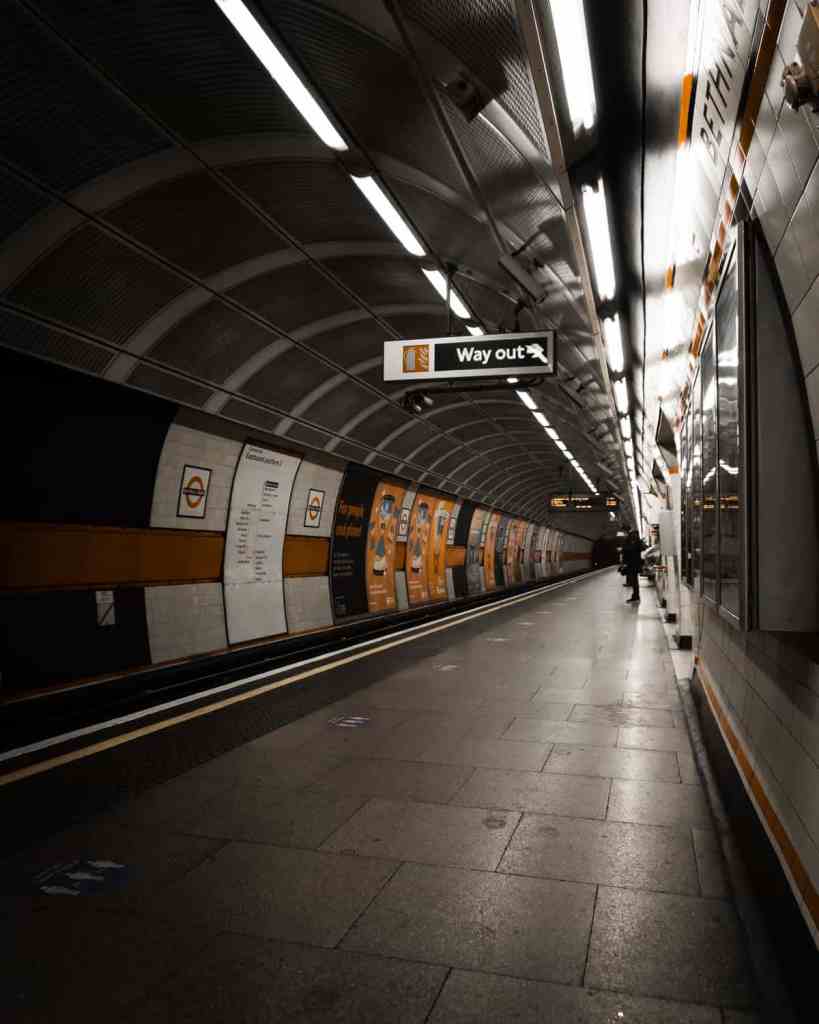
Several stations ring the ground, and which you use matters. Arsenal (Piccadilly line) is the closest at a three-to-five-minute walk, but it has no step-free access and becomes a genuine crush after the final whistle. Holloway Road (Piccadilly line) is exit-only before matches and closes for up to two hours afterwards, with eastbound trains not stopping pre-match — so don’t build a plan around it.
The smarter picks are Finsbury Park (Victoria and Piccadilly lines plus National Rail) and Highbury & Islington (Victoria line, Mildmay Overground and Great Northern rail), both around a ten-minute walk, both step-free, and both noticeably less crowded than Arsenal. Note that Drayton Park is closed on matchdays entirely.
Coming from outside London: King’s Cross St Pancras is your gateway — from there it’s a couple of stops on the Piccadilly line to Arsenal, or the Victoria line to Highbury & Islington, and if the weather’s kind it’s a pleasant 40-minute walk north up through the back streets.
Bus to Emirates Stadium
More than 20 TfL routes pass within a ten-minute walk of the ground, with main stops on Holloway Road, Nag’s Head, Seven Sisters Road, Blackstock Road and Highbury Corner. A single fare is £1.75 with a daily cap of £5.25, making it the cheapest way around and a solid escape valve if you’re sick of the Underground crush.
Emirates Stadium Parking
Don’t. Matchday road closures run from roughly an hour before kick-off to an hour after, the surrounding streets are residents-permit only with cars towed for chancing it, and the rare legitimate space runs to inflated hourly rates. There is effectively no realistic parking for visiting fans — leave the car at the hotel.
Cycling: A genuinely good shout. There’s signposted cycle parking near Arsenal’s Highbury House on Drayton Park and secure parking at Finsbury Park station, letting you skip the post-match transport scrum entirely.
Hotels Near Emirates Stadium
London is enormous and brilliantly connected, so you don’t need to be on the stadium’s doorstep — you need to be somewhere with a clean Tube line to the ground and a decent scene of its own. For most visiting supporters that means Islington, which gives you buzz, restaurants and an easy run up the Victoria line. Book early for marquee fixtures: a title-winning Arsenal means the big derbies and European nights drive serious accommodation demand.
Islington and Angel — the best all-round base
This is where we’d point most first-time visitors: a lively, restaurant-packed stretch a short hop south of the ground, with the Victoria line carrying you straight up to Highbury & Islington. The Hilton London Angel Islington on Upper Street is the comfortable upper-mid choice, right in the thick of the bars and food. The Premier Inn London Angel Islington near Angel is the dependable, good-value pick — reliably clean, reasonably priced, and a regular base for matchgoing fans. For families or longer stays, Citadines Islington offers aparthotel rooms with kitchenettes and a bit more space.
Highbury and Finsbury Park — closest to the ground
If you want to walk to the match, base yourself just north. The Travelodge Finsbury Park is a no-frills budget option right by Finsbury Park station, roughly ten minutes’ walk from the turnstiles — about as convenient as cheap gets. The Premier Inn London Archway is another reliable chain option a short Tube ride away, handy if the closer places are booked out.
King’s Cross and St Pancras — the arrival gateway
Ideal if you’re coming in by train or want a direct Piccadilly-line shot to Arsenal. The St Pancras London, Autograph Collection is the splurge — a genuinely spectacular Victorian railway hotel built into the station itself. For something far cheaper, Point A King’s Cross offers compact, modern, budget rooms two minutes from the station, and The Gyle is a solid mid-range choice nearby.
Budget options
Beyond the Travelodges, Prime Backpackers on City Road is a straightforward hostel that draws a fair few Arsenal fans on matchdays — you trade space and privacy for price, but it’s clean, central-ish and well connected. The honest tradeoff with all the budget picks is location or comfort: you’ll either be a little further out or in a smaller, plainer room, but with London’s transport you’re rarely more than 20–30 minutes from the ground.

Pubs Near Emirates Stadium
Matchday around the Emirates is a proper North London pub crawl waiting to happen, and the heart of it is Blackstock Road, the strip of supporters’ pubs running up towards Finsbury Park where the singing starts long before kick-off. Fans spill out of the boozers on Holloway Road, Hornsey Road and Blackstock Road from late morning on a weekend fixture, and the walk to the ground turns into a slow tide of red. Get there early, find a pub, and let the day build — half the experience is the couple of hours beforehand.
Best Pregame and Postgame Pubs
The George (Eden Grove): The closest iconic Arsenal pub to the turnstiles, three or four minutes from the ground — wall-to-wall memorabilia, Gunners Lager flowing, and an atmosphere that feels like an extension of the North Bank. It’s small and it gets packed, so arrive early.
Tollington Arms (Hornsey Road): A proper Arsenal institution, decked head to toe in shirts and scarves, about five minutes from the ground. Warm, lively and welcoming to visiting fans from abroad — one of the most authentic pre-match experiences you’ll find.
The Gunners Pub (Blackstock Road): A big, boisterous matchday operation with an outdoor patio, a stage and singing throughout. Two things to know: food is limited on matchdays, and they sometimes run age restrictions at the door for games, so it’s one for an older group rather than a family.
The Blackstock (Seven Sisters Road) and Bank of Friendship (Blackstock Road): Two reliable Blackstock-area pubs — the former a buzzy, big-screen matchday spot with a real family-club feel, the latter a traditional boozer with a sizeable beer garden and a more relaxed pace.
The Coronet (Holloway Road): A cavernous Wetherspoons inside a beautifully converted old cinema. It’s not a dedicated Arsenal pub, but it’s cheap, vast, and a sensible place to start or refuel without queueing six deep at the bar.
Best Restaurants in the Area
Il Guscio (Highbury): A warm, family-run Italian a short walk from the Emirates on Blackstock Road — genuinely good pasta and pizza, an owner who treats you like a guest in his home, and a matchday-friendly location. The pick if you want a proper sit-down meal close to the ground.
Upper Street, Islington — the broader scene: A short trip south, Islington’s main drag is where the best of the area’s dining lives. Noci is a lively, hugely popular modern Italian; Mr LoBo is a standout Peruvian spot if you fancy something different; Terra Rossa is dependable Italian with a strong gluten-free menu and a family-friendly room; and La Petite Auberge is a cosy, classic French bistro for a more grown-up evening. For a special occasion, Frederick’s does refined British-French cooking with a lovely garden conservatory.
Why You Should Go
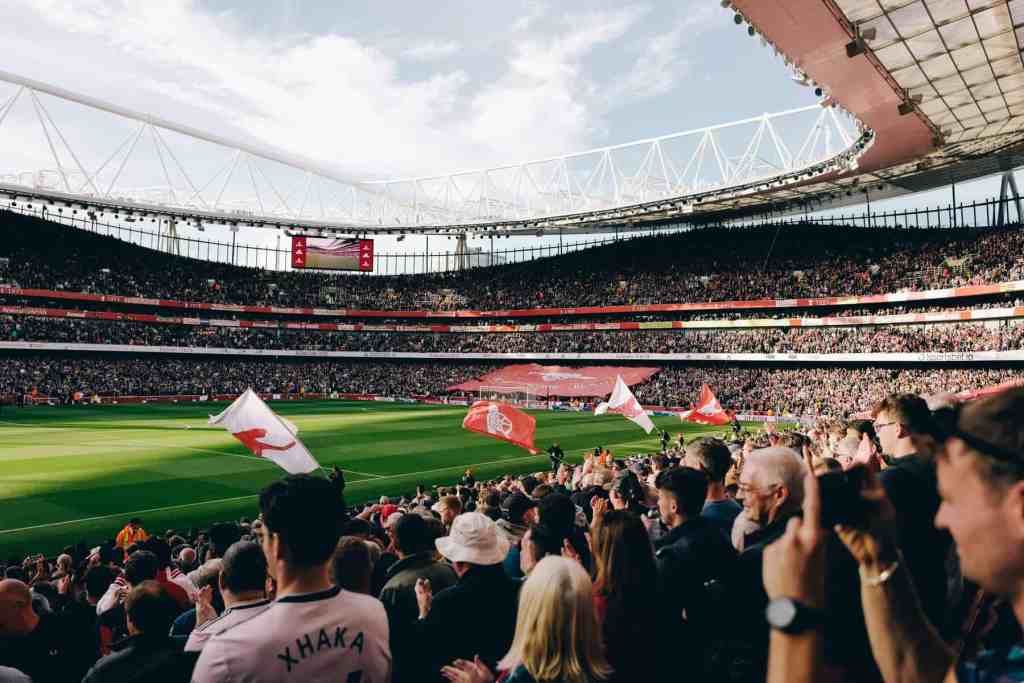
The Emirates spent its early years living in Highbury’s shadow, but that’s long gone — this is a modern football ground that’s finally found its voice, and a title-winning Arsenal side has given it the noise and the occasion to match the architecture. You get clean sightlines from almost any seat, a steep, enclosed bowl that holds the sound, one of the best-kept pitches in world football, and a matchday culture packed into the pubs of North London that’s worth a day on its own. Sort your ticket through the right channels, get there early enough to soak up Blackstock Road, and you’ll understand quickly why 100,000 people are sitting on a waiting list to do this every other week.
Explore our other Premier League and European Football Guides as well as these:
Tottenham Hotspur Stadium and Stamford Bridge
Written by Brad Richards. Founder of Gameday Guides. This guide includes insights from personal visits as well as updated info from team sources, fan forums, and stadium policies. We aim to help you plan with confidence — enjoy your gameday. If you have any tips, if we missed anything or you have a question, don’t hesitate to shoot us an email.