


Best Seats At The L.A Coliseum
The Los Angeles Memorial Coliseum is the rare stadium where the history isn’t a plaque on the wall — it’s the building itself. Opened in 1923 as a memorial to L.A.’s World War I veterans, it has hosted two Olympics, a World Series, two Super Bowls, a papal Mass, and USC football every fall for more than a century, and in 2028 it becomes the first stadium on earth to host a third Olympic Games. A $315 million renovation finished in 2019 dropped capacity to 77,500, replaced every seat, and added a seven-story premium tower, all while the Los Angeles Conservancy made sure the iconic peristyle arches at the east end stayed exactly as they were.
The reality of this legendary stadium: it’s still a big open bowl with a lot of concrete, real sun for day games, and parking that rewards people who plan. But the sightlines hold up almost everywhere, and there is nothing else in college football quite like walking in under those arches.
Seating Overview
The Coliseum is a wide, shallow bowl with the field running east-west and the peristyle arches at the east end zone, so the thing that actually separates a great seat from a mediocre one here is row, not just section. Get too low and the bowl’s shallow rake means you lose the far sideline; get the right rows and the sightlines are some of the best you’ll find in a stadium this old. Sections are numbered in three tiers after the renovation — the 100s closest to the field, 200s in the middle, 300s up top — and the press box and the new premium tower sit on the south side, with the student sections and benches anchoring the lower bowl.
The Sweet Spots: Best Non-Premium Seats
The lower-bowl sideline near midfield, mid-rows. The 100-level sideline sections flanking the benches are the classic USC seats — the Trojan bench sits in front of the 121–122 sections, the visitors in front of 106–107, so anything in the lower sideline between those benches puts you at or near the 50. The catch is height: skip the first 15 or so rows, where the shallow relief hides the far side of the field, and aim for roughly rows 25–45, where you’re high enough to read the offensive line but still close enough to hear the hits. This is premium-priced for non-club, but it’s the view people picture when they picture the Coliseum.
The 300-level sideline, lower rows. This is the quietly smart seat — the elevated all-22 angle that lets you watch plays develop like a coach, for $40–80 less per seat than the lower sideline. The first few rows of the upper deck aren’t nearly as far from the action as the height suggests, and you get full-field depth perception you simply can’t get from row 20 below.
The trade is the obvious one: you’re disconnected from field-level noise and you’ll lose individual faces. Best for people who came to watch the football, not the sideline.
The lower end zone under the peristyle. Sitting behind the goalposts at the east end is unorthodox, but you’re directly under the arches and the Olympic torch, which is a genuinely different way to experience the place. The sightline down the field is worse than the sidelines — when the ball’s at the far end you’re squinting — but for atmosphere and the entrance experience it’s hard to beat. More on this one below under what’s worth trying once.
Best Value Seats
The 300-level corners are the value play. You’re paying budget money for an angled but completely watchable view, and you’re still inside the bowl for a USC game rather than watching at home. You give up some depth perception on plays breaking away from you, and you’re a longer walk from concessions and restrooms — but for the price difference against the sideline, that’s a fair trade. Just don’t drift into the very back rows up here, where following the ball gets genuinely hard.
Cheapest Way In
The upper end-zone sections are the floor on price, usually the cheapest ticket in the building for non-marquee games. You’re high and at a steep angle, and plays on the near side get awkward, but you can see the whole field and you’re there. This is the “I just want to say I went to a game at the Coliseum” seat, and for that job it’s honest value. The Trojans also flood the secondary market for lesser opponents (more on that below), so these can drop well under face if you wait.
Our Pick
If you’re handing one recommendation to a first-timer: the lower-bowl sideline near midfield, rows 25–45. It costs more than the upper deck, but the combination of proximity, a clean read of the line of scrimmage, and being level with the energy of the bench is the seat that makes people understand why this place is special.
Heat & Shade
The south side is the shade side. The field runs east–west, so by kickoff on an afternoon game the sun sits above and behind the Scholarship Club Tower and the press box, then sets behind the west end zone. Anything on the south sideline has the sun at its back.
The north sideline bakes the longest. That’s USC’s own side and the student end — great atmosphere, no relief. From late August into October a noon or 12:30 kickoff over there is a genuine endurance test.
Back rows of the south lower bowl get shade first. The tower rises above them and throws the earliest shadow in the building. If you’re buying for a September day game, that’s the seat.
Night games are a different stadium. A 7 p.m. kickoff is comfortable everywhere and the torch lighting lands better in the dark. If you have a choice of game, take the night one.
What to Avoid (and What’s Worth Trying Once)
The lowest rows of the lower bowl, any section. It sounds great to be “right on the field,” but the shallow rake means you’ll have plays on the far sideline disappear behind the near-side action, and you lose all sense of how a play is developing. Rows in the mid-20s and up are objectively better football seats for less money than the front-row premium.
The very back rows of the upper deck. Once you’re near the top, identifying players gets tough and the ball gets lost against the crowd on sideline plays. If these are your only option for a marquee game, fine — but don’t pay up for them.
Worth it once: the peristyle end zone. The sightline isn’t the point. Walking in under the arches, sitting beneath the Olympic torch, and being right there when it’s lit between the third and fourth quarters is one of those experiences that’s about the building, not the game. Do it once.14
Premium Seating & Clubs
ll of the Coliseum’s premium product lives in or atop the seven-story Scholarship Club Tower on the south side, and most of it is tied to Trojan Athletic Fund (TAF) donor membership — though the rooftop club sells a limited number of single-game seats to the general public. Lead with what each space is and where it sits, because the sponsor names on these things change and the locations don’t.
The Best Premium Experience
The 1923 Club, on the rooftop at the very top of the tower, is the signature premium experience and it’s about the view as much as the football. You get lounge seating, multiple bars with upscale food and drink for purchase, entry two hours before kickoff, private restrooms, and a 360-degree panorama of Los Angeles — downtown, the Hollywood Hills, the whole city — while the Trojans play below. General fans can buy up to four of these per game, and each ticket now includes a $100 concessions gift card usable inside the club.
It’s the move for a milestone — a graduation, a big birthday, entertaining clients — and explicitly not the move if you want to feel embedded in the crowd. You’re trading field-level energy for comfort, altitude, and a skyline.
Best Value Premium
If you’re going to be here more than once or twice a season, the Lou Galen Club seats are the smart-money premium call. You get a comfortable padded stadium seat — not a bleacher — plus access to the climate-controlled Lou Galen Club lounge, where premium food and drink (including alcohol) are available away from the concourse crush.
It costs meaningfully less than the rooftop or a suite, and the padded seat and the air-conditioned halftime alone change how a September day game feels. For a season-ticket holder or anyone hitting three-plus games, it’s the best comfort-per-dollar in the building.
Other Premium Options
A few other tiers exist inside the tower and worth knowing: loge boxes (24 of them, with lounge access — a small private group setup); Founders and Scholarship Tower suites (fully furnished, theater-style seating, dedicated attendants); and the standout for the bucket-list crowd, the Field Suites — private, furnished on-field spaces for 34 guests, right behind the east end zone, with early access, field-level attendants, and eight VIP parking passes per suite. The Field Suites are the closest you’ll get to standing on the grass without a helmet.
Suites & Group Options
Traditional luxury suites and the larger tower spaces are booked for corporate groups and big celebrations, with pricing that swings hard by opponent — a Big Ten marquee game costs a multiple of a non-conference tune-up. Groups of 20-plus are the usual customers. For availability and current pricing, the path is USC Group Sales rather than the secondary market.
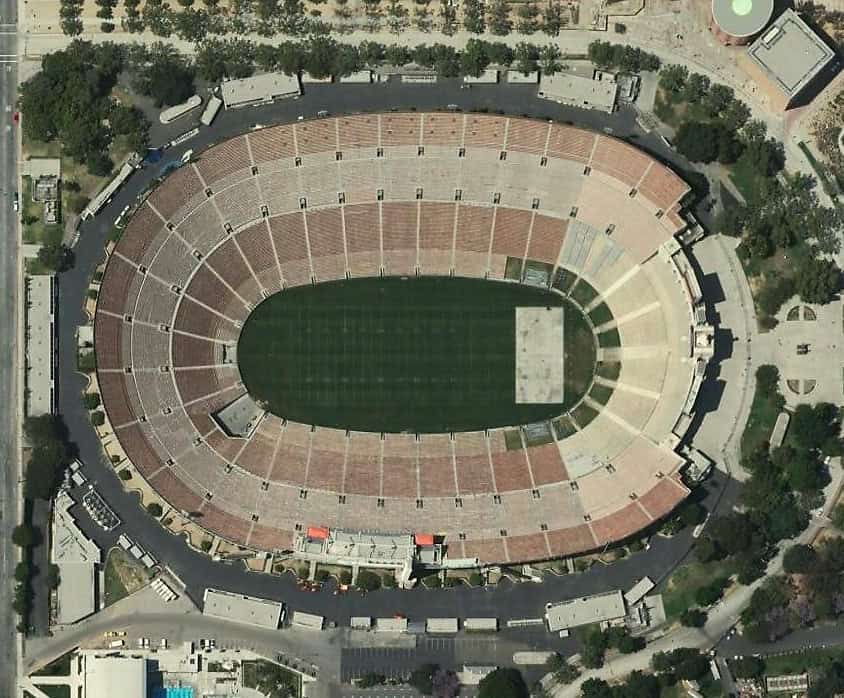
L.A Coliseum Seating Chart
Current capacity is 77,500, set in the 2019 renovation that brought it down from roughly 93,000 by widening seats and adding aisles, legroom, and the premium tower. Seating is a single continuous bowl divided into three tiers — 100s (closest to the field), 200s (middle), and 300s (upper) — with club seating in the 400s on the south side and the field running east-west, peristyle arches at the east end. Student sections sit in the lower and middle bowl on the north side, and the press box and premium tower are on the south. Here is the updated Seating Chart.
Tickets To USC Football
USC’s move to the Big Ten changed the ticket math: marquee visitors (Michigan, Ohio State, Penn State, Oregon, plus Notre Dame and UCLA) now sell hard and hold their price, while non-conference and lesser Big Ten games flood the secondary market and routinely drop below face in the final week. For the big ones, buy early; for everything else, patience on the resale market is rewarded, and you can often upgrade your seat for less than face the morning of the game.
If you’re comparing prices across resale platforms, Our partner Vivid Seats is worth checking against the others before you commit, since the same seat frequently lists at different all-in prices once fees are added.

L.A Coliseum Bag Policy
The Coliseum runs a strict clear-bag policy and there is no bag check on site, so getting this right before you leave the car matters.
You get one clear plastic, vinyl or PVC bag no bigger than 12″ x 6″ x 12″, or a one-gallon clear Ziploc-style bag, plus one small clutch no larger than 6.5″ x 4.5″ that doesn’t need to be clear.
Throw an empty gallon Ziploc in your pocket. If security callcs your bag oversized, you transfer your keys and wallet into the Ziploc and walk in. Without it, you’re walking back to the car.
Backpacks, fanny packs, cinch bags, camera bags, coolers and luggage of any kind are all turned away. Diaper bags and medically necessary items are allowed after inspection. A few off-site luggage-storage services operate near Exposition Park if you’re coming straight from the airport.
Key Venue Policies
You can bring food in. Pre-packaged snacks in your clear bag, two factory-sealed water bottles 17 oz or under per person, plus an empty reusable bottle to fill inside. Unusual for a venue this size and a real money-saver.
Bring a seat cushion. Cushions are allowed as long as they have no pockets and no metal hardware. Worth knowing before the third quarter, when the upper bowl stops being comfortable.
Grab free sunscreen at any guest experience booth. It’s complimentary and almost nobody knows. Bring your own in a lotion or cream tube in your clear bag — aerosol and metal cans are turned away at the gate.
Your phone won’t work as ID. The Coliseum does not accept mobile driver’s licenses, including California’s. Carry a physical ID for anything age-gated.
The building is fully cashless. Cards and mobile pay only, concessions included, and campus parking too. The exception is the street-cart scene outside, which runs on cash and Venmo.
Tickets are mobile-only and screenshots get rejected. Download to your phone’s wallet before you leave. Alcohol stops at the end of the third quarter, two drinks per transaction, no shots.
No re-entry, no strollers, no umbrellas. Once you’re out you’re out. Strollers can’t come in at all — leave them in the car. Ponchos, not umbrellas, if rain is in the forecast.
Free stadium Wi-Fi is on the #FightOn network. Cell service in a full bowl is what you’d expect from a hundred-year-old concrete building.
Here is the Coliseum’s handy guide: LA Coliseum A to Z Guide

Getting To The Coliseum
The Coliseum sits in Exposition Park just south of downtown, and the genuine best answer for most people is the train — driving here is the harder, more expensive path.
LA Coliseum Parking
If you must drive, USC campus parking is effectively your only option — the Exposition Park lots are permit-only for USC games, with no cash lots. Campus structures run around $50, cashless only, first-come-first-served, opening several hours before kickoff, with a 10–15 minute walk to the stadium from most of them.
The Downey Way and Figueroa Street structures are the closest at roughly a 10-minute walk, and the reserved Shrine and Grand Avenue structures can be prepaid online in advance if you want a guaranteed closer spot. For big games (Notre Dame, UCLA, top-10 Big Ten visitors) get there two hours out; 90 minutes is enough for a regular game before the lots back up.
Metro E Line (Recommended)
The Metro E Line runs right past the stadium with two stops — Expo Park/USC and Expo/Vermont — both a five-minute walk from the gates, and Metro adds service on game days. Trains come every 8–10 minutes at peak, it’s a few dollars each way on a TAP card you load before boarding, and it sidesteps every bit of the parking and traffic ordeal.
The one thing to know: the post-game platform is a crush. If you’d rather not stand shoulder-to-shoulder, kill 20–30 minutes near the stadium and let the first wave clear before you head for the train.
Rideshare
Uber and Lyft work, but the timing trap is real: rideshare is banned from entering the Exposition Park area until roughly 45–60 minutes after the event ends because of traffic flow. So if you bolt the second the clock hits zero, you’re either walking several blocks out to get picked up or waiting nearly an hour for the ban to lift — and that’s exactly when surge peaks.
Pre-game you’ll pay $15–30 from most of L.A.; post-game can be two to three times that. The play is to either eat and drink for an hour while it clears or walk a few blocks away from the park to meet your driver faster.
USC Gameday Tips and Things to Do
USC gameday isn’t a parking-lot tailgate in a college town. It’s an urban campus in the middle of Los Angeles, with the band marching the crowd to the stadium, palm trees over the lawns, and the Metro dropping thousands of fans in cardinal and gold a five-minute walk from the gates. Here’s what the people who do this every fall already know.
The History You’re Standing In
Treat the building as the first attraction. The Coliseum opened in 1923 as a memorial to LA’s World War I veterans and has been USC’s home every season since — the longest run of any major team in any venue in this city.
The résumé is absurd. Two Olympics (1932 and 1984), the 1959 World Series, two Super Bowls, a 1987 papal Mass, and the Dodgers for three seasons after they left Brooklyn. It was named a National Historic Landmark the day before the 1984 opening ceremony.
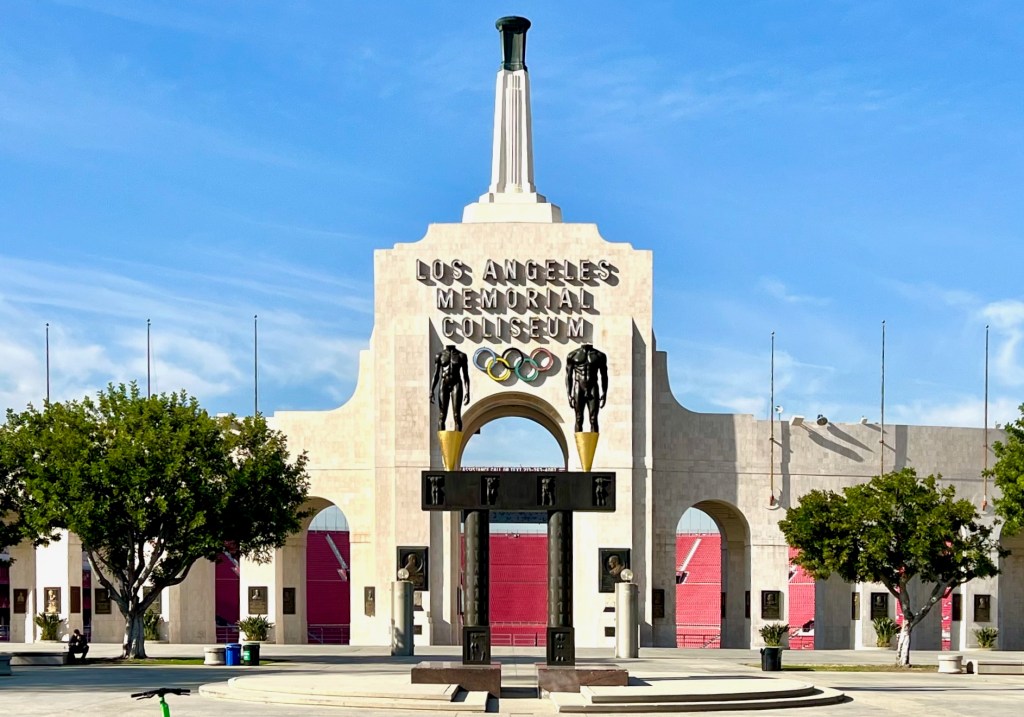
Give yourself ten minutes at the peristyle before kickoff. The arches at the east end and the Olympic torch above them are the soul of the place, and there are plaques inside dedicated to both Games. Rushing straight to your seat is the rookie move.
What the 2019 Renovation Changed
$315 million, privately funded by USC, finished for the 2019 home opener. Work started after the 2017 season, and USC paid for all of it after taking over the stadium’s master lease.
Every seat was replaced and widened. That plus new aisles and legroom is what dropped capacity from roughly 93,000 to 77,500 — fewer seats, better ones, cupholders throughout.
The peristyle was restored, not modernized. The LA Conservancy made sure the arches came back closer to the original 1923 design, which is why the entrance still feels like the entrance.
The Scholarship Club Tower is the only genuinely new structure. Seven stories on the south side holding the suites, loge boxes, club seats and rebuilt press box — and, not incidentally, the only real shade in the stadium.
It didn’t stop in 2019. The west videoboard was fully replaced in 2025 with a 6,000-square-foot LED display, 22 new concession points of sale went in, all 1,100 club seats were swapped out, and 400-plus new fan pavers were laid at Olympic Plaza below the peristyle.
Best Gates and Arrival Strategy
Walk around to the east-end peristyle gates. Most fans pile into the big north gates and stand in line. The peristyle side is usually lighter and it puts you walking in under the arches — the best entrance in college football and often the faster one.
Gates open two hours before kickoff; be there 60 minutes out at the latest. That’s the Coliseum’s own guidance, and for a marquee game the security backup makes 90 minutes the smarter target.
Have your phone and a physical ID in hand. Mobile ticket loaded to your wallet, not a screenshot. If you brought no bag at all, look for the express lanes through the metal detectors.
USC Gameday Traditions Worth Watching For
The Trojan Walk, about 2.5 hours before kickoff. The team walks through the Olympic Gateway statues at the southeast corner and down into the stadium while fans line the rail. Get there 20–30 minutes early for a rail spot at a big game.
Follow the band, don’t just watch it. Two hours out, the Spirit of Troy plays a concert at Tommy Trojan on campus and then physically marches the crowd down to the stadium. Find it and walk in behind it.
Rub George Tirebiter’s nose on the way down. The statue of USC’s old stray-dog mascot sits at the south end of Trousdale Parkway looking toward the Coliseum, and rubbing his nose for luck is a genuine Trojan Knights tradition.
Traveler runs after every touchdown. A white Andalusian carrying a Trojan warrior gallops the perimeter of the field while the band plays “Conquest.” The tradition dates to 1961, and it’s the loudest twelve seconds of the day.
Listen for the Victory Bell. The 295-pound bell came off a Southern Pacific freight train, was gifted to UCLA in 1939, and was stolen by six Trojan Knights in 1941. The winner of the rivalry game keeps it for the year — and when USC has it, the Knights ring it after every Trojan score.
Watch for the Song Leaders. Still in the same white sweaters they’ve worn since the 1960s, and still officially known to most fans as the Song Girls — USC renamed them Song Leaders in 2024. They dance to the live band rather than piped-in music, which is why their routines sync with whatever the Spirit of Troy is playing.
Do not leave before the torch. Between the third and fourth quarters the stadium goes dark, the crowd lights up their phones, and the Olympic torch is lit above the peristyle. It’s the goosebump moment of the day and people miss it trying to beat traffic.
LA Coliseum Food and Drink
Start with the tri-tip hoagie on garlic-buttered bread. It’s the consensus best thing in the building and it survived the 2025 menu overhaul for a reason. Street tacos and loaded asada fries are the other safe bets over generic stadium fare.
The Fight On Grill near Gate 19 was rebuilt for speed. If you’re eating between quarters and don’t want to miss a drive, that’s the stand to aim for.
Self-serve beer jets at Tunnels 17 and 21, Coors Beer Cave at Tunnel 15. Pouring your own beats a staffed line, and spirits are now sold stadium-wide rather than just beer and wine.
Buy in the first quarter or right at the start of the third. Halftime runs 20 minutes deep, and the alcohol cutoff at the end of the third quarter makes the late beer lines worse than the food ones.
Follow the bacon smell on the walk out. The street carts selling Danger Dogs — bacon-wrapped, grilled onions and peppers, $10–15, cash or Venmo only — are the real local rite. Eat one on the way to the train.
Surviving a Day Game
The south side is the shade side. The field runs east–west, so the sun sits above and behind the Scholarship Club Tower and sets behind the west end zone. The north sideline — USC’s own side — bakes the longest.
Grab free sunscreen at a guest experience booth. It’s complimentary and almost nobody knows. Bring your own as a lotion or cream in a clear tube; aerosol and metal cans get turned away at the gate.
Bring a seat cushion. Cushions are allowed as long as they have no pockets and no metal hardware, and by the third quarter of a long game you’ll understand why that’s on the list.
Carry water in. Two factory-sealed bottles of 17 oz or less per person, plus an empty reusable bottle to fill inside. For a September kickoff that’s the difference between enjoying the fourth quarter and enduring it.
Bringing Kids to a USC Game
Kids two and under get in free on a lap. Past that, everyone needs a ticket.
Strollers are prohibited entirely. Not checked, not folded — leave it in the car. This surprises more families than anything else here.
The upper-deck corners are the family play. Watchable views at a price that doesn’t sting with a few kids, and you’re away from the rowdier student-adjacent lower bowl.
Grab a child ID band at customer service. Baby changing tables are at every street-level restroom plus a run of upper-concourse locations, so you’re not hunting.
Autographs and Player Access
The Trojan Walk is the whole game for access. Positioning at the rail near the Olympic Gateway 2.5 to 3 hours out is where fans high-five players, coaches and the spirit squads on the way in — far more intimate than trying to catch anyone afterward.
Earlier is strictly better. At marquee games fans start lining the rail well before the buses arrive, and the front row is first-come.
USC Tailgating at Exposition Park
Tailgating here is lawns and food halls, not pickup-truck beds. It happens on campus grass, not in the parking garages, and it looks nothing like an SEC lot.
You need a permit to set up on campus. Any group tailgating on USC grounds has to reserve through the university’s tailgating portal, and requests are due about three weeks ahead to dodge a late fee. Showing up with a tent and no permit doesn’t work anymore.
The free Modelo fan zone on Christmas Tree Lane is the no-planning option. East of the Coliseum, opens roughly four hours out, with games, music, food trucks, beer gardens and TVs showing other games. Open to everyone, all ages.
No tailgating at USC Village. Restaurants and shops are open, but parking there is for shoppers and diners only.
Getting Out: Exit Strategy
Everything jams at once. The train platform fills, and rideshare can’t even enter Exposition Park until 45 to 60 minutes after the game ends. There’s no clever route around both.
Build in a deliberate 30–60 minute buffer. Finish your Danger Dog, let the first wave clear, then walk. The people who get out fastest are the ones who never tried to beat the crowd.
Coming from Orange County, the Valley or the Inland Empire? Take Metrolink. Ride into Union Station, transfer to the Metro B or D line to 7th St/Metro Center, then the E Line down to Expo Park/USC. It skips the downtown freeway crawl entirely, and it’s the route locals recommend to anyone driving in from an hour out.
Best Photo Spots at the LA Coliseum
The peristyle arches are the shot. Best from the lower end-zone bowl looking up, and they light beautifully at night.
Tommy Trojan for the obligatory fan photo. Go three-plus hours early — by two hours out the band concert has swallowed the whole plaza.
The Olympic Gateway statues at the southeast corner. Bronze, dramatic, and they double as the Trojan Walk backdrop.
LA Coliseum Tours and Off-Season Visits
The Coliseum runs historic tours year-round. Worth it if you’re in LA outside football season or traveling with someone who cares more about 1932 and 1984 than about the Big Ten.
Ask about the Concourse of Heroes and the Memorial Court of Honor. That’s where the building’s history is actually laid out, and most gameday visitors walk past both.
The box office at Gate 29 has free 15-minute parking. It sits across from the California Science Center, which makes it an easy stop if you’re already in the park.
Things to Do in Exposition Park
You’re parked in one of LA’s best museum clusters, all walkable. The California Science Center is free and houses the Space Shuttle Endeavour; the Natural History Museum has a 63-foot whale skeleton and the only T. rex growth series in the world; the California African American Museum is also free.
The Lucas Museum of Narrative Art is the new one. George Lucas and Mellody Hobson’s museum of visual storytelling opens right in the park, which makes a fall game weekend line up well.
BMO Stadium is next door. LAFC and Angel City FC play there if you want a second event in the same trip.
USC, the Coliseum and the 2028 Olympics
The Coliseum hosts the opening and closing ceremonies plus track and field in 2028. That makes it the first stadium anywhere to host three Games.
A $100 million temporary track gets built 11 feet above the football field. It has to sit on stilts over the first few rows because the early-90s renovation added 14 rows at the bottom of the bowl and shrank the floor.
USC will likely play the 2028 season somewhere else. There are only about two weeks between the Paralympic closing ceremony and USC’s scheduled home opener, which isn’t enough time to tear the track out and regrow the grass. SoFi Stadium in Inglewood is the likeliest landing spot, though USC hasn’t announced anything.
Translation: the next two seasons are your window. If you want to see the Trojans in their historic home before the disruption, go now.
Hotels Near The L.A Coliseum
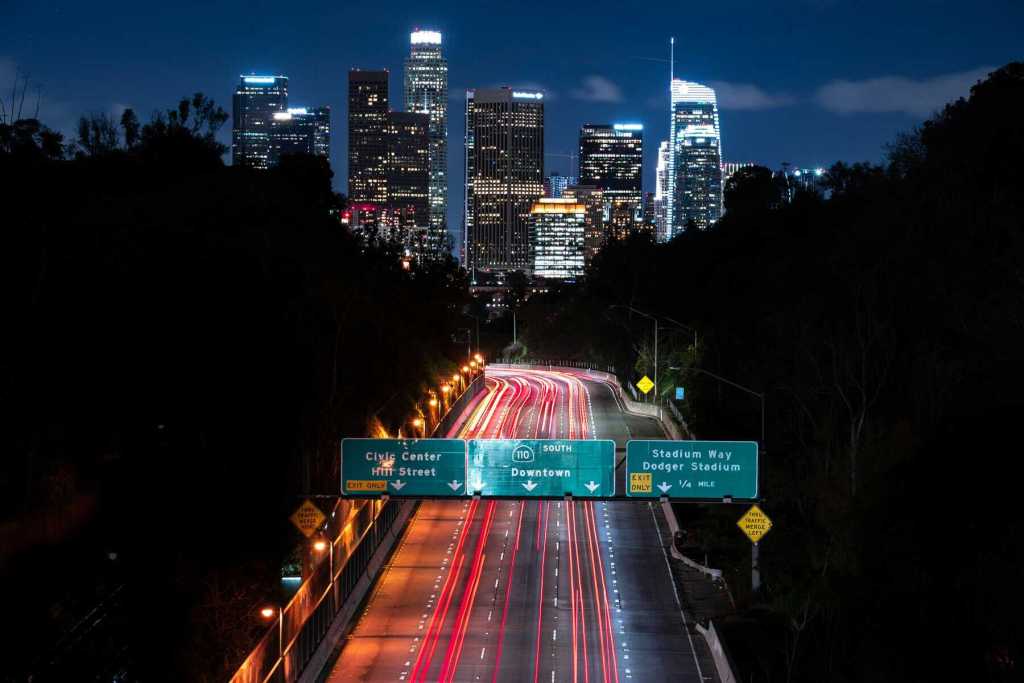
Most out-of-town fans here are alumni, and the real choice is campus nostalgia versus the full downtown L.A. weekend — both sit near the Metro E Line, so neither leaves you stranded from the stadium.
Best Areas to Stay
On or adjacent to campus is the play if you want to walk to the Coliseum, hear the band warm up, and stay inside the Trojan bubble all weekend. Downtown L.A. (DTLA), about 10–15 minutes north, is for fans who want luxury hotels, rooftop bars, and a city weekend wrapped around the game, with an easy E Line ride down to Exposition Park. For marquee weekends, book six-plus months out either way — Notre Dame and UCLA weekends sell out and prices roughly double.
Hotel Recommendations
The Campus Pick — USC Hotel. The only USC-owned hotel, a three-minute walk to the Coliseum, with onsite dining and a pool, surrounded by fellow Trojans. It’s the maximum-convenience, deepest-immersion option; book well ahead for big games.
The DTLA Splurge — JW Marriott L.A. LIVE. Luxury in the heart of downtown at L.A. LIVE, steps from Crypto.com Arena, with a rooftop pool and a stack of restaurants. About 15 minutes to the Coliseum by car or a straight shot on the E Line — built for making a full weekend of it.
The Milestone Trip — The Ritz-Carlton, Los Angeles. Same L.A. LIVE tower as the JW, a notch more refined, with a 26th-floor pool and Club Level lounge. This is the anniversary/reunion/entertain-clients choice.
The Culture Base — Omni Los Angeles at California Plaza. Atop Bunker Hill, across from MOCA and steps from Grand Central Market and The Broad — the pick if you want to fold downtown’s art and food scene into the trip.
The Younger-Alumni Vibe — Hotel Figueroa or Moxy DTLA. Both trendy, walkable to downtown nightlife, 10–15 minutes to the stadium — good for groups who care more about location and the scene than thread count.
Budget Options
DoubleTree by Hilton Los Angeles Downtown, in Little Tokyo, is a solid full-service mid-tier with a rooftop garden, two blocks from the Metro, and 50-plus restaurants within walking distance — downtown access without luxury pricing. Courtyard by Marriott L.A. LIVE is the predictable, reliable budget-of-the-entertainment-district choice, about 15 minutes out and walkable to downtown food. You give up the campus walk and the luxury polish; you keep the Metro line and a real bed near the action.
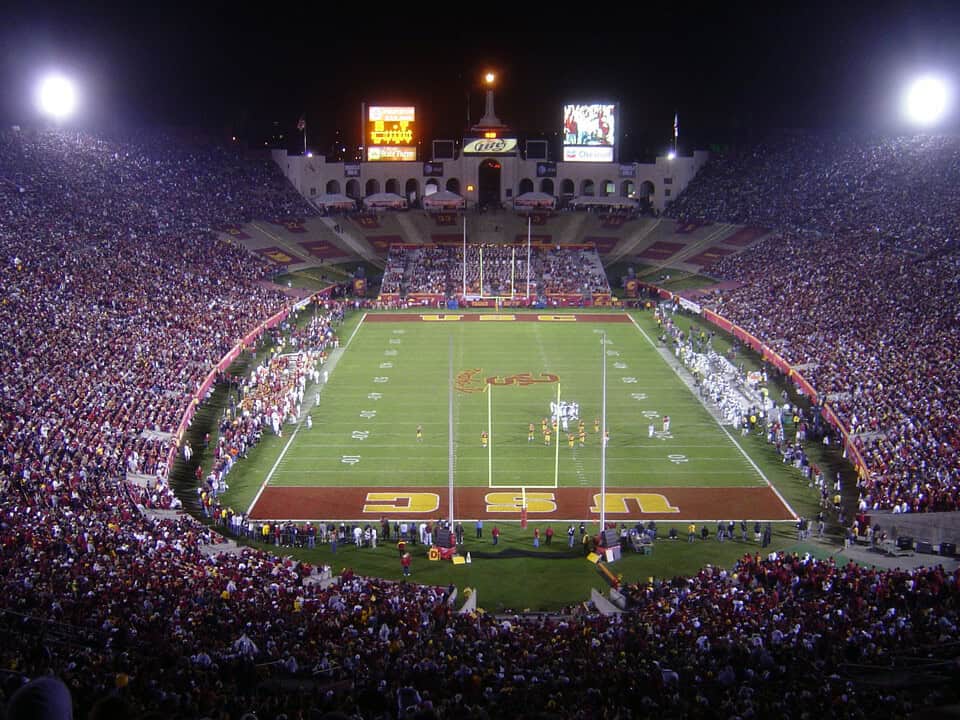
USC Gameday Scene
A USC Saturday doesn’t take over a town, because Los Angeles doesn’t hand itself over to anybody. There’s no square packed with people in cardinal since Thursday, no main drag shut down. What you get instead is a campus that switches on for about six hours — lawns filling under the palms, the band audible three blocks away, families and students and people who graduated forty years ago all funneling down the same stretch toward Exposition Park — surrounded by a city going about its normal weekend.
That shapes how people build the day. Most treat the game as one piece of a weekend rather than the whole thing: brunch somewhere across town, an afternoon on campus, then dinner and drinks back downtown afterward, because the blocks immediately around the stadium empty out fast once the crowd disperses. The near-campus options are a short, specific list worth knowing, and the deep end of LA’s food and bar scene sits ten minutes north on the E Line. Plan for both and you’ll eat well. Plan for a college-town bar crawl and you’ll be disappointed.
Around the Coliseum on Gameday
The Rose Garden is the front door and almost nobody treats it that way. Step off the E Line at Expo Park/USC and it’s directly across the street — seven acres of sunken garden with a spray fountain, gazebos and the original 1910s exposition facades framing it, and it’s been sitting there since before the stadium was built. Most of the crowd hustles past it toward the gates. Walking through it instead costs you four minutes and is the nicest part of the approach.
Christmas Tree Lane is the spine of the whole scene. The tree-lined road running east of the stadium is where the tailgate energy concentrates, and by three hours out the lawns on either side are a continuous run of canopies, folding tables and portable speakers. Even with no plans and no reservation, walking that corridor end to end is the best free hour of the day.
Visiting fan bases claim their own patch. The Notre Dame and Big Ten alumni clubs have been booking Exposition Park lawns for decades, so on a marquee weekend you’ll pass a full opposing-colors tailgate a hundred feet from a cardinal one. It’s friendlier than it sounds and it’s a genuinely LA thing — nobody here has a monopoly on the neighborhood.
The sidewalk economy is part of it. Vendors set up along Figueroa and at the park entrances hours out — paletas and shaved ice, folding tables of unofficial shirts, umbrella carts. Bring cash; almost none of it takes cards, and it’s the last of that before you hit a fully cashless stadium.
Best Pregame and Postgame Bars Near USC
The 9-0 (901 Bar & Grill) is the legendary student dive on Figueroa and also the single biggest rookie trap of the day — the line runs two hours deep by early afternoon on a big Saturday. If you want the student scene, go Friday night instead, when it’s just as packed but actually moves.
Rock & Reilly’s on Hoover is the sane version of the same idea: a big patio, plenty of TVs, and staff who are used to feeding large groups at speed. It’s the pick if you’re four or more people and don’t want to gamble on a wait.
The Lab Gastropub on Figueroa pulls an older, alumni-heavy crowd and stays walkable to the stadium. Food is fine rather than memorable — you’re going for a seat, a beer, and a conversation you can hear.
Tom’s Watch Bar near LA Live is where to land afterward if you’re basing downtown. Wall-to-wall screens means you catch the rest of the national slate while the traffic around Exposition Park untangles itself without you.
Best Gameday Restaurants Near the LA Coliseum
Mercado La Paloma on Grand Ave is the answer most visitors never find — a converted warehouse half a mile from the stadium holding a handful of family-run kitchens under one roof. It’s the rare spot that’s both genuinely close and genuinely worth the trip, and it’s busy well before kickoff.
Holbox, inside the Mercado, serves Yucatán-style seafood — ceviches, tostadas, octopus tacos — at a level that draws people from across the county. Expect a line, know that it moves faster than it looks, and note it’s closed Mondays.
Chichen Itza, a few stalls over, has been doing Yucatecan cooking here for decades. Cochinita pibil, handmade tortillas, plantains; it’s the sit-down-and-take-your-time counterweight to eating tacos standing up.
Jack’s N Joe on Figueroa is the pregame breakfast play for an early kickoff — big portions, all-day breakfast, priced for students. One catch: it closes at 2:30 on weekends, so it only works for a noon or 12:30 start.
23rd Street Café is the other near-campus standby, doing an Indian-Mexican-American mash-up that sounds like a dare and isn’t. The chicken tikka masala quesadilla is exactly as strange and good as advertised.
El Huero (Chano’s) runs 24 hours and exists for the 1 a.m. version of you. It’s a genuine USC institution and the correct end to a night game.
Why You Should Go
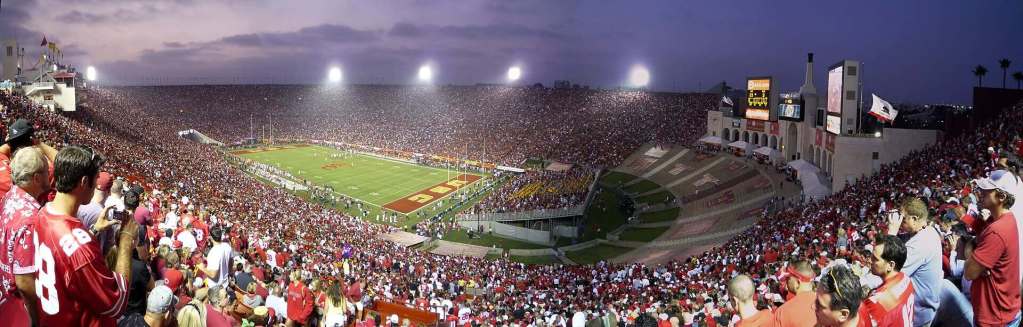
The Coliseum isn’t the newest or the most comfortable stadium you’ll visit, and a September day game will test you. But it’s one of a handful of places where you’re sitting inside actual American sports history — a hundred-plus years of USC football, three Olympics, the torch lighting up at dusk — and the renovation quietly fixed most of the things that used to make it a hard day out. If you want a college football experience with real weight to it, in a city worth a whole weekend, this is the one. And with the Olympics taking the building in 2028, the next two seasons are the time to do it.
Explore our College Football Page. And here are some guides to LA’s great venues:
SoFI Stadium and the Rose Bowl
Dodger Stadium and Angel Stadium
Crypto.com Arena and Intuit Dome
Written by Brad Richards. Founder of Gameday Guides. This guide includes insights from personal visits as well as updated info from team sources, fan forums, and stadium policies. We aim to help you plan with confidence — enjoy your gameday. Let us know if we missed anything or if we need to make corrections.